

Ringless Voicemail Drops: When They Work, When They Don’t, and Why SMS Helps
24 Jun 2026
Table of Contents
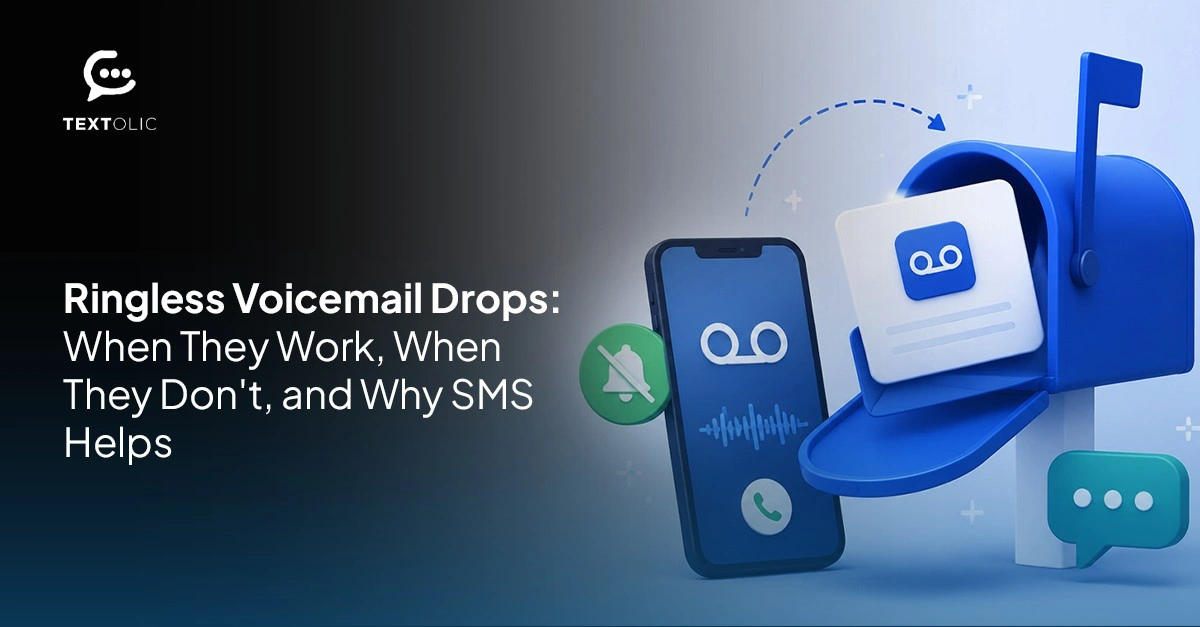
A voicemail nobody heard ring. That’s the pitch behind ringless voicemail, and for sales and marketing teams trying to get more replies without dialing more numbers, it sounds almost too easy.
Sometimes it is easy. More often, results fall short of the pitch. This guide covers what ringless voicemail actually does, where it tends to underperform alone, and why pairing it with a text often works better.
Real estate, finance, and insurance teams tend to see the biggest gains from getting this combination right.
Table of Contents
What Ringless Voicemail Actually Is, and What It Isn’t
A lot of the confusion starts at the basic definition. Ringless voicemail puts a pre-recorded audio message straight into someone’s voicemail box. The phone doesn’t ring, not even once.
This isn’t a phone call, and it isn’t a robocall in the legal sense people usually mean either, although regulators look at it with similar scrutiny (more on that in a minute). No missed call notification, no record of an attempted call at all. Recipients just open their voicemail later and find a message waiting.
Technically, the audio file gets pushed straight to the carrier’s voicemail server, skipping the ringing step entirely. Vendors call this RVM marketing, voice broadcasting, or voicemail drop software, but it’s the same process underneath.
A lot of people assume this feels intrusive, the way an unexpected call does. Generally, it doesn’t. Nobody’s day gets interrupted by a ring at a bad moment, which is also, honestly, part of the problem. That lack of interruption is exactly why ringless voicemail rarely creates the urgency a live call manages to.
Why Ringless Voicemail Alone Has Diminishing Returns
Most teams go into ringless voicemail expecting a high-volume channel that quietly produces replies in the background. That expectation hasn’t held up well lately.
Voicemail listen rates have fallen quite a bit. A good chunk of B2B contacts, especially younger ones, simply don’t check voicemail from a number they don’t recognize. Messages just sit there, sometimes for days, sometimes never opened at all.
On its own, RVM tends to produce low reply rates sometimes. Not really a sign the channel is broken, more that it was never built to do the whole job by itself, and most teams ask it to anyway.
Send more voicemails, and you’ll get a few more replies, but the returns flatten out fast, usually within a few weeks of real volume. At some point the sequence needs another channel doing real work too.
Worth saying clearly: none of this makes RVM useless. Just incomplete, when it’s the only thing running.
The RVM + SMS Pairing That Recovers Response Rates
Add a text message into the mix and the numbers tend to shift. Here’s the sequence: the voicemail drop goes out first, and an SMS follows five to ten minutes later, mentioning the voicemail directly.
Voicemail script: “Hi [Name], this is [Rep] from [Company]. I left a message about [Topic] and wanted to make sure it reached you. Call or text back whenever works.”
SMS follow-up, sent 5-10 minutes later: “Hi [Name], I just left you a voicemail about [Topic]. Easier to text back if that’s more convenient. Let me know!”
So why does pairing the two outperform either one running alone? A voicemail lands as the first touch, but most people don’t act on it the moment it arrives. A text shows up a few minutes after as a second touch, easier to respond to, which nudges the recipient to go check the voicemail they just got.
Many teams find that combining Ringless Voicemail with SMS creates more opportunities for engagement than relying on either channel alone. Ringless voicemail plus SMS works mostly because each channel covers a gap the other has. Reply friction is the weak spot for voicemail. Emotional presence is the weak spot for text. Run them together and both gaps close.
Timing matters more than people expect going in. Wait too long and the moment’s gone. Five to ten minutes keeps the voicemail recent enough that the follow-up text feels connected to it, not random.
Want to see what an RVM and SMS sequence looks like running live inside your own campaigns?

Use Cases Where Ringless Voicemail Outperforms SMS
For most outreach, text wins on speed and ease of reply. But a few situations actually favor voice over text, and it’s worth knowing which ones.
Complicated or emotionally loaded topics land better as audio. Think loan refinance offers, insurance policy reviews, or a price adjustment on a home sale. A 160-character text strips out nuance these conversations need. A real voice carries tone, reassurance, urgency, things text doesn’t do well.
There’s also a case for RVM with contacts who’ve stopped responding to SMS. Three unanswered texts usually means the channel has worn out its welcome, at least for now. Switching to voice messaging for sales breaks the pattern because it feels different from whatever already failed.
A mortgage broker checking in before a rate lock expires. An insurance agent reaching someone ahead of a renewal. A real estate agent re-engaging a buyer who went quiet after a showing. Each benefits from a human voice doing something text structurally can’t.
Compliance for Ringless Voicemail: TCPA, State Laws, and What’s Changed
Skipping this section is the single most common way teams end up in trouble later, so it’s worth slowing down here.
Under TCPA, the FCC treats ringless voicemail as a call. Prior express written consent is required before sending any marketing message to a mobile number. Not much ambiguity here, regardless of what some vendors might suggest.
A few states go further than federal rules. Florida and Oklahoma both add restrictions on top of TCPA, and other states have tightened rules since 2023. If anything, the compliance bar has gotten higher lately, not lower.
None of this puts RVM off the table. Consent has to be documented properly before the first message goes out, and that documentation needs to hold up if it’s ever questioned. Legal review before running any campaign at real volume, especially across more than one state, heads off most problems down the line.
Curious whether ringless voicemail fits your outreach the way it’s supposed to?

Setting Up RVM + SMS Sequences in 360 Textolic
Putting this sequence together inside 360 Textolic takes a short list of steps.
Create an automated workflow that sends a Ringless Voicemail, then follows up with an SMS after a predefined delay.
Before testing anything live, set up opt-out handling. A STOP reply to the SMS needs to suppress both channels for that contact, not just stop the texts while voicemails keep going.
Wrapping Up
Ringless voicemail isn’t dead, and it isn’t a shortcut either. Alone, it tends to undersell what the pitch promises. Paired with SMS and timed properly, it gets much closer to delivering what people expect.
Get the consent piece right. Get the timing right. Do both, and ringless voicemail becomes a useful part of a sequence instead of a channel that quietly disappoints on its own.
Categories

Solve It with Salesforce. We’ll Show You How.
AI. Apps. Experts. Everything you need to win with Salesforce under one roof.Frequently Asked Questions
What is ringless voicemail?
A pre-recorded audio message delivered straight to someone's voicemail box, with no call placed and no missed call notification triggered. Recipients just find it there next time they check.
How does it work inside a CRM?
Usually, a trigger in the CRM kicks it off, something like a stalled deal or a missed call attempt. The same workflow can chain in an SMS a few minutes later, and SMS responses and engagement activity are automatically logged back to Salesforce records. A rep checking later sees the whole exchange without hunting through two systems.
How should teams measure engagement from these campaigns?
Look at reply rate per channel first, then combined. If RVM alone sits in the low single digits but jumps once SMS gets added, that's a clear signal the pairing is earning its place.
Can SMS workflows support two-way replies and automated follow-ups?
Yes, generally. A reply gets routed to whoever's assigned and creates a task for them. If nobody replies within a set window, a follow-up can fire automatically, so nothing depends on a rep remembering.
What are the main benefits of ringless voicemail?
Honestly, it depends what you're using it for. By itself, the upside is fairly limited. Paired with SMS, the real benefit is a second touch that recovers replies that neither channel was getting alone.
When should a business use it?
Mainly when the message carries real weight, financially or emotionally, or when someone's already stopped responding to text. Not something to run by default on every contact. More of a tool for specific moments than a constant channel.
What should teams avoid?
Skipping documentation on consent is the biggest one. Right behind that is running RVM at scale without checking state-level rules first, which tends to be the mistake that causes the most cleanup work afterward.
How can 360 Textolic support this use case?
A sequence builder for both RVM and SMS, adjustable delay timing, and opt-out suppression across both channels at once. Book a demo, or talk to our team, to see it set up against a real campaign.

About the author
Editorial TeamThe Editorial Team at 360 Degree Cloud brings together seasoned marketers, Salesforce specialists, and technology writers who are passionate about simplifying complex ideas into meaningful insights. With deep expertise in Salesforce solutions, B2B SaaS, and digital transformation, the team curates thought leadership content, industry trends, and practical guides that help businesses navigate growth with clarity and confidence. Every piece we publish reflects our commitment to delivering value, fostering innovation, and connecting readers with the evolving Salesforce ecosystem.
Recent Blogs
 Software Services
Salesforce Staff Augmentation for Fintech: How to Scale Compliant CRM teams
Salesforce staff augmentation for fintech requires professionals who understand Financial Services Cloud’s data model, know how financial compliance requirements (SOX, GDPR, CCPA, FCA regulations) affect…
Read More Industry
Salesforce Staff Augmentation for Healthcare: Compliance-Ready Talent On Demand
Salesforce staff augmentation in the healthcare sector entails personnel knowledgeable about Salesforce and its compliance landscape, handling HIPAA-compliant data, PHI data modeling architecture, HL7/FHIR data…
Read More Salesforce Clouds
Marketing Cloud Developer: Skills, Rates, and How to Hire the Right One
The Marketing Cloud developer develops the following in Salesforce Marketing Cloud: Journey Builder automation processes, Email Studio templates using AMPscript, Marketing Cloud Connect integration of…
Read MoreReady to Make the Most Out of Your Salesforce Instance?
Our Salesforce aces would be happy to help you. Just drop us a line at contact@360degreecloud.com, and we’ll take it from there!
Subscribe to our newsletter
Stay ahead with expert insights, industry trends, and exclusive resources—delivered straight to your inbox.