




35%
Reduction in Production Delays
40%
Higher First-Time Fix Rate
4x
Faster Salesforce Deployments
25%
Increase in Forecast Accuracy
50%
Shorter Partner Onboarding Time
The Manufacturing Disconnect Slowing You Down
Disparate systems. Siloed data. Manual workarounds. In manufacturing, these gaps cost you downtime, out-of-stock situations, and eroded margins.
Without a centralized CRM:
- Sales teams chase quotes in documents while production lags behind
- Partners and distributors operate from outdated product lists
- Field technicians lack visibility into inventory and asset history
- Inventory and asset data live in spreadsheets or legacy systems
With Salesforce:
- Product forecasts sync instantly between CRM and ERP for real-time availability
- Distributors access the latest pricing, product configurations, and order status
- Field Service agents arrive with asset history, parts availability, and guided workflows
Production Delays, Data Gaps, Missed Deadlines—Sound Familiar?
Tailored Salesforce Services for Manufacturers to Boost ROI
We don’t just “implement” Salesforce—we partner with you to engineer CRM, production, distribution, and service workflows that drive measurable performance improvements.
Salesforce Clouds We Tailor for Manufacturing Needs
We tailor Salesforce clouds to streamline manufacturing—from sales and partner management to production, supply chain, and field service.
Awards & Accolades











Salesforce Insights & Updates
Stay ahead with the latest insights, expert tips, and industry trends—featuring exclusive tips and tricks from our Salesforce experts to drive innovation and success.
 Uncategorized
Salesforce Just Added Something New. Here’s How to Put It to Work.
Winter ’27 is live. Dreamforce just added more. Is your team using any of It? Two big drops landed in one month, and most teams…
Read More Salesforce Services
Salesforce Technical Debt 10 Signs Your CRM Needs a Strategic Overhaul (and What to Do About It)
Three years ago, the Salesforce org your team implemented was clean. Logical field names. Documented Flows. A handful of integrations that actually made sense. Today?…
Read More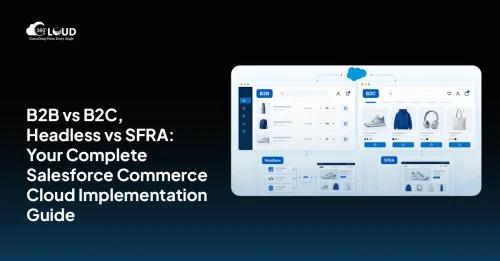 Salesforce Clouds
Salesforce Commerce Cloud Implementation: The 2026 Guide for B2B and B2C Commerce Teams
Commerce has always been competitive. But in 2026, the bar has shifted in ways that are hard to ignore. Whether someone is a consumer checking…
Read MoreReady to Optimize Your Manufacturing Operations with Salesforce?
Frequently Asked Questions
How does Salesforce support manufacturing companies?
Salesforce for Manufacturing Industry bridges CRM, ERP, field service, and asset tracking—enabling real-time visibility across sales, production, inventory, and service. With Manufacturing Cloud and custom workflows, teams collaborate seamlessly to reduce lead times and improve fulfillment.
Can it help manage production forecasts and orders?
Absolutely. With Salesforce Manufacturing Cloud Implementation, orders and forecasts sync directly with your production systems. This ensures planning teams always act on current demand signals, reducing stock-outs and overload.
Does Salesforce support channel and partner management for manufacturers?
Yes. Using Salesforce Partner Management for Manufacturers and Experience Cloud, you can onboard distributors, share real-time product catalogs, manage rebates, and track performance—all in a secure, branded portal.
Can field technicians access asset and inventory data on-site?
Definitely. With Salesforce Field Service for Manufacturing and Asset and Inventory Tracking, technicians get mobile access to assets’ maintenance history, parts availability, and guided repair workflows—boosting first-time fix rates.
Can Salesforce help predict production and maintenance needs?
Yes. By combining Data Cloud with Einstein AI and Tableau Analytics, you get predictive insights on supply chain bottlenecks, asset maintenance needs, and production forecasts—helping you plan proactively and reduce unplanned downtime.
Is integration with ERP systems possible?
Absolutely. Our Salesforce Integration with ERP Systems uses MuleSoft or API connectors to sync order, inventory, and production data—ensuring Salesforce stays current with enterprise applications like SAP, Oracle, or Microsoft Dynamics.
Got a Question? Ask Us!
Ready to Solidify Your Digital Transformation Efforts Using Salesforce? Talk to Us!

Subscribe to our newsletter
Stay ahead with expert insights, industry trends, and exclusive resources—delivered straight to your inbox.
Customize Consent Preferences
We use cookies to help you navigate efficiently and perform certain functions. You will find detailed information about all cookies under each consent category below.
The cookies that are categorized as "Necessary" are stored on your browser as they are essential for enabling the basic functionalities of the site.
We also use third-party cookies that help us analyze how you use this website, store your preferences, and provide the content and advertisements that are relevant to you. These cookies will only be stored in your browser with your prior consent.
You can choose to enable or disable some or all of these cookies but disabling some of them may affect your browsing experience.
Necessary cookies are required to enable the basic features of this site, such as providing secure log-in or adjusting your consent preferences. These cookies do not store any personally identifiable data.
Functional cookies help perform certain functionalities like sharing the content of the website on social media platforms, collecting feedback, and other third-party features.
Analytical cookies are used to understand how visitors interact with the website. These cookies help provide information on metrics such as the number of visitors, bounce rate, traffic source, etc.
Performance cookies are used to understand and analyze the key performance indexes of the website which helps in delivering a better user experience for the visitors.
Advertisement cookies are used to provide visitors with customized advertisements based on the pages you visited previously and to analyze the effectiveness of the ad campaigns.
Other uncategorized cookies are those that are being analyzed and have not been classified into a category as yet.