

AgentExchange: Salesforce’s Biggest Bet Since the Cloud
04 May 2026
Table of Contents
There’s a question quietly spreading through boardrooms and operations teams right now: What if you didn’t have to hire someone to do that?
Not in the cold, cost-cutting way that phrase has always sounded. But in a genuinely new way – where a piece of software doesn’t just assist a task, it actually owns it. Responds to customers. Drafts contracts. Onboards new employees. Resolves IT tickets. And does all of this while your actual team focuses on the work that really needs a human.
That idea is the engine behind Salesforce’s biggest bet right now. And, they made it much more real with the launch of AgentExchange.
Table of Contents
What Even Is AgentExchange?
Think of it as an app store – but instead of apps, you’re browsing AI workers.
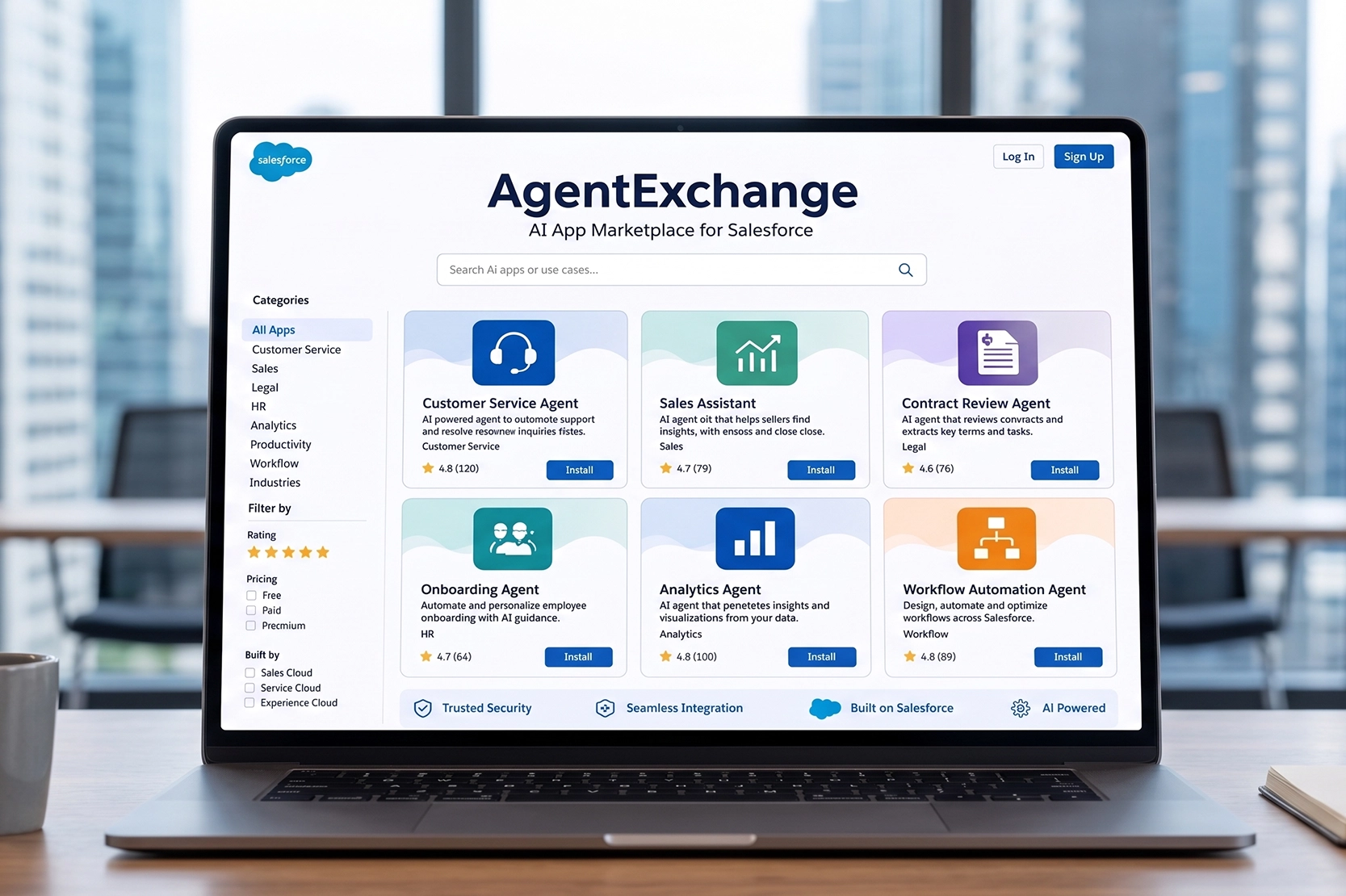
AgentExchange is a marketplace where businesses can discover, try, and deploy ready-made AI agents that plug directly into Salesforce. These aren’t chatbots that answer FAQs. They’re autonomous agents: software that can take multi-step actions, make decisions, and carry out complex tasks without someone holding their hand through every step.
Need an AI agent that handles customer service escalations? There’s one for that. Want one that automates contract approvals end-to-end? You can find that too. Looking for something tailored to HR onboarding, sales follow-ups, or IT support? The marketplace has it, or will soon.
Salesforce launched AgentExchange with over 200 partners and hundreds of pre-built actions, topics, and templates already available. Partners include Google Cloud, Docusign, Box, and Workday – recognizable names that bring serious depth to what these agents can actually do.
This Isn’t Salesforce’s First Marketplace Rodeo
To understand why AgentExchange is a big deal, you have to look back at what Salesforce did twenty years ago.
In 2005, Salesforce launched AppExchange – the first enterprise cloud marketplace. At the time, it was a novel idea: let third-party developers build apps that extend Salesforce, and let customers browse and install them. It worked. Spectacularly. AppExchange now has over 13 million installations and hosts over 7,000 programs. More than 91% of Salesforce customers use at least one partner app from it.
AgentExchange is trying to do the same thing, but for the age of AI agents. Where AppExchange was about extending what Salesforce could do, AgentExchange is about extending what Salesforce can do on its own.
AppExchange helped customers get more value from the platform with prebuilt apps and workflows. AgentExchange opens up the same opportunity – this time for AI agents in what Salesforce is calling the digital labor market.
Brian Landsman, Salesforce’s EVP of Global Business Development and Partnerships
Bridge the gap between AI potential and operational reality.

The $6 Trillion Number You Should Pay Attention To
Salesforce isn’t being subtle about the size of the opportunity here. The company positions AgentExchange as a gateway into a $6 trillion digital labor market, a figure that represents the potential value of work that AI agents could eventually take on across global businesses.
That number might sound inflated, but consider what’s actually in scope. Customer service. Sales development. Legal document processing. Financial reconciliation. IT helpdesks. HR admin. These are functions that every mid-to-large company runs, all day, every day, and they’re exactly the kinds of structured, repeatable workflows that AI agents are being built to handle.
The pitch isn’t that AI replaces all of this overnight. It’s that businesses can now start deploying these agents in targeted, practical ways, without building everything from scratch.
So What Can You Actually Do With AgentExchange?
Here’s where it gets concrete. AgentExchange offers four types of building blocks that partners can create and customers can use:
Actions are the individual tasks an agent can perform, things like creating a support case, sending a Slack message, updating a record, or pulling data from an external system. Google Cloud’s integration, for example, lets agents search the web in real time using Google Search and access up-to-the-minute information.
Topics group related actions together around a specific job, like “handle returns” or “manage employee onboarding.” They give agents a focused lane to operate in.
Prompt Templates are pre-written instructions that shape how an agent communicates and reasons. They ensure consistency and quality across interactions without requiring you to engineer everything yourself.
Agent Templates are the full package – a complete AI agent combining topics, actions, and instructions, ready to deploy or customize. Think of it as buying a pre-assembled product rather than sourcing every component yourself.
Customers can browse all of these directly on the AgentExchange marketplace or from inside Salesforce’s own Agent Builder tool. That last detail matters; it means discovering and adding new agent capabilities is built into the same place where you’re already working, rather than requiring a separate procurement journey.
What Makes AgentExchange Different From Just… Using AI?
Fair question. There’s no shortage of AI tools right now. So what does a marketplace specifically for Salesforce agents actually offer that’s different?
Security and vetting. Every solution on AgentExchange passes through Salesforce’s security and customer review process before it’s listed. In a world where businesses are rightfully cautious about what AI they let touch their customer data, that’s not a small thing.
AgentExchange empowers customers to seamlessly integrate trusted AI solutions within their workflow. Now our developer community can directly tap the expertise of our partner ecosystem to get the right industry-specific solutions so they can build and implement AI agents.
Alice Steinglass, Salesforce’s EVP of Platform, Integration and Automation
Industry depth. Generic AI tools are general-purpose by design. AgentExchange connects businesses with partners who specialize in specific industries – meaning an agent built for healthcare workflows isn’t just relabeled software from a retail solution.
Native integration. Because everything is built on Salesforce’s platform, agents have direct access to CRM data, customer history, and business workflows. They don’t need clunky connectors or workarounds to do their jobs.
Slack built in. AgentExchange actions include native Slack capabilities, so agents can send messages, update Slack canvases, or search Slack channels as part of their workflows. For businesses where Slack is the operational spine, this is more useful than it might first sound.
Who’s Already Paying Attention
Goodyear’s CEO, Mark Stewart, was among those who spoke at launch, calling AgentExchange a potential accelerant for speed and customer experience across their operations. That’s not a throwaway quote – Goodyear is a 125-year-old industrial company managing a complex global supply chain. When businesses of that scale start talking publicly about AI agents doing operational work, the signal is worth noting.
The Bigger Picture
There’s a version of the future where hiring decisions look different. Not because people lose jobs en masse, but because organizations can deploy capable, trusted AI agents to handle the routine and predictable, and redirect human effort toward the complicated, creative, and relational.
AgentExchange is Salesforce’s bet that this future arrives through a marketplace, not a one-size-fits-all product. The logic is the same as AppExchange: a platform is only as powerful as the ecosystem built on top of it, and ecosystems grow when you give builders a place to sell and buyers a place to browse.
With 200+ partners at launch and the full weight of Salesforce’s distribution behind it, AgentExchange has the pieces in place. Whether it becomes the defining marketplace for enterprise AI agents, the way AppExchange became the defining marketplace for enterprise cloud apps – is the question the next few years will answer.
But if you’re a business still thinking about AI as something to evaluate later, AgentExchange is a signal worth heeding: later is starting to look a lot like now.
Want to move beyond chatbots to a fully autonomous enterprise?

Categories

Solve It with Salesforce. We’ll Show You How.
AI. Apps. Experts. Everything you need to win with Salesforce under one roof.
About the author
Kriti SharmaKriti, Assistant Manager - Content at 360 Degree Cloud, brings over 8 years of experience as a content strategist and writer, specializing in the Salesforce ecosystem. She is an expert at crafting compelling narratives, translating complex topics around Salesforce, automation, and AI into high-impact content that resonates with the audience and drives measurable marketing results. Outside of her professional life, Kriti fuels her creativity by exploring new places and seeking out fresh perspectives.
Recent Blogs
 Salesforce Clouds
Salesforce CPQ to Revenue Cloud Migration: Why the Orgs That Waited Are Now Playing Catch-Up
There’s a boardroom conversation that happened at a lot of companies between 2022 and 2024. RevOps brings up Salesforce CPQ to Revenue Cloud migration. Finance asks what…
Read More AI and Agentforce
Agentforce Enabled by Default: What Every Salesforce Admin Needs to Know Before Winter ’27
Salesforce releases usually arrive with a to-do list. Sandbox testing, a few toggle decisions, maybe a quick training doc for end users. Agentforce Winter ’27 is a different situation. …
Read More Salesforce Services
Salesforce License Optimization: How to Cut Costs by 30% Before Your Next Renewal
Most companies overpay for Salesforce. Not by a little – by 20 to 30%. And the frustrating part? Nobody planned for it. License waste doesn’t announce itself. It compounds quietly, quarter by…
Read MoreReady to Make the Most Out of Your Salesforce Instance?
Our Salesforce aces would be happy to help you. Just drop us a line at contact@360degreecloud.com, and we’ll take it from there!
Subscribe to our newsletter
Stay ahead with expert insights, industry trends, and exclusive resources—delivered straight to your inbox.