

Marketing Cloud Developer: Skills, Rates, and How to Hire the Right One
20 Jun 2026
Table of Contents
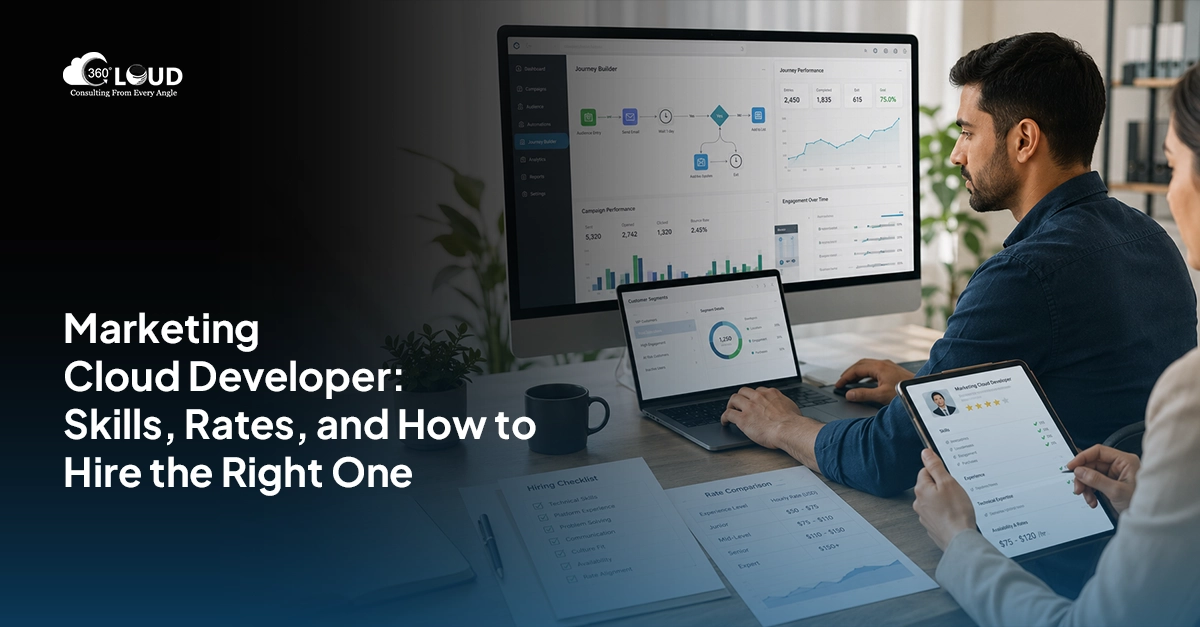
The Marketing Cloud developer develops the following in Salesforce Marketing Cloud: Journey Builder automation processes, Email Studio templates using AMPscript, Marketing Cloud Connect integration of Sales/Service Cloud, Data Extensions and SQL-based data management, as well as API-based integration of Marketing Cloud with other systems. There’s a difference between a general Salesforce developer and the Marketing Cloud developer: the platform, programming language, and database model differ enough for the general Salesforce developer not to be a good fit.
Experience with Salesforce Marketing Cloud among candidates is often exaggerated. An admin who manages to create a simple email campaign in Email Studio doesn’t mean the same thing as a developer who creates AMPscript code, Journey automation flows, builds Data Extension architecture, and integrates Salesforce Marketing Cloud with a CDP from a third party.
This guide shows you how to assess whether a candidate is really capable of developing for Marketing Cloud and how much it will cost.
Table of Contents
The Marketing Cloud Expertise Spectrum
Level 1: Marketing Cloud Administrator
What they do: Day-to-day campaign execution, email builds using templates, audience segmentation using existing Data Extensions, Journey Builder using standard activities, basic reporting.
What they don’t do: AMPscript, custom Journey activities, SQL data management, Marketing Cloud Connect configuration, API integrations.
Rate range: $40–65/hr (US-based), $25–40/hr (India-based)
When to use: Ongoing campaign operations, email production, standard journey maintenance. Not for implementation, integration, or custom development.
Level 2: Marketing Cloud Developer
What they do: Dynamic email/SMS/push content via AMPscript, Journey Builder with extensive branching and custom activities, Data Extensions and SQL Query activity design for data manipulation, Marketing Cloud Connect setup and debugging, REST and SOAP API integration with Marketing Cloud, basic Server-Side JavaScript scripting.
Non-capabilities: Large-scale enterprise architecture planning/design, CDP integration architecture design, Interaction Studio (Personalization) implementation.
Rate range: US-based: $70-$100/hr, India-based Summit Partner: $40-$55/hr.
When to use: Setting up a new Marketing Cloud business unit, designing custom journeys, Marketing Cloud Connect configurations, API integration with other systems.
Level 3: Marketing Cloud Architect / Senior Specialist
What they do: Complete Marketing Cloud Architecture: Design of Data Extensions for intricate data requirements, Enterprise Journey Architecture, Cross-Cube data strategy (Marketing Cloud + Data Cloud + Sales Cloud), Interaction Studio (Personalization) Implementation, Complex API integration patterns, Marketing Cloud Account Engagement (Pardot) migration plan, Multi Business Unit implementation.
Rate range: $100 – 130/hr (US based), $60 – 80/hr (India based Summit Partner)
When to use: Marketing Cloud Architecture, Enterprise-level implementation, Migrating Pardot to Marketing Cloud, Data Cloud & Marketing Cloud implementation, Multi Business Units implementation.
Skip the bad hire. Get a vetted SFMC developer matched to your project.

Core Marketing Cloud Developer Skills
AMPscript
AMPscript is Marketing Cloud’s proprietary scripting language for dynamic content in emails, landing pages, SMS, and push notifications. Hire a Marketing Cloud developer who can:
- Write conditional content blocks (show/hide content based on subscriber data)
- Perform lookups against Data Extensions for personalized content
- Format data (dates, currency, strings) for email content
- Handle error conditions in AMPscript gracefully
- Build AMPscript-driven preference centers and unsubscribe pages
AMPscript is not optional for any serious Marketing Cloud development. If a candidate claiming Marketing Cloud developer status can’t write AMPscript fluently, they’re not a Salesforce Marketing Cloud specialist.
Data Extensions and SQL
Marketing Cloud’s data layer is built on Data Extensions, essentially database tables within Marketing Cloud. An SFMC developer skills should include:
- Designs Data Extension schemas for subscriber data, product data, transactional data
- Writes SQL Query activities to join, filter, and transform data within Marketing Cloud
- Manages Send Relationships between Data Extensions and subscriber lists
- Understands the difference between Sendable, Non-Sendable, and Synchronized Data Extensions
SQL in Marketing Cloud is simplified compared to full SQL, but it’s still SQL. A candidate who describes their Marketing Cloud data experience as “creating segments” without SQL knowledge is operating at the admin level.
Journey Builder
In addition to the regular Journey Builder activity types, such as Send Email, Wait, and Decision Split, a Journey practitioner at the developer level:
- Develops custom Journey activities using the Custom Activity architecture from Marketing Cloud
- Creates complicated branch structures using Data Extension-based Decision Splits
- Connects Journey Builder to other applications with entry sources via REST API
- Creates Journey versions and updates for live journeys
- Constructs re-engagement and suppression logic within Journey structures
Marketing Cloud Connect
Marketing Cloud Connect is the integration between Marketing Cloud and Sales/Service Cloud. A developer configures:
- Contact and Lead synchronization between Salesforce and Marketing Cloud
- Synchronized Data Extensions from Salesforce objects
- Subscriber management across both platforms
- Tracking data flow back to Salesforce Campaign and Activity records
Marketing Cloud Connect is notoriously complex to configure correctly. Misconfiguration produces data sync problems that are difficult to diagnose and expensive to remediate. This is an area where genuine depth matters when you want to hire an SFMC expert.
What to Verify in Marketing Cloud Developer Candidates
AMPscript fluency: When you hire an SFMC expert, ask them to walk through an AMPscript conditional content block they’ve written. Specifically: “How would you write AMPscript to show different email content based on a subscriber’s loyalty tier stored in a Data Extension?” A genuine Salesforce Marketing Cloud specialist gives you the AMPscript syntax. An admin-level candidate gives you a process description.
Data Extension architecture experience: “Walk me through how you structured a Data Extension model for an e-commerce client with orders, products, and subscriber preferences.” The answer should reference schema design, Send Relationship configuration, and the tradeoffs between Data Extension complexity and query performance.
Describe your project. We’ll tell you whether you need a developer or an architect.

Journey Builder scope: “What’s the most complex Journey you’ve built, and what made it complex?” A developer-level answer involves custom activities, complex branching, API integrations, or multi-step re-engagement logic. An admin-level answer involves a 3-step welcome series.
Marketing Cloud certifications: The relevant certifications for developer-level work are Marketing Cloud Developer and Marketing Cloud Consultant. Marketing Cloud Administrator certification is admin-level. Ask to verify through Trailhead.
Common Marketing Cloud Project Types and Who You Need
| Project Type | Required Level |
| Standard email campaign execution | Admin |
| Journey Builder implementation (standard flows) | Admin–Developer |
| AMPscript personalization builds | Developer |
| Marketing Cloud Connect configuration | Developer |
| Data Extension architecture for complex data | Developer–Architect |
| REST API integration with external system | Developer |
| Pardot/Account Engagement migration | Architect/Senior Specialist |
| Data Cloud + Marketing Cloud integration | Architect |
| Multi-business-unit setup and governance | Architect |
Conclusion
All issues that arise from hiring a candidate for Marketing Cloud are basically one mistake – assuming that there is such a position like “Marketing Cloud experience.” In reality, there are three distinct roles involved here – administrator who executes campaigns, developer responsible for AMPscript and custom journey activities, and architect designing cloud integration and architecture. Hiring someone for the role of an administrator at developer rates, or vice versa, will only lead to trouble.
Use the SFMC developer skills and rate ranges in this guide as your baseline. Verify depth with specific technical questions, not general experience claims. And if the project scope is large enough that getting the hire wrong would hurt, bring in a partner who’s done this work before.
That’s where we come in. 360 Degree Cloud places and deploys Salesforce Marketing Cloud specialists across implementation, integration, and ongoing managed services. If you’re figuring out what your project actually needs, start with a conversation.

Categories

Solve It with Salesforce. We’ll Show You How.
AI. Apps. Experts. Everything you need to win with Salesforce under one roof.Frequently Asked Questions
Is Marketing Cloud development the same as Salesforce development?
No, that is a completely different platform using a different programming language (AMPscript instead of Apex), a different data structure (Data Extensions instead of Salesforce Objects), and a different architecture for integration. A developer on Salesforce who has no Marketing Cloud background cannot be called a developer on Marketing Cloud despite any expertise they have on Salesforce as a whole.
Can a Marketing Cloud admin handle an implementation project?
For standard implementations of limited scope, setting up email templates, configuring basic journeys, importing subscriber lists, an experienced admin can handle it. For implementation projects involving Marketing Cloud Connect, custom journey development, data architecture, or AMPscript-heavy personalization, a developer-level resource is needed.
What's the difference between Marketing Cloud and Marketing Cloud Account Engagement (Pardot)?
Marketing Cloud is the B2C marketing automation product by Salesforce, used for sending bulk emails, SMS, push notifications, and Journey automations. Marketing Cloud Account Engagement is the B2B marketing automation product by Salesforce (previously known as Pardot), more deeply integrated into the Sales Cloud lead management system. The platforms use different architectures, different functionality, and different skill sets.
How do we evaluate a Marketing Cloud developer's Data Cloud experience?
Data Cloud (formerly known as Customer Data Platform) is an independent offering compared to Marketing Cloud yet one that is becoming increasingly intertwined with the latter. Ask explicitly: "Have you used any Data Cloud segments to act as Journey Builder start events?" and "Are you familiar with activating Data Cloud unified profiles within Marketing Cloud to leverage Ampscript for personalization purposes?"

About the author
Editorial TeamThe Editorial Team at 360 Degree Cloud brings together seasoned marketers, Salesforce specialists, and technology writers who are passionate about simplifying complex ideas into meaningful insights. With deep expertise in Salesforce solutions, B2B SaaS, and digital transformation, the team curates thought leadership content, industry trends, and practical guides that help businesses navigate growth with clarity and confidence. Every piece we publish reflects our commitment to delivering value, fostering innovation, and connecting readers with the evolving Salesforce ecosystem.
Recent Blogs
 Salesforce Clouds
Salesforce CPQ to Revenue Cloud Migration: Why the Orgs That Waited Are Now Playing Catch-Up
There’s a boardroom conversation that happened at a lot of companies between 2022 and 2024. RevOps brings up Salesforce CPQ to Revenue Cloud migration. Finance asks what…
Read More AI and Agentforce
Agentforce Enabled by Default: What Every Salesforce Admin Needs to Know Before Winter ’27
Salesforce releases usually arrive with a to-do list. Sandbox testing, a few toggle decisions, maybe a quick training doc for end users. Agentforce Winter ’27 is a different situation. …
Read More Salesforce Services
Salesforce License Optimization: How to Cut Costs by 30% Before Your Next Renewal
Most companies overpay for Salesforce. Not by a little – by 20 to 30%. And the frustrating part? Nobody planned for it. License waste doesn’t announce itself. It compounds quietly, quarter by…
Read MoreReady to Make the Most Out of Your Salesforce Instance?
Our Salesforce aces would be happy to help you. Just drop us a line at contact@360degreecloud.com, and we’ll take it from there!
Subscribe to our newsletter
Stay ahead with expert insights, industry trends, and exclusive resources—delivered straight to your inbox.