

How to Choose a Salesforce Staffing Partner: 10-Point Checklist
07 Jun 2026
Table of Contents
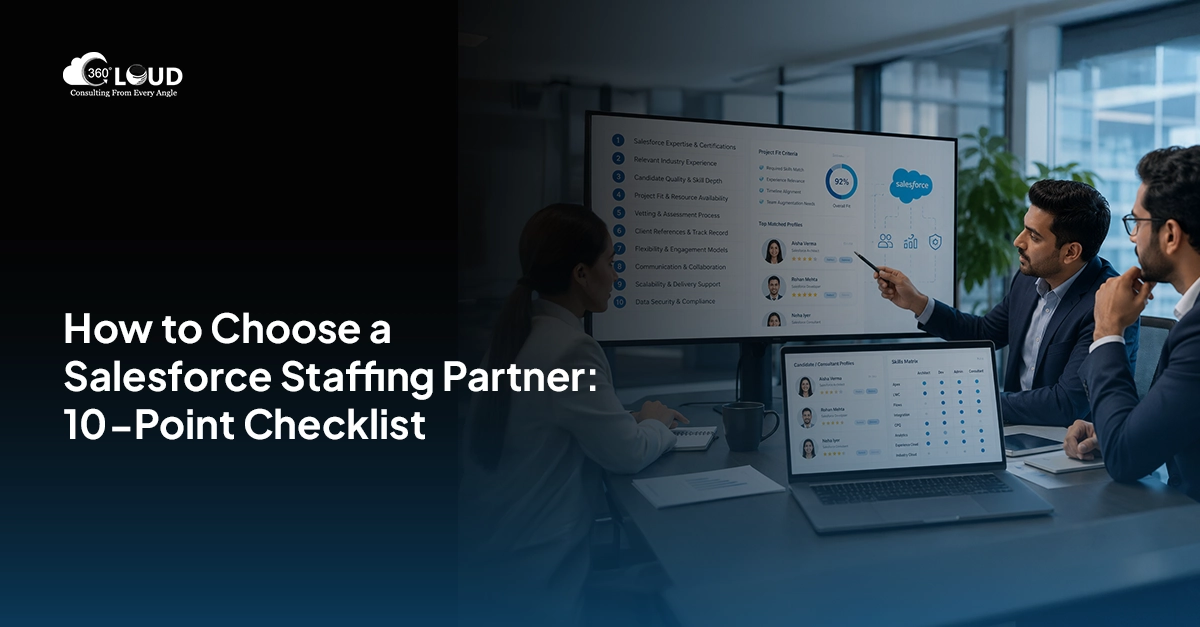
A Salesforce staffing agency with a Salesforce Platinum Partner designation that keeps a pre-screened list of candidates who have verified certifications, who can deploy a certified candidate in 24 hours, provides clear and flexible pricing, and adheres to knowledge transfer guidelines is the kind of partner you want on your Salesforce project.
If you think about how to choose a Salesforce staffing partner, it is not difficult when you know what to check. The problem is that most providers look similar on a website. Summit Partner logos, certification counts, client testimonials. The differences that actually matter, deployment speed, knowledge transfer policy, replacement capability, governance structure, only surface when you ask the right questions.
This checklist gives you exactly those questions.
Table of Contents
The 10-Point Evaluation Checklist
1. Salesforce Partner Tier
What to check: Summit (Platinum) is the highest tier Salesforce awards. It requires demonstrated client satisfaction scores, certification investment across the partner’s team, and performance standards Salesforce tracks directly.
Why it matters: Summit status is not self-reported. Salesforce validates it. It’s the floor for any serious augmentation provider, not a differentiator by itself, but a disqualifier if it’s absent.
Question to ask: “Can you share your current AppExchange listing showing your partner tier?”
A qualified partner will have their tier publicly visible on AppExchange. If they redirect you without showing it, that’s a data point.
2. Certified Professional Count and Certification Verification
What to check: Total certification count is less useful than asking for specific certifications relevant to your requirement. A provider with 1,200+ certifications but none in Health Cloud isn’t right for a Health Cloud engagement.
Why it matters: Any provider can claim certification volume. The specific certifications for your specific project are what matter, and they need to be verifiable, not asserted.
Question to ask: “Can you show me verified certifications in [specific cloud] for the candidates you’d place with us? We’ll want to check on the Salesforce Trailhead Verification portal.”
A reputable partner will provide verification links as part of the candidate profile. Reluctance to provide verification before a commitment is a red flag.
Tired of “we can usually deploy quickly”? Ask us for a real bench number.

3. Industry Vertical Experience
What to check: Has the provider delivered Salesforce work specifically in your industry? Healthcare experience requires HIPAA awareness. Fintech requires understanding of financial data handling. SaaS orgs often have complex CPQ and integration requirements.
Why it matters: A developer with only retail Salesforce projects in his/her portfolio will fail to understand compliance and configurations needed for your industry.
Question to ask: “Can you name three projects you’ve delivered in [your industry] and describe the Salesforce clouds and compliance context involved?”
Vague answers (“we’ve worked with healthcare clients”) are less useful than specific delivery context. You want project-level specifics.
4. Deployment Speed for Your Specific Requirement
What to check: Not “how fast do you deploy” in general, but “how fast can you deploy a [specific role] with [specific certifications] for a [specific duration]?”
Why it matters: Providers who say “48–72 hours” as a default answer may be starting a search when you call. Providers who say “48–72 hours” because they maintain an active bench of pre-vetted professionals are telling you something different.
Question to ask: “If I needed a Health Cloud developer with HIPAA awareness for a 16-week engagement starting in two weeks, what’s your current bench depth for that profile? How quickly could you have candidates in front of me?”
The specificity of the answer tells you whether they’re drawing from a live bench or fabricating confidence.
5. Transparent Pricing and Rate Benchmarks
What to Look For: Does the vendor quote you rate ranges or do they give their quotes after hours of scoping calls? Is the quote competitive with the benchmark for the position/region?
Why it’s important: 2026 market benchmarks: Mid-level Salesforce Developer – $65–$100/hour (US) / $25-$55/hour (India-based qualified partners)
If you are quoted a number outside of those ranges without a justifiable reason, you’re paying for overhead, not talent.
Question to Ask: What is the rate range for a mid-level Apex developer with LWC experience for a 3-month period? Is that an US or India based delivery?
6. Contract Flexibility and Minimum Engagement
What to check: What are the minimum engagement terms? Can you scale resources up or down mid-engagement? Is there an early termination provision if the project scope changes?
Why it matters: Projects change. A provider with rigid 6-month minimums and no scaling flexibility creates problems when your project scope shifts. The engagement structure should accommodate your reality, not the other way around.
Question to ask: “What’s your minimum engagement term? If we need to add a second developer two months in, how does that work commercially? What’s the process if the scope changes and we need to end the engagement early?”
Backlog stuck for 90 days? Bring us the gap and we’ll scope the fix.

7. Knowledge Transfer Policy
What to check: “Knowledge transfer is a priority for us” is not a policy. Documentation milestones, code commenting requirements, and sprint deliverables that include knowledge artifacts, those are policies.
Why it matters: When the augmented professional leaves, your team should be stronger for the engagement, not more dependent on whoever comes next. Knowledge transfer determines that outcome. This is the point most organizations regret not pressing on before they signed.
Question to ask: “Walk me through exactly how you structure knowledge transfer. When does documentation start? What does a sprint delivery look like from a knowledge artifact perspective? What does your team produce before the engagement closes?”
A provider with a real policy answers in specifics. A provider without one answers in principles.
8. References and Verifiable Case Studies
What to check: Referrals from customers that speak about delivery results, rather than just about their relationship. A referral customer that says “they were great to work with” is not telling you as much as one that tells you about what they built, what the problem was, and if it was delivered on time.
Why it matters: Any provider can curate a testimonials page. References who will take an actual call and answer specific delivery questions tell you something different.
Question to ask: “Can you connect us with two or three past clients in similar roles to ours, specifically for augmentation engagements, not full project delivery? We’d like to discuss their experience with the candidate quality and engagement governance.”
If the provider is slow to produce references for augmentation engagements specifically, that’s a signal.
9. Communication and Governance Model
What to check: How does the provider handle issues when they arise? Is there a named account manager or delivery lead who owns the engagement, or do you get a helpdesk? What’s the escalation path if the resource isn’t performing?
Why it matters: Every engagement has friction. What determines outcome is how the provider handles it. A provider with a clear governance structure, a named delivery contact, defined escalation path, regular check-ins, handles friction better than one that doesn’t.
Question to ask: “Who is my named contact throughout the engagement? What’s the escalation process if there’s a performance concern? How quickly can I expect a response to a mid-engagement issue?”
10. Replacement Capability
What to check: What happens if the augmented professional isn’t working out after two or three weeks? How quickly can a replacement be placed? At what cost?
Why it matters: Every provider will tell you they place high-quality professionals. The test of that claim is what happens when it’s wrong. A provider with bench depth can replace within days. A provider without bench depth is starting a search.
Question to ask: “If we’re two weeks in and the resource isn’t the right fit for our team, what’s the replacement process? How quickly, what steps, and at what cost?”
Red Flags That Should End the Conversation
- Can’t show partner tier on AppExchange. Either they don’t have Summit status or they’re hoping you don’t check. Check.
- Vague on deployment speed. “We can usually deploy quickly” without specifics means they’re starting a search when you commit.
- No knowledge transfer process beyond verbal assurance. If they can’t describe what documentation looks like in practice, assume it doesn’t happen.
- References are testimonials only; no live reference calls. Written testimonials prove nothing verifiable.
- Rate quotes require signing an NDA first. Transparent providers discuss rates openly; this behavior protects markup, not IP.
- Reluctance to provide certification verification links. Certifications are publicly verifiable. There is no reason to withhold verification links except that they don’t have them.
Questions for the First Vendor Call
Use these five questions in the first 20 minutes of any vendor evaluation call:
- “What’s your current AppExchange partner tier, and can you share the link?”
- “For a [specific role] with [specific certifications], what’s your current bench depth and deployment timeline?”
- “How do you structure knowledge transfer – specifically, what do documentation milestones look like in your sprint delivery?”
- “If the resource isn’t working out at Week 3, what’s the replacement process and timeline?”
- “Can you connect us with two past clients who used you for individual resource augmentation, not full project delivery?”
The answers to those five questions will differentiate a mature provider from one who is not actually staffing-first.
The Checklist Does the Filtering for You
Most providers look the same on a website. Same Summit logo, same certification count, same wall of testimonials. The differences that actually decide your engagement, bench depth, knowledge transfer discipline, how fast a replacement shows up, only surface when you ask. So the real answer to how to choose a Salesforce staffing partner isn’t a gut call after a smooth sales demo. It’s whether the provider can answer ten specific questions in specifics rather than principles. A mature partner shows you the AppExchange link, names three projects in your industry, and walks you through what documentation looks like in week two. The other kind talks in adjectives.
Run the five questions in your first vendor call and you’ll cut a long list fast. That’s the point of having Salesforce partner evaluation criteria written down before anyone gets on the phone, you stop grading vendors on charisma and start grading them on what they’ll actually deliver. Treat this as your staff augmentation vendor checklist, not a one-time read. Print it, take it into the call, and watch how quickly the right provider separates from the rest. Salesforce agency selection isn’t hard once you know what to check. The hard part is remembering to check before you sign, not after.

Categories

Solve It with Salesforce. We’ll Show You How.
AI. Apps. Experts. Everything you need to win with Salesforce under one roof.Frequently Asked Questions
Does Salesforce Summit Partner status guarantee quality?
Summit status verifies that the partner meets Salesforce's minimum standards for certifications, client satisfaction, and business ethics. It's a meaningful floor, better than Silver or Gold, but not a ceiling. Two Summit Partners can have very different bench depths, deployment speeds, and knowledge transfer disciplines. The tier tells you the provider has cleared Salesforce's bar; the staff augmentation vendor checklist tells you whether they meet your specific requirements.
How do I verify a Salesforce partner's tier independently?
Every Salesforce partner has an AppExchange listing that shows their current partner tier. Search the AppExchange by company name and look for the Partner Tier field in their profile. Summit is the highest. If a provider claims Summit status, it will be there.
How many vendors should I shortlist?
Three to five is typical for a serious evaluation. Fewer than three risks missing a better option; more than five creates comparison fatigue without proportional additional information. Use the staff augmentation vendor checklist to pre-screen before investing in full evaluation calls, partner tier and basic deployment speed questions can cut the list quickly.
Can I negotiate contract terms with a staffing partner?
Yes. Minimum engagement duration, escalation terms, knowledge transfer milestones, and replacement provisions are all negotiable before signing. Providers who treat these as non-negotiable standard terms are prioritizing their commercial structure over the engagement quality. Most established providers will negotiate reasonable adjustments when asked clearly.
What's the difference between a staffing firm and a Salesforce-specific staffing partner?
There might be Salesforce developers working with an IT general staffing firm; however, they do not specialise in Salesforce solutions. On the other hand, a Salesforce partner, especially with the Summit or Platinum Partner designation, will keep a pre-vetted bench strictly on Salesforce certifications and will also understand Salesforce deployments better than others. A Salesforce-specialised vendor is a far better option.

About the author
Editorial TeamThe Editorial Team at 360 Degree Cloud brings together seasoned marketers, Salesforce specialists, and technology writers who are passionate about simplifying complex ideas into meaningful insights. With deep expertise in Salesforce solutions, B2B SaaS, and digital transformation, the team curates thought leadership content, industry trends, and practical guides that help businesses navigate growth with clarity and confidence. Every piece we publish reflects our commitment to delivering value, fostering innovation, and connecting readers with the evolving Salesforce ecosystem.
Recent Blogs
 Salesforce Services
Salesforce Health Check: What It Is, What It Covers, and What You Should Do with the Results
Picture this. A VP of Sales asks why the pipeline number in Salesforce is $2.3 million, but the finance report shows $1.8 million. Nobody has…
Read More Salesforce Clouds
Salesforce Just Added Something New. Here’s How to Put It to Work.
Winter ’27 is live. Dreamforce just added more. Is your team using any of It? Two big drops landed in one month, and most teams…
Read More Salesforce Services
Salesforce Technical Debt 10 Signs Your CRM Needs a Strategic Overhaul (and What to Do About It)
Three years ago, the Salesforce org your team implemented was clean. Logical field names. Documented Flows. A handful of integrations that actually made sense. Today?…
Read MoreReady to Make the Most Out of Your Salesforce Instance?
Our Salesforce aces would be happy to help you. Just drop us a line at contact@360degreecloud.com, and we’ll take it from there!
Subscribe to our newsletter
Stay ahead with expert insights, industry trends, and exclusive resources—delivered straight to your inbox.