


Want to Improve Customer Response Rates? Try Salesforce Two-Way Texting
10 Jun 2026
Table of Contents
Low response rates are one of the most frustrating problems in customer outreach. You invest time building campaigns, crafting messages, and segmenting your audience — and then the replies do not come. Or they trickle in slowly enough that the momentum is lost before your team can act on them.
The channel you are using matters more than most teams give it credit for. Email open rates have been declining steadily for years. Phone calls go unanswered. And while these channels still have their place, the businesses seeing the strongest engagement results are the ones that have added Salesforce two-way texting to communicate with customers.
If your Salesforce outreach is not generating the responses your business needs, the answer may not be in the message. It may be in the channel.
Table of Contents
Why Two-Way Texting Changes the Dynamic
Most businesses think of text messaging as a one-directional channel — a way to push information out. Notifications, reminders, confirmations. That kind of one-way Salesforce SMS conversation has its value, but it misses the bigger opportunity.
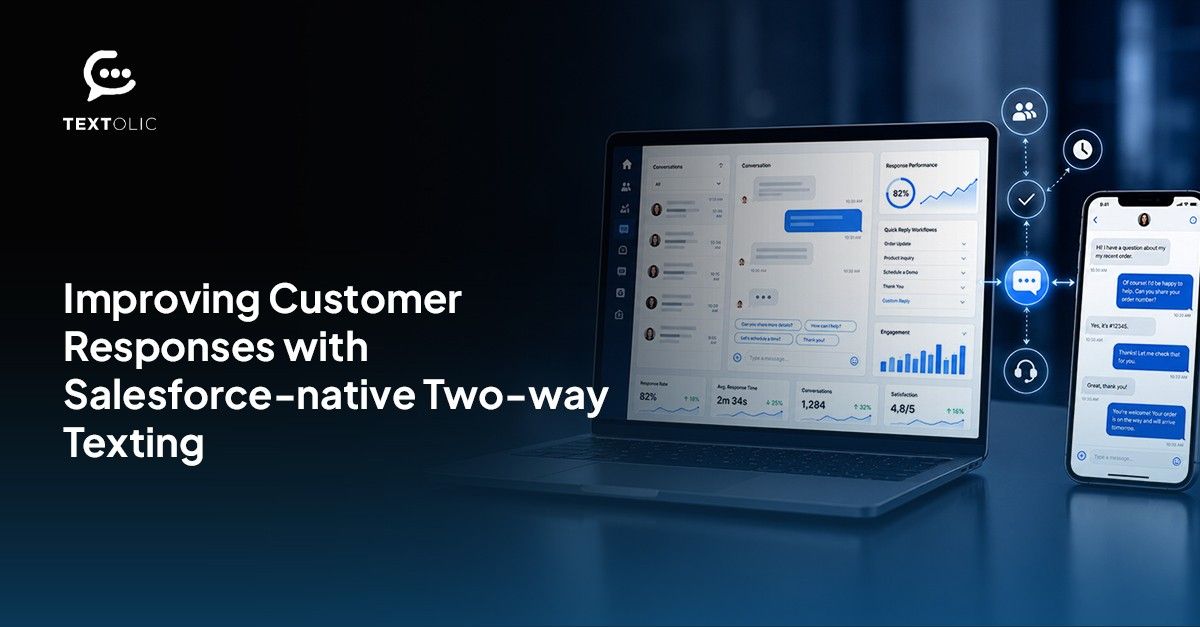
Two-way texting turns SMS into a conversation. Instead of sending a message and waiting, your team sends a message, and the customer can reply — directly, from the same thread, in real time. That reply triggers whatever comes next: a response from a rep, an automated follow-up, or a workflow action inside Salesforce.
This dynamic fundamentally changes the customer experience. A text message that says “Reply YES to confirm your appointment” or “Got a question? Text us here” invites a response in a way that a promotional email simply cannot. The result is engagement that feels more personal and response rates that reflect it.
The Challenge: Two-Way SMS Without a Native Salesforce Integration
The problem most businesses run into is that managing two-way Salesforce SMS conversations outside the CRM creates fragmented data. Your reps are responding to texts in a separate tool. The conversation history is not in the CRM. And when a customer calls in later, the agent has no idea what was already said.
This is not a messaging problem — it is an integration problem. Two-way texting only works smoothly at scale when the conversation lives inside your CRM, where your team has context on every customer interaction.
That is what Salesforce two-way texting solves.
See how two-way SMS conversations run natively inside Salesforce.

What Salesforce Two-Way Texting Looks Like in Practice
When two-way SMS for Salesforce is integrated natively, a few things change immediately.
Reps send and receive messages from within Salesforce. There is no separate inbox to monitor. Incoming replies appear against the relevant Salesforce record, in the same place where the rep manages the rest of their customer interactions.
Every conversation is automatically logged. The full message thread — every outbound message and every reply — is stored in Salesforce against the contact or lead record. Nothing needs to be manually entered. Nothing gets lost when a rep leaves or hands off an account.
Replies can trigger automated actions. If a customer replies “YES” to confirm an appointment, that response can automatically update a Salesforce record, trigger a confirmation message, and create a task for the rep. Two-way texting becomes part of your SMS automation logic, not separate from it.
Your team has context for every conversation. Before responding to an incoming message, your rep can see the contact’s full history in Salesforce — past conversations, account status, open opportunities, and recent activity. They respond with context, which makes the conversation more useful for the customer.
Introducing 360 Textolic: Conversational SMS for Salesforce
360 Textolic is a Salesforce-native messaging platform that makes two-way texting — and two-way conversations across 15+ channels — a native capability inside your CRM.
Here is what makes it effective for improving response rates:
Real Two-Way Conversations, Not Just Replies
360 Textolic supports genuine back-and-forth messaging between your team and your customers, managed entirely within Salesforce. Outbound messages go out from Salesforce, inbound replies come back into Salesforce, and the entire thread is visible to anyone with access to that record.
Salesforce SMS Conversations Tracked Automatically
Every SMS conversation through 360 Textolic is logged to the relevant Salesforce record in real time. Sales reps, service agents, and managers have full visibility into what was said — without any manual data entry. View complete SMS conversation history and analytics directly from Salesforce.
Personalized Outreach at Scale
Personalization is a key driver of response rates. 360 Textolic supports Salesforce merge fields in message templates, so your team can send messages that address the recipient by name, reference their account, or acknowledge a specific interaction — even when sending at scale.
Multichannel: WhatsApp, SMS, and More
Not every customer will respond to SMS at the same rate. Some audiences are more engaged on WhatsApp. Others use different platforms. 360 Textolic supports 15+ channels, giving your team the flexibility to reach customers where they are most likely to respond.
WhatsApp messaging in Salesforce, in particular, offers strong engagement rates in markets where it is the dominant messaging platform. Managing Salesforce WhatsApp conversations through the same interface as SMS means your team has a consistent workflow regardless of channel.
No-Code Chatbots for Automated Responses
For high-volume inbound conversations, 360 Textolic supports no-code chatbot functionality. Routine inquiries — appointment confirmations, FAQs, initial qualification questions — can be handled automatically, freeing your team to focus on conversations that require human attention.
Want to upgrade your two-way messaging inside Salesforce and boost engagement?

The Response Rate Impact
The businesses that move from one-way broadcast messaging to two-way conversational SMS for Salesforce consistently report a meaningful improvement in engagement. SMS response rates average around 75% — a number that reflects the channel’s immediacy and the expectation of a reply that two-way messaging creates.
For context, that is significantly higher than the average email response rate for most B2B and B2C outreach. The channel is doing work that email simply cannot do.
If improving customer response rates is a priority for your team, adding Salesforce two-way texting through a native CRM integration is one of the most direct ways to get there.
Categories

Solve It with Salesforce. We’ll Show You How.
AI. Apps. Experts. Everything you need to win with Salesforce under one roof.Frequently Asked Questions
What is Salesforce two-way texting?
It is the ability to send and receive SMS messages within Salesforce, where both outbound messages and incoming replies are managed from within the CRM and logged against the relevant records.
How does two-way SMS for Salesforce improve customer response rates?
Two-way SMS for Salesforce creates a conversational dynamic that feels more immediate and personal than email. It invites replies, and customers can respond directly without any friction.
Can replies from customers trigger Salesforce workflows?
Yes. Incoming replies can trigger Salesforce Flows or Process Builder actions, such as updating a record, creating a task, or sending a follow-up message.
Is the SMS conversation history stored in Salesforce?
Yes. 360 Textolic logs all messages — outbound and inbound — against the relevant Salesforce records automatically.
Can I manage WhatsApp conversations the same way as SMS in 360 Textolic?
Yes. 360 Textolic supports Salesforce WhatsApp messaging and manages those conversations the same way as SMS, within the same Salesforce interface.
Does 360 Textolic support automated responses to inbound messages?
Yes. 360 Textolic includes no-code chatbot functionality for handling routine inbound inquiries automatically.
What channels does 360 Textolic support for two-way messaging?
360 Textolic supports 15+ channels, including SMS, WhatsApp, WeChat, and LINE.
Can messages be personalized when using two-way SMS in Salesforce?
Yes. Merge fields from Salesforce can be used in message templates to personalize outbound messages at scale.
What is the average response rate for SMS compared to email?
SMS campaigns average around 75% response rates. Email typically sees response rates in the single digits for most outreach campaigns.
Is 360 Textolic built natively for Salesforce?
Yes. 360 Textolic is a Salesforce-native app that operates entirely within your CRM environment.

About the author
Editorial TeamThe Editorial Team at 360 Degree Cloud brings together seasoned marketers, Salesforce specialists, and technology writers who are passionate about simplifying complex ideas into meaningful insights. With deep expertise in Salesforce solutions, B2B SaaS, and digital transformation, the team curates thought leadership content, industry trends, and practical guides that help businesses navigate growth with clarity and confidence. Every piece we publish reflects our commitment to delivering value, fostering innovation, and connecting readers with the evolving Salesforce ecosystem.
Recent Blogs
 Software Services
Custom Web Application Development Cost Guide (2026)
Get quotes from five vendors for the same web app and you won’t get five similar numbers. You’ll get five wildly different ones. One agency says $30,000. Another says $250,000. Same…
Read More Products
Salesforce SMS Automation: How to Trigger the Right Text at the Right Moment
Six hours. That’s how long a lead sat untouched before anyone in Salesforce so much as glanced at the form notification. Multiply that across a…
Read More Uncategorized
Salesforce for Small Business in India: What the SMB Growth Kit Actually Changes
Most small businesses in India don’t lose deals because the product is weak. They lose deals because nobody followed up on time. A lead comes in through WhatsApp, gets forwarded to…
Read MoreReady to Make the Most Out of Your Salesforce Instance?
Our Salesforce aces would be happy to help you. Just drop us a line at contact@360degreecloud.com, and we’ll take it from there!
Subscribe to our newsletter
Stay ahead with expert insights, industry trends, and exclusive resources—delivered straight to your inbox.