
Table of Contents
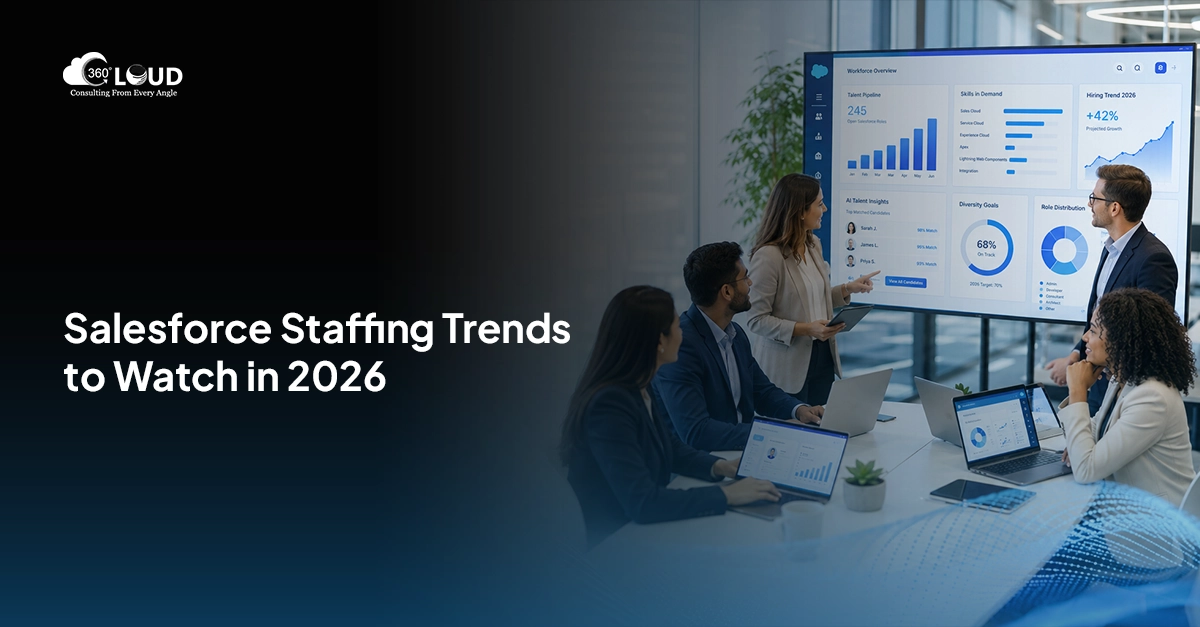
Among other things, key Salesforce hiring trends in 2026 involve growing scarcity of professionals proficient in Artificial Intelligence and Data Clouds, the evolution from broad interest in hiring generalist administrators to an exclusive preference for hiring specialist consultants, the proliferation of offshoring Salesforce development teams and moving away from time and material-based augmentation agreements toward outcome-based engagements.
Teams who crafted their 2022 staffing strategy cannot play by the same rules today. The Salesforce job market of 2026 is a far cry from how things were two years ago. There are some changes that are quite obvious – more open positions, rising price tag of niche skills, greater competition for the same candidates. Then there are certain structural trends that define the way work gets done and Salesforce staffing trends shape how teams get assembled.
Organizations who recognize these Salesforce workforce trends are making smarter hiring decisions. And those who fail to acknowledge them are either overpaying for irrelevant skill sets or are missing deadlines of their Salesforce roadmaps due to talent shortages.
Here is the actual picture in the job market coming into 2026.
Table of Contents
Where the Salesforce Job Market Stands as of 2026
The volume numbers tell one story. Salesforce job postings on Glassdoor went from roughly 14,000 in May 2024 to 31,200 by September 2025. A 120%+ increase. The platform’s footprint in the enterprise expanded, new AI-native features drove implementation demand, and post-pandemic technology investment cycles finally materialized into hiring activity.
But volume and quality aren’t the same thing. Job posting growth doesn’t mean available talent growth. The senior end of the market — architects, implementation leads, cloud specialists, didn’t expand at the same rate. The result is a CRM talent market for 2026 that looks larger than it is for the roles organizations actually need to fill.
That tension – demand growth without proportional supply growth at the specialist level – is what’s driving most of the Salesforce workforce trends below.
Trend 1: AI Skills Have Become a Hiring Prerequisite, Not a Nice-to-Have
However, there has been a quick escalation of the AI implementations across the platform from the Einstein Copilot and Agentforce implementations to the integration of the Einstein AI to the Data Cloud. In turn, it has meant that being familiar with AI has become a basic requirement for anyone working with Salesforce.
In other words, an architect incapable of building AI-powered workflows has lost much of their appeal since the past 18 months. A developer unfamiliar with the AI capabilities of Salesforce and its Data Cloud integrations is at a disadvantage compared to others. An administrator able to configure and prompt the use of the AI features would be preferable to a candidate with no experience with that.
The challenge you face as a hiring manager is that your current team may have all the necessary Salesforce certifications, but no experience with the AI capabilities of the platform. Filling in that gap would be an important consideration for 2026.
Trend 2: Generalist Admin Demand Is Declining; Specialist Demand Is Rising
Two years ago, a Salesforce Administrator certification made someone broadly hireable. A competent generalist admin could fill a lot of organizational needs.
That market is contracting. The roles generating urgent hiring demand in 2026 are specialist roles: CPQ consultants, Revenue Cloud architects, Marketing Cloud developers, Health Cloud implementation specialists, Data Cloud engineers. Organizations running Salesforce at enterprise scale have moved past the problems that generalist admins solve.
The generalist admin hasn’t become irrelevant, they’re still needed for org operations, user management, and standard automation. But the compensation premium and the hiring urgency have shifted decisively toward specialists.
For hiring managers, the implication is practical: a strong generalist admin is not a substitute for a specialist you actually need. And generalist-level hiring for specialist problems is how organizations accumulate technical debt while believing they’ve solved a resource gap.
Generalist hiring for specialist problems is just debt with a delay. Skip it.

Trend 3: Architect Shortages Are Reaching Critical Levels
Technical Architect demand: up 27%. Supply growth: 4%. That gap compounds annually and doesn’t close in the near term because architects take years to develop.
34% of organizations now cite architect shortfall as a primary delivery blocker. Not budget, not strategy, the straightforward inability to find qualified architects.
What this means in practice: organizations that need an architect to guide a complex implementation have three realistic options. They hire one permanently at $180,000–$230,000+ annually, they use a staffing partner’s pre-vetted architect on contract for the duration of the project, or they attempt the implementation without architectural governance and deal with the consequences.
The third option is more common than it should be and produces exactly the kind of org debt that makes future development expensive. That’s the thing. The architect shortage is real, and the workarounds for it all carry real costs.
Trend 4: Offshore Salesforce Teams Are Going Mainstream
Remote-first operations normalized during the pandemic. The combination of that cultural shift with the talent shortage at the senior US market level has pushed offshore Salesforce staffing from “cost-saving experiment” to standard operating procedure for a significant segment of mid-market and enterprise organizations.
37% of organizations expanded their remote staffing engagements in 2025–2026 (DataToBiz). The acceptance of asynchronous collaboration tools, Slack, Jira, Confluence, video standups, has made timezone gaps manageable in ways they weren’t five years ago.
India is the dominant offshore Salesforce market. Rates for experienced Salesforce developers run $25–55/hr. Architects: $40–70/hr. The Salesforce certification ecosystem in India is mature and large, 360 Degree Cloud’s 800+ professionals are predominantly India-based, with a long history of delivering enterprise-level projects for US and UK clients.
The mainstream adoption of offshore models doesn’t mean quality concerns have disappeared. Vetting still matters. Partner quality still varies substantially. But the objection that offshore Salesforce work can’t meet enterprise quality standards has largely been answered by the volume of successful delivery at that model over the past several years.
Trend 5: Outcome-Based Contracts Are Replacing Pure Time-and-Material
The traditional T&M model – bill hours, deliver work – is losing ground to outcome-accountable engagement structures. Organizations that have been burned by T&M engagements where hours were consumed without proportional delivery are demanding milestone-based accountability.
In practice, this looks like: defined deliverables at sprint level, not just hours. Velocity commitments tied to project phase. Documentation milestones as contractual requirements. The SSA 2.0 model, which bakes outcome accountability into the engagement structure, is increasingly the expectation rather than the exception for sophisticated buyers.
This trend benefits clients. It creates real pressure on staffing providers to maintain a higher standard of talent quality and engagement governance. Partners who can’t deliver against milestones can’t hide behind time billing.
Want milestones, not just hours billed? Let’s talk about how we work

Trend 6: The Hybrid Team Model Is Now the Standard Architecture
Pure internal Salesforce teams struggle to maintain specialist depth across every cloud and use case. Pure outsourcing gives up the institutional knowledge and control that good Salesforce operations require. The market has settled on a hybrid as the most functional architecture: a core internal team that owns the org and the relationships, augmented with external specialists for project-specific technical depth.
This isn’t a new idea. But its adoption has accelerated. The norm in 2024 was either internal OR external. The norm in 2026 is internal AND external, structured deliberately rather than by accident.
For hiring managers, this means workforce planning for Salesforce needs to account for both channels, not just headcount, but partner relationships maintained, bench access evaluated, and augmentation capacity ready to activate for the next project push.
What These Trends Mean for Your 2026 Hiring Strategy
Four practical implications:
The specialist over the generalist, without exception. If the position being hired for can be categorized as “salesforce developer,” then the job description must be far more granular. Which cloud? Which certification? And which experience? More specifically defined positions attract more fitting candidates and weed out inappropriate ones.
Work on the 24-hour deployment timeline, not the 90-day hiring process. In cases where you require specialists immediately, the traditional hiring process timeline cannot meet those needs. The investment of time in building the relationship with the specialist staffing firm prior to your immediate need would prove beneficial.
Build AI fluency into every Salesforce role. Einstein Copilot and Agentforce aren’t future features, they’re current ones. Professional development for existing Salesforce staff should include AI capability, not treat it as optional.
Treat offshore as a delivery model, not a cost-cutting measure. Teams that offshore deliberately, with quality governance, time zone alignment, and a clear integration model, get substantially better outcomes than those who do it reactively for rate reduction.
None of This Reverses in 2026
Look at the six Salesforce staffing trends for 2026 together and one pattern emerges. AI fluency stopped being a bonus, generalist admins lost their pricing power to specialists, architects got scarcer, offshore went mainstream, outcome-based contracts replaced billed hours, and the hybrid team quietly became the default. That’s not six separate stories. It’s one story about a CRM talent market in 2026 that’s bigger by volume and tighter where it counts. The Salesforce workforce trends pulling hardest right now all point the same way: be specific about the role, build AI capability into every seat, and line up a staffing partner before the deadline shows up, not during the scramble.
Stop solving specialist problems with generalist hires. Get the real skill.

Categories

Solve It with Salesforce. We’ll Show You How.
AI. Apps. Experts. Everything you need to win with Salesforce under one roof.Frequently Asked Questions
Are Salesforce jobs increasing or decreasing in 2026?
Increasing overall, job postings doubled between May 2024 and September 2025. But the increase is uneven. Specialist roles (architects, CPQ, Marketing Cloud, and Data Cloud) are growing faster than generalist admin roles. And job posting volume doesn't reflect candidate supply; the senior end remains a seller's market.
What Salesforce skills are most in demand right now?
Technical Architects and Solution Architects top the list. CPQ/Revenue Cloud specialists are a close second. Data Cloud architects and AI integration consultants are the fastest-growing demand area. Marketing Cloud developers and Health Cloud specialists have sustained demand in their respective verticals.
Are offshore Salesforce developers as capable as US-based ones?
At the senior and mid-level in established markets like India, the certification depth and project experience are comparable for many types of work. The differentiation is in domain expertise (regulated industries require US-familiar compliance knowledge), communication style, and time zone alignment, all of which are manageable with proper governance. Vetting quality varies significantly by provider; the partner's standards determine the outcome more than geography.
How is AI changing Salesforce staffing?
In both these ways, it is upping the ante on what existing professionals need to know (AI literacy is required, not nice-to-have), and it is decreasing demand for pure rote activities at the entry level, thus tightening the funnel. The end result is a labour market that pays for specialisation and AI proficiency but not generalists like it did two years ago.
Should we prioritize internal hiring or augmentation for our Salesforce team in 2026?
Both, deliberately. Internal hiring for long-term institutional roles, org owners, architecture leads, primary admin. Augmentation for project-specific specialist depth, surge capacity, and skill areas that don't justify a permanent headcount. The two channels serve different purposes; treating them as substitutes for each other misuses both.

About the author
Editorial TeamThe Editorial Team at 360 Degree Cloud brings together seasoned marketers, Salesforce specialists, and technology writers who are passionate about simplifying complex ideas into meaningful insights. With deep expertise in Salesforce solutions, B2B SaaS, and digital transformation, the team curates thought leadership content, industry trends, and practical guides that help businesses navigate growth with clarity and confidence. Every piece we publish reflects our commitment to delivering value, fostering innovation, and connecting readers with the evolving Salesforce ecosystem.
Recent Blogs
 Salesforce Services
Salesforce Health Check: What It Is, What It Covers, and What You Should Do with the Results
Picture this. A VP of Sales asks why the pipeline number in Salesforce is $2.3 million, but the finance report shows $1.8 million. Nobody has…
Read More Salesforce Clouds
Salesforce Just Added Something New. Here’s How to Put It to Work.
Winter ’27 is live. Dreamforce just added more. Is your team using any of It? Two big drops landed in one month, and most teams…
Read More Salesforce Services
Salesforce Technical Debt 10 Signs Your CRM Needs a Strategic Overhaul (and What to Do About It)
Three years ago, the Salesforce org your team implemented was clean. Logical field names. Documented Flows. A handful of integrations that actually made sense. Today?…
Read MoreReady to Make the Most Out of Your Salesforce Instance?
Our Salesforce aces would be happy to help you. Just drop us a line at contact@360degreecloud.com, and we’ll take it from there!
Subscribe to our newsletter
Stay ahead with expert insights, industry trends, and exclusive resources—delivered straight to your inbox.