
Salesforce Summer ’26 Release: What Business Leaders Should Act on First
08 Jun 2026
Table of Contents
Agentforce 360 connects humans, agents, and data on one trusted platform, helping every employee and every company achieve more than they ever thought possible.
— Marc Benioff, Chair and CEO, Salesforce
Salesforce Summer ’26 builds on this vision. The release signals a bigger shift in how businesses will use CRM, from managing customer data to executing work with AI agents, automation, trusted insights, and connected workflows.
For decision makers, the real question is not what changed in the release. It is what Salesforce-driven businesses should prioritize next to improve revenue, service, operations, and customer experience.
Table of Contents
The Big Theme: From CRM System to Agentic Enterprise Platform
For years, CRM has been the place where teams stored customer information, tracked activities, managed pipelines, resolved cases, and created reports. That role is still important, but Summer ’26 points toward a much bigger operating model.
| Traditional CRM Thinking | Salesforce Summer ’26 Direction |
| CRM stores customer data | CRM helps teams act on customer data |
| AI gives suggestions or summaries | AI agents support execution across workflows |
| Users manually update records | More customer and activity data flows back into Salesforce |
| Support depends on disconnected forms and portals | Self-service becomes more guided and resolution-focused |
| Teams work across disconnected tools | Salesforce becomes a more connected execution layer |
| Dashboards show what happened | Trusted data helps teams decide what to do next |
Why Salesforce Summer ’26 Matters for Decision Makers
Salesforce Summer ’26 matters because it shows where CRM is heading. It introduces major updates that can create business-level impact across industries, from faster lead qualification and smarter service resolution to better compliance, revenue recovery, field operations, and AI-led decision-making.
That is why business leaders need to pay attention. The release shows where Salesforce is heading next and where organizations may need to rethink processes, data readiness, automation priorities, and AI adoption before competitors move faster.
- AI Is Becoming Operational
AI is moving beyond summaries, prompts, and recommendations. With updates like Multi-Agent Orchestration, Agentforce Self-Service, Customer Engagement Agent, Collections with Agentforce, and Warranty Claims Assistance, AI is being applied to real workflows such as lead qualification, service resolution, collections, claim checks, and compliance monitoring.
For decision makers, the priority is to identify where AI can reduce delays, manual checks, and repetitive follow-ups.
- CRM Data Is Becoming More Valuable
AI agents are only as useful as the data they work with. Updates like Momentum and Tableau MCP show why complete, trusted, and connected Salesforce data matters more than ever.
Momentum helps capture customer conversations back into Salesforce. Tableau MCP helps AI work with trusted analytical data. Together, they make CRM data more central to forecasting, customer engagement, reporting, and AI-led decisions.
- Manual Work Is Becoming Easier to Identify
Summer ’26 makes the biggest automation opportunities easier to spot. Delayed lead follow-ups, repetitive support questions, manual dispatching, invoice chasing, warranty validation, compliance checks, and disconnected reporting are all areas where Salesforce can now support faster execution.
The value is not in automating everything. It is in finding the manual processes that directly affect revenue, service quality, customer experience, or operational speed.
- Salesforce Readiness Becomes a Leadership Priority
New AI and automation capabilities need the right foundation. Clean data, connected systems, tested workflows, clear permissions, governance rules, and trained users will decide how much value businesses get from Summer ’26.
For leaders, Salesforce readiness is no longer just an admin concern. It directly affects AI adoption, process efficiency, reporting accuracy, and business outcomes.
- Industry-Specific AI Will Matter More
Summer ’26 also shows that AI is becoming more industry-specific. Updates like Slack for Education, Warranty Claims Assistance, Retail Execution Dashboards for Tableau Next, Briefings, and Process Compliance Navigator are built around practical workflows, not generic AI use cases.
For decision makers, the best starting point is to map the release to industry pain points: student support, warranty claims, store execution, field preparation, compliance, collections, or service resolution.
What’s New in Salesforce Summer ’26 Release?
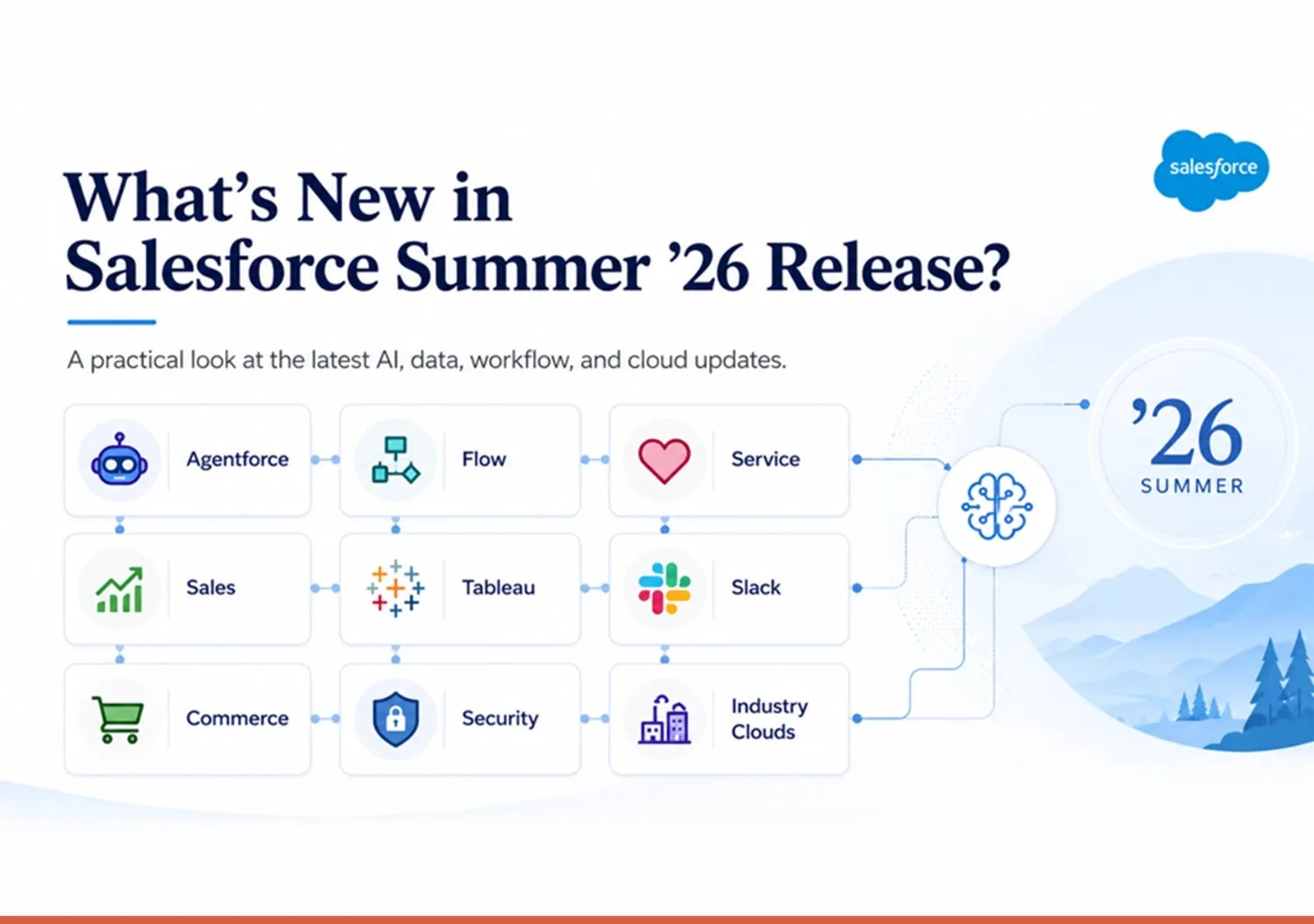
Salesforce Summer ’26 includes updates across Agentforce, Slack, Tableau, Sales, Service, Marketing, Commerce, Field Service, Finance, Compliance, Security, and Industry Clouds.
Salesforce’s release hub says the update delivers AI-driven innovation across every product and industry to help companies become Agentic Enterprises.
1. Multi-Agent Orchestration in Agentforce for More Connected Workflows
One of the biggest updates in Summer ’26 is Multi-Agent Orchestration in Agentforce, which allows multiple AI agents to work together as one coordinated team instead of having one agent handle one isolated task.
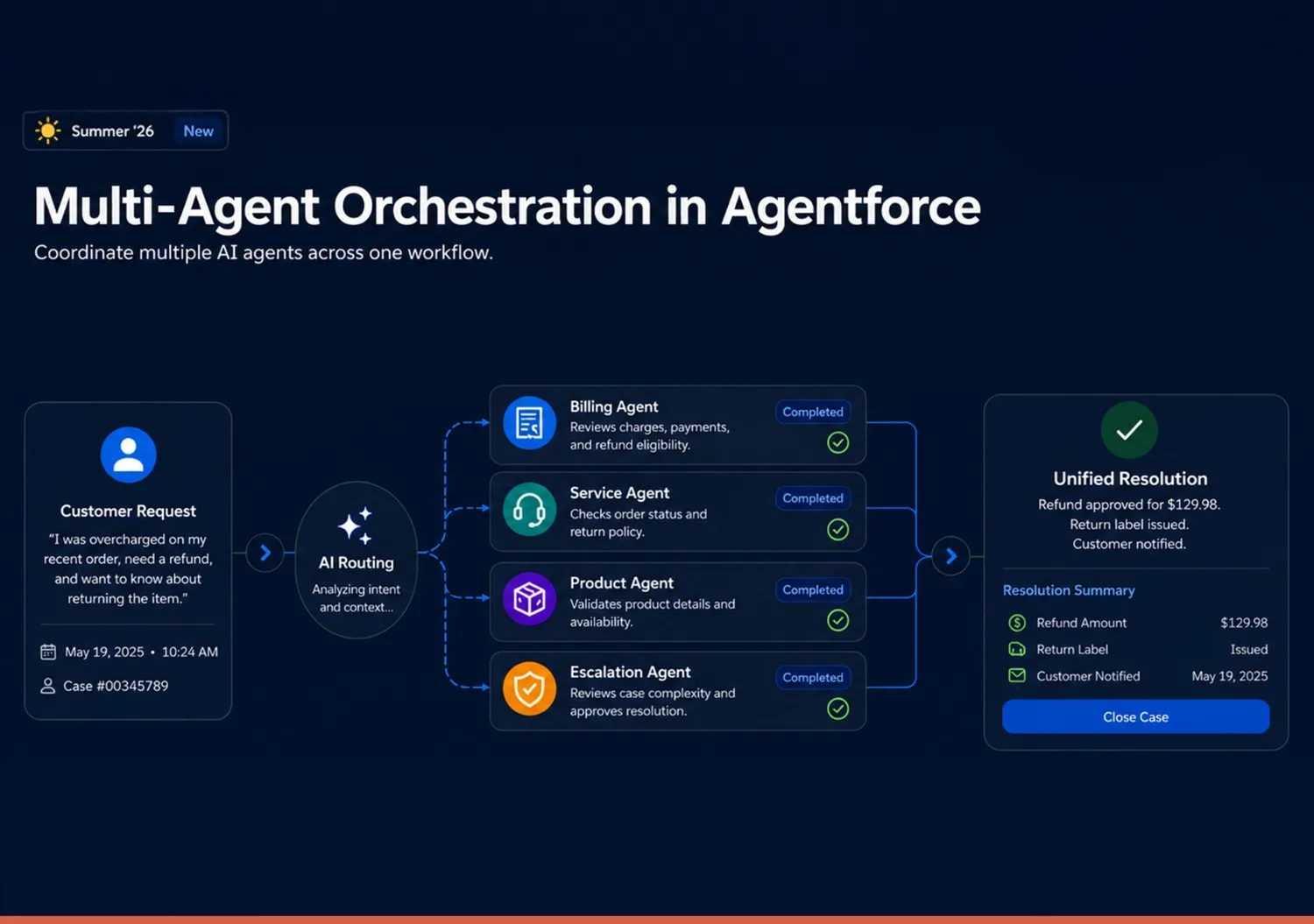
Salesforce says this gives customers one point of contact with shared context across channels, so they do not have to repeat themselves or figure out which agent to reach.
For businesses, this can help in workflows where multiple steps or teams are involved, such as resolving a service issue that requires account history, billing context, entitlement checks, and escalation, or handling a sales inquiry that needs qualification, CRM updates, product guidance, and human handoff.
2. IT Service Domain Pack Enhancements for Faster Employee Support
The IT Service Domain Pack Enhancements include more than 50 specialized AI agents that can work across Slack, Teams, and IT Service Desk. These agents are designed to detect employee intent and resolve support needs across specialist roles.
This is useful for large organizations where IT teams spend too much time on repetitive internal tickets such as access requests, software issues, device problems, password support, or troubleshooting.
Instead of every employee request becoming a manual ticket, AI agents can understand the issue, guide the employee, trigger the right workflow, or route only complex cases to IT.
3. Tableau MCP for More Reliable AI-Driven Insights
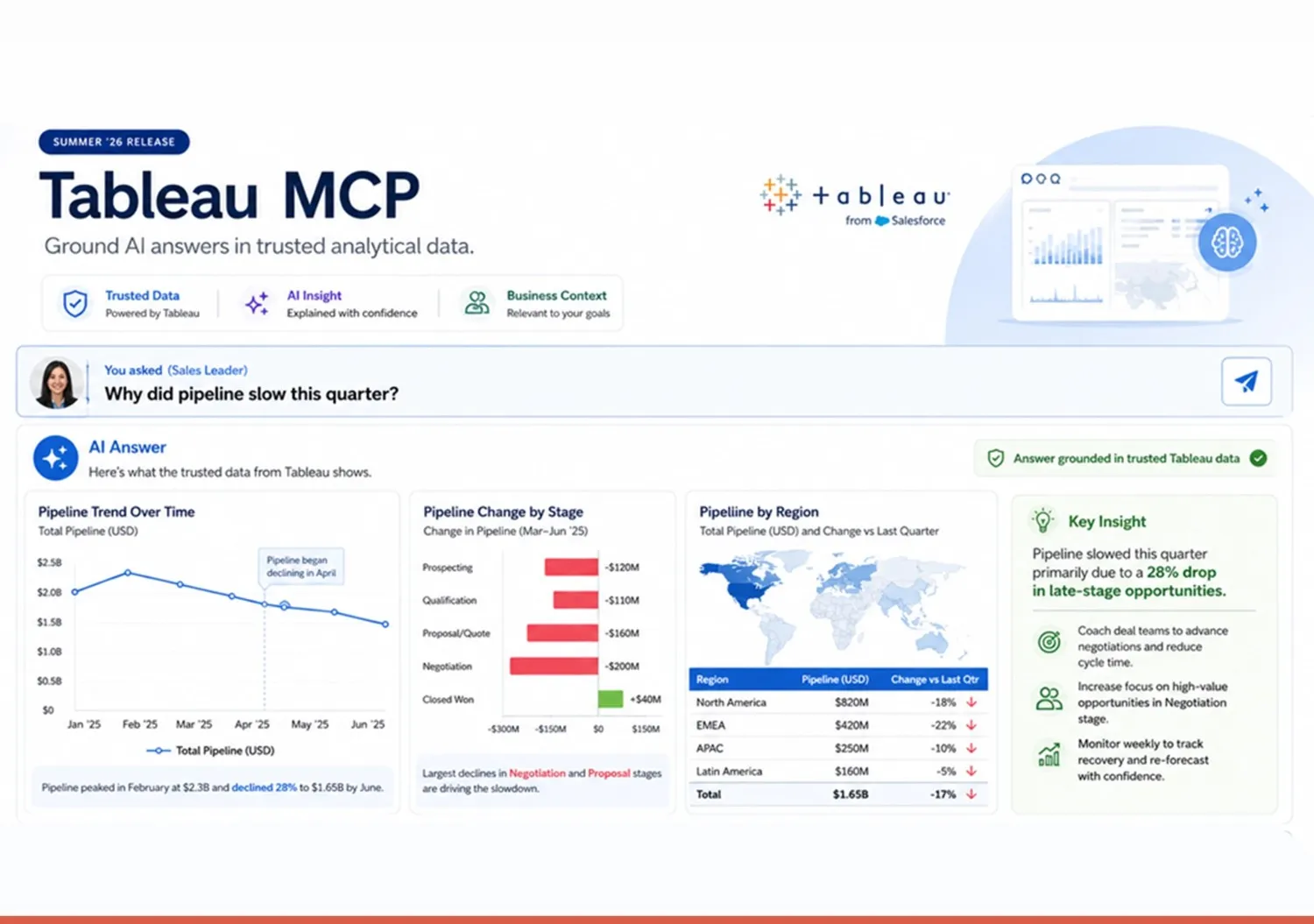
AI agents need trusted business data to give useful answers. Salesforce says many AI models struggle to provide meaningful responses because they are disconnected from a company’s deeper analytical data.
Tableau MCP allows AI agents to query Tableau’s analytics engine directly, so answers are grounded in business context while data stays protected by the Agentforce Trust Layer.
For leaders, this means AI can support better decisions around revenue trends, service delays, customer behavior, or operational performance instead of giving generic responses that lack business context.
4. Agentforce Self-Service for Better Customer Resolution
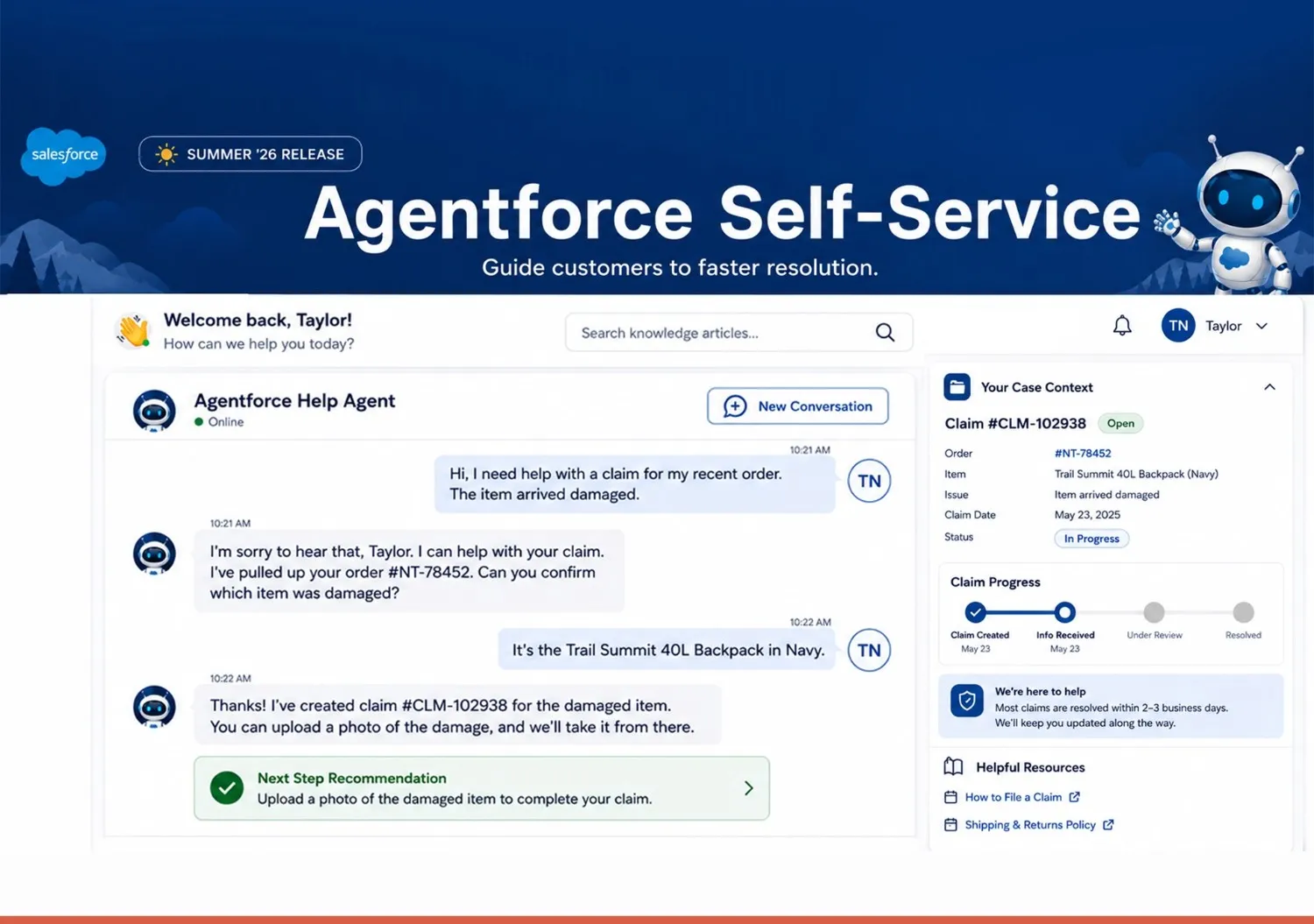
Agentforce Self-Service is designed to make support journeys more direct and less frustrating. Salesforce says customers often face disconnected web pages, dead-end forms, and generic chatbots, so this update introduces a Help Agent, a portal experience, and simplified pricing.
Salesforce also notes that the Help Agent can be set up in six clicks or fewer and can work on the new portal experience or a company website.
For businesses, this can improve customer service by helping people check orders, claims, appointments, or service requests through a more guided experience that understands context, recommends next steps, and escalates when human support is needed.
5. Customer Engagement Agent for Faster Lead Qualification
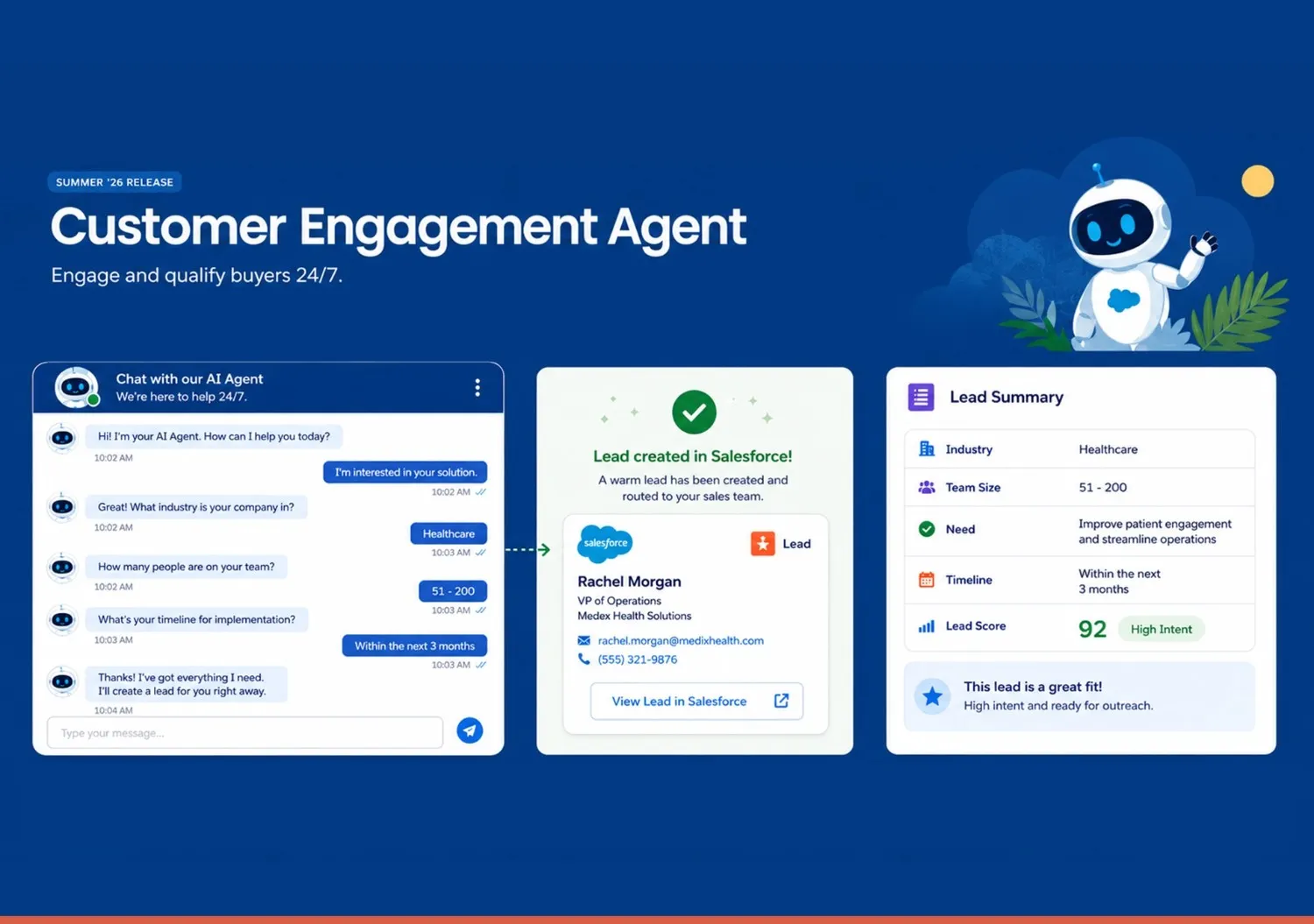
Salesforce says high-quality leads often go cold because busy sales teams cannot respond fast enough. Customer Engagement agent can independently interact with and qualify buyers 24/7 through website and email conversations, then hand warm leads to sales.
For industries like real estate, education, healthcare, financial services, SaaS, and B2B services, this can help teams capture intent, ask qualifying questions, and route better-context leads before interest drops.
6. Momentum for More Complete Revenue Intelligence
Momentum addresses a long-standing CRM problem: important customer conversations often never make it back into Salesforce. Salesforce says Momentum captures and structures customer interactions across calls, emails, and meetings, then writes that data back to Salesforce in real time without changing how reps work.
This can help sales leaders and RevOps teams see what was actually discussed in meetings, which objections came up, what follow-ups were promised, and where a deal may be at risk. The value is not just less manual logging; it is better pipeline visibility and stronger AI readiness because Salesforce has a more complete customer story.
7. Scheduling Console for Smarter Field Service Dispatch
Salesforce says it gives live appointment updates, map-based route visibility, side-by-side schedules, and AI-powered recommendations to surface the closest qualified technicians for emergency jobs.
This is especially useful for field service-heavy industries such as manufacturing, utilities, telecom, healthcare equipment, facility services, and automotive.
When an urgent service request comes in, dispatchers can make faster decisions because technician availability, location, skills, and routes are easier to evaluate in one place.
8. Real-Time Offer Management for More Relevant Personalization
Real-Time Offer Management helps marketing teams deliver personalized, channel-optimized offers based on dynamic customer behavior. The update is designed to solve slow campaign development cycles, lack of personalization at scale, and difficulty managing promotions centrally.
A customer who browses a product category, abandons a cart, or shows repeat interest can receive a more relevant offer based on behavior and buying stage.
9. Storefront Next for Faster Commerce Execution
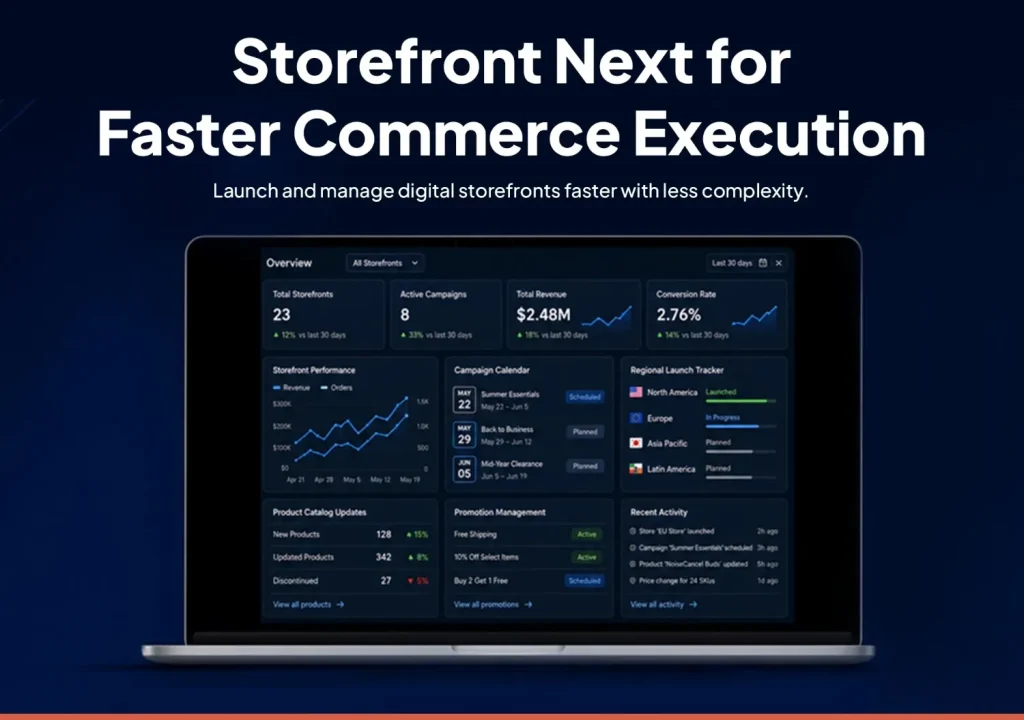
It is designed to give merchants enterprise-grade capabilities without the usual complexity of building and managing large online stores. The goal is to help teams launch and manage digital storefronts faster, adapt to market trends, and reduce dependency on heavy developer resources.
For retail, D2C, B2B commerce, and consumer goods companies, this can make storefront updates, seasonal campaigns, regional launches, and product-line changes easier to execute without long development cycles.
10. Collections with Agentforce for Smarter Revenue Recovery
It uses predictive AI to score invoices based on payment history and account data, then recommends risk-based dunning plans, including outreach cadence, escalation timing, fees, or service holds.
Teams can also define dynamic rules by customer tier, so high-value accounts receive a more measured approach. For CFOs, finance heads, AR teams, and revenue operations leaders, this can help prioritize overdue invoices by risk, customer value, and payment behavior instead of sending the same reminder to every account.
11. Slack First Sales for CRM Work Inside Slack
It brings CRM context and Agentforce Sales into Slack. Salesforce says it gives sellers conversational AI on demand with Slackbot and a proactive layer of agents that can prospect, engage leads, and manage pipeline on behalf of sellers.
This matters because many sales conversations already happen in Slack, but CRM action often happens somewhere else.
With Slack First Sales, sellers can access account context, next-step support, and pipeline assistance without constantly switching tools, reducing friction between sales conversations and Salesforce updates.
12. Process Compliance Navigator for Earlier Risk Detection
Process Compliance Navigator enhancements focus on real-time compliance. Salesforce says the feature connects regulation, policy, risk, and control management, and monitors live workflows to intercept noncompliant actions before they create monetary or reputational violations.
This is especially relevant for financial services, healthcare, insurance, education, public sector, and other regulated industries. Instead of discovering missing approvals, skipped policy steps, or risky actions during an audit, teams can catch issues earlier while the workflow is still in progress.
13. Retail Execution Dashboards for Tableau Next for Stronger Store Performance
Consumer goods companies can now turn fragmented store data into a single source of truth for HQ and field teams. The dashboards unify sales trends with field execution data so teams can spot issues like dipping store compliance or declining visit frequency and act quickly to protect margins, shelf share, and rep productivity.
For consumer goods and retail execution teams, this can help leaders detect regional performance issues earlier and guide field reps before store-level problems affect revenue.
14. Slack for Education for Earlier Student Risk Alerts
Slack for Education connects faculty and staff with student insights and AI-driven alerts in Slack. Salesforce says the goal is to help institutions identify risks early and deliver proactive, coordinated support. This can help student success teams, faculty, admissions, and support staff act faster when a student shows signs of disengagement, missed activity, or support need.
15. Security Mesh for Smarter Risk Visibility
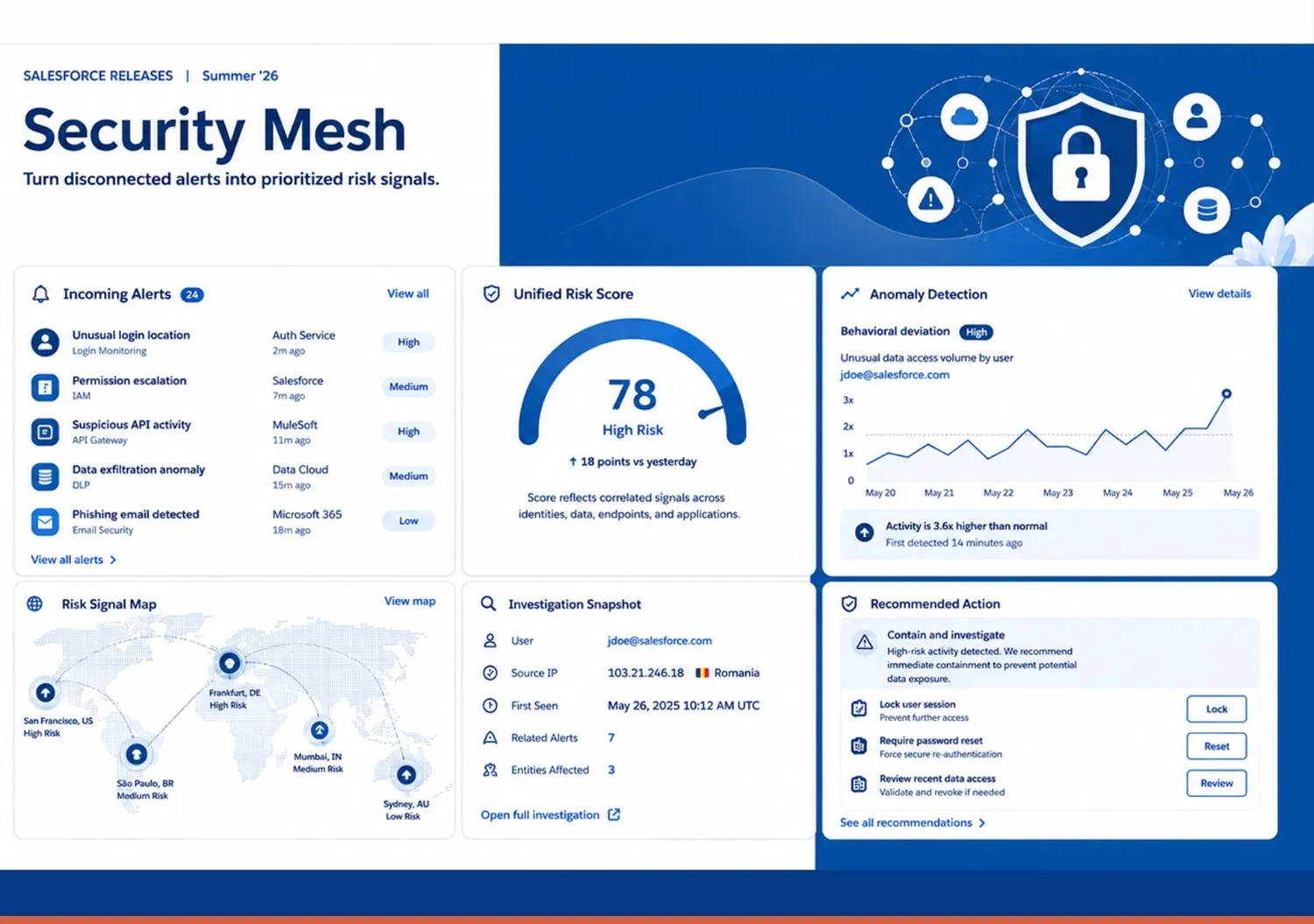
Security Mesh helps unify security data from different sources into a cohesive data fabric. It transforms disconnected alerts into intelligent risk scores so teams can catch anomalies faster and surface threats that may otherwise go undetected.
For CIOs, CISOs, IT security teams, and regulated industries, this matters because alert fatigue is a real problem. Instead of treating every alert as equal, security teams can prioritize threats based on risk context, which becomes more important as AI, data, workflows, and connected systems expand across the business.
16. Industry-Specific Updates for More Practical AI Adoption
Summer ’26 also brings more industry-specific value through updates such as Briefings for healthcare and life sciences teams, Warranty Claims Assistance for manufacturing and service-heavy businesses, Retail Execution Dashboards for consumer goods companies, and Slack for Education for higher education institutions. These updates matter because most businesses do not need generic AI in isolation. They need AI that fits their workflows, such as student support, warranty validation, retail execution, field preparation, compliance monitoring, and service resolution.
What Salesforce-Driven Businesses Should Prioritize Next
A release this broad can easily become overwhelming. The smarter approach is to connect the release to business priorities. Decision makers should use Summer ’26 to ask more practical questions:
- Identify the top 3 manual processes slowing business execution.
- Review which Summer ’26 updates align with those processes.
- Test relevant changes in sandbox before rollout.
- Clean Salesforce data before scaling AI agents.
- Review permissions, approval rules, and governance.
- Train users based on role-specific changes.
- Build an internal release adoption plan with IT, admins, business leaders, and process owners.
Salesforce recommends using release resources such as Trailhead, Release-in-a-Box, webinars, and release notes to explore the latest innovations and prepare for adoption.
Decision makers should use this release to identify where work is still too manual, where customer experience is breaking, where Salesforce data is incomplete, and where AI agents can safely support real business outcomes.

Categories

Solve It with Salesforce. We’ll Show You How.
AI. Apps. Experts. Everything you need to win with Salesforce under one roof.Frequently Asked Questions
What is Salesforce Summer ’26 Release?
Salesforce Summer ’26 is one of Salesforce’s major seasonal releases, bringing new updates across Agentforce, Sales, Service, Slack, Tableau, Marketing, Commerce, Field Service, Finance, Compliance, Security, and Industry Clouds. The release focuses heavily on AI agents, trusted data, automation, and industry-specific workflows.
Why does Salesforce Summer ’26 matter for businesses?
It matters because Salesforce is moving CRM beyond record-keeping. Summer ’26 shows how businesses can use AI agents, automation, and connected data to qualify leads faster, improve service resolution, recover revenue, strengthen compliance, and reduce manual work across operations.
What should businesses do before adopting Summer ’26 updates?
Businesses should review the official release notes, test updates in a sandbox, check data quality, review permissions and governance, prioritize high-impact use cases, train users, and create an internal rollout plan before enabling major changes.
Which Salesforce Summer ’26 updates should decision makers prioritize first?
Decision makers should prioritize updates that solve urgent business bottlenecks. For some companies, that may be Customer Engagement Agent for lead qualification. For others, it may be Agentforce Self-Service, Momentum, Collections with Agentforce, Scheduling Console, Tableau MCP, or industry-specific updates like Warranty Claims Assistance or Slack for Education.

About the author
Editorial TeamThe Editorial Team at 360 Degree Cloud brings together seasoned marketers, Salesforce specialists, and technology writers who are passionate about simplifying complex ideas into meaningful insights. With deep expertise in Salesforce solutions, B2B SaaS, and digital transformation, the team curates thought leadership content, industry trends, and practical guides that help businesses navigate growth with clarity and confidence. Every piece we publish reflects our commitment to delivering value, fostering innovation, and connecting readers with the evolving Salesforce ecosystem.
Recent Blogs
 Salesforce Services
Salesforce Technical Debt 10 Signs Your CRM Needs a Strategic Overhaul (and What to Do About It)
Three years ago, the Salesforce org your team implemented was clean. Logical field names. Documented Flows. A handful of integrations that actually made sense. Today?…
Read More Salesforce Clouds
Salesforce Commerce Cloud Implementation: The 2026 Guide for B2B and B2C Commerce Teams
Commerce has always been competitive. But in 2026, the bar has shifted in ways that are hard to ignore. Whether someone is a consumer checking…
Read More Uncategorized
How Salesforce Agentforce and Google Cloud Integration is Changing Enterprise AI in 2026
Most enterprise AI projects don’t stall because the model is weak. They stall in the plumbing. A sales ops lead wants one agent that can…
Read MoreReady to Make the Most Out of Your Salesforce Instance?
Our Salesforce aces would be happy to help you. Just drop us a line at contact@360degreecloud.com, and we’ll take it from there!
Subscribe to our newsletter
Stay ahead with expert insights, industry trends, and exclusive resources—delivered straight to your inbox.