
SSA 2.0 Explained: The Modern Framework for Salesforce Staffing
06 Jun 2026
Table of Contents
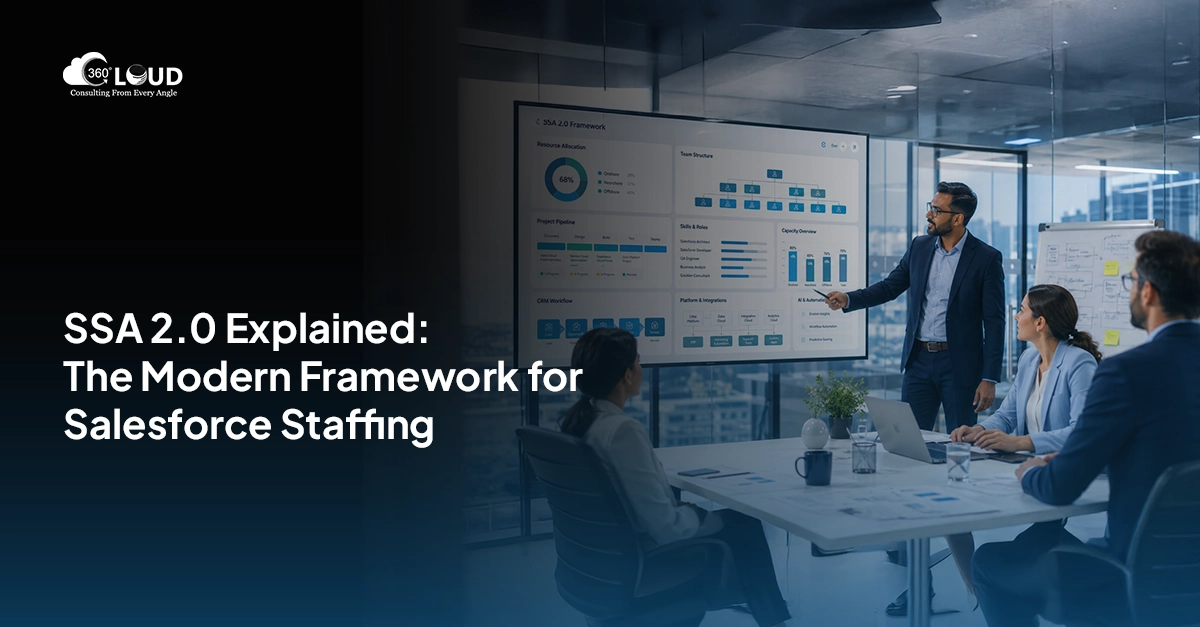
SSA 2.0, or Staff Augmentation 2.0, represents an upgrade to the Salesforce staffing model. It focuses on embedding teams who are accountable for outcomes and prioritize knowledge transfer. The traditional body-shopping method differs because of five key pillars: role specificity, outcome accountability, integration into the client’s culture, built-in knowledge transfer, and AI-assisted matching. This isn’t just a name; it’s about quality and structure. Usually, the differences between SSA 1.0 and SSA 2.0 become clear within about six weeks.
The original staff augmentation framework had a clear and repeatable failure mode. You described a need in broad strokes, a vendor submitted CVs, you picked one based on limited information, they showed up, they billed hours, they left. Sometimes the work was good. Sometimes it wasn’t. And regardless of quality, when the engagement ended, the knowledge sat in the contractor’s head, not in your org, not in your documentation, and certainly not in your internal team’s capability set.
In practice, that model produced a particular kind of dependency: organizations that kept needing to augment because their teams never actually got stronger.
SSA 2.0 fixes that. Not by replacing the fundamental model, contract professionals embedded in client teams remains the core, but by changing what’s built around it.
Table of Contents
Why the Original Staff Augmentation Framework Broke Down
The original model was optimized for one outcome: filling a seat quickly. That’s genuinely useful. Speed matters. But “fill the seat” as the primary success metric produces predictable downstream problems.
No quality filter on role specificity. “We need a Salesforce developer” is not a project brief. It’s a request that gets answered with whoever is available, not whoever is right. A Sales Cloud admin doesn’t solve a Revenue Cloud implementation problem. An Apex developer without LWC experience can’t lead a component library build. If the request is vague, the response will be too.
Hours without accountability for outcomes. Time-and-material billing with no outcome-linked milestones means the contractor’s structural incentive is to bill hours, not deliver results. This isn’t a judgment about character; it’s a structural reality. Incentive alignment matters.
Build a stronger internal team, not just finish another project.

Knowledge disappears at contract end. The most persistent failure of SSA 1.0. The contractor spends weeks building deep expertise in your org’s specific configuration, edge cases, and integration quirks. Then they leave. Nothing has been formally documented. Your internal team is no more capable than when the engagement started.
That’s the thing. The cost of bad augmentation isn’t just the wasted engagement, it’s the cleanup required afterward and the internal skepticism that makes the next engagement harder to approve.
The 5 Pillars of SSA 2.0
Pillar 1: Role Specificity
Every SSA 2.0 engagement starts with a precise role definition. Not “Salesforce developer”, but “Salesforce CPQ consultant with Salesforce Certified CPQ Specialist credentials, hands-on Revenue Cloud pricing engine experience, and familiarity with multi-currency enterprise deployments in orgs with 500+ users.”
Being specific from the start really matters. It makes vetting easier and ensures candidates match better. The onboarding goes smoother too since contractors hit the ground running and are more suited for the job right off the bat.
SSA 2.0 providers maintain structured role profiles, not just CV databases. When a requirement comes in, it’s matched against verified certification data, project type history, and domain experience. That’s why deployment timelines for well-defined requirements run 48–72 hours in a mature SSA 2.0 operation.
Pillar 2: Outcome Accountability
This is the structural change that matters most. In SSA 2.0, engagement milestones are defined at the contract level, not just hours to be delivered, but specific deliverables tied to project phases.
Sprint velocity targets. Deployed features. Code review completion. Documentation milestones. These aren’t informal expectations, they’re agreed deliverables that create a shared standard for what success looks like. When accountability is structural rather than assumed, quality improves. Both parties know what done means.
Pillar 3: Embedded Team Culture
The SSA 2.0 contractor isn’t a vendor sitting adjacent to your process. They join your Jira board, attend your sprint ceremonies, follow your Confluence documentation standards, communicate through your Slack channels. They function like a team member, because that’s what effective augmentation actually requires.
Worth saying: this places demands on the client, not just the contractor. An augmented professional can’t integrate into a team that doesn’t have structure. Sprint cadences, defined ownership, clear escalation paths – these are client responsibilities that make the integration work. The contractor’s ability to embed depends on there being something to embed into.
Define the role, set the milestones, keep the knowledge. Let’s scope it.

Pillar 4: Knowledge Transfer Protocol
Documentation is mandatory. In strategic staff augmentation 2.0, passing on knowledge is a required deliverable, not an afterthought in the project’s last week when contractors are more focused on getting ready for their new job.
In practice, this means: code documentation standards enforced throughout the engagement, not just at the end. Architecture decision records maintained in shared documentation systems. Handover sessions scheduled at 60-day intervals, not only at contract completion. Internal team members paired with augmented professionals on complex builds so the knowledge transfer is continuous, not a one-time briefing.
When this is done correctly, the client team is meaningfully stronger when the engagement ends than when it started. That’s the outcome SSA 2.0 Salesforce staffing framework is designed to produce.
Pillar 5: AI-Assisted Matching
Nowadays, modern staffing services use detailed skill lists, confirmed certifications, and past project types to find the best fits. They look for those whose real experience matches clients’ needs precisely, rather than just having the right buzzwords and being available.
At 360 Degree Cloud, the professional pool spans 800+ certified Salesforce experts across every cloud and specialization. Matching runs against that structured profile data, which is why deployment timelines for well-defined requirements are consistently in the 48–72 hour range, not weeks.
SSA 1.0 vs SSA 2.0 – Named Comparison
| Dimension | SSA 1.0 | SSA 2.0 |
| Role definition | Generic (job title only) | Specific (certifications, project type, domain experience) |
| Primary success metric | Hours billed | Deliverables completed |
| Team integration model | Adjacent (parallel track) | Embedded (inside sprint structure) |
| Knowledge transfer | Ad-hoc or absent | Scheduled contractual deliverable |
| Candidate sourcing | CV database keyword search | Structured profile matching with verified credentials |
| Accountability structure | Informal | Contractual milestones |
| Post-engagement outcome | Team dependency maintained | Team capability improved |
Who SSA 2.0 Is Built For
Strategic staff augmentation 2.0 is the right framework for organizations that:
- Have had a previous augmentation experience that didn’t meet expectations and want a structural reason it will be different this time
- Are starting a significant Salesforce project where architectural decisions have long-term consequences
- Operate in a regulated industry – healthcare, fintech, insurance, where vetting standards are non-negotiable
- Want to build internal Salesforce capability, not just complete a single project
- Are evaluating providers for a multi-month engagement where consistency and integration quality matter
In practice, most mid-market and enterprise organizations fall into at least one of these categories. SSA 1.0 is adequate for simple, low-stakes tasks. For anything complex, the structural difference determines the quality difference.
What SSA 2.0 Looks Like at 360 Degree Cloud
360 Degree Cloud operates exclusively in the Salesforce ecosystem. 14 years. 3,000+ projects. 800+ certified professionals across every Salesforce cloud. 1,200+ certifications.
Every staff augmentation engagement starts with a detailed brief, not a job title. The role is mapped to specific certifications, verified project experience, and domain requirements. The match comes from an active professional pool maintained by an organization that also delivers managed services and full implementation work, which means these professionals are Salesforce practitioners who happen to be placed in client environments temporarily, not transient contractors with thin engagement histories.
Knowledge transfer is standard across every engagement. Documentation requirements are defined at the start. Delivery milestones are built into the contract. And post-engagement, the client team has documentation, trained internal resources, and an ongoing relationship with a partner that has deep knowledge of their org.
Worth saying: that last part matters more than it gets credit for. A partner who understands your org after the engagement ends is more useful than one who disappears at contract close.
Categories

Solve It with Salesforce. We’ll Show You How.
AI. Apps. Experts. Everything you need to win with Salesforce under one roof.Frequently Asked Questions
What is SSA 2.0?
SSA 2.0, or Salesforce Staff Augmentation 2.0, describes an advanced staff augmentation framework. It focuses on accountable outcomes and knowledge transfer, not just sending bodies to do tasks. This framework has five key parts: role specificity, outcome accountability, embedding team culture, built-in knowledge sharing, and AI for better matches. It's not a product but a high standard for how they structure their work.
How is SSA 2.0 different from traditional staff augmentation?
The main differences are accountability structure and how expertise is passed on. For tradition methods, success is measured by billable hours, not quality work. With SSA 2.0, they set milestones at the start. In the old setup, contractors leave behind little info when their time ends. But SSA 2.0 requires thorough docs and proper knowledge sharing throughout the project; it's not just an add-on at the end.
Does SSA 2.0 cost more than traditional augmentation?
SSA 2.0 Salesforce staffing can cost a bit more hourly because of extra governance and documentation. Yet, it leads to better projects and way lower fix-up costs afterwards. So, the total price ends up being lower, even if rates seem similar.
How do I evaluate whether a provider actually operates on SSA 2.0 principles?
To figure out if it's SSA 1.0 or SSA 2.0, ask these: How do you measure success: by hours worked or by what we deliver? When do they start sharing knowledge through documentation? And how well do contractors fit into the client's sprint cycles? The replies should give you a good clue.
Is SSA 2.0 only relevant for large enterprises?
No. Mid-market organisations often benefit more from Salesforce staffing best practices, specifically from the knowledge transfer component, because their internal teams are smaller; they can't afford to lose the expertise when a contractor leaves. The scale of the organisation doesn't determine the value of the framework; the complexity and importance of the work does.

About the author
Editorial TeamThe Editorial Team at 360 Degree Cloud brings together seasoned marketers, Salesforce specialists, and technology writers who are passionate about simplifying complex ideas into meaningful insights. With deep expertise in Salesforce solutions, B2B SaaS, and digital transformation, the team curates thought leadership content, industry trends, and practical guides that help businesses navigate growth with clarity and confidence. Every piece we publish reflects our commitment to delivering value, fostering innovation, and connecting readers with the evolving Salesforce ecosystem.
Recent Blogs
 Uncategorized
How Salesforce Agentforce and Google Cloud Integration is Changing Enterprise AI in 2026
Most enterprise AI projects don’t stall because the model is weak. They stall in the plumbing. A sales ops lead wants one agent that can…
Read More Salesforce Clouds
Salesforce Marketing Cloud Engagement Implementation: The 2026 Guide to Omnichannel Marketing That Converts
Most marketing teams aren’t failing because they lack content. They’re failing because the right message is reaching the wrong person at the wrong time –…
Read More Uncategorized
Dreamforce 2026 Wrapped: Here’s What to Take Back to Your Team
Fifty thousand people packed into Moscone Center this week. Another 120,000+ tuned in online. And for three days straight, Salesforce made one thing very clear: the interface…
Read MoreReady to Make the Most Out of Your Salesforce Instance?
Our Salesforce aces would be happy to help you. Just drop us a line at contact@360degreecloud.com, and we’ll take it from there!
Subscribe to our newsletter
Stay ahead with expert insights, industry trends, and exclusive resources—delivered straight to your inbox.