
Table of Contents
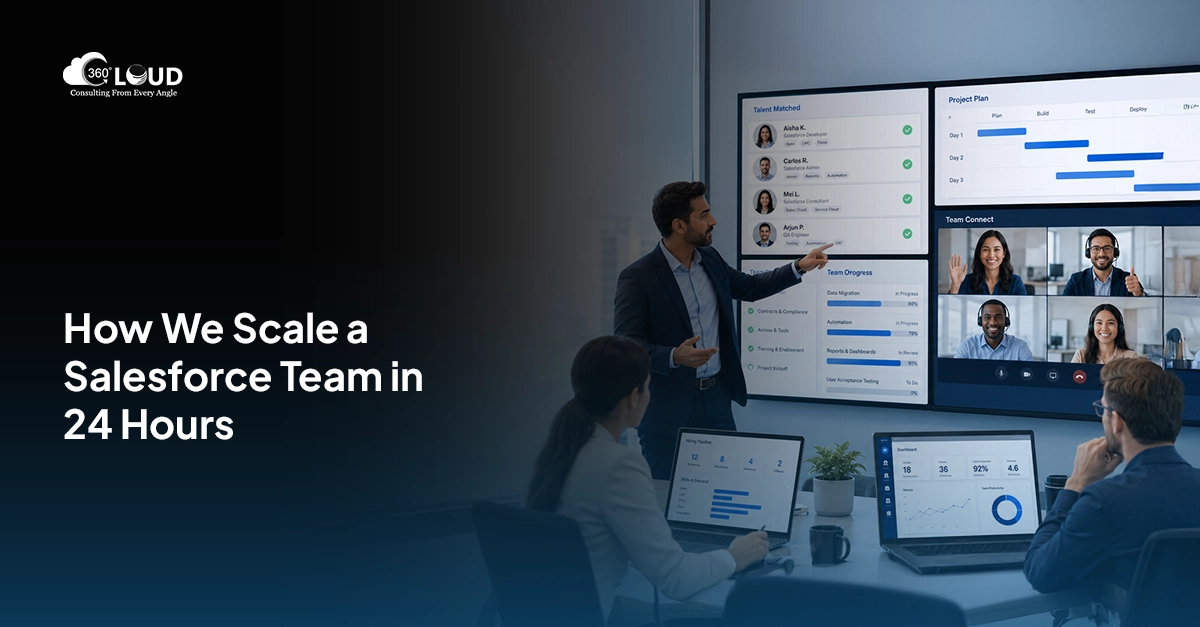
360 Degree Cloud deploys qualified Salesforce professionals within 24 hours for well-defined requirements. The mechanism is a pre-vetted bench: every professional in the pool has completed technical assessment, has verified project history, and is available for placement – not sourced on demand when a brief comes in. Fast deployment is not a claim. It’s the output of a maintained bench.
Most organizations have been told “we can deploy quickly” by a rapid Salesforce staffing partner and then waited three weeks for a qualified candidate. That experience shapes skepticism, and the skepticism is reasonable, because “quick deployment” often means starting a search when the brief lands.
That’s not how this works at 360 Degree Cloud. This article explains the actual mechanism, what makes 24-hour deployment real for the requirements it works for, and what determines whether it works for yours.
Table of Contents
Why 24-Hour Deployment Is Rare
Standard Salesforce developer hiring, full-time or through a staffing agency, has several unavoidable delays:
Sourcing: Finding candidates takes time. Job boards, network outreach, LinkedIn searches – the average time-to-fill for a Salesforce role is 60–90 days through traditional hiring channels. Even staffing agencies often start a sourcing process when a brief arrives rather than drawing from pre-verified inventory.
Vetting: Even if candidates are identified quickly, verifying certifications, checking project history, and running technical assessments takes days to weeks.
Scheduling: Getting candidates in front of the client, managing back-and-forth on availability and interview scheduling, handling feedback, the logistics alone often add two weeks to an otherwise expedited process.
Availability: A candidate who exists is different from a candidate who is available. Active professionals are often mid-engagement elsewhere.
The cumulative effect is that “fast” sourcing usually means 1–3 weeks, not 48–72 hours. The only way to genuinely compress this timeline is to remove the sourcing and initial vetting steps, which requires a maintained bench of pre-vetted professionals who are available.
That’s the structure 360 Degree Cloud runs.
The 24-Hour Mechanism: How the Bench Works
Pre-Vetted, Not Sourced on Demand
Every professional in the 360 Degree Cloud augmentation bench has already cleared the vetting process before any specific client brief arrives:
- Certification verification: Salesforce credentials confirmed through the Trailhead Verification portal. Not self-reported.
- Technical assessment: Cloud-specific assessments covering the depth of the role – Apex coding exercises, LWC component builds, CPQ configuration scenarios, architecture design reviews depending on specialization.
- Project history review: Verified delivery history with real project context, not just titles and dates, but what was built, the org complexity, the integration architecture involved.
- Availability confirmation: Status tracked and updated regularly. Professionals approaching the end of current engagements are flagged as available in advance.
When a client brief arrives, the match happens against a vetted pool, not a sourcing exercise. The search step is replaced with a selection step.
Your project start date can’t move. Your staffing timeline can.

Role Breadth Across the Bench
The bench spans every Salesforce cloud and role type:
- Administrators: Multi-cloud admins, org optimization specialists, release management leads
- Developers: Apex/LWC developers, integration engineers, full-stack Salesforce developers
- Architects: Solution Architects, Technical Architects, Enterprise Architects, Salesforce CTAs
- Specialists: CPQ/Revenue Cloud consultants, Marketing Cloud developers, Health Cloud engineers, Financial Services Cloud specialists, NPSP/NPC Nonprofit consultants, Experience Cloud developers, Field Service Lightning specialists
- Functional Roles: Business Analysts, QA Engineers, Project Managers with Salesforce-specific experience
This breadth means that a brief for a CPQ developer hits a pool of pre-vetted CPQ specialists, not a pool of generalists with questionable CPQ exposure.
How a Specific Request Flows
Here’s what happens when a qualified brief arrives:
Step 1: Brief received. Requirements captured: cloud specialization, certification requirements, org complexity level, engagement duration, timeline, collaboration structure (sync vs async, US timezone overlap needed).
Step 2: Matching against the bench. Candidates identified who meet the technical requirements, certification level, and availability window. Typically 2–3 profiles prepared for client review, with full verification data included.
Step 3: Client reviews profiles. Introductory call scheduled with top candidate(s). Technical discussion of the specific project requirements.
Step 4: Candidate selected, commercial terms finalized, engagement structure confirmed. Access provisioning begins.
Step 5: Org access provisioned. Project brief reviewed. Introductory call with client’s internal technical lead. Codebase walkthrough initiated.
Step 6: First ticket or sprint deliverable delivered.
That’s the standard flow for a well-defined requirement. The constraint is the brief quality – vague requirements produce slower matching. Clear requirements produce fast matches.
What “Well-Defined Requirements” Means
The 24-hour timeline applies when the brief includes:
- Role type: On-demand Salesforce talent- Developers, Architect, Admin, Specialist, BA, the category of work
- Cloud specialization: Sales Cloud, Service Cloud, CPQ, Marketing Cloud, Health Cloud, etc., the specific platform context
- Certification requirement: If there are specific certifications needed, which ones
- Project context: What’s being built – implementation, integration, customization, optimization
- Engagement duration: Short sprint, medium project, long-term extension – this affects bench availability matching
- Timeline: When engagement start is needed
- Collaboration structure: US time zone overlap required or not; sync-heavy or async-friendly
A brief that says “we need an on-demand Salesforce talent” takes longer than a brief that says “we need a mid-level Apex/LWC developer with CPQ exposure for a 12-week Revenue Cloud build starting in two weeks, India-based delivery is acceptable, we need 4 hours of US East overlap.” The second brief matches against the bench in hours.
One certified professional can unblock months of stalled work.

What Happens After Deployment
Fast deployment is one variable. What happens after the professional is on your project determines whether fast deployment was worth anything.
Day 1 onboarding protocol: Org access. Project brief. Named internal technical contact. Codebase or org walkthrough in the first 48 hours. First deliverable in the first week.
Knowledge transfer from Day 1: Documentation expectations aren’t a post-project conversation. They’re embedded in sprint delivery from Week 1. The professional produces documentation artifacts as part of delivery, not as an optional add-on.
Delivery governance: Named account lead at 360 Degree Cloud monitoring the engagement. Regular check-ins. Clear escalation path if issues arise.
Replacement capability: If the professional isn’t the right fit after initial delivery, replacement from the bench happens without starting a new sourcing cycle. The bench is available before the engagement starts and during it.
Industries Where 24-Hour Deployment Is Most Commonly Used
Healthcare / Health Cloud: Project timelines are often driven by regulatory deadlines – HIPAA implementations, care coordination system upgrades, interoperability requirements. External capacity needs are non-negotiable because the deadline isn’t.
Fintech / Financial Services Cloud: New product launches, regulatory reporting configurations, customer data model migrations. Finance organizations don’t tolerate delivery delays caused by resource sourcing.
SaaS / Revenue Cloud: CPQ implementations, subscription management configurations, Revenue Cloud upgrades. SaaS orgs often have fast product cycles that create recurring Salesforce capacity needs.
Nonprofit / NPSP-NPC Migrations: NPSP to NPC migration deadlines are real, and internal capacity is almost never sufficient. Specialist augmentation for migration work is the standard approach.
The Brief Is the Bottleneck. Not the Bench.
Most teams that have been burned by slow staffing assume the delay is unavoidable. It’s not. The delay is structural, a sourcing step that starts when your brief lands instead of before it. That’s not how you scale a Salesforce team fast. You scale fast when the vetting is already done, the bench is maintained, and the match happens against a verified pool, not a job board.
Remove the sourcing step, and the timeline compresses to something that actually matches how projects move.
The Salesforce team scale process at 360 Degree Cloud doesn’t begin when you submit a brief. It begins months earlier, with technical assessments, certification verification, and delivery history reviews completed before any client engagement is in play. By the time your requirement arrives, the selection step is what’s left. Not the search.
On-demand Salesforce talent sounds like a promise most organizations have heard before, and been let down by. The difference here is structural. Every professional in the bench is pre-vetted, availability-tracked, and ready for placement. That’s what makes rapid Salesforce staffing real for well-defined requirements, and a slower process for vague ones. Specificity in the brief is the only variable you control.
360 Degree Cloud has placed certified Salesforce professionals across 3,000+ engagements, admins, Apex developers, architects, CPQ specialists, Health Cloud engineers, Marketing Cloud developers. Every cloud. Every specialization. Every engagement length.
If your project has a start date that can’t move, the conversation takes less time than another week of waiting.

Categories

Solve It with Salesforce. We’ll Show You How.
AI. Apps. Experts. Everything you need to win with Salesforce under one roof.Frequently Asked Questions
Does 24-hour deployment work for Architect-level roles?
For certain Architect profiles, particularly those with common specializations (Solution Architect, Technical Architect with multi-cloud experience), yes. CTA-level roles and highly specialized enterprise architect profiles may take closer to 5-7 business days depending on bench availability at the time of the brief. The bench has Architect depth; availability at any given moment varies. Be specific in the brief about the architecture scope required.
What if the project requirement changes after the professional is placed?
Scope changes are common. If the project evolves beyond the initial brief, the options are: scope adjustment with the current professional if the new requirements are within their profile, supplemental augmentation with an additional specialist for the expanded scope, or a formal engagement scope review. Most scope changes can be accommodated without restarting the process.
How does the client's Day 1 access provisioning affect the timeline?
Access provisioning is the client's responsibility. A client who takes five days to provision sandbox and org access after a professional is confirmed shifts the effective start date regardless of deployment speed. For teams that have run augmentation engagements before, Day 1 access is usually handled in parallel with the selection process.
What makes the brief quality matter so much for deployment speed?
The bench contains professionals across many specializations. The matching process is fast when the requirement is specific, because it's matching against a defined profile. A vague requirement means the match can't be completed with confidence, so we clarify before committing to a candidate. That clarification step is the time cost of a vague brief. Specificity eliminates it.

About the author
Editorial TeamThe Editorial Team at 360 Degree Cloud brings together seasoned marketers, Salesforce specialists, and technology writers who are passionate about simplifying complex ideas into meaningful insights. With deep expertise in Salesforce solutions, B2B SaaS, and digital transformation, the team curates thought leadership content, industry trends, and practical guides that help businesses navigate growth with clarity and confidence. Every piece we publish reflects our commitment to delivering value, fostering innovation, and connecting readers with the evolving Salesforce ecosystem.
Recent Blogs
 Uncategorized
How Salesforce Agentforce and Google Cloud Integration is Changing Enterprise AI in 2026
Most enterprise AI projects don’t stall because the model is weak. They stall in the plumbing. A sales ops lead wants one agent that can…
Read More Salesforce Clouds
Salesforce Marketing Cloud Engagement Implementation: The 2026 Guide to Omnichannel Marketing That Converts
Most marketing teams aren’t failing because they lack content. They’re failing because the right message is reaching the wrong person at the wrong time –…
Read More Uncategorized
Dreamforce 2026 Wrapped: Here’s What to Take Back to Your Team
Fifty thousand people packed into Moscone Center this week. Another 120,000+ tuned in online. And for three days straight, Salesforce made one thing very clear: the interface…
Read MoreReady to Make the Most Out of Your Salesforce Instance?
Our Salesforce aces would be happy to help you. Just drop us a line at contact@360degreecloud.com, and we’ll take it from there!
Subscribe to our newsletter
Stay ahead with expert insights, industry trends, and exclusive resources—delivered straight to your inbox.