
How to Transition from Staff Augmentation to a Full-Time Hire
29 Jul 2026
Table of Contents
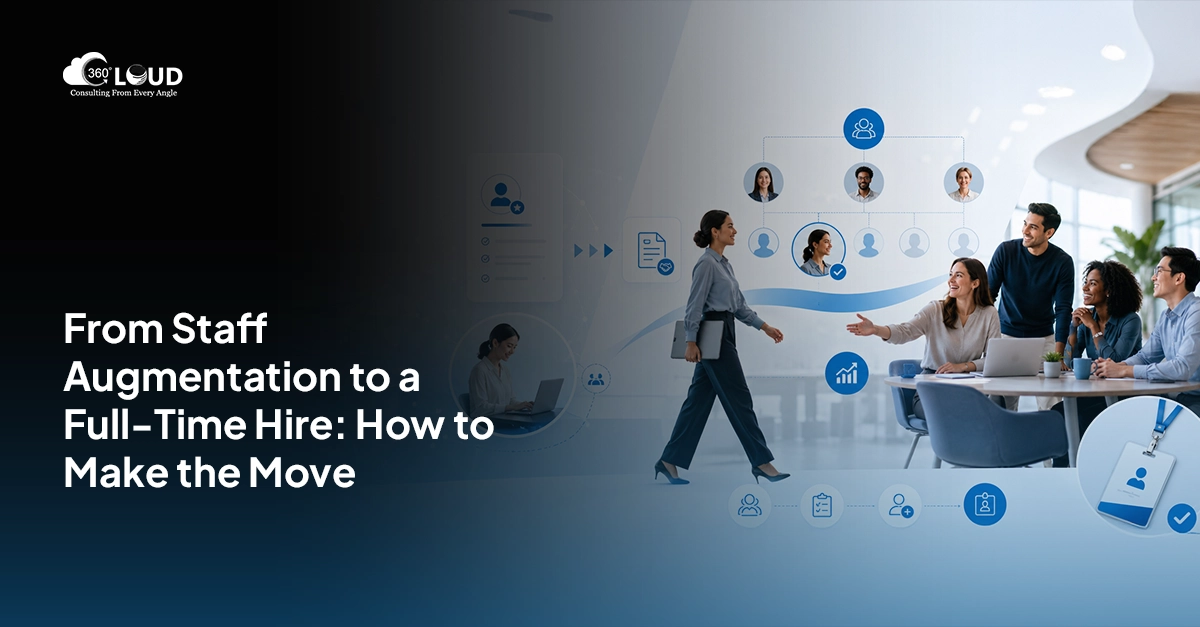
Converting a contract Salesforce developer to full-time is possible, commercially structured (not free), and often the right decision when the Salesforce need is clearly permanent and the contractor has demonstrated both technical quality and cultural fit. The conversion fee is typically 10-20% of first-year salary, negotiated with the staffing partner. The transition itself, done well, avoids a hiring process entirely and skips the 60-90 day ramp-to-productivity that a new FTE hire would require.
There’s a good reason to convert: you already know this person works. You’ve seen their code, watched them navigate your org, watched how they communicate under pressure. That information is worth something. A new FTE hire gives you a CV and interview performance as the basis for a $145,000+ commitment. A conversion gives you 3-6 months of actual delivery history.
The conversion process has commercial steps, practical steps, and timing considerations. Here’s how to navigate all three.
Get the conversion fee structured right, before it becomes a negotiation problem.

Table of Contents
When Conversion Makes Sense
Not every good contractor should be converted to full-time. Before initiating a conversion conversation, be clear on why you’re doing it.
Strong indicators for conversion:
- The Salesforce need is genuinely permanent. Not a project that ends in three months, but an ongoing function that requires 40 hours/week of Salesforce expertise indefinitely.
- The contractor has demonstrated not just technical quality but org ownership behavior – proactively flagging issues, suggesting improvements, building for maintainability rather than just delivery.
- The contractor is already functionally integrated into your team’s culture, communication patterns, and processes. The “new hire” integration cost is already paid.
- The contractor has expressed openness to a full-time role. Worth a direct conversation before investing in the formal process.
Indicators that conversion isn’t the right path:
- The need is project-based with a natural end date. Converting a contractor for a project that ends in 4 months creates the same exit problem that FTE hiring does.
- The contractor’s expertise is narrow – highly specialized in CPQ or Marketing Cloud but your ongoing need is broader. A general Salesforce developer covering day-to-day work is a different profile than the CPQ specialist you’ve been using.
- The contractor has indicated they prefer contract work. Many experienced Salesforce contractors choose contract work deliberately for the flexibility and rate premium. Pushing conversion when someone prefers contracting creates a relationship that doesn’t stick.
The Commercial Structure of Conversion
Conversion Fee
Most staffing partners charge a conversion fee when a client converts a contractor to full-time employment. This is standard industry practice and should be expected, not treated as a surprise.
Typical conversion fee range: 10-20% of the first-year base salary.
For a Salesforce developer at $145,000 base salary, that’s $14,500-$29,000.
This compares favorably to the alternative:
- External recruiter fee for a Salesforce developer: 20-25% of first-year salary ($29,000-$36,250)
- Internal recruiting cost for a senior hire: $8,000-$15,000
- Ramp-to-productivity for a new hire who doesn’t know your org: $15,000-$25,000
- 60-90 day delay before a new hire starts
The conversion fee is almost always less expensive than recruiting from scratch – and you get someone who already knows your org, your team, and your processes.
Negotiating the Conversion Fee
The conversion fee is negotiable, and you have more leverage than you might think:
Negotiate at the start of the engagement, not the end. If conversion is a possibility you want to preserve, include a conversion fee provision in the initial engagement agreement. Staffing partners expect this request and will usually agree to a lower fee (10-12%) if negotiated upfront rather than 15-20% if raised after the fact.
Length of engagement matters. If the contractor has been on engagement for 12 months, some partners will reduce the conversion fee recognizing that the engagement itself demonstrated value to both parties. Ask whether tenure affects the fee.
Negotiate as a business decision, not a complaint. The conversion fee pays for the partner’s recruitment, vetting, and placement investment. A professional request to negotiate the fee is reasonable; treating it as unfair creates friction in a relationship you may want to maintain for future augmentation needs.
Not sure if conversion or a fresh hire is the right call? Get a clear read.

The Transition Process
Step 1: Confirm the Contractor’s Interest (Privately First)
Before initiating any formal process, have a direct conversation with the contractor. Don’t go to the staffing partner first – if the contractor isn’t interested, the formal process creates awkwardness for everyone.
Ask directly: “We’ve been happy with your work, and we’re at a stage where we’re thinking about permanent Salesforce capacity. Is that a conversation you’d be interested in having?”
Their response tells you whether to proceed. If they’re interested, continue. If they prefer contract work, thank them, continue the engagement, and recruit externally.
Step 2: Align Internally on the Role and Comp
Before approaching the staffing partner, be clear internally on:
- Job title and seniority level – what is the role being created?
- Base salary range – what’s budgeted? This determines the conversion fee.
- Scope of responsibility – is the role what the contractor has been doing, or is it a broader or narrower scope?
- Start date expectation – how quickly does the conversion need to complete?
Having these details ready makes the formal conversation with the staffing partner fast and clean.
Step 3: Notify and Negotiate with the Staffing Partner
Contact your account manager at the staffing partner with a specific request: “We’d like to explore converting [contractor name] to a full-time hire. What does the conversion fee look like?”
Be prepared to share the target base salary range – the fee is calculated against it. Get the fee in writing before proceeding.
If you negotiated a conversion provision in your original engagement agreement, reference it. The fee should be applied as specified.
Step 4: Structure the Offer
The offer to the contractor should include everything a new-hire offer includes:
- Base salary
- Benefits package
- Start date
- Title and reporting structure
- Any equity or bonus structure
Don’t assume the contractor will accept any offer. They’re transitioning from contractor rates (which include a gross rate premium to cover their self-employment costs and the lack of benefits) to an employment package. The math needs to work for them. A Salesforce developer at $85/hr (US) earns approximately $176,800 annualized – they’re not going to accept a $90,000 base salary offer. The offer needs to be competitive with market base salary for the role.
Step 5: Knowledge Transfer and Continuity Planning
Determine the transition date and plan continuity:
- Does the engagement contract run to a natural end point before the employment start date, or is there an overlap period?
- If the contractor was placed through the partner, is there a contractual notice period before the engagement can end?
- Is there any documentation or handover that should happen before the status transition (from contractor to employee)?
Most transitions happen cleanly when the timing is aligned – engagement wraps, employment starts. The awkward scenario is when the employment offer is accepted before the engagement notice period is completed. Coordinate with the staffing partner on the transition timeline.
The Alternative: When Not to Convert but to Replace
Sometimes the better decision is not to convert the current contractor but to end the engagement and recruit a permanent hire independently.
When this makes more sense:
- The contractor’s expertise is right for the project but not right for the ongoing role
- Conversion fee negotiations aren’t reaching an acceptable number
- The contractor’s preference for contract work means conversion creates a retention risk anyway
- The ongoing role requires a different profile (broader scope, more seniority, specific FTE-only capability)
In this case, start the FTE recruiting process 60-90 days before the contractor engagement ends, run them in parallel, and plan a knowledge transfer sprint with the contractor as the final deliverable before exit.
Categories

Solve It with Salesforce. We’ll Show You How.
AI. Apps. Experts. Everything you need to win with Salesforce under one roof.Frequently Asked Questions
Can I hire the contractor directly without going through the staffing partner?
The engagement agreement between your company and the staffing partner almost certainly includes a non-hire clause preventing direct employment of placed contractors for a defined period (typically 12-24 months) without paying the conversion fee. Bypassing this clause creates legal and relationship risk. Pay the conversion fee – it's almost always less expensive than the litigation or relationship damage from circumventing it.
What's the right salary for a converting Salesforce contractor?
Market rates for Salesforce FTE roles in 2026 (Glassdoor, Salary.com): mid-level developer $120,000-$155,000; senior developer $145,000-$185,000; CPQ specialist $130,000-$175,000. The conversion offer should be within market range. Starting below market because "they were happy at their contractor rate" doesn't work – the contractor rate was gross, not net, and included their self-employment overhead.
How long does the conversion process take?
With an engaged contractor and an aligned staffing partner, it takes 2-4 weeks from initial conversation to signed offer. Background check and onboarding paperwork add 1-2 weeks to employment start. The total elapsed time from "We want to convert" to "They're an employee" is typically 4-6 weeks – substantially faster than recruiting and hiring a net-new candidate.
Does converting affect my relationship with the staffing partner for future engagements?
It shouldn't, if handled professionally. Conversions are an expected part of the business for qualified staffing partners. Paying the conversion fee and providing reasonable notice maintains the relationship. Partners who react poorly to professionally handled conversions are not partners you want for your next engagement.
What if the conversion offer is rejected?
Have a plan. If the contractor declines the offer, you still have an engagement running - and now there's potential awkwardness about the ongoing relationship. The cleanest path: accept their decision gracefully, discuss whether the engagement continues on its current terms, and begin parallel external recruiting if the permanent role is still needed. Most contractors who decline conversion are professional about it.

About the author
Editorial TeamThe Editorial Team at 360 Degree Cloud brings together seasoned marketers, Salesforce specialists, and technology writers who are passionate about simplifying complex ideas into meaningful insights. With deep expertise in Salesforce solutions, B2B SaaS, and digital transformation, the team curates thought leadership content, industry trends, and practical guides that help businesses navigate growth with clarity and confidence. Every piece we publish reflects our commitment to delivering value, fostering innovation, and connecting readers with the evolving Salesforce ecosystem.
Recent Blogs
 Uncategorized
How Salesforce Agentforce and Google Cloud Integration is Changing Enterprise AI in 2026
Most enterprise AI projects don’t stall because the model is weak. They stall in the plumbing. A sales ops lead wants one agent that can…
Read More Salesforce Clouds
Salesforce Marketing Cloud Engagement Implementation: The 2026 Guide to Omnichannel Marketing That Converts
Most marketing teams aren’t failing because they lack content. They’re failing because the right message is reaching the wrong person at the wrong time –…
Read More Uncategorized
Dreamforce 2026 Wrapped: Here’s What to Take Back to Your Team
Fifty thousand people packed into Moscone Center this week. Another 120,000+ tuned in online. And for three days straight, Salesforce made one thing very clear: the interface…
Read MoreReady to Make the Most Out of Your Salesforce Instance?
Our Salesforce aces would be happy to help you. Just drop us a line at contact@360degreecloud.com, and we’ll take it from there!
Subscribe to our newsletter
Stay ahead with expert insights, industry trends, and exclusive resources—delivered straight to your inbox.