
Dreamforce 2026 Wrapped: Here’s What to Take Back to Your Team
18 Sep 2026
Table of Contents
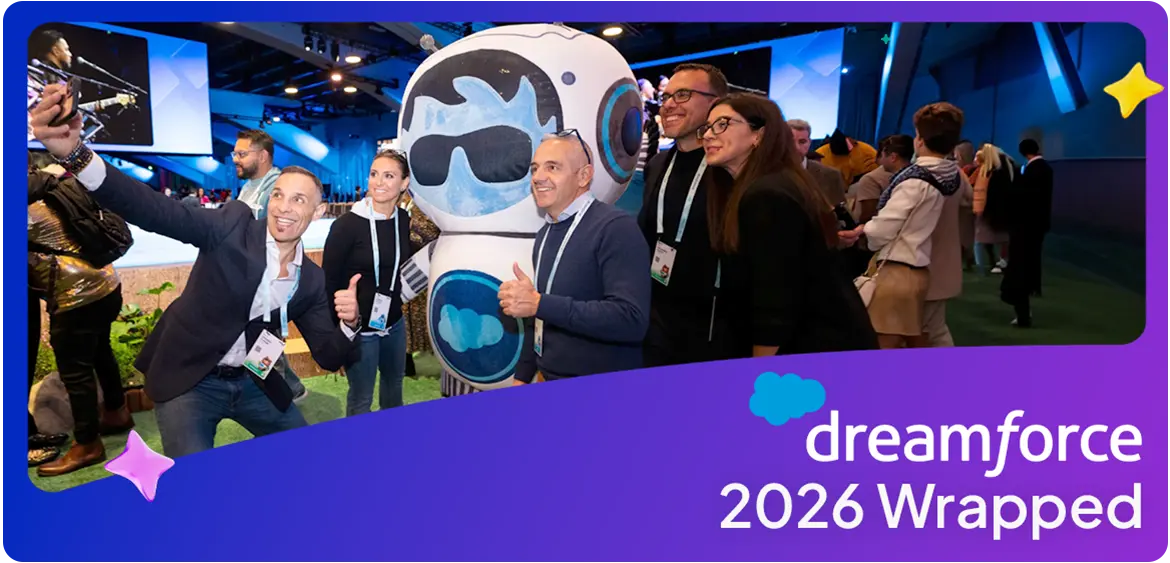
Fifty thousand people packed into Moscone Center this week. Another 120,000+ tuned in online. And for three days straight, Salesforce made one thing very clear: the interface you’re used to is not the future they’re building.
And for three days straight, Salesforce made one thing very clear: the interface you’re used to is not the future they’re building.
Whether you’re running Salesforce day-to-day, advising clients on it, or just trying to keep your team’s roadmap current, this year’s keynote had more substance – and more names, numbers, and product launches – than most.
If you weren’t glued to the livestream, here’s everything worth knowing – and everything worth acting on.
Table of Contents
The Big Reveal: AIforce Wants to Kill the Login Screen
The headline announcement wasn’t a feature. It was a philosophy shift.
AIforce is Salesforce’s new “interface layer” that lets people work with their CRM data from wherever they already are – Slack, Claude, or a custom UI they build themselves – instead of logging into Salesforce at all. Under the hood, it bundles four pieces: Claudeforce (the deepened Anthropic partnership), Slackforce (CRM context inside Slack), Agentforce Coworker (an AI teammate that lives in Lightning), and a Headless Toolkit of APIs, MCP servers, and developer tools for anyone building custom experiences on top.
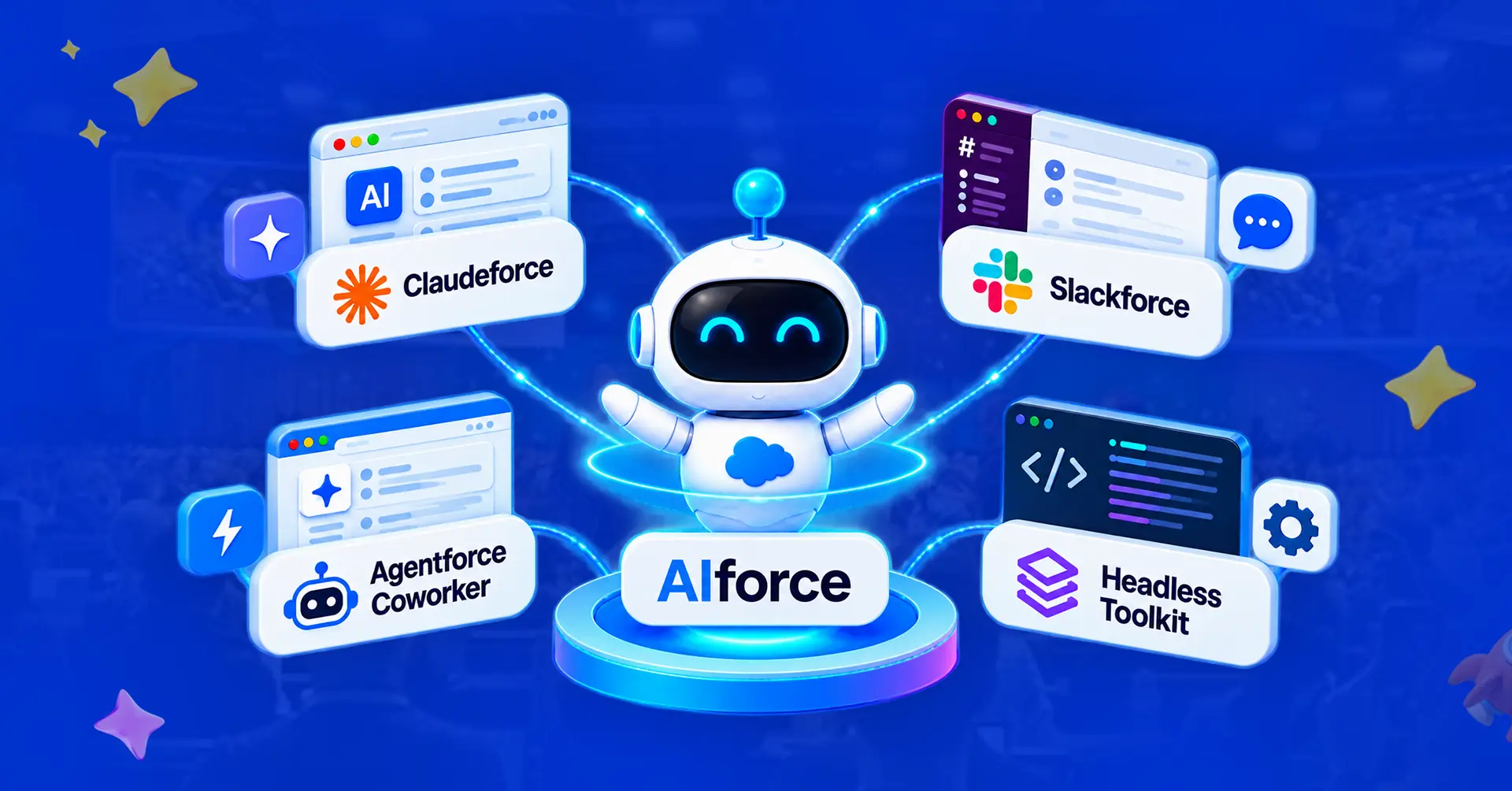
The pitch, in plain terms: your data and workflows stay governed inside Salesforce, but nobody has to open the Salesforce app to use them.
It’s a big enough shift that Salesforce played this clip from co-founder Parker Harris to set it up:
“Why should I ever log into Salesforce again? … Maybe you never will.” – Parker Harris, Salesforce Co-Founder
Why it matters for your team: if your reps, support agents, or ops folks have ever complained about tab-switching or clunky UI, this is Salesforce’s direct answer. It’s also a signal that “adoption” is about to mean something different – less about training people on screens, more about training agents on workflows.
Claudeforce, Koa, and the Reasoning Model Race
The Anthropic partnership got real teeth this year. Claude is now selectable as a reasoning model inside Agentforce’s Atlas Reasoning Engine, and a new plugin called Salesforce in Claude ships with 37 prebuilt sales skills – think meeting prep, pipeline review, and opportunity analysis – governed by the same permissions your CRM already enforces.
Salesforce also unveiled Koa, its first purpose-built CRM reasoning model, alongside Moirai, a forecasting model aimed at demand and inventory planning. Salesforce was pointed about how Koa was built:
“No customer data was used to train the Koa reasoning model.”
The message: Salesforce isn’t betting on one AI provider. It’s building an orchestration layer that lets customers pick the model – Claude, ChatGPT, or its own – best suited to the task at hand.
Pricing changed too. Agentforce now comes in three tiers – Core, Advanced, and Max – with consumption-based credits layered in, shifting cost away from flat per-seat licensing and toward pay-per-task. Worth flagging to any client or stakeholder still budgeting on last year’s model.
Marc Benioff Takes Center Stage
No Dreamforce keynote works without Benioff, and this one leaned hard into his two favorite themes: trust and denial of doom.
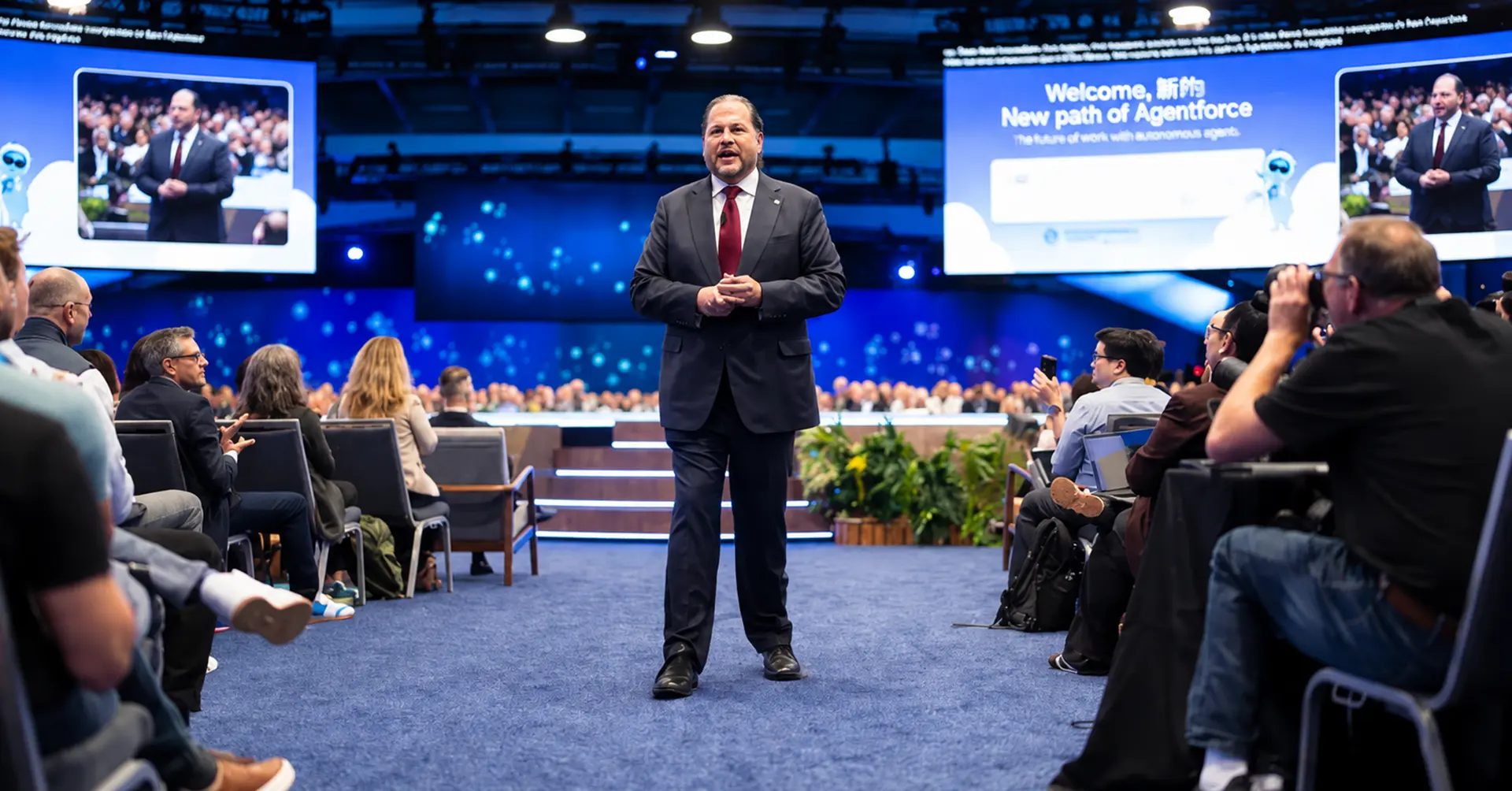
On trust, he was unambiguous about how Salesforce handles customer data inside its AI models – zero retention, audited repeatedly, no exceptions:
Your data is your data.… You’re not training any other model when you’re using our products.
Marc Benioff, CEO, Salesforce
On doom, he spent time directly rebutting the “SaaSpocalypse” narrative that’s dogged the software industry all year – the idea that AI-generated, vibe-coded tools will make platforms like Salesforce obsolete. Benioff dismissed the theory outright, backing it up with the company’s recent strong quarterly numbers as proof the platform business is still very much alive.
He also used the stage for something outside the product roadmap: a $27 million donation to San Francisco public schools, framed as part of a broader push for AI access that doesn’t leave communities behind. It’s a reminder that Benioff’s keynotes are never purely a product demo – they’re also where he stakes out where he thinks the industry should be heading, morally and structurally.
The Supporting Cast Brought Their Own Fireworks
This year’s keynote had more star power than usual, and it showed:
- Jensen Huang (NVIDIA) took a noticeably more aggressive stance on AI’s pace than anyone else on stage, arguing regulation should stay out of the market’s way and comparing AI’s arrival to the industrial revolution.
- Dario Amodei (Anthropic) offered the counterweight – more measured, more focused on responsible pacing and industry-wide safety standards, while acknowledging even Anthropic underestimated how fast AI would become central to business.
- Patrick Stokes (President, Applications and Marketing) live-demoed a Salesforce interface he built by simply talking to Claude over a few days – no code, just conversation – and announced the whole Claudeforce experience is now in open beta on AppExchange.
The contrast between Huang’s full-speed-ahead energy and Amodei’s caution-first framing was, honestly, one of the more interesting unscripted moments of the week – a live preview of the debate every enterprise leader is quietly having internally right now.
Meet the New Agent Lineup – They All Have Names Now
Salesforce moved away from generic “AI agent” talk this year and introduced a roster of named, role-specific agents meant to be deployed out of the box:
- Casey: a support agent already live on help.salesforce.com, credited with resolving five million service conversations since launch.
- Fin: a newly acquired customer-service agent, positioned as one of the strongest performers in the category.
- Piper: handles inbound engagement and pipeline generation straight from a company website.
- Paige: an internal IT and HR service agent.
- Marshall: an operations agent built for backend, back-office work like supplier onboarding.
- Hunter: the first agent built on Salesforce’s new “long-horizon runtime,” meaning it can chase a sales-pipeline goal across days or weeks instead of just completing one task and stopping.
Why it matters for your team: the shift from “build your own agent” to “deploy a named, pre-scoped one” lowers the technical bar significantly, but it also means someone still has to define exactly what each agent is and isn’t allowed to do before it goes live.
More Wins Across the Customer 360 Stack
Beyond the big four announcements, Salesforce rattled off a rapid tour of smaller – but genuinely useful – updates across every cloud:
| Cloud | What’s new |
| Sales | Hunter now ships with data vendors built in (ZoomInfo, Demandbase, Apollo) |
| Service | CCaaS goes live in October (details below) |
| Marketing | A campaign agent that builds and iterates campaigns on its own |
| Commerce | A shopper agent that personalizes recommendations in real time |
| Field Service | Voice-to-text so techs can fill forms hands-free on the job |
| IT & HR | A self-updating CMDB (configuration management database) |
| Revenue Cloud | A renewals agent that flags accounts and suggests upsells automatically |
| Tableau | Proactive intelligence – insights surface before you ask for them |
| Industries | 500+ prebuilt, industry-specific agents and actions baked in |
None of these are individually headline-grabbing, but together they signal something bigger: agentic AI is no longer a bolt-on feature – it’s being stitched into every corner of the platform.
Contact Center as a Service – Live in October
Salesforce confirmed its new Contact Center as a Service (CCaaS) offering goes live next month, folding telephony, CRM, and the contact center into a single system instead of stitched-together tools. The pitch is straightforward: no more bouncing between separate telephony, case, and knowledge systems mid-call.
If your org runs a contact center on a separate CCaaS vendor today, this is worth a serious look at renewal time – though it’s smart to press for specifics on language support, supported channels, and migration paths before committing.
Governance Gets Its Own Spotlight: Salesforce Guardian and Agent Fabric
As agents multiply, Salesforce used this Dreamforce to answer the question every security team was already asking: who’s watching the agents?
- Salesforce Guardian: a new security suite (an evolution of Salesforce Shield) focused on agent identity, flagging risky or “rogue” agents, data classification, and zero-data-retention enforcement.
- Agent Fabric: MuleSoft’s evolution into a central registry that tracks agents across Salesforce, Azure, AWS, and Google, giving admins one place to see data lineage, latency, error rates, and cost per agent.
Salesforce’s platform president put the scale of the problem in blunt terms:
“Hundreds of agents, thousands of agents – who knows? Millions of agents across all your teams, platforms and enterprises. How are you going to manage them?” – Rohan Kumar, President of Platform and Engineering, Salesforce
Why it matters for your team: if you’ve been treating AI governance as a “we’ll figure it out later” item, this is Salesforce telling you later is now. Agent sprawl is a real, near-term risk for any org running more than a couple of pilots.
What to Pull into Your Next Sprint Planning
Strip away the stagecraft and here’s what actually matters for anyone running or advising a Salesforce org:
- The UI is becoming optional. Start thinking about which workflows in your org could move into Slack or Claude instead of forcing people back into Salesforce’s screens.
- Multi-model is the new normal. Claude, ChatGPT, and Salesforce’s own models are all going to sit inside Agentforce. Model choice is now an architecture decision, not a one-time platform bet.
- Budget conversations are shifting. Task-based pricing means the ROI conversation moves from “how many seats” to “how many workflows are actually automated.” Get ahead of that with clients and stakeholders now, before renewal season forces the question.
- Named agents lower the barrier – not the responsibility. Deploying Casey, Fin, Piper, or Hunter is easier than building an agent from scratch. Someone still needs to own its scope, permissions, and escalation rules.
- Governance can’t wait for a bigger rollout. Salesforce Guardian and Agent Fabric exist because agent sprawl is already a real problem for early adopters. If you’re past pilot stage, put a governance owner in place now.
- Contact center consolidation is coming. If CCaaS interests your org, October’s launch is worth watching closely before your next renewal cycle.
From Announcements to Implementation
Every Dreamforce leaves teams with a long list of shiny new capabilities and a much shorter list of people who know how to actually implement them without breaking what already works.
That’s the gap 360 Degree Cloud sits in.
As a Salesforce Summit Partner, our consulting and staff augmentation teams are already fielding the real questions this keynote raises – which workflows are ready to go headless, how to govern multi-model AI access without creating a permissions mess, and how to plan for consumption-based Agentforce pricing instead of getting surprised by it.
If Dreamforce 2026 raised more questions than it answered for your org, that’s exactly the conversation we’re set up to have.
Categories

Solve It with Salesforce. We’ll Show You How.
AI. Apps. Experts. Everything you need to win with Salesforce under one roof.
About the author
Editorial TeamThe Editorial Team at 360 Degree Cloud brings together seasoned marketers, Salesforce specialists, and technology writers who are passionate about simplifying complex ideas into meaningful insights. With deep expertise in Salesforce solutions, B2B SaaS, and digital transformation, the team curates thought leadership content, industry trends, and practical guides that help businesses navigate growth with clarity and confidence. Every piece we publish reflects our commitment to delivering value, fostering innovation, and connecting readers with the evolving Salesforce ecosystem.
Recent Blogs
 Salesforce Clouds
Salesforce Commerce Cloud Implementation: The 2026 Guide for B2B and B2C Commerce Teams
Commerce has always been competitive. But in 2026, the bar has shifted in ways that are hard to ignore. Whether someone is a consumer checking…
Read More Uncategorized
How Salesforce Agentforce and Google Cloud Integration is Changing Enterprise AI in 2026
Most enterprise AI projects don’t stall because the model is weak. They stall in the plumbing. A sales ops lead wants one agent that can…
Read More Salesforce Clouds
Salesforce Marketing Cloud Engagement Implementation: The 2026 Guide to Omnichannel Marketing That Converts
Most marketing teams aren’t failing because they lack content. They’re failing because the right message is reaching the wrong person at the wrong time –…
Read MoreReady to Make the Most Out of Your Salesforce Instance?
Our Salesforce aces would be happy to help you. Just drop us a line at contact@360degreecloud.com, and we’ll take it from there!
Subscribe to our newsletter
Stay ahead with expert insights, industry trends, and exclusive resources—delivered straight to your inbox.