

Contract vs Full-Time Salesforce Developer: What Hiring Managers Need to Know
12 Aug 2026
Table of Contents
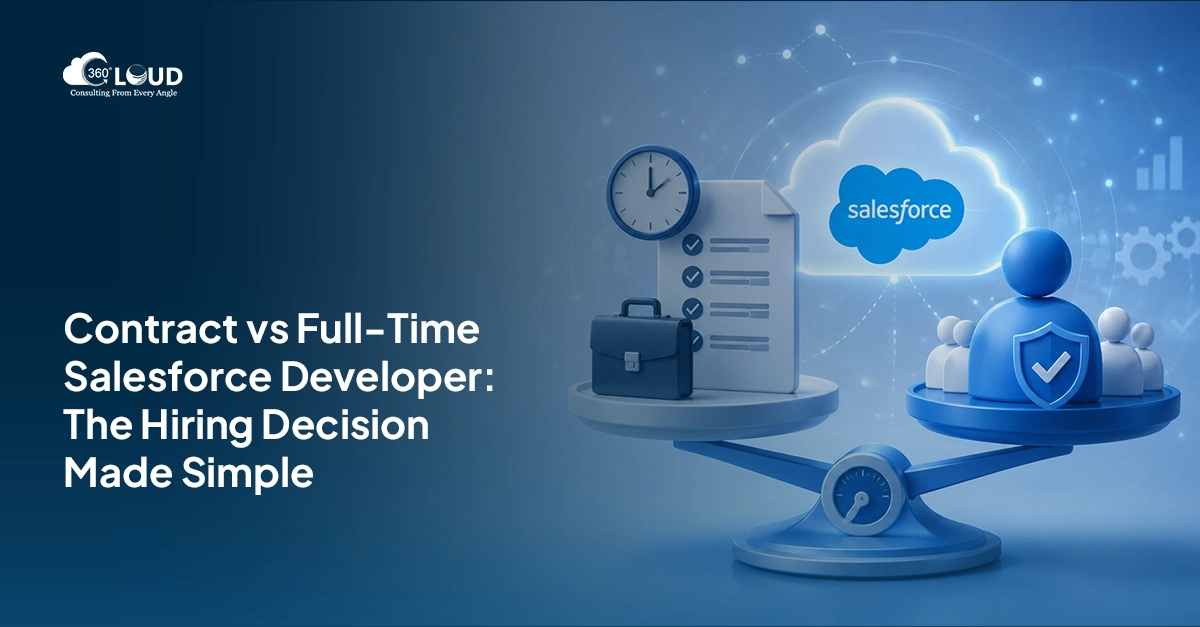
Contract Salesforce developers offer immediate availability, access to niche certifications, and no long-term commitment – ideal for defined projects or when the hiring timeline can’t match the project timeline. Full-time developers offer institutional knowledge, org ownership, and long-term consistency – better when Salesforce is a permanent, central operational function. The choice depends on how permanent the need is and how specific the required skills are.
Most hiring managers don’t have a strong abstract preference for one model. They have a project, a timeline, a budget, and a skill requirement – and they need to know which approach actually solves their problem.
So let’s be direct about it.
Not sure which model fits? One conversation usually settles it.

Table of Contents
The 2026 Salesforce Developer Market Snapshot
The Salesforce developer market in 2026 has two distinct characteristics worth understanding before you make a hire decision.
Volume is up; senior availability is down. Job postings for Salesforce developers grew from roughly 14,000 in May 2024 to 31,200 by September 2025 on Glassdoor. But the surge is concentrated at the employer demand side. The supply of mid-to-senior Salesforce developers with real project depth – Apex, LWC, integration architecture, specific cloud expertise – hasn’t kept pace.
Specialist skills carry a genuine premium. A general Salesforce developer with admin and basic development skills is more accessible than two years ago. A CPQ developer, a Marketing Cloud architect, a Health Cloud integration specialist with HL7 experience – these roles take longer to find and cost more when you find them. The specialty drives both availability and rate.
Understanding this split informs the contract vs full-time decision. If you need a specialist for a project, the contract market is often faster and cheaper than trying to hire one full-time.
Contract Developer – Rates, Pros, Cons, and Red Flags
Rates (2026)
| Salesforce Contract Developer Role | US Hourly Rate |
| Admin / Junior Developer | $40–65/hr |
| Mid-Level Developer (Apex/LWC) | $65–100/hr |
| Senior Developer | $85–120/hr |
| Specialist (CPQ, Marketing Cloud, Health Cloud) | $80–130/hr |
| Solution Architect | $100–160/hr |
Sources: ZipRecruiter, Salary.com, Enstacked.com – 2026 data
Pros of Contract
Immediate availability. Through a qualified partner, 48–72 hours from brief to candidate review. Through a staffing platform, days to a week. No 90-day hiring cycle.
Specialist access without permanent commitment. Need a CPQ developer for 12 weeks? You don’t need to hire one full-time. The specialist comes in, does the specific work, and the engagement closes.
No long-term overhead. No benefits, no equity, no severance exposure. When the project ends, the engagement ends. Your headcount stays flat.
Proven project experience. Good contract developers have worked across multiple orgs and implementations. That breadth of exposure often accelerates delivery on your project.
Cons of Contract
Management burden stays with you. The contractor is productive when well-directed. If your internal leads don’t have clear requirements, sprint structure, and review capacity, augmentation underperforms.
Institutional knowledge doesn’t accumulate (without structure). A contractor who leaves after 3 months may take their knowledge of your org’s custom code with them – unless knowledge transfer is explicitly built into the engagement.
Rate looks expensive vs salary on paper. The hourly rate comparison to FTE salary is the persistent objection. It’s wrong when you run full cost of ownership, but you may have to make that case internally.
Red Flags When Evaluating Contract Developers
- CV that lists Salesforce certifications but can’t explain how they used them on real projects
- No clear Apex or LWC portfolio – “I know it” without evidence
- Inability to describe a complex integration they built, end-to-end
- References that are vague about delivery outcomes (“great guy, worked with us for a while”)
- Unwillingness to do a brief technical assessment
Certifications don’t predict delivery. Project history does. We verify both.

Full-Time Developer – Salary, Fully-Loaded Cost, Pros, and Cons
2026 Salary Ranges
| Full-Time Salesforce Developer Role | Base Salary Range (US) |
| Junior Developer (1–3 years) | $80,000–$110,000 |
| Mid-Level Developer (3–6 years) | $120,000–$155,000 |
| Senior Developer (6+ years) | $145,000–$185,000 |
| Specialist (CPQ, Marketing Cloud) | $130,000–$175,000 |
Sources: Glassdoor, Salary.com, Salesforce Ben – 2026 data
Fully-Loaded Cost: What the FTE Actually Costs
| Cost Component | Estimate |
| Base salary (mid-level example) | $145,000 |
| Employer payroll taxes (~8.5%) | $12,325 |
| Health insurance (employer contribution) | $8,000–$12,000 |
| 401(k) match (4%) | $5,800 |
| Equipment and licenses | $4,000–$6,000 |
| Training and certification | $3,000–$5,000 |
| PTO cost (15 days) | $8,365 |
| Recruiting fee (20–25% of salary, Year 1) | $29,000–$36,250 |
| Ramp-to-productivity (60 days) | $15,000–$25,000 |
| Total Year 1 Fully-Loaded | $230,490–$255,740 |
That’s the real cost of a $145,000 mid-level developer in Year 1. From Year 2 onward, it drops to approximately $186,490–$213,740 (removing recruiting fee and ramp cost, keeping all other components).
Pros of Full-Time
Institutional knowledge builds over time. An FTE who stays 2–3 years develops deep understanding of your business processes, your Salesforce org’s history and quirks, and your team’s working style. That knowledge is hard to replicate with contract resources.
Org ownership. A full-time developer who takes genuine ownership of the Salesforce environment – proactively monitoring, suggesting improvements, preventing issues – is extremely valuable. This kind of engaged ownership doesn’t always happen with contractors.
Team culture and consistency. If your Salesforce function is central to operations and you’re building a team around it, full-time hires create the stable culture and relationships that make teams work over years.
Cons of Full-Time
60–90 day time-to-hire. If the project is starting now, this is a blocker.
Year 1 cost is substantially higher. The recruiting fee and ramp cost make Year 1 expensive – $230,000+ for a mid-level developer.
Severance and retention risk. If the business changes and you no longer need the role, unwinding a full-time hire carries cost and complexity that a contract ending does not.
6 Questions That Clarify Which Hire Is Right
1. Can the project wait 60–90 days for a hire to start?
Yes: FTE is viable. No: contract is the only option that fits the timeline.
2. Is the Salesforce need permanent and ongoing?
Yes: FTE economics improve past the 18-month mark. Temporary or project-scoped: contract.
3. Do you need a specialist skill that doesn’t justify a permanent role?
Yes: contract. No – the role is broadly needed ongoing: FTE.
4. What’s the budget for Year 1, including recruiting?
If Year 1 fully-loaded FTE cost ($230,000+) exceeds budget: contract may be the only viable option.
5. Do you have a technical lead who can direct and review the contractor’s work?
Yes: augmentation works. No internal Salesforce oversight: either a senior contract developer who can work more independently, or a managed services structure.
6. Is there an existing Salesforce team the developer would join?
Joining an existing team: FTE builds integration better over time. Solo developer in an org: either model works; contract delivers faster.
The Hybrid Model: When to Use Both
Many organizations end up with both – and it’s not a sign of indecision. It’s usually the right structure.
A full-time admin or junior developer owns the org, manages day-to-day operations, and accumulates institutional knowledge. A contract specialist – CPQ developer, Marketing Cloud engineer, Apex architect – comes in for the project phases that require depth the permanent team doesn’t have.
The FTE provides continuity and org ownership. The contract resources provide specialist depth. Neither is sized wrong for its purpose.
Common Mistakes When Hiring Contract Salesforce Developers
Hiring on certifications alone. Trailhead badges and certification counts don’t predict delivery performance. Project history and the ability to articulate what they actually built does.
No onboarding structure. A new contractor without org access, a project brief, and a named point of contact on Day 1 loses a week before they’re productive. That week costs you at contract rates.
No knowledge transfer requirement. If documentation and code commenting aren’t explicit requirements, they don’t happen. Build them into the brief before the engagement starts.
Using a freelance marketplace without vetting standards. The quality variance on freelance platforms for Salesforce work is substantial. A Salesforce Summit Partner with pre-vetted professionals and quality governance is not the same risk profile as a marketplace profile with a 4.2-star rating.
The Right Hire Is the One That Fits the Actual Situation
The contract vs full-time Salesforce developer debate gets framed as a preference question. It’s not. It’s a situation question. The project timeline, the skill requirement, the budget, the permanence of the need – those variables make the decision, not a philosophical position on employment models.
If the project starts in three weeks and the skill required is a CPQ specialist your team doesn’t have and won’t need permanently, contract is the answer before the conversation gets much further. If Salesforce is central to how your business operates, the need is indefinite, and you’re building a team around it – full-time economics make sense past the 18-month mark.
Most organizations that think clearly about Salesforce developer hiring options end up with both, not because they couldn’t decide, but because the hybrid structure is genuinely the right answer. A full-time resource building institutional knowledge and owning the org day-to-day. Contract specialists brought in for the project phases that require depth the permanent team doesn’t carry. The permanent vs temp Salesforce question resolves itself when you separate operational continuity from project-based specialist work.

Categories

Solve It with Salesforce. We’ll Show You How.
AI. Apps. Experts. Everything you need to win with Salesforce under one roof.Frequently Asked Questions
How do I find a qualified contract Salesforce developer quickly?
Through a Salesforce Summit Partner with a maintained bench. Describe the specific requirements: certifications needed, project type, org complexity, timeline. A qualified partner can have candidates in front of you within 24–48 hours. Freelance platforms are an option but require more vetting on your side.
Can a contract developer become full-time if they're a strong fit?
Yes. Trial-to-hire arrangements are common and can be negotiated with a staffing partner upfront. The partner typically charges a conversion fee (10–20% of first-year salary). It's worth negotiating this at the start of the engagement if conversion is a real possibility.
What's the minimum commitment for a contract Salesforce developer?
Most partners work with a 4–6 week minimum for meaningful delivery. Below that, onboarding overhead consumes too much of the engagement window. Some partners offer sprint-based engagements (2-week cycles with defined deliverables) for shorter, specific needs.
Do offshore contract Salesforce developers work for US time zones?
Many established India-based Salesforce teams have overlapping morning/evening hours with US East and West Coast teams. A 4–5 hour overlap window is standard. Async-first collaboration with structured daily or bi-daily check-ins works well for most development engagements.
How do I verify Salesforce certifications before I hire?
Salesforce certifications can be verified through the Salesforce Trailhead Verification portal. Any candidate should be willing to share their verification link. A partner with a vetting process should provide this as part of the candidate profile, not require you to chase it.

About the author
Editorial TeamThe Editorial Team at 360 Degree Cloud brings together seasoned marketers, Salesforce specialists, and technology writers who are passionate about simplifying complex ideas into meaningful insights. With deep expertise in Salesforce solutions, B2B SaaS, and digital transformation, the team curates thought leadership content, industry trends, and practical guides that help businesses navigate growth with clarity and confidence. Every piece we publish reflects our commitment to delivering value, fostering innovation, and connecting readers with the evolving Salesforce ecosystem.
Recent Blogs
 Uncategorized
How Salesforce Agentforce and Google Cloud Integration is Changing Enterprise AI in 2026
Most enterprise AI projects don’t stall because the model is weak. They stall in the plumbing. A sales ops lead wants one agent that can…
Read More Salesforce Clouds
Salesforce Marketing Cloud Engagement Implementation: The 2026 Guide to Omnichannel Marketing That Converts
Most marketing teams aren’t failing because they lack content. They’re failing because the right message is reaching the wrong person at the wrong time –…
Read More Uncategorized
Dreamforce 2026 Wrapped: Here’s What to Take Back to Your Team
Fifty thousand people packed into Moscone Center this week. Another 120,000+ tuned in online. And for three days straight, Salesforce made one thing very clear: the interface…
Read MoreReady to Make the Most Out of Your Salesforce Instance?
Our Salesforce aces would be happy to help you. Just drop us a line at contact@360degreecloud.com, and we’ll take it from there!
Subscribe to our newsletter
Stay ahead with expert insights, industry trends, and exclusive resources—delivered straight to your inbox.