
Talk to Us

How Salesforce Implementation Can Help Retailers to Upgrade their Operations

Salesforce is one of the most renowned platforms in retail, enabling seamless management of data while maintaining customer relationships. Salesforce implementation also helps in the creation of efficient sales processes, and real-time tracking of leads and sales activities.

With Salesforce, retailers can effortlessly build detailed customer profiles, monitor interactions and preferences, and automatically generate quotes and proposals. The platform also offers robust tools for tracking lead flow, conversion rates, and measuring the impact of marketing initiatives—critical for driving success in the retail industry.

Beyond its core sales capabilities, Salesforce provides a suite of additional features tailored to retail businesses, including customer service tools, market analysis, and supply chain management.

In essence, Salesforce is a powerful solution that helps retailers streamline their sales operations and boost overall performance and that’s what we are going to cover in this blog.

Why Retailers Should Go For A Salesforce Implementation Partner 

Salesforce can make a true difference for any retailer who is looking for a way to streamline operations and achieve customer satisfaction. Let’s have a look at some prominent ways a Salesforce implementation partner can help achieve them all. 

1. Boost Loyalty While Saving Costs

Salesforce for retail is crafted to equip businesses for success in a digital-first landscape. By leveraging this unified CRM platform, retailers can align their teams, create impactful commerce and marketing strategies, and consistently deliver exceptional service at every customer interaction.

The outcome? Reduced operational costs and stronger customer loyalty—key drivers for long-term growth in the retail sector.

2. Engage More Customers

Salesforce is a trusted platform that helps businesses to achieve smooth collaboration among retail teams. As Salesforce for retail provides teams with a unified platform for sharing data and files , it enables them to ensure everyone remains on the same page. This majorly helps sales reps as they would be having just the right data through which they can build stronger customer relationships and boost loyalty. 

Whether it’s offering personalized recommendations or quickly addressing concerns, Salesforce enables retail teams to consistently exceed customer expectations and enhance brand loyalty.

3. Unify Different Departments

For retail businesses, Salesforce implementation is popular as a trusted platform to unify different departments in a business like sales, marketing, service, commerce, and IT. This enables them to stay aligned with the same updated data and stay on the same page when it is about managing customer data or purchase details. 

Having a unified platform enables retailers to have a complete view of the journey of each customer. Retailers can access actionable insights through which they can deliver personalized experiences to make sure they always meet customer expectations.

4. Achieve Seamless Buying Experience

It is becoming increasingly important to build streamlined experiences across every touchpoint in the current market for retail businesses. With the help of Salesforce, retailers can connect with customers at a time that is the most suitable for them. 

Retailers can also manage customer records, which helps them to boost conversions and build loyalty. Retailers can also work to simplify the purchasing process, offer outstanding service and personalized recommendations to customers to enhance customer satisfaction.

5. Enhance Business Flexibility

As retailers expand, Salesforce provides the scalability and flexibility necessary for growth. Its cloud-based infrastructure allows retailers to effortlessly add new users, integrate with other business systems, and respond to evolving market dynamics.

For instance, a retailer can leverage Salesforce to manage its customer loyalty programs. By automating rewards and tracking engagement, they enhance customer loyalty and drive repeat purchases.

6. Enable Personalization

When it comes to running effective retail marketing, retailers should trust the power of personalization. Salesforce Marketing Cloud can help retailers to manage their records and data and get insights from it to customize every customer interaction. Retailers would easily be able to track the preferences of customers along with their previous purchase records through which they can tailor campaigns uniquely to target them. This will ultimately help in achieving better results and more engagement. With Marketing Cloud, retailers can turn new customers into loyal clients by providing relevant, personalized experiences throughout the entire customer journey.

7. Simplify Work for Sales Reps 

Salesforce helps sales assistants in retail by equipping them with just the right features that help them boost efficiency and elevate service quality. With real-time access to customer data, inventory updates, product details, etc., sales reps can offer personalized assistance and tailored recommendations, enhancing the shopping experience. A Salesforce implementation partner enables retailers to redefine their sales teams as trusted advisors, driving higher customer satisfaction and loyalty.

Streamline Your Retail Operations with Salesforce Implementation

Salesforce is highly trusted as a CRM solution, especially among retailers as it offers them a comprehensive solution that will enable all teams to manage all operations centrally. From automating sales processes to managing customer data, Salesforce is a one-stop solution for all retailers. Whether it is boosting the efficiency of the team members or improving operational efficiency, Salesforce can help them achieve all. Contact us and get these benefits for your retail business as well.

How a Salesforce Consulting Firm Can Upgrade Your Healthcare Operations

It’s true that for any healthcare institution to operate efficiently, they need just the right system. From managing patient records to streamlining appointment scheduling, all they need is just the right solution. That’s where HCPs hire a Salesforce consulting firm to have the trusted experts onboard to manage all operations and workflows.

Being the most renowned CRM solution globally, Salesforce is highly trusted in the healthcare sector for custom solutions to improve patient management and boost engagement. 

With its powerful toolkit, Salesforce provides a scalable response to the ever-changing demands of the healthcare sector, allowing professionals to focus on what truly matters—delivering outstanding patient care. In this age of digital transformation, grasping the benefits of Salesforce implementation in healthcare is essential for any organization striving to lead the industry.

Different Ways a Salesforce Consulting Company Helps A Healthcare Institution

Any healthcare institution would have a lot of data to handle while managing critical operations. What makes them easy is to have a Salesforce consulting company helping them. So, let us have a look at some of the ways having the right company along would help HCPs.

1. Streamline workflows while reducing costs

For the success of any healthcare organization, it is necessary to streamline clinical workflows. Salesforce consulting services can significantly enhance efficiency while cutting operational costs.

Salesforce supports different automation tools and features that can help to simplify and automate redundant and routine tasks. These tasks could be anything like prescription renewing prescriptions, reminders for follow ups, allowing your staff to dedicate more time to patient care. HCPs can foster better collaboration across departments, resulting in a more comprehensive approach to patient care.

Not only this, Salesforce for healthcare also supports advanced reporting features to pinpoint areas for cost savings and implement data-driven strategies to optimize financial outcomes and get better insights into the data as they’ll be able to access data on a centralized platform would allow 

2. Strategize better with data-driven decisions

Having the support of the right Salesforce professionals would help healthcare centers to manage data and work with it. They can easily analyze data and make decisions around it. This would help in improving patient experience and their satisfaction with the care. They can also be able to monitor healthcare specific KPIs like patient satisfaction rate, success rate of the treatment, or any other metric.

Salesforce supports different features and tools for advanced reporting that will help teams identify which operations need improvement. This data would help HCPs to know the areas that have certain challenges and timely take action to fix them to boost operational efficiency.

3. Work with predictive analytics

Salesforce certified consultants can leverage predictive analytics to enhance the capacity of the healthcare organization to understand unique needs of each patient and take actions whenever required. Healthcare providers can identify individuals at high risk so that any preventative care strategies for patients can be timely implemented.

Using the feature of predictive analytics in the right way also helps the team to know any shortages like in medical equipment, staff, or medication, making it easier for teams to manage everything. All of this predictive analytics feature will help healthcare providers to adjust care pathways for better patient satisfaction.

4. Boost patient experience

A Salesforce consulting firm helps to maintain a comprehensive view of patient data that enables HCPs to smoothly maintain data records and take necessary actions. They can view patients’ previous records, treatment details, billing history, and other details in a single screen, which allows healthcare providers to deliver personalized and high-quality care. Salesforce also enables them to work with appointment scheduling features to streamline the process while minimizing waiting time for patients. 

Additionally, Salesforce’s email and SMS tools enable consistent communication with patients, offering appointment reminders, follow-up details, and valuable educational resources.

5. Enhance data security

Salesforce consulting services help ensure compliance and protect sensitive information. With Salesforce, healthcare organizations can tailor data access permissions, ensuring that only authorized personnel can view sensitive patient details. The platform also offers comprehensive audit trails to monitor data usage.

Additionally, Salesforce can generate automated reports to assist healthcare organizations in meeting regulatory requirements, maintaining transparency, and minimizing the risk of non-compliance penalties.

6. Enable better communication

Effective communication can be very helpful to make healthcare operations successful, and that’s where Salesforce experts offer just the right tools to work with. Salesforce supports Chatter, an efficient communication and collaboration platform that enables healthcare members to share information and collaborate in real-time. The platform’s integration with video conferencing tools like Zoom supports telehealth solutions, enabling remote consultations and breaking down physical barriers to care. 

Additionally, Salesforce’s knowledge base tool serves as a centralized repository for clinical information, guidelines, and resources, creating a collaborative learning environment for healthcare staff.

Hire a Salesforce Consulting Firm for your Healthcare Operations

Considering all the ways Salesforce tends to help healthcare institutions and providers, it can be a real game-changer to improve efficiency and patient satisfaction. The key is to have the right professionals who can handle the platform for you. Contact us and get these certified and experienced Salesforce rockstar to assist you with your healthcare workflows and record management.

Wondering How 360 Local Timezone Finder Can Transform Your Business? Here’s What You Need to Know

From maximizing customer satisfaction to cultivating a loyal audience, well-timed communication is of prime essence globally. One often-overlooked aspect of this is Salesforce timezone management. With businesses spanning continents, knowing the exact local time of your clients and partners can make or break crucial interactions. Enter 360 Local Timezone Finder, a tool that seamlessly integrates with Salesforce to revolutionize how you manage global time zones.

In this blog, we’ll explore global communication challenges and how 360 Local Timezone Finder can improve sales efficiency, project management, customer service, and marketing campaigns across borders.

The Global Communication Challenge

When you run an international business, dealing with time zones is a typical headache. When working on global projects—coordinating the perfect time for a client in London while you are in New York or managing a project with a team in Tokyo, consideration of local time is extremely important.

Otherwise, ignoring your clients’ timezones can lead to problems like miscommunication, missed deadlines, and scheduling conflicts. When Salesforce users operate globally, they often need to manage multiple tasks and appointments to manage their sales process across multiple timezones effectively.

This is when the concept of Salesforce Time and Timezone tracking comes to the rescue.

360 Local Timezone Finder: A Game-Changer in Salesforce Timezone Management

More than a clock, 360 Local Timezone Finder is a native app that connects to Salesforce seamlessly, allowing timezone data for each contact or lead on your lists. You get the local time of your contacts within Salesforce, no matter their country. It automatically displays the local time whenever someone accesses a record so that they don’t want to calculate each and every time while navigating different records. Now, let’s see how it can help you further.

Enhancing Client Communication with Real-Time Insights

Don’t you think it would be great if you could see the local time for each contact in your Salesforce CRM immediately? As insignificant as it sounds, this tiny aspect of your business functionality can help you be superior in global operations and profitability. For example, you can reach out to clients at a time when there’s a high chance of their availability, excluding late nights and early mornings. Not only would such respect for their local time prove your professionalism but also your willingness to deliver the best experiences to global customers and drive positive responses.

Furthermore, with Salesforce time tracking and Salesforce time and timezone management integrated into your workflow, your team can schedule meetings, send emails, and make calls with precision. This reduces the chances of missed opportunities due to poor timing and ensures that your global clients feel valued and respected.

Boosting Sales Efficiency

Sales teams thrive on efficiency, and the ability to instantly know the local time of a client or lead is a significant advantage. For instance, a sales representative in the U.S. managing leads in Europe can prioritize their outreach based on the local time zones, ensuring that calls and emails are sent during business hours. This optimization leads to higher engagement rates and, ultimately, more closed deals.

Moreover, by using 360 Local Timezone Finder, sales teams can better coordinate their follow-ups, avoiding situations where they might unintentionally call a prospect during off-hours. This feature ties directly into the broader concept of Salesforce time tracking, where every minute counts towards achieving sales targets.

Streamlining International Project Management

When teams are scattered in different timezones, successful project management seems like an uphill task to project managers. Scheduling meetings at the best time becomes challenging. Salesforce time and timezone tracking tools like 360 Local Timezone Finder provide a streamlined solution to these challenges.

By integrating this tool into Salesforce, project managers can view the local times for all team members involved in a project. This visibility allows for more effective scheduling, reducing the chances of delays caused by time zone misunderstandings. Additionally, it facilitates better communication, as team members are more likely to be available and responsive during their working hours.

Improving Customer Service Response Times

Like products and services, customer service is equally important, and 80% of customers admit that. Time is of the essence in customer service. Client support tickets have to be answered as fast as possible, regardless of where they are from. Thus, with 360 Local Timezone Finder integrated into Salesforce, when the support team receives a ticket, it can see the client’s local time immediately. This enables them to prioritize their response and attend to clients when they are most likely available as per their timezone.

As an illustration, if a client sends in a ticket late at night based on their own area; then this could be dealt with first thing the following morning hence ensuring that the client gets a very timely reply during his or her business hours. This attention to specificity enhances customer satisfaction and enhances overall customer relationship.

Driving Marketing Campaign Success

Timing is crucial for any marketing plan, especially when conducted globally. The success of activities such as email newsletters, promotions, or webinars largely depends on their timing. Therefore, through Salesforce timezone management using 360 Local Timezone Finder, marketers can segment their audiences according to local time zones, enabling campaigns to reach recipients at optimal times.

Take a marketing team’s email campaign, for example, which might have been scheduled to go out at 10:00 AM in each recipient’s local time to increase opening rates and interactions. Similarly, when it comes to global webinars, this tool helps determine the best session times for people from different parts of the world, thereby increasing participation numbers.

The Future of Salesforce Timezone and Time Tracking Management

As businesses continue to expand their global reach, the importance of effective Salesforce timezone management will only grow. The future of managing global operations by companies is represented by tools such as 360 Local Timezone Finder, which ensures that time zones are no longer barriers to success.

Integrating these types of tools into your Salesforce environment increases operational efficacy, sales performance, customer relationship management systems, and project management processes. By knowing your clients’ or partners’ local times in just seconds, your team will work with improved effectiveness, lowering risks associated with miscommunication and missing opportunities.

Conclusion: Elevate Your Global Operations with 360 Local Timezone Finder

In today’s world of multinational companies operating in multiple time zones, having a tool like 360 Local Timezone Finder is simply priceless. This app built inside Salesforce not only makes handling time zones easier but also improves all your business processes—sales, marketing activities, customer service, and project management.

By leveraging 360 Local Timezone Finder, a tool for tracking timezone and local time, your business can achieve greater efficiency, build stronger client relationships, and drive better results. Don’t let time zone challenges hold you back—embrace the power of 360 Local Timezone Finder and take your global operations to the next level. Contact us today!

Salesforce Acquires PredictSpring for Retail Sector Boost: Hire a Salesforce Administrator to Know More

Salesforce has made a strategic move to strengthen its standing in the retail sector with a recent merger. They have recently announced the acquisition of PredictSpring, which is a point-of-sale firm. This California-based company is known for its cutting-edge solutions like inventory management and remote payment, enabling businesses to engage with customers in dynamic and innovative ways. There’s a lot that you as a Salesforce user will achieve if you’re from the retail sector. Just hire a Salesforce administrator and witness how this acquisition can be game-changing for you. 

This blog is to share some light on more details about this acquisition and what benefit will this bring for the retail businesses. 

What Exactly is PredictSpring?

PredictSpring is renowned for its innovative POS systems, empowering store employees to seamlessly engage with customers and complete transactions on mobile devices. With features like customer profiling and the ability to order out-of-stock items online, their technology is an invaluable asset in enhancing customer service within the retail sector.

Founded in 2013 by a former Google Product Manager, Nitin Mangtani, PredictSpring has made significant strides in the industry. During his seven-year tenure at Google, Mangtani played a pivotal role in expanding the Google Shopping Team from a few hundred merchants to hundreds of thousands worldwide. His expertise lies in search infrastructure and optimizing mobile conversions.

Salesforce and PredictSpring

Salesforce and PredictSpring have been partners since 2019. They have been working with each other to deliver a unified experience across Commerce and Service Cloud. Due to this efficient sync, Salesforce decided to acquire it.

With PredictSpring now fully integrated into Salesforce, retailers will be able to harness the full power of omni-channel capabilities of Salesforce. This integration strengthens Salesforce’s ability to offer a comprehensive suite of retail solutions, positioning it to excel in an increasingly digital retail landscape.

How Retail Businesses Can Flourish with this Acquisition

The acquisition of PredictSpring by Salesforce offers significant opportunities for retail businesses to grow in the competitive market. Here’s how this acquisition could be helpful for retail businesses:

1. Enhanced Customer Engagement

PredictSpring is known for enabling seamless customer interactions. Its merger with Salesforce will allow retailers to provide a more personalized and efficient shopping experience, thus helping them to boost sales, for which you can hire a Salesforce administrator. The store reps can connect with customers through mobile devices, process transactions instantly, and access their profiles, which will help in achieving customer satisfaction. 

2. Unified Omni-Channel Experience

Agents at retail businesses would now be able to offer a unified shopping experience to their customers across both online and offline channels. This omni-channel way to engage with them ensures that customers receive consistent service and information. They can be shopping online, in-store, or on mobile devices, agents can still work on driving sales and improving customer retention.

3. Advanced Inventory Management

Retailers have been using PredictSpring for advanced inventory management features, which would now be combined with the AI features of Salesforce analytics. This allows retailers to work with easier stock management and inventory tracking to fulfill customer orders and win their trust.

4. Make Data-Driven Decisions

The retailers will also be able to manage and handle data related to sales and customers that will be helpful. Salesforce integration supports tools for AI and analytics that can help to turn this data into actionable insights, enabling retailers to make informed decisions on everything.

5. Streamlined Operations

This merger of Salesforce and PredictSpring will help in automating business processes, such as marketing, customer service, and sales and order management. This increases efficiency, reduces operational costs, and allows businesses to focus more on strategic growth and customer experience.

6. Scalability and Flexibility

This acquisition would make it easier for retailers to work with as it would provide them with a scalable platform offering flexibility in how they manage their operations and customer interactions. You can hire a remote Salesforce developer to work with these features and enable scalability for your business. This would ultimately provide a dynamic growth environment for retail businesses. 

Hire a Salesforce Administrator for your Retail Business

Salesforce has actively been working to boost operations and customer satisfaction for retail businesses and this acquisition with PredictSpring is another such step that will take retail businesses closer to their customers. If you are also handling a retail business, contact us and our top Salesforce expert will help you to upgrade your operations and boost your sales.

Why Should You Consider QuickBooks and Salesforce Integration?

For every company that works with critical insights into finance, expenses, performance metrics, and revenue, it is essential to give ample focus to business accounting. This information is essential and sensitive and has to be maintained safely across different departments of a company. Every department would have to be dependent on that data to make data-driven decisions and plan the next best actions. QuickBooks is trusted by businesses worldwide to smoothly and securely manage accounting information. But what increases its value is the Salesforce integration with QuickBooks.

You can easily sync data between Salesforce and QuickBooks in real-time by integrating both platforms. Thus, teams can be sure that the data is consistent on both platforms at all times and can easily be accessed without any doubt regarding inaccuracy. Not only this, this sync also helps to eliminate the need to input data manually.

This integration can bring along a lot of advantages that can help companies dealing with complex accounting challenges. Here, we’ll have a look at different ways this integration can be helpful.

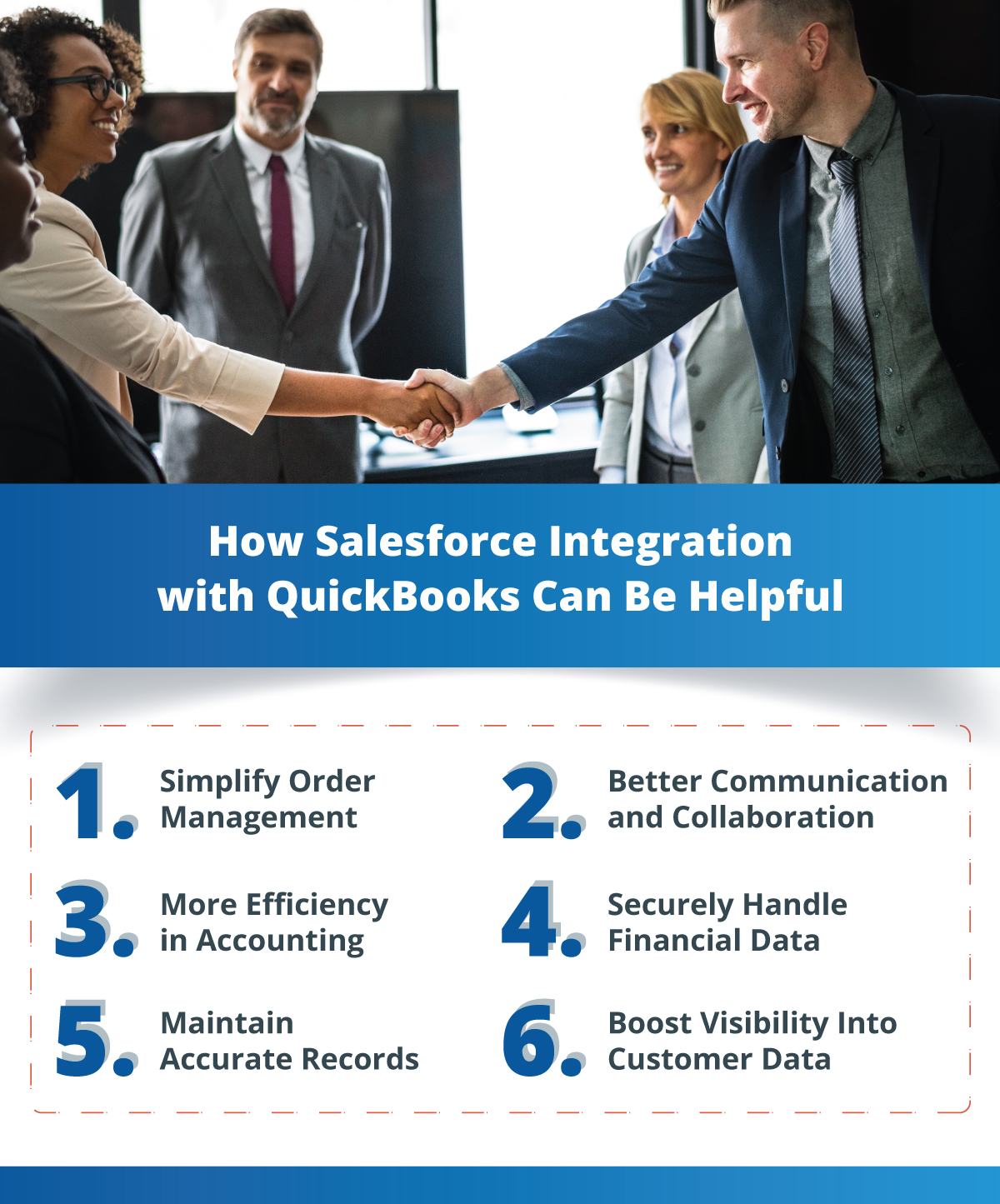
How Salesforce Integration with QuickBooks Can Be Helpful

Collaborating the power of Salesforce and QuickBooks can completely transform the way that you’ve been handling accounting and financial information. This would provide you with a centralized platform from where you can access your accounting information along with customer details. 

We’ve listed some of the top advantages that you’ll uncover when you integrate your QuickBooks account with Salesforce. 

1. Simplify Order Management

Integrating Salesforce with QuickBooks brings a more streamlined approach to order management. Since sales representatives, who are directly involved in generating invoices, often have detailed insights into each sale, this integration allows both sales and finance teams to monitor incoming payments more effectively. 

By uniting these two systems, the process of order management becomes simpler and more efficient, reducing complexity and boosting overall operational accuracy. This is how the integration would simply order management while enabling teams to manage all operations over a single platform. 

2. Better Communication and Collaboration

This integration helps to improve collaboration between sales and accounting teams. This enables teams to get better clarity of their roles and responsibilities by sharing access to the same data. This helps to boost teamwork but also drives greater efficiency and effectiveness across the board.

The integration with the help of a Salesforce integration company would connect all features to present them over a centralized platform that can be accessible by both sales and marketing teams. This would enable teams to always be on the same page when it’s about working with accounting details and information. 

3. More Efficiency in Accounting

This integration also helps to drastically reduce or eliminate errors while saving a considerable amount of time on data entry and maintenance. 

Teams can automate the data sync between both platforms, eliminating the need to manually enter the data.  This not only minimizes the risk of mistakes but also helps to keep the data secure. 

4. Securely Handle Financial Data

Losing critical data is every company’s worst fear. However, after conducting the integration you can be sure that your customer details, financial records, and other vital information are securely stored in the cloud, safe from potential threats.

We all know how crucial it is to safeguard the business and client accounting details and any negligence can cost a lot to the company. By integrating both platforms with the help of Salesforce integration services, you can safely work with the accounting details while accessing the contact details over the same centralized platform. 

5. Maintain Accurate Records

A key principle in both accounting and auditing is completeness—ensuring that all transactions are accurately recorded and securely stored. This makes it easier to track them in the future. With the integration of QuickBooks and Salesforce, you can effortlessly generate and organize customer receipts, monitor these records, and keep a close eye on all your receivables. This powerful combination provides you with the clarity and control you need over your financial data.

6. Boost Visibility Into Customer Data

The integration offers enhanced visibility into your sales and customer data. You can easily track payments and other transactions along with other customer related details like purchase history and contact details. This is possible by the combined power of both the solutions. 

This comprehensive view with Salesforce integration allows you to gain a deeper understanding of your customers’ preferences, so representatives can make informed decisions when it comes to transforming strategies for marketing and sales.

Salesforce Integration with QuickBooks for Simplified Accounting

It is clear that the integration of both the platforms would make accounting and data management easier for different businesses. It helps to boost cross-departmental collaboration, empowers businesses to make more informed decisions, enables teams to manage customer financial details safely, increases efficiency, and elevates customer experiences. 

As customer expectations continue to rise, leveraging such integrated solutions isn’t just beneficial—it’s essential for achieving success. So, what you need here is to have a certified Salesforce professional. Contact us and connect with an expert who can help to integrate your QuickBooks with Salesforce, giving you the best of both worlds. 

Battling Poor Email Deliverability with Salesforce Verify the Email 

Among various communication tools available today, email marketing still stands as one of the most critical approaches toward business success. However, even if they are written with great attention to detail, emails can still be ineffective if they have low deliverability rates. It is important to have a grasp of this problem so as to maximize the impact of your marketing and interact in a way that is effective with your audience. In this blog, we will discuss the issue of lower email delivery rates, discuss why data quality is critical in this context, and finally tell you how Salesforce Verify the Email can help to solve this problem.

Understanding the Problem: What is Poor Email Deliverability?

Email deliverability can be defined as the actual percentage of the mail that successfully gets through to the concerned recipient rather than getting bounced or directed to the spam folder.

Invalid or Outdated Email Addresses

One of the main factors influencing the low deliverability rate is the existence of incorrect or irrelevant email addresses in the recipient list. If emails are sent to the wrong or inactive email addresses, then they are most likely to bounce or return. Mined bounces, specifically hard bounces, where an email is sent to a permanently non-existent address, immediately affect your deliverability and your sender’s worthiness. High bounce rates also alert the ESPs about the possibility of it hosting a low-quality list, thus more of your future messages being blocked or blacklisted.

High Bounce Rates

Bounce rates are a key indicator of email deliverability issues. Bounce rates are relative to the total count of emails that are recovered as undeliverable. Bounce rates usually are of two types, namely hard bounces and soft bounces, even though the former is permanently undeliverable. Every bounce is a problem for deliverability, but the hard bounces are especially so because they point to a more serious problem of the legitimacy of an email list. High, regular bounce rates also negatively affect your sender’s reputation, rendering it even more difficult to deliver any future messages to the intended recipients’ inbox.

Poor Sender Reputation

Sender reputation is one of the key factors that dictates the mailbox inbox or spam folder location of your emails. For instance, a poor sender reputation occurs when one has high bounces and complaints and sends messages to invalid email addresses. The most effective way to keep a healthy sender reputation is by cleaning your list and following best practices for email marketers. Loss of sender reputation means that you are likely to experience poor deliverability of your emails regardless of the type of email marketing that you are conducting.

Impact on Campaign Performance

Poor email deliverability has a rather close relationship to the effectiveness of your email marketing. If your emails fail to land in the primary folder known as the inbox, they will never be opened and read or prompt any actions. This leads to such consequences as reduced participation rates, decreased conversion results, and, ultimately, decreased return on investment (ROI). Also, delivery problems that constantly occur negatively affect the image of your brand and your audience’s confidence in your information, which is crucial when working on your marketing objectives.

The Role of Data Quality in Email Deliverability

This is something that commonly causes low email deliverability, and there is no necessity to mention its name; it is called poor data quality. If you have a list of 2000 names and email addresses, which actually may include the wrong or old email addresses, every time you launch a campaign it is already in trouble. Bad addresses lead to hard bounces, and that is really bad for the sender’s reputation. Heavy bounces are the direct consequence of sending emails to invalid addresses. Since any provider of the email service does not like situations where they receive hard bounces, they can end up filtering all your emails to the spam folder or even completely barring the emails from reaching your targeted recipients.

A sure way to avoid low deliverability rates is to ensure that the users’ details in the email list are accurate and recent. This is where Salesforce Verify the Email comes into play.

How Salesforce Verify the Email Solves Poor Deliverability

Salesforce Verify Email is aimed to solve the problem of low email deliverability by verifying the data in your email lists. 

Reducing Bounce Rates

Another best part to verify the email address in Salesforce is that it helps minimize bounce rates. To avoid the occurrence of hard bounces, it is always advisable to double-check the addresses before including them in the database. This pro-active validation assists to keep the list of e-mail addresses clean thus enhancing deliverability rates and safeguarding sender credentials. This means that with a low number of bounces, your emails will get to the intended inbox and deliver the desired effect.

Improving Sender Reputation

It is vital to have a good sender reputation when it comes to email marketing. Verify the Email enables you to improve your sender reputation by providing a list of verified and valid email addresses. When your list is filled with safe and active subscribers, you will have a good sender reputation and your emails will not end up in the spam folder or filtered by ESPs.

Enhancing Data Quality and Campaign Success

The advantage of using Salesforce Verify Email is that it offers real-time verification and ongoing data management hence enhancing data accuracy. One of the ways that this can be done is through the real-time verification tool, which makes it possible to verify the email address in Salesforce as it is entered into the database. Furthermore, constant checking and verification also assist in maintaining a clean and current email list. Thus, with high data quality, email verification helps in targeting the audience and personalizing your campaigns in order to achieve better engagement and hence a better campaign result.

Cost-Efficient Operations

Furthermore, Salesforce Verify the Email is effective for cost optimization, and it enhances deliverability as well. By avoiding having to target the wrong email addresses, you will hence avoid having to spend a lot of money on marketing and resource management. The fact that this tool makes everything effective also extends to the organizational aspect, as your marketing team does not have to spend its time worrying about data quality problems while being able to concentrate on creating powerful campaigns.

Conclusion

A very low percentage of successful deliverability can be very damaging to your email marketing. Poor deliverability must be tackled at the root level, which usually requires implementing the right tools so that your email marketing campaigns are more successful. Salesforce Verify the Email is a very effective way of solving the issue of poor deliverability because it provides you with the means to check your data and ensure that it is valid and accurate.

When you verify the email address in Salesforce,  you can overcome barriers that lead to high bounce rates, low sender reputation, and complaints. Since verification is done in real-time and the data get updated regularly, high-quality of data is ensured, contributing to the success of your email campaigns. Never let bad deliverability be a reason to stop your business growth—start using Salesforce Verify Email to make your email marketing magnificent today! Contact us to learn more.

Different Ways Salesforce Consulting Partner Can Help with Salesforce Adoption

Salesforce is adopted by companies across different industries, considering its customizable features and scalability. But not all employees are able to adopt Salesforce easily. The best approach for companies is to get help from a Salesforce consulting partner to use the platform the right way and maximize Salesforce utilization. 

We’ve covered here some of the major challenges that people come across with Salesforce adoption with some ways to overcome them. 

Common Challenges with Salesforce Adoption

It is common for many companies to face multiple challenges while using Salesforce to adopt it efficiently. We have listed a few of the common challenges faced by companies.

1. Avoiding Change

Many companies and their employees are used to working with legacy systems due to which they fear to adopt new systems. Employees may be reluctant to use Salesforce when they are new to it, fearing additional work and training.

It’s crucial to clearly communicate the benefits of Salesforce adoption to your team and they should be aware of how the platform is in alignment with their business goals. Effective change management should be a central component of your Salesforce adoption strategy. Involving employees at every stage is key—this includes transparent communication about why Salesforce is being adopted and the positive impact it will have on the entire company, particularly for employees.

2. Issue with the Data Quality

Salesforce adoption can be very challenging, especially when the quality of data is affected. This can also be caused due to Incomplete records, duplicate data, and inaccuracies.

There are chances when sales representatives can miss out on managing Salesforce records due to a confusing user interface and the tedious nature of data entry. This leads to incomplete and inaccurate data, further compounded by existing data quality issues. These CRM data challenges are common and can seriously impact user productivity and confidence in the platform.

To overcome these hurdles, your company must prioritize data governance throughout the Salesforce adoption process. Clear guidelines and standards for data entry, maintenance, and integration are essential.

3. Lack of Customization

Even when a business invests in Salesforce, the standard version often falls short of addressing all the intended challenges. Insufficient customization and a subpar user experience can create significant hurdles during the adoption process. Default settings rarely align perfectly with an organization’s unique needs, leading to potential adoption issues.

To overcome this, it’s essential to customize Salesforce by tailoring the interface, creating personalized reports and dashboards, and implementing process automation features. By doing so, you can enhance user satisfaction and significantly improve adoption rates.

Best Strategies for User Adoption Followed by The Best Salesforce Consultant

It’s true that adopting Salesforce can be challenging but that could be easier when you follow the best practices suggested by the best Salesforce consultant.

1. Get Stakeholder Support

You should engage with the leadership team and key stakeholders to build acceptance and backing for Salesforce implementation. A Salesforce consulting partner can help emphasize the anticipated benefits and the value Salesforce will bring to achieving the organization’s goals. Demonstrating to executives how Salesforce can drive business success will help eliminate potential adoption challenges and significantly improve the adoption rate.

2. Focus on Training

While enthusiasm is crucial for driving change, it’s equally important that your team possesses the necessary knowledge and skills to adapt and refine existing workflows. Providing thorough training is key to ensuring successful Salesforce adoption and its effective integration into daily operations.

Start by teaching your team the fundamentals of Salesforce navigation and account management. Once everyone has a solid grasp of these basics, move on to role-specific training that aligns with their individual responsibilities, such as editing contact records or building reports.

3. Work on Change Resilience

Understanding the specific needs and workflows of your end-users is key to crafting messages that resonate, from the initial product launch to training sessions and ongoing support. Consider creating detailed, step-by-step Salesforce guides and embedding them in Knowledge articles for easy reference.

Employees might still be hesitant to embrace the change during the Salesforce adoption process despite thorough training and resources. To counter this, motivate Salesforce usage by gradually reducing reliance on legacy systems, introducing Salesforce-exclusive processes, and conducting performance reviews based on Salesforce data. Additionally, consider implementing gamification elements for peer-based adoption and rewarding users who actively incorporate Salesforce into their daily routines. These strategies can help ease the transition and encourage consistent use of Salesforce across the organization.

4. Focus on Metrics

It’s essential to implement feedback practices and Salesforce adoption tracking reports. These tools will allow you to monitor the adoption process, identify users who may need additional support, fine-tune training materials, and plan future release communications.

Key metrics for successful Salesforce adoption include user login frequency, record creation rates, contact and opportunity generation, activity completion, and task status updates. Regularly tracking these metrics with the help of a certified Salesforce consultant provides valuable insights into user engagement, allowing you to assess and enhance adoption rates over time.

Get Help From a Salesforce Consulting Partner for Smooth CRM Adoption

To maximize the benefits of Salesforce without adding complexity to your business, rely on top experts to address all your Salesforce challenges. The right Salesforce partner can streamline your adoption process by customizing reports and dashboards, giving your team quick access to crucial data in one place. 
The best consultants can also conduct a Salesforce audit to ensure that your implementation delivers the full potential of the platform. Contact us to get the certified Salesforce professionals to assist you with Salesforce adoption.

Grow Your Financial Services Operations with a Salesforce Development Company

Considering the sensitive nature of data maintained and operations conducted, financial services firms have always been on the lookout for the best technologies that can simplify their operations and boost their productivity. Hiring a trusted Salesforce development company is one way to ensure having the right support of experts to manage financial services operations. 

Do you know what makes the top choice of CRM for financial services firms? It’s the customizability and security it offers to tailor the operations according to the business while safely handling sensitive client and business information. 

However, you need to have the right support of experts to implement and manage the platform for maximum utilization. That’s where Salesforce consulting services step in to help firms leverage the CRM the right way.

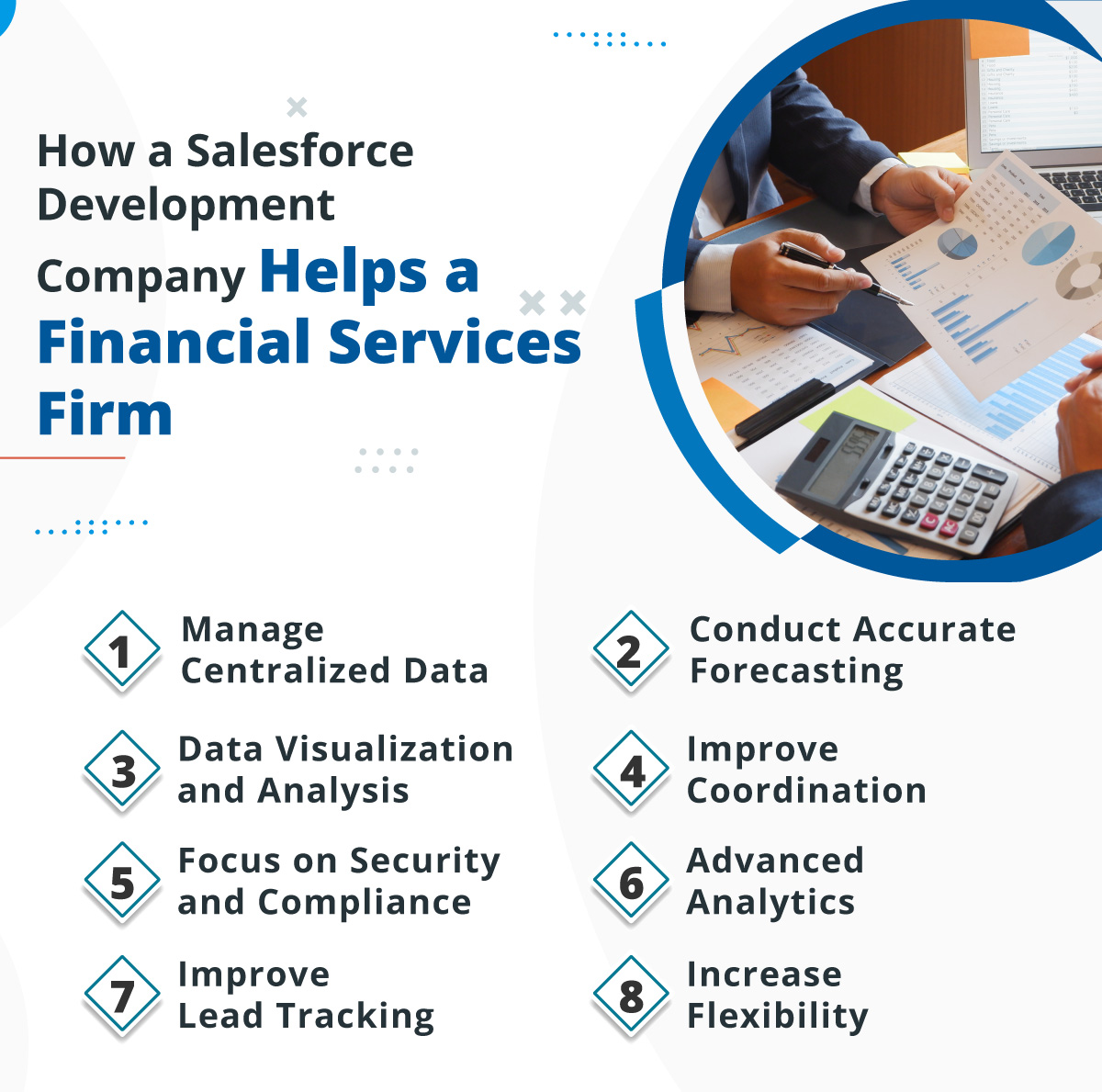
Salesforce Development Company to Assist a Financial Services Firm Grow

Hiring Salesforce development services has become a common and efficient practice among businesses from different industry segments, specially for financial services. This is due to the range of support and services they tend to offer. So, let’s cover some points here on how exactly these trusted Salesforce partners can help companies dealing in financial services.

1. Manage Centralized Data

Salesforce offers a unified view of your business data with instant, reliable access, streamlining operations by eliminating the need for duplicating client information across different systems. This enables financial services professionals to make investment decisions with the customer’s perspective in mind, allowing for personalized offerings that provide a competitive edge over other institutions.

2. Conduct Accurate Forecasting

Financial services professionals often face a lot of difficulty to work with predictions and forecasting for which they fail to have the right solution. Salesforce CRM empowers them with timely access to crucial client data, enabling more accurate financial decisions and budget forecasts.

With Salesforce, executives can better anticipate future income, assess potential risks and opportunities, and take proactive measures to stay ahead.

3. Data Visualization and Analysis

Forrester research indicates that 89% of companies using algorithm-driven financial services for decision-making gain a significant competitive edge.

Salesforce’s real-time analytics equip financial advisors with the tools to precisely budget, forecast expenses, and take immediate corrective action. Powered by artificial intelligence, these analytics provide crucial insights and unparalleled visibility into the customer journey, revenue, retention, and churn.

Moreover, Salesforce CRM presents data through customizable reports and dashboards, making complex information easily digestible. Financial professionals can tailor these metrics to monitor exactly what they need, when they need it.

4. Improve Coordination

According to a Salesforce report, 67% of respondents believe that better coordination between finance and sales can significantly enhance forecasting and boost revenue growth.

Few other CRMs for financial services can manage millions of records while effectively supporting financial agents, marketers, and support teams across globally distributed departments.

More importantly, Salesforce development services provide all these teams with a bird’s-eye view of customer data, no matter where the customer or team is located. This connectivity links all data sources, enriching customer experience profiles to offer a complete picture of your audience and a deeper understanding of client needs.

5. Focus on Security and Compliance

Salesforce integrates security into every aspect of its platform, effectively managing risks and ensuring regulatory compliance. It offers a range of security features, including security health checks for regular system audits and inspections after each release.

Additionally, a Salesforce development company supports multi-factor authentication to safeguard both corporate and client data. With these robust security measures in place, your team can confidently and efficiently carry out their tasks.

6. Advanced Analytics

Salesforce includes a built-in analytics dashboard powered by advanced AI. You can access reporting features and custom dashboards to enable your financial team to make smarter decisions that will help companies achieve growth.

Financial firms can also access the Salesforce Financial Services Cloud to manage the entire financial life cycle of your business. Financial Services Cloud offers numerous advantages for organizations looking to streamline their finance operations whether it’s for forecasting, reporting, or budgeting.

7. Improve Lead Tracking

When it’s essential to closely monitor leads and referrals, Financial Services Cloud makes it effortless. By utilizing integrated partner apps and other powerful tools within the Salesforce ecosystem, you can effectively manage and track leads. Additionally, the platform’s robust referral components enable your finance team to efficiently track and manage referrals. Upon lead conversion, the system automatically creates an account and opportunity, streamlining the process further.

8. Increase Flexibility

Salesforce allows wealth management firms, retail banks, insurance agencies, and other financial sectors to tailor CRM functionality to their specific needs. For instance, you can build a customized commission calculator or set the system to highlight upcoming events.

Additionally, Salesforce’s low-code, click-not-code interface lets you customize the platform using pre-defined code blocks, enabling the creation of custom workflows without the need for developers.

This low-code approach allows financial institutions to replicate their real-life processes within the system quickly, without the need for extensive coding. Moreover, this modular setup simplifies future scaling without compromising previously developed workflows.

Manage Financial Operations with a Salesforce Development Company

Managing financial information and operations can be a real challenge. It can be even worse when the team does not have the right solutions to manage it all. Implementing Salesforce can help your team work with a CRM solution that can be customized according to your business needs. That’s how you’ll be able to manage all operations while achieving customer satisfaction. So, contact us and get with one of our trusted experts to discuss your existing challenges.

What Makes Pardot Implementation The Best Way to Marketing Automation

Every business around the globe tries to achieve a deeper understanding of their customers. The main focus always remains on boosting customer experiences and delivering personalized content that drives lead generation . There’s a lot that comes along with sales pipeline management, involving coordinating online and offline channels, social media engagement, and interactions at meetings and industry events. Marketing automation is essential in this competitive market. When executed properly, it can dramatically boost Return on Investment and enhance your overall business performance. That’s where Pardot implementation will help.

Pardot is the key to marketing automation. You can achieve seamless marketing automation, improving marketing results, and faster growth with Pardot.

This blog will emphasize on the value of Pardot to enable marketing automation in businesses. 

Marketing Automation for Businesses by Pardot Implementation

Marketing has its own importance for every business, helping them to build a brand image among the audience. And to make it more effective, marketing automation can bring in real transformation. 

Here we have covered different ways Pardot implementation can help businesses make the most of marketing automation. 


1. Better Sales Funnel Management

Pardot helps to  efficiently manage your sales funnel and streamline the sales process. Pardot helps you identify high-value prospects and prioritize them for your sales team by leveraging lead tracking and scoring. Automated lead assignment ensures that every lead receives prompt follow-up, minimizing the risk of missed opportunities. 

Moreover, Pardot’s seamless integration with Salesforce fosters collaboration between marketing and sales teams, enabling smoother handoffs and boosting conversion rates.

2. Automated lead qualification

Pardot comes to the rescue to help the sales team to evaluate leads automatically. A Salesforce Pardot consultant can help to automatically score leads, according to the previous engagement with customers. This automation enables sales teams to enhance conversion rates and boost overall sales performance by concentrating on the most qualified leads.

3. Easier Campaign Management

There are numerous amazing Pardot features that can help to simplify your campaigns, thus enabling you to create and monitor marketing campaigns faster and more efficiently. Pardot takes the hassle out of manual tracking and coordination, from setting up landing pages and forms to tracking performance. This allows marketers to concentrate on crafting engaging content and optimizing their campaigns. With Pardot, you can simplify your campaign management process and achieve superior results.

4. Automate Email Marketing Campaigns

You can create and run automated email campaigns by efficiently using Pardot that deliver timely and personalized messages to your contacts. From running an attractive welcome email for new leads or a nurturing campaign for existing customers, Pardot’s B2B marketing automation ensures each email is sent at the optimal time. This helps to strengthen relationships and boost conversions.

5. Targeted Lead Nurturing

Nurturing leads have now become easier. You can now nurture leads through every stage of the buyer’s journey, all possible with Pardot consultants. Working with dynamic content and automated drip campaigns helps teams provide relevant information to prospects, making it easier to work around the funnel and engage with them in a better way.

Pardot Salesforce integration also helps by segmenting leads based on demographics, behaviors, and interests, thus making targeted lead nurturing easier. B2B marketers can deliver customized content and offers to each segment, ensuring prospects receive the information they need to make informed purchasing decisions.

6. Workflow Automation

Teams should prioritize strategic tasks that require human insight, like crafting new campaigns and fine-tuning existing ones. Pardot supports marketing teams by automating routine tasks and optimizing workflows. Its automation capabilities allow teams to save time and effort while maintaining a steady and timely execution of marketing activities.

7. Account-Based Marketing

In B2B marketing, key accounts demand tailored attention. Pardot helps marketers in businesses from different industry sections to craft personalized communications for each account. This enables reps to work on fostering deeper connections with decision-makers and influencers.

Pardot Salesforce integration enables businesses to access some wonderful strategies for account-based marketing through which you can monitor engagement at the account level. This will enable you to evaluate your marketing strategy performance, and refine your approach as needed. By delivering customized experiences to key accounts, businesses can boost their opportunities for securing valuable partnerships and deals.

Pardot Implementation: Your Way to Growth

There are numerous advanced features in Pardot that you can uncover with the right professionals. After implementing Pardot, you can access features to create automated nurture campaigns and to connect with prospects right from your email inbox. These powerful features can give you a competitive advantage and elevate your marketing strategy to help you business lead

Implementing Pardot features the right way can help you engage with your audience more effectively and meaningfully. So, explore Pardot and unlock the full potential of your marketing automation journey!


logo Live Chat