
Talk to Us

10 Reasons Salesforce Managed Services Are a Game-Changer in 2026 

As Salesforce continues to rule top CRM charts, many businesses are turning to Salesforce managed services ensure they are getting the most out of their investment.  

You have spent dollars on implementing and customizing your Salesforce instance. But as the months roll by and performance starts to dip, you don’t want your shiny new CRM to lose its edge. That’s why taking Salesforce managed services is crucial. 

In this blog post, we’ll talk about the top 10 reasons why Salesforce managed services can be a breakthrough solution for your business in 2026 and beyond.  

Top 10 Reasons to Go for Salesforce Managed Services   

Whether you’re scaling, optimizing, or transforming, here’s why managed services are reshaping the way businesses extract value from their CRM.

1. Implementation isn’t the Finish Line, It’s the Starting Point

The biggest mistake that companies make is they invest a lot of time and money implementing Salesforce but fail to keep the system up to date. This is because internal teams lack bandwidth for continuous optimization. Salesforce managed services ensure ongoing alignment between the platform capabilities and evolving business needs.  

2. Rising Complexity Demands Cross-Skilled Experts 

Today, Salesforce orgs often span multiple clouds, custom apps, and third-party integrations. Managing all that in-house means maintaining a team of admins, architects, developers, and analysts. With managed services, you get access to that full spectrum, on demand, without bloated headcount. 

3. Budget Constraints are Forcing Smarter Delivery Models

Hiring halts, delayed backfills, and limited tech budgets are making full-time hires less viable. That’s where managed services offer continuity without long-term cost commitment and provide you flexibility without sacrificing delivery.  

4. Proactive Monitoring Reduces the Reactive Firefighting 

In unmanaged Salesforce orgs, small issues like duplicate records, broken workflows, and degraded performance snowball. And if you go for Salesforce managed services, you can get proactive health checks, usage tracking, and real-time performance monitoring to eliminate the friction before it blocks growth.  

5. Release Cycles are Too Fast for DIY Admins 

As we all know, Salesforce delivers three major releases every year. These releases are often heavy on automation, AI, and UI changes. And if you miss any one of them, you can lag behind and lose customers. However, with managed services, you can get release-readiness baked in, from sandbox previews to feature enablement and change management.  

6. Data Quality is a Strategic Advantage 

It is a no-brainer that Salesforce without data quality becomes a liability. Your database will be clogged with duplicates, dead leads, and conflicting records. And that’s where managed services offer ongoing data audits, deduplication, and enrichment workflows to ensure your reports are reliable.  

7. Automation and AI Needs Governance

In 2026, every business wants Flow, Agentforce, Einstein GPT, and AI agents, but many of them struggle to offer governance. Without a governance layer, automation sprawl can create risk instead of value. However, Salesforce managed services build and maintain automation frameworks with compliance and scalability in mind.  

8. End-User Adoption Doesn’t End with Training 

Adoption drop-off after go-live is still one of the top reasons Salesforce ROI stagnates. Leveraging managed services will allow you to get ongoing user support, refresher training, and UX improvements to drive stickiness and self-serve success.  

9. IT Teams are Done Being the Middlemen 

Internal IT teams are not Salesforce experts, and they’re overwhelmed. Therefore, it’s time you utilize Salesforce managed services that can act as your Salesforce center of excellence. It can bridge the gap between business users, vendors, and internal IT with strategic ownership.  

10. Grow Without Actual Hiring 

Yes, you read that right. The most tech-savvy Salesforce organizations are scaling output without scaling teams. Managed Salesforce services allow you to scale workflows, processes, and features without growing internal operations. 

The Bottom Line

In 2026, Salesforce managed services are no longer just for support. They are strategic, proactive, and crucial for making Salesforce a true growth engine.  

Ready to Get More Value from Salesforce Without Hiring? Let’s Talk! 

If you need an extra set of hands managing your Salesforce instance, our Salesforce experts would be happy to help. Just drop us a line at contact@360degreecloud.com, and we’ll take it from there! 

Best Phone Number Verification Service in the USA

In the market, where relationships with customers, lead generation, and data accuracy impact the revenue, valid phone numbers in your CRM should be a priority. No matter which area of business you work in, whether it is sales, customer service, or marketing, accurate and actionable contact data is essential. Especially for Salesforce users, phone number verification service in Salesforce is not just a good-to-have feature—it’s an operational necessity. If you are searching for top phone number verification services in the USA, this post will explain how you can find one that is quick, accurate, and automatic.

Is There a Way to Verify a Phone Number

Absolutely. How to verify a phone number depends on the level of detail and accuracy you want. ​There is more than one approach to do this.

  • Basic Format Validation: Ensures the number is formatted in the usual way.
  • Number Type: Check if the number is mobile, landline, or VoIP for making the most of the available numbers using the right outreach method.
  • Line Activity Check: Verify if the number is active and running so you can call the person.
  • OTP Verification: Sent a code to check that the user really owns that number.

For those using Salesforce, integrating this process inside the CRM makes everything much quicker and automated. Now that the basics are laid out, businesses can enhance their verification process by selecting smarter tools designed to be both fast and able to handle a high volume. So, it is the ideal time to consider a well-developed Salesforce-native solution that quickly and reliably verifies phone numbers without leaving your CRM, Verify the Phone (VTP).

Why VTP is the Best Salesforce Phone Number Verification Service in the USA

How to verify a phone number effectively? This is a million-dollar question when data accuracy is a priority and numerous options are available. Verify the Phone (VTP) stands out as the leading choice for phone number verification in Salesforce. The solution exists to support modern Salesforce users who expect quick, accurate, and smart techniques in the contact validation process.

1. Seamless Salesforce Integration

VTP is Salesforce-native, which means no external tools, no clunky APIs, and no data exit. It works smoothly within your existing Salesforce environment, offering verification without interrupting your workflows.

2. Real-Time and Bulk Verification

Whether you’re validating one number at the point of entry or verifying thousands in bulk, VTP handles both with ease. This flexibility is crucial for fast-moving sales and marketing teams that can’t afford to waste time on manual checks.

3. Improved Data Quality

Improved data quality drives better business results. Verified phone numbers reduce failed calls and undelivered SMS messages, leading to higher engagement with customers. This increased accuracy boosts conversion rates, enhances customer satisfaction, and ultimately drives more revenue by ensuring your outreach efforts connect with real, active contacts.

4. Automation and Workflow Optimization

VTP lets you automate phone number verification in Salesforce as part of your data cleaning processes. This ensures that every new lead, contact, or case that enters your system is instantly validated, reducing manual work and the risk of human error.

5. High Accuracy for U.S. Phone Numbers

VTP is designed to deliver precise verification results for U.S. and other countries’ phone numbers. By identifying invalid, inactive, or high-risk numbers upfront, it helps reduce compliance risks, particularly around regulations like TCPA, by allowing teams to engage only with legitimate, reachable contacts.

What Makes VTP Different from Other Services?

  • Salesforce-Native: No integrations or third-party apps required.
  • Carrier Detection: Know whether it’s a mobile, landline, or VoIP number.
  • Status Check: Know if the number is active or disconnected..
  • Point-of-Entry Verification: Stops bad data before it enters your CRM.
  • Web-to-Lead and Web-to-Case Verification: Instantly verify phone numbers captured through online lead forms or support case submissions, ensuring only valid, actionable numbers enter your Salesforce database.

What Difference VTP Makes to Your Business

– Reliable Contact Data for Long-Term Success

Verified and up-to-date phone numbers help businesses reduce communication failures, improve engagement, and support scalable sales and marketing efforts, ensuring every outreach is based on trustworthy, high-quality contact data.

– Higher Conversion Rates from Accurate Outreach

Focusing outreach on verified contacts ensures communications are relevant and effective, which boosts engagement, builds trust, and significantly increases the chances of converting leads into loyal, long-term customers.

– Streamlined Lead Management

Filtering out fake or inactive numbers right at entry saves teams valuable time, allowing them to concentrate efforts on genuine, qualified prospects and improving overall sales efficiency and productivity.

– Enhanced Trust, Better ROI

Accurate phone numbers ensure that your team’s outreach is productive. There’s no wasted time calling dead numbers or following up with invalid leads. This boosts your campaign performance and delivers a stronger return on investment.

– Built for Scale

Whether you’re a small business or an enterprise planning for effective Salesforce bulk messaging or outreach, VTP can handle massive data volumes. Bulk verification processes can be scheduled or triggered automatically, giving your teams more time to focus on engaging prospects.

– Improved Deliverability and Contact Rates

Bad phone data can damage your sender score and reputation with telecom providers. With VTP, your messages and calls are delivered only to numbers that are correct and reliable, improving both reach and reputation.

Final Thoughts

In the U.S. business environment, where every lead and customer interaction counts, clean contact data is more important than ever. Knowing how to verify a phone number efficiently within your CRM is a competitive advantage. For businesses using Salesforce, Phone Number Verification in Salesforce becomes seamless and powerful with Verify the Phone (VTP). It delivers real-time accuracy, automation, and peace of mind. If you want to supercharge your contact strategy and avoid the pitfalls of invalid data, VTP is the best phone number verification service in the USA to trust.

Start verifying smarter, not harder.

Top Salesforce Consulting Firms in 2026 

Salesforce consulting companies play a vital role in helping businesses maximize the potential of their Salesforce investment. And as of 2026, the AppExchange platform has a great network of more than 3400 consulting and services partners, backed by over 170,000 Salesforce-certified experts globally. And in the USA alone, there are over 1900 consultancies highlighting the wide reach and proficiency available to businesses looking for specialized Salesforce consulting solutions.  In our A-list of top Salesforce consulting companies in the USA, we have highlighted the firms that are technically exceptional and also forward-thinking—leaders who combine deep Salesforce expertise with industry specialization and a track record of delivering measurable business results. 

Top Salesforce Consulting Companies to Consider in 2026 

Let’s take a look at the top Salesforce consulting companies in 2026 that you might want to consider for your business. 

1. 360 Degree Cloud

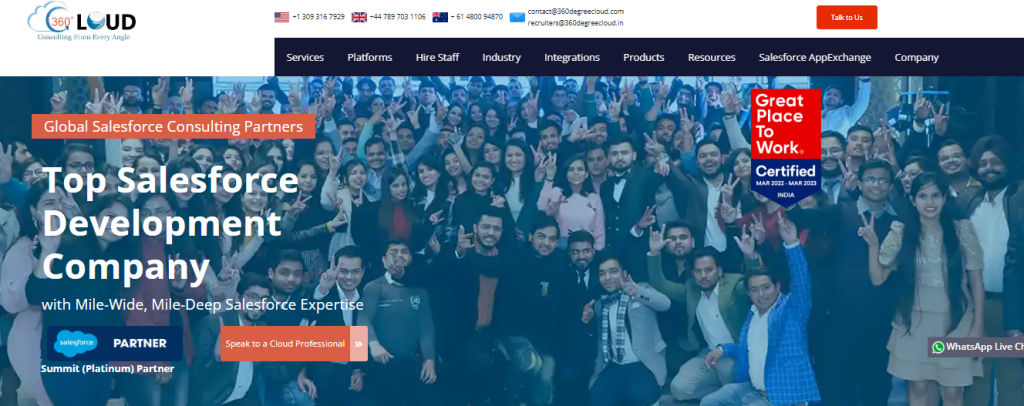
360 Degree Cloud is a 13+ year-old organization and Salesforce Summit Partner. They have carved out a niche in 2026 by blending Salesforce consulting with AI-first product development. It is a CRM Consulting and Systems Integration company specializing in Salesforce solutions that have functional operations across 30+ industries. Across reviews, 100% of clients admired their great project management, timely delivery, and transparent communication. 360 Degree cloud offers Salesforce managed services, Salesforce AppExchange development, Salesforce implementation, and Salesforce augmentation services along with custom software development. They also specialize in Salesforce solutions like Einstein, Agentforce, Marketing Cloud, Sales Cloud, Service Cloud, Non-Profit Cloud, and Mulesoft. 

  • Founding Year: 2012 
  • Headquarters: California, Faridabad 
  • AppExchange Products: 6+ 

2. Think Beyond

Think Beyond is a UK-based Salesforce consulting company known for offering tailored CRM solutions to enterprise clients across Europe. They have over 60 certified Salesforce professionals who combine business acumen with platform expertise to help businesses strengthen their operations and drive growth. They operate across various industries and offer different solutions like Salesforce development and integration, Zendesk to Salesforce migration, Genesys Cloud CX implementation, etc. 

  • Founding Year: 2018 
  • Headquarters: London, UK 
  • AppExchange Products:

3. Ascendix Technologies

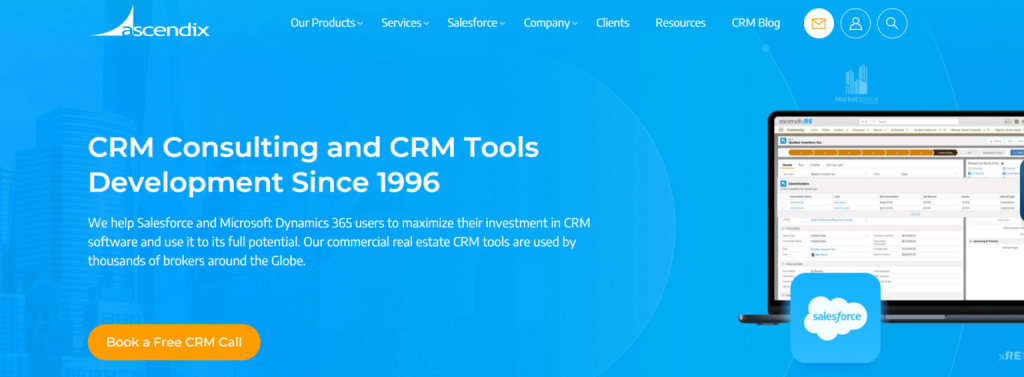
Ascendix Technologies is a Salesforce Summit Partner and AppExchange Partner with over 20 of experience. They specialize in CRM consulting and custom software development services, Salesforce implementation and optimization, Salesforce migration, AI consulting, Salesforce configuration and customization, Salesforce integration, etc. They operate in different domains like commercial real estate, residential real estate, private equity, capital markets, Non-profit and education, Transport and logistics, etc. 

  • Founding Year: 1996 
  • Headquarters: Dallas, Portugal, Poland 
  • AppExchange Products:

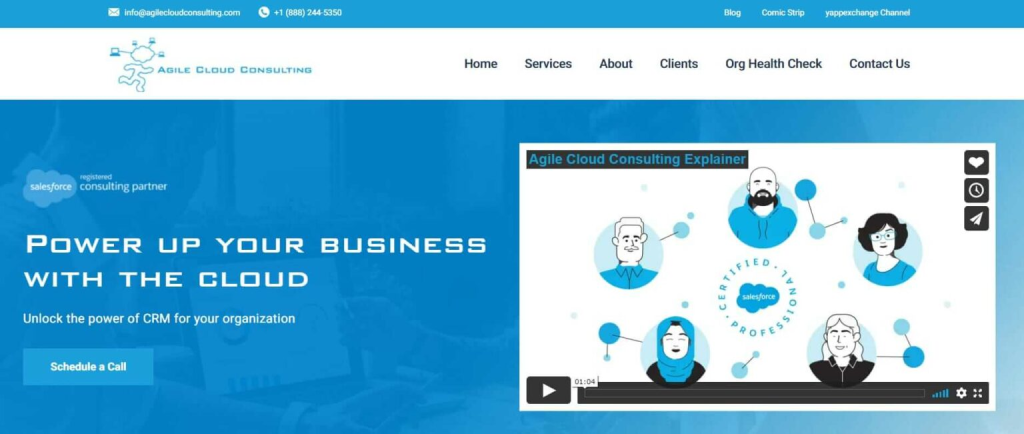
4. Agile Cloud Consulting

Agile Cloud Consulting is a Salesforce Crest Consulting Partner that helps businesses with Salesforce Org check, implementation strategizing, AppExchange App development, data migration, system migration, and Salesforce managed services. They also specialize in Sales Cloud, Service Cloud, Manufacturing Cloud, Health Cloud, Experience Cloud, Non-Profit Cloud, and CPQ Cloud. This consultancy is from New York, and specializing in CRM makes them the best Salesforce consulting service provider within these narrow areas.  

  • Founding Year: 2010 
  • Headquarters: New York 
  • AppExchange Products:

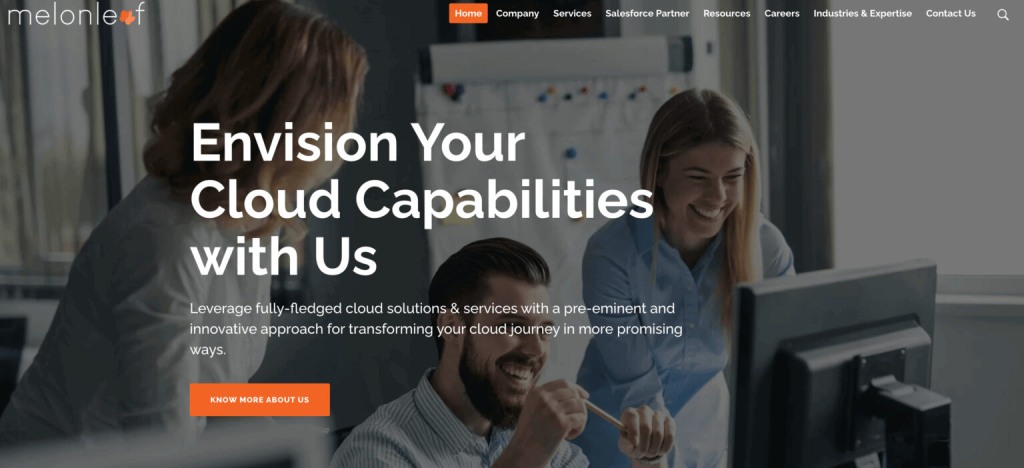
5. Melonleaf Consulting

The next on our list is Melonleaf Consulting, which helps businesses maximize their Salesforce investment by offering services like audits, implementation, administration, support, data migration, Salesforce platform and Lightning development, and AppExchange app development. They primarily offer services to Healthcare & Pharmaceutical, Automobile, Education, Real Estate, and Media & Entertainment sectors. In addition to Salesforce services, they offer support for various platforms like Zendesk, HubSpot, and Pipedrive.  

  • Founding Year: 2020 
  • Headquarters: Claymont, DE 
  • AppExchange Products:

The Bottom Line

In 2026, choosing the best Salesforce consulting partner is not just about implementation; it is all about finding a partner who is delivering continuous innovation. 360 Degree Cloud is leading the way not just because of their headcount or certification but due to their understanding of how to turn Salesforce into a true business enabler.  

Ready to Discuss Your Salesforce CRM Project Requirements? Let’s Talk!

Our Salesforce experts would be happy to help. Just drop us a line at contact@360degreecloud.com, and we’ll take it from there!  
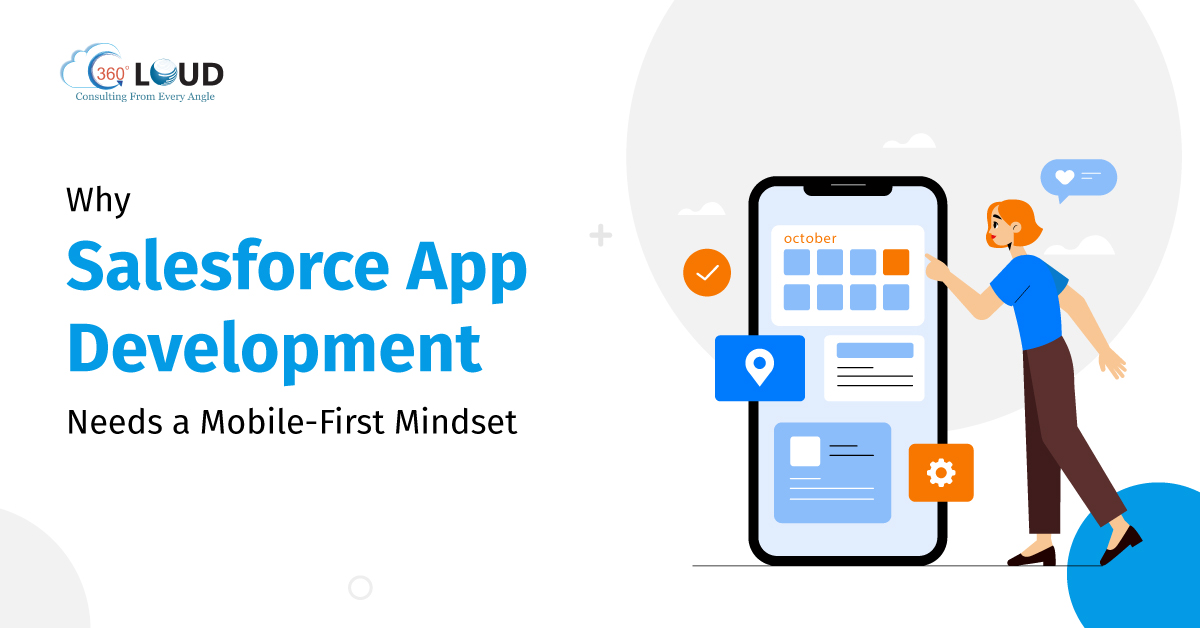
Why Salesforce App Development Needs a Mobile-First Mindset 

If you are sending or receiving a payment, checking the weather, or doing shopping online, there is a strong chance that you are using a mobile application. In fact, people spend 88% of their time on mobile, and there were approximately 288 billion mobile app downloads worldwide, with worldwide spending on mobile apps reaching $171 billion in 2023, as per Statista. The numbers are speaking for themselves. Aren’t they? And to make the most out of this opportunity, you need to focus on the mobile-first approach. Also, sales reps, field service engineers, and savvy customers demand immediate, intelligent, and intuitive mobile experiences. And with the rapid use of AI, offline workflows, and AppExchange ranking algorithms that now support mobile optimization, ISVs and Salesforce consultants must rewire their Salesforce app development services approach. 

Why a Mobile-First Mindset Is Crucial in 2025 

We live in an era where everyone is on the go, and they take actions on the move. And the mobile is the first touchpoint for it, be it updating records or approving deals. Here’s why a mobile-first approach is important for Salesforce mobile app development. 

1. Field-Driven Use Cases Are Increasing 

Mobile has become the key interface for customer-facing roles, for example, salespeople closing deals on-site and technicians updating job statuses in remote areas. The field-driven use cases are especially rising in industries like logistics, manufacturing, healthcare, and energy. It is challenging for these users to tolerate laggy load times and desktop-dependent features. Therefore, you need to show your A-game in your Salesforce AppExchange app development.  

2. AI-Powered Alerts Require Quick Response 

Real-time insights are as good as the real-time action you take on them. Salesforce’s growing suite of AI-driven tools, like Einstein and Agentforce, generates timely alerts that need immediate action. A delay caused by poor UI or an inaccessible action path can cost you revenue and, worst of all, customers.  

3. Offline Access Isn’t Optional Anymore 

You cannot always stay connected, and assuming the same is not safe. This can be due to multiple reasons, like compliance policies, unstable connectivity, and rural deployments. Therefore, while offering Salesforce mobile app development services, it is key to make the most out of Salesforce’s mobile SDKs and offline storage mechanisms. It will ensure that your app works smoothly in offline mode, with intelligent sync logic and user-friendly error handling. 

4. AppExchange Rankings Require Mobile Optimization

AppExchange gives utmost importance to mobile-optimized apps in both visibility and performance scoring. With the mobile-first approach starting to influence your listing’s relevance, poor mobile user experience can negatively impact your app discoverability. Therefore, it becomes a necessity to make your Salesforce app development approach mobile-first in a crowded marketplace.  

5. Integrations Must Work Natively on Mobile 

In 2025, it would be a sin for developers to forget to test how integrations behave in a mobile context because APIs and third-party tools are part of every modern app stack. For example, a seamlessly integrated payment system on desktop can fall apart easily on mobile if it is not optimized. 

Now that we’ve talked about the importance of a mobile-first mindset for Salesforce app development services, let’s shift focus to the best practices for the same. 

Best Practices for Mobile-First Salesforce App Development 

Here are some best practices that you should follow in 2025 and beyond to ensure your app performs reliably in the field and delivers the right value. 

  • Always keep in mind that design for contextual use, not just screens. Design for thumb zones, fast decision-making, and minimal cognitive load. You can use conditional layouts in Salesforce Mobile to tailor UIs by profile or location. 
  • Leverage Salesforce Mobile SDK or Lightning Web Components (LWC) that are mobile-friendly by design. 
  • Build and test offline first. Assume your users will be offline and implement local data storage, intelligent caching, and conflict resolution strategies. 
  • Always implement lazy loading, use compressed images, and remove unnecessary API calls. Also, consider implementing client-side validation and offline-first logic to reduce server dependency. 

The Bottom Line 

In 2025, if you really want to generate revenue from your Salesforce apps, you need to prioritize a mobile-first mindset. And if you are an ISV pushing an AppExchange product, the success truly depends on how your Salesforce solution performs on the users’ mobiles. 

Ready to Develop a Mobile-First AppExchange Product? Talk to Us! 

Our Salesforce developers would be happy to help you. Just drop us a line at contact@360degreecloud.com, and we’ll take it from there! 
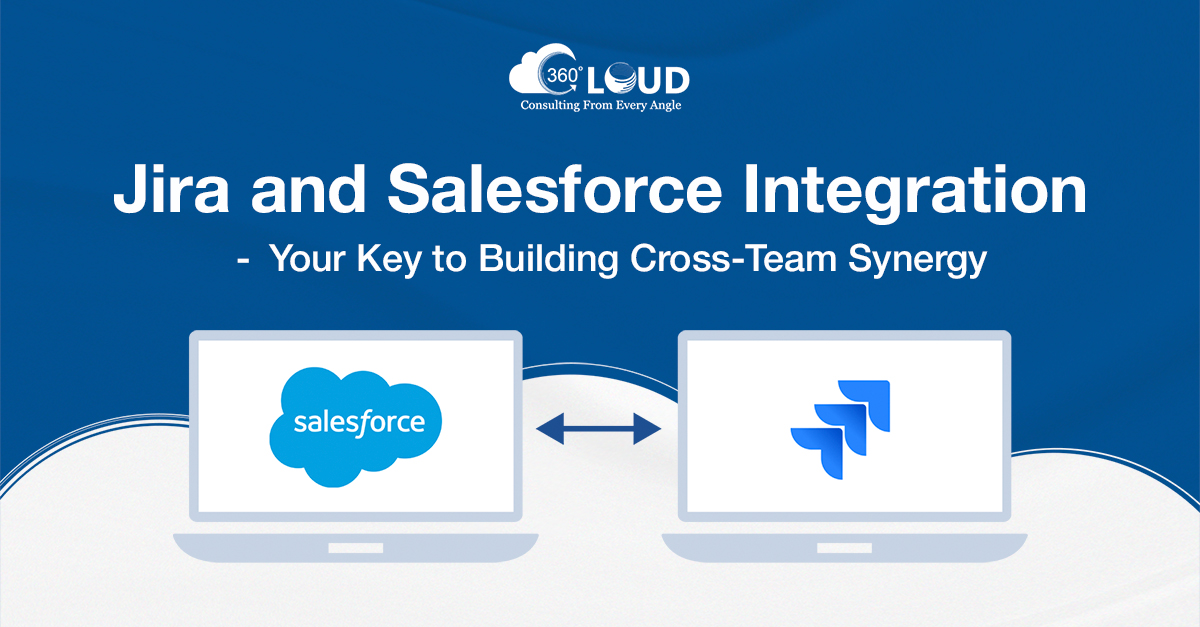
Jira and Salesforce Integration— Your Key to Building Cross-Team Synergy 

To run and manage successful business operations, companies have multiple tools in their tech arsenal. However, if these are not integrated, it can lead to siloed data and disconnected experiences. Therefore, a great way to boost cross-team collaboration is by connecting workplace tools like Jira and Salesforce integration.  

This integration gives teams a single source of truth for customer data, facilitates effective communication, and enables effective tracking of campaigns. In this blog post, we’ll talk about how Jira and Salesforce integration can improve your team’s efficiency and cross-team collaboration initiatives. 

How Jira and Salesforce Integration Drive Cross-Team Collaboration 

Jira and Salesforce integration promote cross-team productivity. Here’s how: 

1. Enable Contextual Collaboration:

Jira and Salesforce integration build a living system of shared context. Also, your team will be able to see: 

  • How a Jira issue affects a live Salesforce opportunity. 
  • Product feedback is captured during the initial sales stages. 
  • Patterns across key accounts or industries that signal risk.  

Similarly, with Marketo to Salesforce integration, marketing campaigns can be directly tied to deal progress, improving demand generation to close won handoffs.  

2. Predict Escalation Risks Early

Gone are the days when sales teams only found out about bottlenecks when the damage was done. With integrated systems, ensure that you: 

  • Get smart alerts for Jira tickets linked to high-value Salesforce accounts. 
  • Active escalations to warn of renewal risks with predictive models. 
  • Trends across Salesforce SharePoint integrations and project documentation reveal bottlenecks early. 

3. Automate Critical Workflows Across Functions

The days of automating simple tasks are gone. With intelligent bi-directional sync, Jira and Salesforce integration now automate: 

  • Specific ticket creation from customer cases. 
  • Prioritization of bugs tied to crucial accounts. 
  • Updates across Salesforce and Jira without human intervention. 

Similar to how NetSuite Salesforce integration streamlines finance and billing operations, Jira and Salesforce integration minimize the friction between sales, service, and development teams. 

4. Solidify Customer-Facing Collaboration

Your support team needs to keep the customers at the center of everything they do. Jira and Salesforce integration help you exactly do that. They can get a holistic view of customer data and can directly access relevant sales data and customer history, and prioritize support tickets. Also, the integration ensures that: 

  • The support team can directly resolve queries without facing data silos. 
  • The sales team knows the status of unresolved engineering tickets. 
  • The product teams receive live feedback on urgent needs. 

Now that we have talked about how Jira and Salesforce integration can drive cross-team collaboration, let’s shift focus to how this integration would look in 2025. 

What Should Jira-Salesforce Integration Look Like in 2025

Here’s how the modern Jira and Salesforce integration should look. 

  • No-Code/Low-Code Setup: You can design and deploy integration workflows with drag-and-drop interfaces. It completely eliminates the dependency on developer sprints.  
  • AI-Powered Prioritization: With the help of AI, you can analyze case descriptions and score tickets based on urgency, account value, and sentiments. 
  • Bi-directional Sync: Updates in Salesforce, like a case comment or status, instantly reflect in Jira and vice versa. Also, comments, ownership changes, and attachments stay aligned across the system without duplication.  
  • Granular Permissions: You can get complete role-based access, as in who can see what, with field-level sync rules without exposing sensitive data to the wrong people. 
  • Mobile-First Access: Your integration should be mobile-first so that you can easily track, update, or escalate issues directly from your phone. Additionally, mobile forms, push alerts, and offline-ready syncs ensure that nothing slips through the cracks. 

The Bottom Line 

The data silos between customer-facing teams and product-building teams have always been a challenge for fast-growing companies. And if you want to solve that challenge for your business, improve processes, and enhance cross-team collaboration, you should consider integrating your Salesforce instance with Jira. 

Ready to Integrate Salesforce and Jira Flawlessly? Let’s Talk! 

Our experts will be happy to play a part in your Salesforce journey. Just drop us a line at contact@360degreecloud.com, and we’ll take it from there! 
Why Hire Salesforce Admins with a Data-First Mindset 2025 

Every business wants to invest in the powerful Salesforce CRM, but many of them struggle to get accurate reporting, high user adoption, and utilize AI opportunities. This is often due to poor data practices at the admin level. Traditional Salesforce admins focus only on configuration and support and treat data as a passive asset. That’s why you need to hire Salesforce administrators, who treat data as a core product, not an afterthought. 

In this blog post, we’ll talk about why it is important to hire a Salesforce administrator with a data-first mindset and what to look for when you are hiring. 

Benefits of Hiring a Data-Driven Salesforce Administrator 

Just like you’d hire Salesforce product managers to shape better user experiences, hiring data-driven Salesforce admins ensures your CRM actually works for your business and makes all the difference. Let’s take a look at the other benefits. 

1. Improved Data Quality and Governance

A data-first Salesforce admin doesn’t wait for dirty and duplicate data to create bottlenecks. They create smart infrastructure to prevent this situation. Therefore, you should hire a Salesforce administrator who focuses on the data-first approach. They will go beyond the basic data validation rules, establish governance frameworks in collaboration with RevOps and security teams, and access controls that reflect business hierarchies. 

2. Better Business Decision Support

Whether you hire Salesforce developers to build custom features or hire Salesforce product managers to align CRM capabilities with user needs, the impact of your data-first admin is what truly strengthens strategic decision-making. Modern Salesforce admins optimize record types and custom objects for reporting granularity, tag important lifecycle stages (like MQL, SQL, SQO) with timestamps for cohort analysis, and align CRM data with business KPIs. 

3. Enhanced AI/ML Enablement

As we already know, Salesforce has become an AI/ML friendly ecosystem with the rise of Einstein Copilot, Agentforce, and dynamic content personalization. However, all these innovations are as good as the data behind them. When you hire a data-first Salesforce admin, they would know how to structure inputs for machine learning, enforce labeling consistency, and optimize fields for classification. Additionally, you get strategic enablers who support AI training pipelines, tag data intelligently, and build flows that provide real-time enrichment. 

4. Stronger Cross-Functional Collaboration

Do you know what makes a Salesforce admin the best? The answer is operating at the intersection of GTM, Ops, IT, and analytics. They understand what a CRO needs from pipeline analytics and what a compliance officer expects from access controls. Whether working alongside a Salesforce consultant to implement scalable GTM strategies or supporting a Salesforce developer to execute integrations, a data-first Salesforce administrator ensures consistency in data architecture and process logic across functions. 

5. Faster Adoption of Salesforce Innovation

From Agentforce’s autonomous AI agents to Slack’s evolution into an agentic centralized work platform, Salesforce in 2025 is redefining how teams operate and engage with data. To truly capitalize on this innovation, you need to hire Salesforce administrators who bring a data-first mindset. They should be able to implement event-driven automation, orchestrate cross-cloud flows, personalize experiences with dynamic pages, and leverage Data Cloud to unify customer profiles.  

Now that we have talked about the benefits of hiring a data-first Salesforce admin, let’s talk about the recipe to hire a perfect Salesforce administrator with a data-first mindset. 

What to Look for When Hiring? 

To find and hire a highly skilled Salesforce admin with a data-first mindset, you need to look for curiosity, business acumen, and a strong sense of data stewardship. Also, look beyond certifications and focus on the following: 

  • Analytical Mindset: Find out how they have used CRM data to help a team make a better decision. 
  • Experience with Reporting and Dashboards: Expertise in CRM Analytics or integrations with BI tools like Tableau or Power BI is a plus. 
  • Knowledge of Data Structures: Knowing how to model relationships between objects for scalability and performance. 
  • Collaborative Experience: Can they work with marketing ops, sales leaders, and technical teams. 
  • Process Optimization Skills: Have they improved lead routing, case assignment, or revenue attribution using data? 

The Bottom Line

The role and responsibilities of a Salesforce Administrator have changed drastically. Employing a data-first administrator is a strategic, not a tactical, choice in a time when cross-functional insights, clean data pipelines, and AI readiness are essential for CRM success. It’s time to reconsider your company’s perception of administrators as just button-clickers. Administrators who view data as the foundation of growth rather than merely a result of operations will be the ones of the future. 

Looking to Hire an Expert Salesforce Administrator? Talk to Us! 

Our Salesforce experts would be happy to help you. Just drop us a line at contact@360degreecloud.com, and we’ll take it from there! 
Salesforce CRM Consulting in the Age of GenAI: What’s Changing and What Isn’t 

Generative AI has already shaken up the globe in terms of technology and customer engagement, and Salesforce is no different. From Agentforce empowering the sales and customer support initiatives to Einstein Co-pilot changing how users interact with data, the traditional Salesforce CRM consulting playbook doesn’t cut it anymore. 

For Salesforce consulting companies, the stakes are high. The clients are not just looking for simple Salesforce integration consulting or implementation. What they are seeking are solid AI-native strategies, data readiness, and intelligent orchestration. 

In this blog post, we’ll talk about the consulting paradigms reshaped by gen AI and the core fundamentals that remain the same. 

What’s Changing? 

Without a doubt, generative AI is turning the Salesforce ecosystem from a system of record into a system of intelligence. Salesforce consulting companies are the strategic enablers of this shift that are helping businesses leverage new possibilities for scale, speed, and smarter customer engagement. Let’s take a look at what is changing with the gen AI shift.

1. Rise of AI-Powered Roles 

Gone are the days when Salesforce CRM consulting was only about developers, admins, and architects. The use of AI in Salesforce has introduced plenty of new roles like low-code Salesforce AI professional, code-gen Salesforce AI professional, AI adoption consultant, etc. Therefore, the value is in training AI, orchestrating intelligent outputs, and creating self-learning workflows.  

2. Intelligent Automation & Personalization 

Salesforce is strengthening automation through intelligent agents that can act, reason, and learn across systems with Einstein GPT and Agentforce. The age of goal-driven, context-aware automation that instantly adjusts to operational data and customer behavior is already here. Therefore, as a smart Salesforce consulting firm, you should focus on enabling self-governing agents that can manage complex returns, qualify leads, and update data without the need for human assistance.  

3. Focus on System Design & Orchestration 

Salesforce implementation has evolved from basic configuration to intelligent system design in the current time. These days, savvy Salesforce consultants are concentrating on developing data models that are ready for immediate interpretation and intelligent response. They also integrate feedback loops for ongoing AI development and plan processes where AI initiates business action across platforms.
They also integrate feedback loops for ongoing AI development solutions and plan processes where AI initiates business action across platforms.

Now that we have talked about what has changed for Salesforce CRM consulting in the age of AI, let’s take a look at what is constant.  

What’s Not Changing

Despite all the AI shift, there are some fundamentals that are still intact in the Salesforce consulting world. Let’s see what they are.   

1. Customer Centricity

Customer centricity still remains non-negotiable in the AI world. Because it goes without saying that the heart of any CRM initiative remains the customer. There is no doubt that AI can predict and automate tasks, but strategy must begin with human needs and the challenges that they are facing. Taking a cue from that, smart Salesforce consulting companies are keeping customers at the center of everything they do and using tools to amplify it. 

2. Strategic Implementation 

Everyone likes quick wins. However, if you want your business to really succeed and need sustainable growth, it is crucial to align CRM architecture with your long-term business goals. Therefore, while looking for Salesforce consulting services in the USA or anywhere, always start with asking ‘why’ and not ‘how’.

3. Data Integration 

This one goes without saying. AI output is as good as the data it is trained on. Additionally, if you don’t integrate your tech stack, siloed systems, fragmented data pipelines, and poor metadata hygiene can kill your CRM efforts. Therefore, your Salesforce integration consulting must include integrating data across on-premise, cloud, and third-party apps. 

4. Salesforce Consulting Prowess 

AI can be your go-to assistant, but can it replace human judgment in complex enterprise use cases? The answer is no. Therefore, Salesforce CRM consulting adds a crucial layer for guiding clients through ethical AI use and organizational change management. Always keep in mind that the gen AI might write code and summarize meetings but can never negotiate with stakeholders and drive adoption. 

But how do you choose the right Salesforce consulting partner that aligns with your goals and fulfill your needs? Let’s find out. 

What to Look for in Salesforce CRM Consulting Today? 

Choosing the right Salesforce consulting partner today requires multiple rounds of evaluation that go beyond basic implementation experience. Let’s take a look at the boxes that a Salesforce consultant must check to be on your most wanted list. 

  • AI-Maturity Readiness: Are they able to help you utilize AI rather than only implementing widgets with GPT capabilities? 
  • System Thinking: Do they view Salesforce as a standalone implementation effort or as a component of your broader digital ecosystem? 
  • Data Ethics & Governance: Do they help you in creating systems that are not only effective but also subject to audits and accountability? 
  • Change Management Capabilities: Are they capable of promoting behavioral change and user adoption in addition to using technology? 
  • Accelerators & IP: Do accelerators & IP contribute industry templates, AI-ready playbooks, or reusable assets? 

The Bottom Line

The future of Salesforce consulting is all about offering more intelligent and integrated solutions. While technologies keep evolving, the heart of successful Salesforce CRM consulting remains the same, which is customer obsession, strategic depth, and relentless focus on the result. As a Salesforce ISV partner, we are evolving our approach to meet this moment, infusing AI into our consulting initiatives without losing sight of human-first principles.      

Ready to Future-Proof Your Salesforce Journey With Expert Consulting? Talk to Us! 

Our Salesforce experts will be happy to help. Just drop us a line at connect@360degreecloud.com, and we will take it from there. 

Salesforce Migration from Classic to Lightning: Why Waiting Is a Risk in 2025 

Salesforce Classic used to be the prime interface for Salesforce users until 2016. Then, the company rolled out a new and improved interface for Salesforce Lightning. It has a refreshed UI that focuses on displaying the information in a visually appealing way. For the last few years, the Salesforce migration from Classic to Lightning Experience has been more of a nice-to-have than a necessity. But in 2025, the scenario has changed. It is no longer a matter of if your organization should migrate to Lightning; it’s why you haven’t already.

In this blog post, we’ll talk about why Salesforce migration to Lightning is crucial and why it can be a strategic and operational risk if you don’t do it.  

5 Reasons You Need Salesforce Migration From Classic to Lightning 

Salesforce Lightning is the next generation of Salesforce. It is a powerful platform for fast and easy app development and an AppExchange ecosystem for ready-to-install solutions. Let’s take a look at the other benefits and reasons for Salesforce migration.  

1. Salesforce Will Stop Supporting Classic Sooner or Later

Let’s be honest. You can’t keep using Salesforce Classic forever. Salesforce introduced the Lightning version a long time ago to introduce a whole new way for users to sell. After that, the company has been promoting the Lightning Experience and encouraging the users to switch. Also, they have introduced the ‘Turn on Lightning Experience‘ critical update in January 2020 that has enabled Lightning Experience for all orgs that haven’t already done so. The update was not a forced transition, but it is an excellent time to check if your Org is ready for Lightning. You can look for professional Salesforce migration services to make this process a breeze.  

2. Salesforce Innovation Has Left Classic Behind

If you are a Classic user, you will not get any new features and updates. Salesforce has been clear that they wouldn’t add any features and enhancements to Salesforce Classic. This means that you will be spending your dollars on an outdated system, and you will miss out on great AI-infused features and enhancements. All innovation happens in Salesforce Lightning, including AppExchange development. It is very costly to support both versions, so most AppExchange Partners offer updates and feature rollouts for Lightning users only. If you stay on the Classic version, you’ll not be aligned with the future Salesforce roadmap.  

3. The Cost of Technical Debt is Rising

Every extra day you delay the Salesforce migration from Classic to Lightning, you are accumulating technical debt, which is compounding. If you are on the Classic version, your teams are still creating customizations, reports, workflows, and automations on top of a system that Salesforce no longer updates. And when you finally decide to migrate to Lightning, all of those Classic-based setups may need to be rebuilt or replaced, ultimately adding time, cost, and complexity to the migration. In 2025, if you delay your migration move, it will often end up being more expensive than doing migration now. 

4. Boost Team Productivity by 20 Times

Lightning Experience is not limited to just a UI overhaul. It adds to the productivity layer. It offers features like Kanban view, dynamic pages, advanced analytics dashboards, AI integration, integrated flow automation, etc. These features are built to help your teams move faster, close more deals, and deliver stellar customer experiences. Sticking to Salesforce Classic may pose a risk for your business, and you might miss out on equipping your marketing, sales, and support teams with advanced tools.  

5. Migration to Lightning Will Require At least Six Weeks

Salesforce migration from Classic to Lightning requires time and will easily take six weeks for switch. Also, you need to make sure to plan at least a few weeks before the post-launch activities to analyze performance, collect feedback, and make changes. Salesforce has not mentioned when they plan to phase out the Classic UI, but once it happens, businesses like yours will start looking for Salesforce consulting partners. So, you might have a hard time finding the right one who might be available right away. Therefore, we suggest you should start thinking about your migration strategy right now. 

The Bottom Line 

One of the best ways to drive Salesforce Lightning adoption is to deliver value. If your team seems to be reluctant to make the move, start by identifying the valuable features and benefits that Lightning has to offer to your team. Also, you can create a change management plan for your team to make the process smooth. Keep in mind that your team will always fear change, and they will always be too busy to make a transition, and the best time to make the switch is now. The sooner you start, the sooner you will be ready.  

Ready to Make a Switch from Salesforce Classic to Lightning? Let’s Talk! 

Our Salesforce experts would be happy to assist you in your migration process. Just drop us a line at contact@360degreecloud.com and we’ll take it from there! 
logo Live Chat