
All About the Agentforce: The Key to Build Autonomous AI Agents
20 Aug 2026
Table of Contents
Every vendor calls their chatbot “AI” these days. Agentforce is different, and that’s not a marketing line. Salesforce built it to do something copilots never could: act on its own, inside real business processes, without someone babysitting every step. If you’ve been asked to figure out what Agentforce actually does for your business, this is the blog that skips the fluff and gets into the mechanics.
Table of Contents
What Is Agentforce?
Agentforce is Salesforce’s platform for building autonomous AI agents, digital workers that can reason through a task, pull real CRM data, take action, and hand off to a human only when it genuinely needs to. Not when it’s programmed to ask. When it needs to.
Evolution from copilots to autonomous AI
Copilots wait. You type a prompt, they respond, and the conversation ends there. Agentic AI doesn’t wait around for permission at every turn. Agentforce agents can plan multi-step actions, check business rules, and execute a workflow start to finish. That’s the shift Salesforce is betting on, and honestly, it’s the same shift most of the enterprise software world is racing toward right now.
Why Salesforce introduced Agentforce
Salesforce watched customers hit a ceiling with basic chatbots and static automation. Rules-based bots break the moment a conversation goes off-script. Agentforce was built to close that gap, using large language models grounded in real CRM and Data Cloud context, so agents actually understand what they’re being asked instead of pattern-matching keywords.
Key capabilities
- Natural language reasoning grounded in your business data
- Autonomous multi-step task execution
- Pre-built and custom actions (Flows, Apex, APIs)
- Guardrails and human-in-the-loop escalation
- Deployment across Slack, web, WhatsApp, voice, and more
Enterprise benefits
Faster resolution times. Lower cost per case. Fewer tickets sitting in a queue overnight because nobody was awake to handle them. None of this replaces your team, by the way, it takes the repetitive 80% off their plate so the harder 20% gets real attention.
Curious how Agentforce fits into your Salesforce org?

How Does Agentforce Work?
Agentforce runs on a layered architecture, and each layer does something specific.
LLM Foundation – the reasoning engine. Salesforce lets you choose from multiple foundation models depending on the use case.
Business Context – pulled from your CRM records, cases, and metadata so the agent isn’t guessing.
Prompt Templates – structured instructions that shape how the agent interprets a request.
Agent Actions – the actual tasks an agent can perform: updating a record, triggering an approval, sending a message.
Flow Integration – Agentforce can call existing Salesforce Flows, so you’re not rebuilding automation you already have.
Apex Integration – for logic that needs custom code, Apex classes plug straight into agent actions.
APIs – connects Agentforce to systems outside Salesforce entirely.
Data Cloud – unifies data from every source so agents work off a single, current view of the customer.
Trust Layer – the Einstein Trust Layer masks sensitive data, logs every action, and keeps outputs auditable. This is the piece that actually lets security teams sign off.
Agentforce Builder Explained
Agentforce Builder is where you actually assemble an agent, and it’s built so you don’t need a developer for every step.
- Build with Natural Language – describe what the agent should do in plain English, and Builder scaffolds the logic.
- Configure Agent Instructions – set the tone, scope, and boundaries of what the agent is allowed to say and do.
- Add Actions – attach Flows, Apex, or Prompt Templates as the agent’s toolkit.
- Define Guardrails – block topics, cap spending limits, restrict which records an agent can touch.
- Test Agents – run simulated conversations before anything goes live.
- Deploy Across Channels – one agent, published to Slack, your website, mobile, or voice, without rebuilding it per channel.
Step-by-Step Guide to Building an Autonomous AI Agent
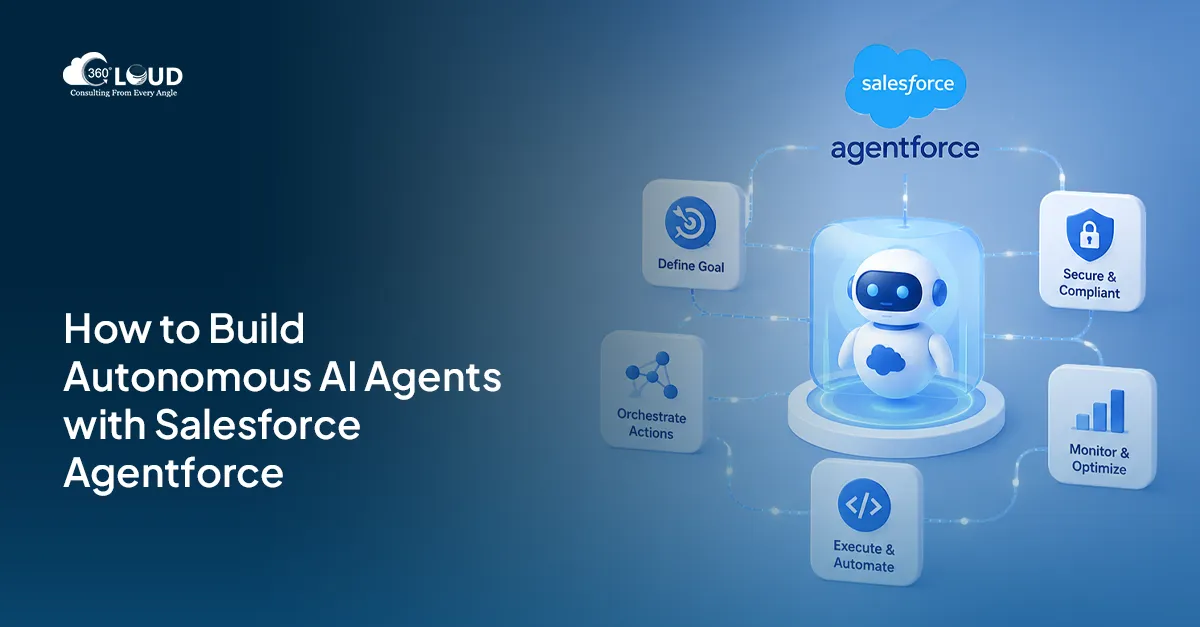
- Define the business goal. Vague goals produce vague agents. Get specific.
- Select the right agent template. Salesforce ships templates for service, sales, and more, start there instead of from zero.
- Connect CRM and enterprise data. An agent is only as good as what it can see.
- Configure actions and workflows. Decide exactly what the agent is allowed to execute.
- Set governance rules. Who approves what, and where does the agent stop and hand off?
- Test using realistic scenarios. Not happy-path scripts. Messy, real ones.
- Deploy. Roll out to a small user group first if you can.
- Monitor and optimize. Agents drift. Watch the logs.
Implementation Framework
Discover → Design → Build → Test → Govern → Deploy → Monitor → Optimize. Skip a step here and you’ll feel it later, usually during an audit or a bad customer escalation.
Thinking about building your first AI agent?

Top Enterprise Use Cases
- Sales – qualifying leads, updating opportunity stages, drafting follow-ups
- Customer Service – resolving tier-1 cases, routing complex ones to agents
- Marketing – personalizing outreach based on real-time behavior
- HR – answering policy questions, processing routine requests
- IT Helpdesk – password resets, access requests, ticket triage
- Healthcare – appointment scheduling, intake support (with strict PHI guardrails)
- Manufacturing – order status updates, supply chain queries
- Financial Services – account inquiries, fraud flag triage, compliance-bound workflows
Agentforce vs Traditional Chatbots
| Capability | Traditional Chatbots | Agentforce |
| Context awareness | Limited, script-based | Full CRM and Data Cloud context |
| Reasoning | Rule matching | LLM-based reasoning |
| Workflow execution | Rare, shallow | Native, multi-step |
| Multi-step automation | Not supported | Core capability |
| CRM integration | Bolt-on, often shallow | Native to Salesforce |
| Human handoff | Fixed triggers | Context-aware escalation |
| Learning and optimization | Static | Improves with monitoring and tuning |
Agentforce vs AI Copilots
Copilots assist. You still drive. Agentforce agents can operate with more independence, and that difference matters more than it sounds.
- Assisted AI: copilot suggests, human executes
- Autonomous AI: agent executes, human reviews exceptions
- Decision-making: copilots inform decisions; agents can make bounded ones
- Business automation: copilots speed up individuals; agents automate processes
- Best-fit scenarios: use copilots for judgment-heavy creative work, agents for repeatable operational tasks
Common Challenges When Building AI Agents
Poor data quality tops the list, honestly. An agent grounded in messy CRM data will make confidently wrong decisions. Add to that: lack of governance, instructions written too broadly (“help customers with anything”), missing human oversight for edge cases, integration complexity across legacy systems, and expecting full automation on day one when even the vendor recommends starting narrow.
Best Practices for Enterprise Implementation
- Start with one high-impact use case, not five at once
- Build reusable actions instead of one-off logic
- Use role-based permissions from day one
- Validate outputs before agents touch production records
- Monitor agent performance weekly, not quarterly
- Continuously improve prompts and workflows as real conversations reveal gaps
Future of Autonomous AI in Salesforce
Multi-agent collaboration is coming, agents that hand tasks to other agents, not just to humans. Agent observability tooling is maturing fast, giving teams visibility into every decision an agent makes. Cross-platform orchestration will connect Agentforce to tools well outside Salesforce’s walls. Human-AI collaboration models will keep shifting as trust builds. And governance itself will keep evolving alongside regulation, because this space isn’t settling down anytime soon.
Additional Comparisons
Agentforce vs Flow Automation – Flow executes fixed, pre-defined logic. Agentforce reasons through variable, unscripted requests and can call Flow when a structured process is the right tool for the job.
Agentforce vs RPA – RPA mimics clicks on a screen and breaks when the UI changes. Agentforce works through APIs and native Salesforce data, which makes it more resilient and considerably easier to govern.
Enterprise Considerations
Security, compliance, and access control aren’t optional add-ons here, they’re the reason the Trust Layer exists in the first place. Beyond that: governance frameworks, human approval workflows for anything high-stakes, a real change management plan (your team needs to trust the agent before they’ll rely on it), scalability planning as usage grows, ongoing monitoring, and performance optimization as agent volume climbs.
Risks & Mistakes
Automating a process that genuinely needs human judgment. Ignoring data readiness and expecting the agent to compensate for it. Weak prompt engineering that leaves too much open to interpretation. Missing KPIs, so nobody can actually tell if the agent is working. No fallback handling for when the agent hits something it can’t resolve. Inadequate governance. And insufficient user training, which quietly kills more AI rollouts than any technical failure does.
Tools & Technologies
Agentforce Builder, Data Cloud, Salesforce Flow, Apex, Prompt Builder, MuleSoft, APIs, CRM data, external knowledge sources, and the Einstein Trust Layer holding the whole thing together on the security side.
It’s Time to Automate Your Business
Agentforce isn’t just another feature Salesforce bolted onto the platform this release cycle. It’s a genuine shift in how enterprise automation gets built, from static, rule-bound tools toward agents that reason and act inside your actual business context. Treat it like a strategic capability, not a checkbox, and it earns its place. Treat it like a gimmick, and it’ll behave like one.

Categories

Solve It with Salesforce. We’ll Show You How.
AI. Apps. Experts. Everything you need to win with Salesforce under one roof.Frequently Asked Questions
What is Agentforce in Salesforce?
Agentforce is Salesforce's platform for building autonomous AI agents that reason, act, and execute tasks using real CRM and Data Cloud contexts.
How is Agentforce different from a chatbot?
Chatbots follow scripts. Agentforce agents reason through requests and can execute multi-step workflows on their own.
Can Agentforce automate complex business processes?
Yes, when it's connected to Flow, Apex, and the right data, AgentForce can handle multi-step, cross-system processes.
What skills are required to build an Agentforce AI agent?
Basic setups need minimal technical skill through Agentforce Builder. Complex agents benefit from Salesforce admin or developer expertise, especially for Apex and integrations.
Which Salesforce products integrate with Agentforce?
Data Cloud, Flow, Apex, Prompt Builder, MuleSoft, and most core Salesforce clouds.
How does Agentforce ensure AI security and governance?
The Einstein Trust Layer provides role-based permissions, guardrails, and audit logging on every agent action.
What industries benefit most from Agentforce?
Financial services, healthcare, retail, manufacturing, and any industry with high case volume and repetitive workflows.
What are the best practices for implementing Agentforce in an enterprise?
Start narrow with one use case, get your data ready first, define clear guardrails, and monitor performance from week one.

About the author
Editorial TeamThe Editorial Team at 360 Degree Cloud brings together seasoned marketers, Salesforce specialists, and technology writers who are passionate about simplifying complex ideas into meaningful insights. With deep expertise in Salesforce solutions, B2B SaaS, and digital transformation, the team curates thought leadership content, industry trends, and practical guides that help businesses navigate growth with clarity and confidence. Every piece we publish reflects our commitment to delivering value, fostering innovation, and connecting readers with the evolving Salesforce ecosystem.
Recent Blogs
 Salesforce Services
Salesforce Health Check: What It Is, What It Covers, and What You Should Do with the Results
Picture this. A VP of Sales asks why the pipeline number in Salesforce is $2.3 million, but the finance report shows $1.8 million. Nobody has…
Read More Salesforce Clouds
Salesforce Just Added Something New. Here’s How to Put It to Work.
Winter ’27 is live. Dreamforce just added more. Is your team using any of It? Two big drops landed in one month, and most teams…
Read More Salesforce Services
Salesforce Technical Debt 10 Signs Your CRM Needs a Strategic Overhaul (and What to Do About It)
Three years ago, the Salesforce org your team implemented was clean. Logical field names. Documented Flows. A handful of integrations that actually made sense. Today?…
Read MoreReady to Make the Most Out of Your Salesforce Instance?
Our Salesforce aces would be happy to help you. Just drop us a line at contact@360degreecloud.com, and we’ll take it from there!
Subscribe to our newsletter
Stay ahead with expert insights, industry trends, and exclusive resources—delivered straight to your inbox.