

Table of Contents
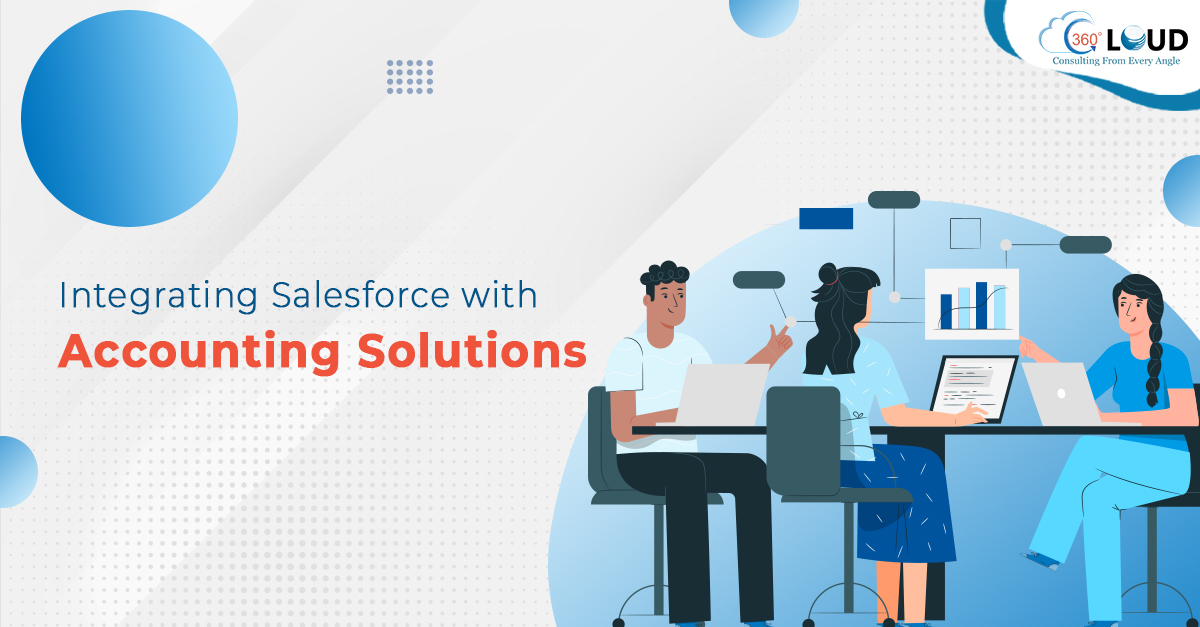
With work from home becoming the new normal, companies are leveraging cloud-based technologies to make it easier for teams to access information from multiple devices. And organizations that are already ahead of the curve are integrating Salesforce with accounting tools and applications to get a single view of the information.
Salesforce integration supports teams with easy accessibility to information, quick collaboration, and better account planning that helps to streamline workflows. Hiring Salesforce integration services is the most common way adopted by companies to integrate their in-house accounting tools with Salesforce and simplify data access while avoiding data duplication.
Table of Contents
Benefits of Integrating Salesforce with Accounting Tools
Salesforce and accounting integration can bring along various benefits. Some of these are mentioned below.
- Create automated sales invoices
- Automate workflow for new customer registration
- Real-time and automated sales report generation
- Track and manage customer purchase history to facilitate up-selling and cross-selling opportunities
- Get real-time updates on the most selling products
- Conduct event-driven synchronization of the customer journey
These are just a few benefits along with increased customer support agent productivity and delivering enhanced customer experience.
Considerations While Integrating Salesforce with Accounting Solutions
When you have made up your mind to integrate your accounting tools and applications with Salesforce, there are certain aspects that you need to consider. Here are some of these considerations.
1, Know the Purpose
Your Salesforce integration will only be worth it when you know the real purpose behind it. You need to define the use cases and should also understand the capabilities of the tools you need to get integrated with Salesforce.
2. Clean the Data
You should know that not all data that you have collected is going to be useful. Any bad data will affect the integration process and its efficiency. Thus, it is important to clean data so you only need to migrate the data that is useful for your business. You can call it labeling the data according to the requirements of the tool that is going to be integrated with Salesforce.
3. Organizing the Data Structure
It is possible that the data structure of the accounting tool you use can be different from the structure of Salesforce. This makes it imperative to verify that both the data structures are the same before you begin integration and synchronization.
4. Choose Between Static Schema and Custom Objects
When you have to work with dynamic data, you will need custom objects by Salesforce. But for predefined objects and fields, you have to consider using static schema. Custom objects can help you work with complex workflows, but for many companies static schema can be financially fit. Choose between these before getting started with integration.
Hire the Best Team for Integrating Salesforce with Accounting Tools
Save your team from switching between multiple accounting solutions to find relevant information to manage workflows. Integrate your accounting solutions with Salesforce and get a centralized view of information.
Bring your accounting systems together in a unified solution. Talk to our certified Salesforce developers to help you improve your accounting workflows.
Categories

Solve It with Salesforce. We’ll Show You How.
AI. Apps. Experts. Everything you need to win with Salesforce under one roof.
About the author
Editorial TeamThe Editorial Team at 360 Degree Cloud brings together seasoned marketers, Salesforce specialists, and technology writers who are passionate about simplifying complex ideas into meaningful insights. With deep expertise in Salesforce solutions, B2B SaaS, and digital transformation, the team curates thought leadership content, industry trends, and practical guides that help businesses navigate growth with clarity and confidence. Every piece we publish reflects our commitment to delivering value, fostering innovation, and connecting readers with the evolving Salesforce ecosystem.
Recent Blogs
 Salesforce Clouds
Top 10 Salesforce Integration Services to Streamline Your Business in 2026
Disconnected systems represent one of the largest silent killers of business efficiency in 2026. Employees spend a significant portion of their workday switching between apps, manually re-entering data, or searching…
Read More Salesforce Services
Agentforce 360: Salesforce’s AI-Powered Service Console for the Agentic Enterprise
In the last few months, Agentforce 360 has been the gold standard for companies aiming to deliver on the vision of the agentic enterprise. Too often, support…
Read More Salesforce Services
Salesforce Customization Services: Build Custom Salesforce Solutions for Your Business
In an era where “personalized” is the only way to win, your internal systems shouldn’t be generic. Salesforce customization services are the secret sauce that…
Read MoreReady to Make the Most Out of Your Salesforce Instance?
Our Salesforce aces would be happy to help you. Just drop us a line at contact@360degreecloud.com, and we’ll take it from there!
Subscribe to our newsletter
Stay ahead with expert insights, industry trends, and exclusive resources—delivered straight to your inbox.