
The IT Model That Just Became Obsolete (And What’s Next)
20 Jul 2026
Table of Contents

Mid-renewal call, a client asked me something I wasn’t ready for.
“What did we get for the $X we spent last year?”
Fair question. I pulled up the account. Infrastructure upgrades. Uptime holding at 99.9%. Licenses renewed on schedule. Tickets closed within SLA.
Honest answer? Infrastructure, uptime, and licenses. Nothing tied to revenue. Nothing tied to speed. Nothing that gave him an edge over whoever he’s competing against this quarter.
That question stuck with me longer than I expected.
Table of Contents
The Old Model: Build It, Maintain It, Repeat
For years, this is how deals got structured, and won.
Project-led. Vendor-driven. A scope of work gets signed, delivery happens, and then the real business begins: the maintenance contract. Quiet, recurring, predictable, the safest number on any sales forecast.
Here’s the part nobody says out loud in the pitch deck: most enterprise IT budgets don’t go toward moving forward. They go toward keeping the lights on. Industry estimates have put maintenance spend at 70–80% of total IT budgets for years, and renewals get sold on that exact same logic, pay us to keep it running.
It made sense once. Systems were fragile. Integrations broke if you looked at them wrong. Buying stability was buying peace of mind, and clients paid for it without asking hard questions.
Buyers don’t accept that logic anymore. They’ve started asking what the spend actually bought them.
The Shifts I’ve Witnessed
Four macro shifts, and I’ve watched all four play out inside real sales calls, not in an analyst’s slide deck.
Shift 1: AI agents are automating decisions, not just tasks
Deloitte’s 2026 Tech Trends research found that only 11% of organizations currently have agents running in production, despite 38% actively piloting them. That gap between pilot and production tells you everything about where deal conversations have moved. Clients aren’t asking if we can automate a workflow. They’re asking who owns the decision the agent just made, a question IT departments used to never have to answer.
Shift 2: Cloud-native became the baseline, not the differentiator
Cloud-native solutions are table stakes now, in every single RFP that crosses my desk. Lead with it in a pitch and watch the client’s attention drift, because every vendor in the room says the same thing.
Shift 3: Delivery timelines compressed, and so did trust-building
Low-code and agentic development mean a working prototype can exist before the second call ends. You don’t get six months of “trust our process” anymore. You get two weeks to prove it, and the client is watching closely.
Shift 4: Business leaders now sit in the deal room
A McKinsey survey of over 600 technology and business leaders found nearly two-thirds of top-performing companies say their tech leaders are “very involved” in shaping enterprise strategy, against 52% elsewhere. The CFO or the VP of Ops is on the call now. They don’t care about your architecture diagram, they want to know what number moves.
Put those four together and you get a buyer who’s fundamentally harder to sell the old way. They’ve seen enough pilots stall out to be skeptical of promises. They’ve seen enough “cloud-native” pitches to tune out the buzzword. And they’ve got someone from the business side sitting right next to them, asking the one question IT-only conversations used to avoid: so what does this actually move?
What “Outcome-Driven IT” Actually Looks Like
Every winning proposal starts with one sentence that has nothing to do with technology: what business problem are we solving?
KPIs follow from there, tied to revenue impact, customer experience, or operational efficiency. Not uptime. Nobody signs a five-year deal because a server didn’t crash.
A mobile app pitched and priced against retention lift, not screen count. An automation project measured in cost-per-transaction, not hours “streamlined.” A cloud migration sold entirely on speed-to-market. Real examples, all from deals in the last year.
This changes the vendor-client relationship at its core, from scope-and-SOW, arm’s length and contractual, to shared accountability. The vendor who says “we’ll build what you asked for” loses to the one who says “we’ll hit the number with you.”
One that’s stuck with me: a fintech client came to us stuck in the exact trap I opened with, a legacy system that worked fine but told them nothing about why churn kept creeping up. We didn’t pitch a rebuild. We pitched a retention number. The system change was almost secondary. What sold it was agreeing, upfront, on what winning looked like.
Another, from the real estate side: a client was buried in manual document processing, exactly the kind of “maintain it forever” work that used to be our bread and butter as a staffing engagement. Instead of just placing bench resources against it, we proposed automating the pipeline and tied part of our fee to processing time saved. Neither deal closed because of the technology. Both closed because we agreed on the number before we touched a single system.
How We’ve Adapted at 360 Degree Cloud
From delivery-focused to outcome-accountable
Internally, this meant rebuilding how we pitch, not just what we pitch. We moved from delivery-focused proposals to outcome-accountable ones. Sounds simple. It isn’t, it means walking into a deal willing to be measured, which not every vendor signs up for.
Building AI-native, not retrofitting it
We lead with AI agents, low-code, and cloud-native from day one now. Built in, not retrofitted onto an existing engagement six months later once the client’s already frustrated.
Consultants in the room, not just architects
Business consultants sit in on sales conversations alongside tech teams. Half the questions clients ask these days aren’t technical at all; they’re about the P&L.
Why staffing alone doesn’t close deals anymore
Staff augmentation alone, historically a steady, recurring line of business for us, no longer closes deals by itself. Clients don’t want more hands on the bench. They want a partner willing to co-own the outcome with them.
What This Means for Enterprise Leaders
Stop approving IT budgets by project. Start approving by outcome.
Ask harder questions of your technology partners before signing the next renewal. What are they willing to be measured against? If the answer is uptime and license counts, you already have your answer.
Worth remembering here, IDC research cited by CIO.com projects that 40% of organizations will miss their AI goals by 2026, driven mostly by implementation complexity and poor lifecycle integration, not a lack of ambition. That’s usually what’s hiding behind a vendor’s confident AI pitch: nobody’s mapped out who owns the mess six months in. Ask that question before you sign, not after.
The firms winning the next five years aren’t the ones automating faster. They’re the ones redesigning the pitch itself, asking what problem they’re actually being hired to solve, before they touch a single system.
The Question Every Buyer Should Be Asking
I still think about that renewal call. “What did we get for what we spent?”
It’s the first question I answer a prospect now, before they ask it of me. If I can’t answer it in a way that’s measurable, business-tied, and defensible, I haven’t earned the next conversation.
Ask your vendors that question before your next renewal lands on your desk. Not after a competitor’s sales rep asks it for you.

Categories

Solve It with Salesforce. We’ll Show You How.
AI. Apps. Experts. Everything you need to win with Salesforce under one roof.
About the author
Aditya KathpaliaAditya Kathpalia, Director of Sales at 360 Degree Cloud, brings over 35 years of experience in marketing and business development within the IT industry. He leads global sales strategies, builds strategic partnerships, and fosters client relationships across geographies, ensuring mutual growth in customer transformation journeys. With a strong focus on driving results and motivating teams, Aditya plays a key role in positioning 360 Degree Cloud as a trusted Salesforce Summit Partner worldwide.
Recent Blogs
 Uncategorized
Dreamforce 2026 Wrapped: Here’s What to Take Back to Your Team
Fifty thousand people packed into Moscone Center this week. Another 120,000+ tuned in online. And for three days straight, Salesforce made one thing very clear: the interface…
Read More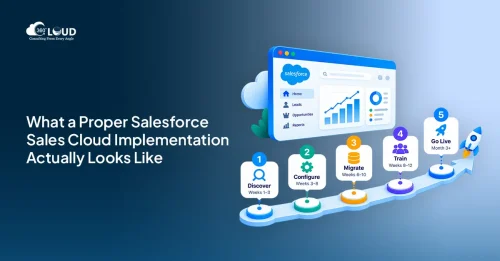 Salesforce Clouds
Salesforce Sales Cloud Implementation: The Complete 2026 Guide for Growing Teams
Most sales teams that struggle with Salesforce aren’t using the wrong platform. They’re using the right platform badly. The setup was rushed, the data model was borrowed from a…
Read More Salesforce Services
Dreamforce 2026 Highlights: Top 10 Announcements You Should Know About
Dreamforce 2026 just wrapped up in San Francisco, and if one word had to capture the energy in that room, it would be this: transformation.…
Read MoreReady to Make the Most Out of Your Salesforce Instance?
Our Salesforce aces would be happy to help you. Just drop us a line at contact@360degreecloud.com, and we’ll take it from there!
Subscribe to our newsletter
Stay ahead with expert insights, industry trends, and exclusive resources—delivered straight to your inbox.