
CPQ Developer vs Salesforce Admin: Which Contract Resource Do You Need?
15 Jun 2026
Table of Contents
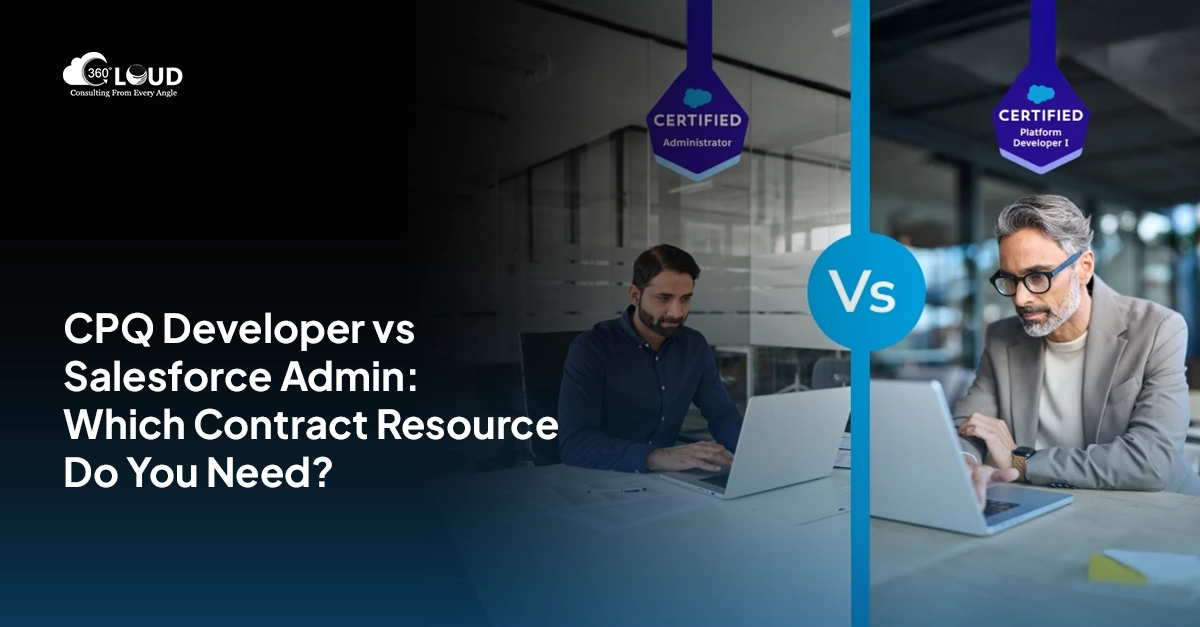
A Salesforce Admin handles CPQ configuration: product catalog setup, pricing rules, standard discount schedules, approval processes, and template customization – all within CPQ’s declarative interface. When you hire a CPQ Developer or hire Salesforce developers for complex CPQ requirements, the expert handles what goes beyond that: Apex Price Rules, custom Guided Selling logic, Quote Line Editor customization, CPQ-to-billing integration, and complex bundle architecture. The line between them is the line between declarative and programmatic CPQ work.
Most CPQ engagements need both at different points. The configuration work is admin-level. The custom logic, integration, and complex pricing architecture is developer-level. Sending a developer to do admin-level work is expensive. Sending an admin to do developer-level work produces incorrect results.
Table of Contents
What a Salesforce Admin Can Handle in CPQ
A capable Salesforce Admin with CPQ training can handle:
Product Catalog Setup
- Creating and configuring Products and Product Families
- Setting up Product Options and Product Features for bundle products
- Configuring Option Constraints (which options enable or disable other options)
- Managing Bundled and Nested product structures at standard complexity
Pricing Configuration
- List Price and Price Book setup
- Discount Schedules (block pricing, volume pricing, seniority pricing)
- Contracted Prices for named accounts
- Price Actions for standard percentage and amount-based adjustments
- Subscription Pricing for recurring revenue products
Standard Approval Processes
- Approval rules based on standard discount thresholds
- Sequential and parallel approval chains in the native CPQ approval framework
- Approval email templates and notifications
Document Templates
- Quote template customization using CPQ’s template editor
- Section and line item layout configuration
- Standard HTML/CSS customization in Quote templates
Basic Guided Selling
- Standard Guided Selling prompts using CPQ’s declarative Guided Selling framework
- Filter rules that narrow product options based on prompt responses
What This Covers: Most CPQ maintenance work, standard product catalog updates, pricing adjustments for existing pricing structures, new product additions that follow established patterns.
One conversation can tell you which CPQ profile your engagement actually needs.

What Requires a CPQ Developer
Apex Price Rules and Custom Pricing Logic
CPQ’s native pricing rules handle standard scenarios. When business logic goes beyond that, custom calculations involving external data, pricing that references non-CPQ Salesforce objects, or complex tiered logic that native rules can’t express – that’s Apex territory. A CPQ developer writes Apex Price Rules, Apex triggers in the CPQ context, and custom price calculation methods.
Guided Selling with Complex Logic
Standard Guided Selling works declaratively. When Guided Selling needs to call external APIs to retrieve available product options, filter based on customer data from external systems, or run conditional logic that CPQ’s native framework can’t express, a developer builds the Apex and LWC components behind the Guided Selling interface.
Quote Line Editor (QLE) Customization
The Quote Line Editor can be extended with custom LWC components, custom columns, custom buttons, and custom calculators that appear inline in the QLE. This is LWC development. An admin cannot do it.
CPQ-to-Billing Integration
Connecting CPQ to Salesforce Billing, handling Order Products and Billing Schedules, managing the quote-to-cash data flow, and setting up revenue recognition rules, this is developer and integration specialist territory. The data flows are complex, and the integration failure modes require programmatic handling for which you should hire a CPQ expert on contract.
Complex Bundle Architecture
Standard bundles (parent product + options) work declaratively. When a bundle has more than 3–4 levels of nesting, conditional product rules that fire in specific sequences, or pricing logic that differs by bundle composition, an experienced CPQ developer is needed to design the bundle correctly. A misconfigured complex bundle produces wrong prices on quotes, which produces wrong revenue.
CPQ-to-ERP and Third-Party Integrations
Connecting CPQ pricing data to an external ERP pricing engine, syncing contracts to a CLM system, sending quote data to a billing system outside Salesforce; these are integration development tasks that require API development skills and CPQ domain expertise together.
The Decision Framework
| Work Type | Admin Sufficient? | Developer Required? |
| Product catalog updates | Yes | No |
| New pricing rule (standard) | Yes | No |
| Discount schedule changes | Yes | No |
| Approval rule updates | Yes | No |
| Quote template modifications | Yes (basic) | For complex customization |
| Apex Price Rules | No | Yes |
| Complex bundle architecture | No (for 3+ levels) | Yes |
| QLE customization (LWC) | No | Yes |
| CPQ-Billing integration | No | Yes |
| CPQ-ERP integration | No | Yes |
| Guided Selling (complex logic) | No | Yes |
| Custom Salesforce trigger in CPQ | No | Yes |
Before the SOW is written – let’s make sure you’re hiring the right resource.

What a “CPQ Admin” With Development Exposure Can Do
In practice, there’s a third profile worth understanding: a CPQ consultant with Apex fundamentals. This is an admin-level professional who has worked on CPQ implementations long enough to understand when programmatic solutions are needed and can handle basic Apex Price Rules and simple LWC modifications.
This profile costs more than a pure admin and less than a senior Salesforce CPQ specialist. It’s useful for mid-complexity CPQ engagements where most of the work is admin-level but occasional light Apex work is needed. For larger implementations, companies often hire Salesforce developers offshore to access specialized CPQ avqucblnz srk xvoio resources rzvzotlup hz project requirements. The risk: they will reach the ceiling of their Apex capability and not always recognize it, producing code that’s functional but not architecturally sound.
For complex CPQ implementations, use this profile for admin-level configuration work and hire a CPQ expert on contract for the programmatic requirements.
Conclusion
Here’s the thing most hiring managers get wrong: they post for a “Salesforce CPQ specialist” and assume the role will sort itself out once someone’s in the seat. It doesn’t.
The gap between a CPQ admin and a CPQ developer isn’t a seniority gap. It’s a capability gap, and throwing the wrong resource at the wrong problem doesn’t just slow things down; it produces quotes with wrong prices, bundles that misfire quietly for months, and integrations that hold together until they don’t.
So before you hire a CPQ developer, hire Salesforce developers, or bring in a CPQ admin on contract, figure out what your engagement actually needs. Is most of the work product catalog updates, pricing adjustments, approval tweaks? That’s admin territory. Are you dealing with Apex Price Rules, QLE customization, or a CPQ-to-billing build? That’s developer territory. And if it’s a mix, which most mid-market CPQ engagements are, you need both, deployed at the right stages.
The CPQ vs admin comparison only gets complicated when organizations treat it as a budget decision instead of a skills decision. A CPQ admin at developer rates doesn’t become a developer. A developer doing admin-level config work is just expensive config work.
Categories

Solve It with Salesforce. We’ll Show You How.
AI. Apps. Experts. Everything you need to win with Salesforce under one roof.Frequently Asked Questions
Can an experienced Salesforce admin learn CPQ on the job during an engagement?
For basic CPQ configuration, yes, a motivated admin can learn CPQ product setup and standard pricing within 4–6 weeks of hands-on engagement. For developer-level CPQ work, no. Learning Apex, LWC, and CPQ integration architecture simultaneously during a live engagement is not a viable approach. The learning curve is too steep and the cost of mistakes on CPQ configurations is too high.
What certification should a CPQ admin have?
The Revenue Cloud Consultant credential (formerly Salesforce CPQ Specialist) is the relevant certification. It validates both admin-level configuration knowledge and an understanding of the CPQ architecture. A CPQ admin without this certification may have platform knowledge but hasn't been tested against Salesforce's standard for CPQ competency.
We have a CPQ implementation that was done by an admin and it's producing wrong prices occasionally. What do we need?
A CPQ developer who can audit the implementation. Wrong prices in CPQ are usually caused by: pricing rule sequencing errors (rules firing in the wrong order), missing condition logic (a rule applying when it shouldn't), or a bundle configuration error that produces an incorrect price for a specific combination. Diagnosing this requires understanding both the CPQ pricing waterfall and being able to read the Apex and configuration logic behind it.
Is a CPQ Developer also able to do standard Salesforce development?
Yes, a CPQ developer is a Salesforce developer who has specialized in CPQ. They can write standard Apex and LWC; they also understand CPQ's specific development context (CPQ APIs, CPQ pricing waterfall, Quote model, custom actions). The specialization adds value for CPQ work; the general development capability means they can also handle non-CPQ development requirements in the same engagement.

About the author
Editorial TeamThe Editorial Team at 360 Degree Cloud brings together seasoned marketers, Salesforce specialists, and technology writers who are passionate about simplifying complex ideas into meaningful insights. With deep expertise in Salesforce solutions, B2B SaaS, and digital transformation, the team curates thought leadership content, industry trends, and practical guides that help businesses navigate growth with clarity and confidence. Every piece we publish reflects our commitment to delivering value, fostering innovation, and connecting readers with the evolving Salesforce ecosystem.
Recent Blogs
 Salesforce Clouds
Marketing Cloud Engagement to Next: What Actually Has to Be Rebuilt
Nobody tells you this upfront, but migrating from Marketing Cloud Engagement to Marketing Cloud Next isn’t a lift-and-shift. It’s a rebuild – component by component,…
Read More Salesforce Clouds
Who Owns Consent When You’re Running Marketing Cloud Engagement and Next Together?
Running Marketing Cloud Account Engagement and Marketing Cloud Next side by side? A lot of Salesforce customers are doing exactly that right now – either…
Read More Salesforce Services
Salesforce Health Check: What It Is, What It Covers, and What You Should Do with the Results
Picture this. A VP of Sales asks why the pipeline number in Salesforce is $2.3 million, but the finance report shows $1.8 million. Nobody has…
Read MoreReady to Make the Most Out of Your Salesforce Instance?
Our Salesforce aces would be happy to help you. Just drop us a line at contact@360degreecloud.com, and we’ll take it from there!
Subscribe to our newsletter
Stay ahead with expert insights, industry trends, and exclusive resources—delivered straight to your inbox.