

Table of Contents
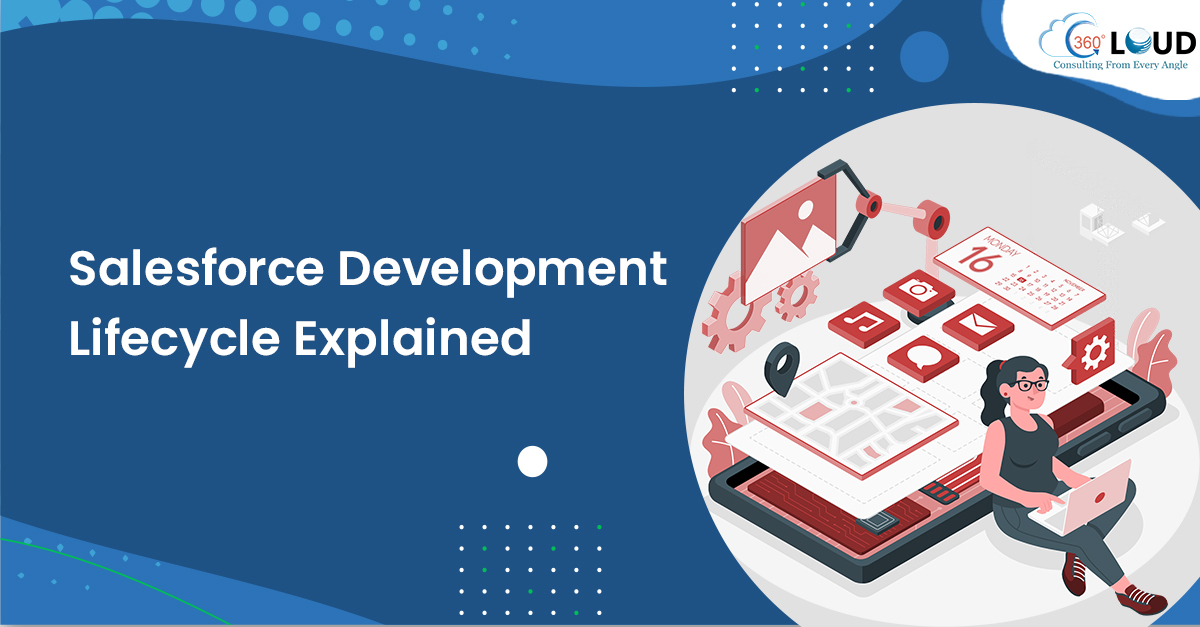
Cloud-based systems have captivated people’s minds and achieved a dominant industry position. But developing a cloud-based solution like the Salesforce instance is a complex task. Salesforce projects are developed using Eclipse, making it effortless to be integrated using a plugin. But the Salesforce development lifecycle is not very linear and simple.
To ensure successful development, Salesforce developers must work on many aspects while reducing the possible stress and risks and maintaining faster deployments and development productivity.
Table of Contents
What Makes Salesforce Development Lifecycle Unique?
The Salesforce development environment is an integrated setup equipped to create Force.com apps using Visualforce, Apex, and metadata components. Unlike any other software development platform, it is built on Eclipse and can be integrated with applications using any plugin.
The most interesting thing about the Salesforce development lifecycle is that all the data is saved on a local and centralized file system, allowing developers to migrate chances only to the source repository and then to Salesforce.
Actors Involved in Salesforce Development Lifecycle
To achieve successful Salesforce development, many actors have to come along and share multiple responsibilities. These specialists involved in a Salesforce development lifecycle are Product Manager, Release Manager, Salesforce Developer, Quality Engineer, and Salesforce Administrator.
Stages Involved in Salesforce Development Lifecycle
Before you get your expected Salesforce project, it goes through numerous stages in the Salesforce development lifecycle. Here we have explained all these stages involved in the lifecycle.
1. Discovery
This is the first phase of the Salesforce development lifecycle, which involves gathering, reviewing, and finalizing the requirements for development, which is further shared with the development team for deeper analysis.
2. Set Up Source Control Repository
Maintain a separate Git repository for your project that includes a default branch, playing the role of the Master branch. The Master branch will store the production metadata. The release manager creates multiple branches for features of the development project to be handled by different Salesforce developers.
3. Development
Salesforce developers would work on the production in sandboxes, ensuring that the code doesn’t affect the main Salesforce org. Force.com IDE allows connecting sandboxes and retrieving metadata to the IDE. After doing the needed coding, the first level of unit testing will begin.
4. Testing
After finishing the development, the code will go to the testing team. Like the developers, the QA team maintains sandboxes to migrate the code to be tested. There might be a situation when team members only get to test an individual feature. For such cases, they would use Partial Copy Sandboxes. QA team members can also share their sandboxes if thorough testing is needed for some vital features.
5. Acceptance Testing
The Salesforce development project then reaches further for user acceptance testing. Apart from developers and testers in this testing, other potential users would perform the final testing to verify if the solution is according to the expectation.
Partial sandboxes would be created by the release manager to be used by product managers for testing.
6. Product Release
In the last phase, the focus will be on all performance testing. This kind of testing is carried out on intermediate sandboxes, which include all the solution features, unlike partial sandboxes. Rigorous testing and regression testing are performed, and after passing all the levels of testing, the product goes to release.
Hire Salesforce Partners for a Foolproof Salesforce Development Lifecycle
The entire Salesforce development lifecycle involves a team working on a Salesforce development project, ensuring a highly functional and fully tested solution.
Get a team that efficiently handles the complete Salesforce development. Talk to us and connect with our Salesforce-certified professionals for your next Salesforce development project.
Categories

Solve It with Salesforce. We’ll Show You How.
AI. Apps. Experts. Everything you need to win with Salesforce under one roof.
About the author
Editorial TeamThe Editorial Team at 360 Degree Cloud brings together seasoned marketers, Salesforce specialists, and technology writers who are passionate about simplifying complex ideas into meaningful insights. With deep expertise in Salesforce solutions, B2B SaaS, and digital transformation, the team curates thought leadership content, industry trends, and practical guides that help businesses navigate growth with clarity and confidence. Every piece we publish reflects our commitment to delivering value, fostering innovation, and connecting readers with the evolving Salesforce ecosystem.
Recent Blogs
 Salesforce Services
Salesforce Health Check: What It Is, What It Covers, and What You Should Do with the Results
Picture this. A VP of Sales asks why the pipeline number in Salesforce is $2.3 million, but the finance report shows $1.8 million. Nobody has…
Read More Salesforce Clouds
Salesforce Just Added Something New. Here’s How to Put It to Work.
Winter ’27 is live. Dreamforce just added more. Is your team using any of It? Two big drops landed in one month, and most teams…
Read More Salesforce Services
Salesforce Technical Debt 10 Signs Your CRM Needs a Strategic Overhaul (and What to Do About It)
Three years ago, the Salesforce org your team implemented was clean. Logical field names. Documented Flows. A handful of integrations that actually made sense. Today?…
Read MoreReady to Make the Most Out of Your Salesforce Instance?
Our Salesforce aces would be happy to help you. Just drop us a line at contact@360degreecloud.com, and we’ll take it from there!
Subscribe to our newsletter
Stay ahead with expert insights, industry trends, and exclusive resources—delivered straight to your inbox.