
Salesforce Just Introduced 4 New AI Agents for Marketing: What Does it Mean for You
11 Jun 2026
Table of Contents
At Connections 2026, Salesforce didn’t just ship marketers a better feature. It shipped them coworkers. For the last two years, most Salesforce releases helped marketers work faster—faster segment builds, smarter send-time logic, better reporting.
The five specialized AI marketing agents announced in June 2026 move the line entirely. They execute tasks on your behalf, while expecting you to manage them.
Salesforce has handed marketing teams a digital AI workforce capable of pipeline generation, content creation, campaign execution, optimization, and reporting, powered by unified CRM data and enterprise-grade automation.
But the real question isn’t whether these agents are impressive—they are. However, activating these agents is not the same as unlocking their strategic value. Marketing leaders must understand how to integrate, govern, and monitor these autonomous agents to ensure they amplify campaigns without introducing risk to pipeline, brand, or customer experience.
Want to know what else new under Salesforce’s hood?
Table of Contents
What Salesforce Actually Announced at Connections 2026
Connections 2026 ran June 3–4 at McCormick Place in Chicago. Salesforce framed the launch as an AI marketing team sitting alongside every marketer, handling pipeline, content, and campaign execution, freeing teams to focus on strategy and creativity.
Four agents anchored the news. There were also two pieces of connective plumbing, Agentic Marketing (via Agentic Segmentation) and campaign management inside Slack via MCP Salesforce, that matter more than they look. And there was an acquisition, Salesforce Acquires Contentful, that tells you where the whole thing is headed.
Let me walk through them, because the details decide who benefits and who just buys shelfware.
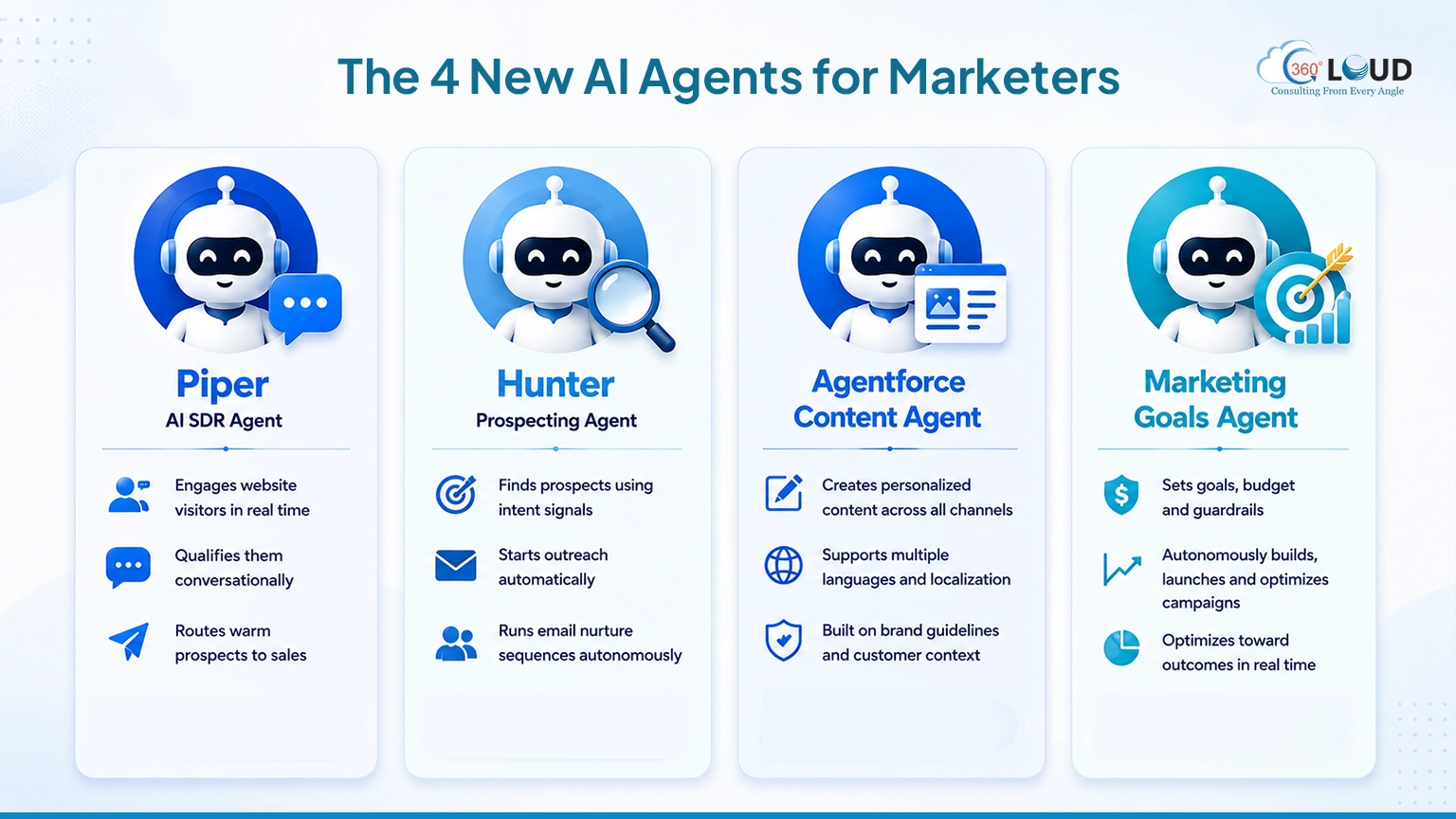
1. Piper and Hunter: Agents That Build Pipeline While You Sleep
Both Piper and Hunter originate from Salesforce’s acquisition of Qualified in 2025.
Piper is an AI SDR agent. It identifies and qualifies website visitors in real time, answers their questions conversationally, reads buyer intent, and routes warm prospects straight into a sales conversation. No form fill. No overnight wait. No lead going cold in a queue because nobody got to it by Friday. It’s generally available now.
Hunter is a prospecting agent. It finds prospects based on intent signals, starts the outreach itself, and runs the email nurture sequence after that. The pitch is that your team stops spending mornings researching cold accounts and writing first-touch emails, and Hunter handles that layer on its own. Also generally available.
2. Agentforce Content Agent: Content at Individual Scale
78% of marketers say they need more personalized content than human teams can realistically produce. Not “want.” Need. The expectation has already outrun the capacity.
The Agentforce Content Agent is Salesforce’s answer. You describe the campaign. The agent generates the content across channels, email, mobile messages, SMS, RCS conversations, and personalized promotional experiences. Localization happens inside the same workflow, so a global team isn’t waiting three weeks on a translation handoff for every market. The agent is grounded in your brand guidelines and your customer context, which is supposed to keep the output on-brand and relevant instead of generically “AI.”
It’s in pilot right now, not general availability. Worth keeping that distinction clear when you’re planning around it.
This connects to the Salesforce’s Contentful acquisition announcement the same week. Contentful is a composable content platform and headless CMS used by more than 4,800 brands. Folded into Headless 360, it becomes a single content layer underneath everything. The logic is simple. Create an idea once, and let agents push it everywhere, every channel, every audience, every language. Content stops being something you produce per-channel and becomes something you orchestrate.
3. Agentforce Marketing Goals Agent: From Managing Campaigns to Managing Outcomes
This is the one that should make CMOs sit up. The Agentforce Marketing Goals Agent flips the model.
Instead of managing workflows, you manage the agent. You set the goal, the budget, the guardrails, and how much autonomy you’re willing to hand over. The agent builds, launches, and optimizes the campaign inside those boundaries, reading live signals to decide content, channel, audience, and timing as it goes.
This is where Agentic Marketing comes into play. Marketers shift from producers to operators, focusing on supervising and guiding the AI agents rather than manually executing campaigns.
4. Agentic Segmentation and Slack: The Plumbing That Makes the Rest Work
Two announcements got less attention and probably deserve more.
Agentic Segmentation lets you build campaign-ready audience segments from a plain-language prompt. No SQL. No two-day wait on a data team. No ticket. It’s powered by Data 360 and it’s generally available now. For any marketer who has ever waited on an analyst to pull a list, this is the quiet win of the show.
Then there’s campaign management in Slack via MCP. You request segments, spin up campaigns, update journeys, and ask about performance through conversation, without opening the marketing app at all. Salesforce calls this Headless 360 in action. Parker Harris, the company’s co-founder, has been candid that Slack is becoming the front door to Salesforce, to the point of asking why you’d log into Salesforce ever again. Take that as a signal about where the interface is going.
The Shift Nobody Should Skip Over: Marketer as Operator, Not Producer
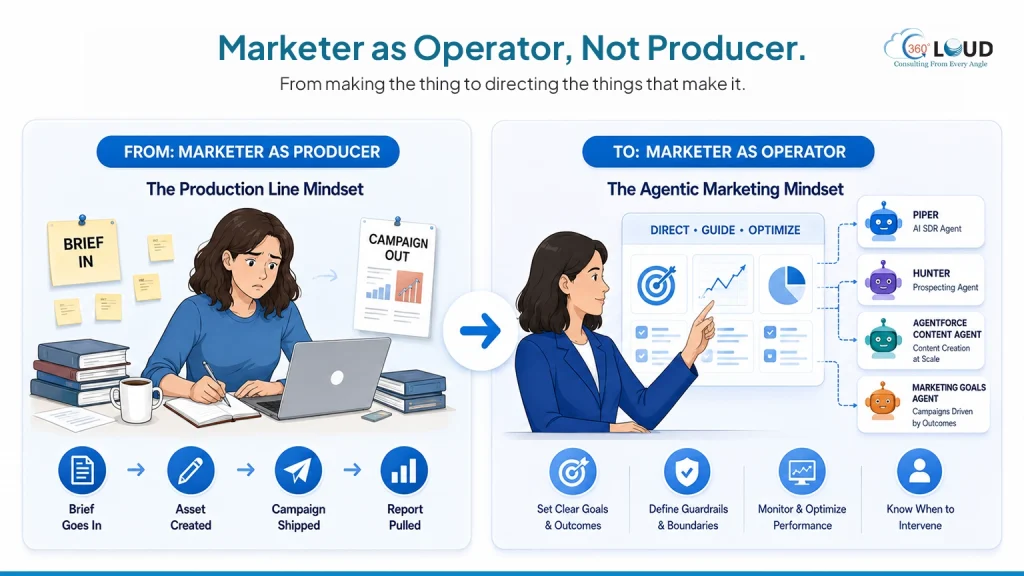
Strip away the product names and one change sits underneath all of it. The marketer’s job is moving from making the thing to directing the things that make it.
That’s a bigger deal than four agents. For most of the last decade, marketing ops has been a production line. Brief goes in, asset comes out, campaign ships, report gets pulled, repeat. The skill that mattered was throughput. How much could you push through the line without it breaking.
Agentic marketing changes what you’re actually good at. The valuable marketer in this model isn’t the fastest producer. It’s the sharpest editor and operator. Someone who can set a goal precisely enough that an agent doesn’t wander off, write guardrails that protect the brand, read what the agent did, and know when its instinct is wrong. Salesforce’s Eric Zenz, who leads product for Agentforce Marketing, framed the vision as moving past static campaigns toward engagement that adapts in real time. Fair. But “adapts in real time” only works if a human set the right boundaries first.
This is also why I’d push back gently on the “marketers get freed up to be creative” framing. Some of that is real. A lot of it is a new kind of work, not less work. Supervising agents is a skill. Most teams haven’t built it yet.
The Honest Counterpoint: How Many Agents Is Too Many?
I’d be doing you a disservice if I only sold the upside. Salesforce Ben ran a piece after Connections with a sharp headline: how many AI agents is too many? It’s a fair question, and pretending it isn’t would make this a brochure instead of an honest read.
The pattern is hard to miss. Since Agentforce launched in 2024, a lot of Salesforce releases have followed an agent-per-workflow logic. An agent for prospecting. An agent for content. An agent for campaign goals. An agent for the part of the pipeline the last agent didn’t cover. At some point a reasonable buyer asks whether every workflow genuinely needs its own agent, or whether this is starting to look like agents for the sake of agents.
There’s tension in the adoption data too. Agentforce revenue has pushed past $1 billion in ARR, which is real traction by any measure. Yet there’s still a gap between how Salesforce wants customers to use these agents and how customers actually use them once they’re live. Buying the capability and operationalizing it are not the same thing, and the second one is where most of the disappointment happens.
So is four agents too many? Not inherently. The risk isn’t the count. It’s deploying agents into an environment that can’t support them, then blaming the agent when the results are mediocre. Which brings me to the part that actually decides outcomes.
Agents Are Only as Good as the Context Underneath Them
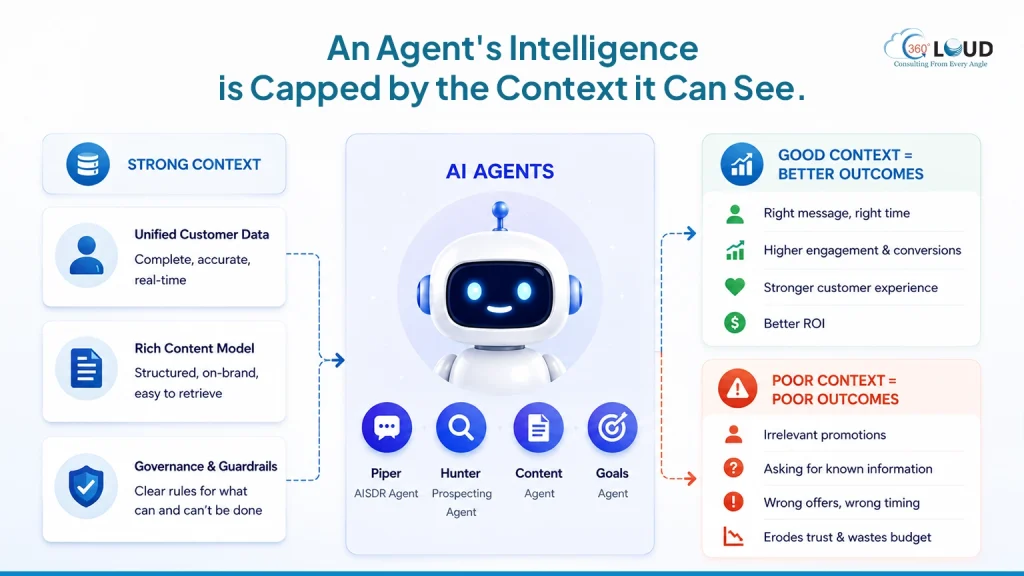
Salesforce said one thing at Connections that’s easy to scroll past and shouldn’t be. Without shared context, an agent can only react to isolated signals. It promotes a product the customer bought yesterday.
It asks for information the customer already gave you. It does the digital equivalent of a salesperson who didn’t read the file before the meeting. That’s the whole game. An agent’s intelligence is capped by the context it can see.
In the 2026 State of Marketing report, drawn from roughly 4,450 marketers, the consistent theme is that AI is producing results but disconnected data is holding teams back. The capability is there. The wiring isn’t.
This is why Agentic Segmentation runs on Data 360, and why Salesforce keeps pointing at its CDP as the foundation under all of it. An agent that can write a flawless email is worthless if it’s pointed at a stale, fragmented, half-duplicated view of the customer. Garbage context produces confident, fluent, on-brand garbage. At scale. Automatically. That’s arguably worse than a slow human, because it’s wrong faster and in more places.
So before you get excited about which agent to pilot first, the harder questions are these.
- Is your customer data unified?
- Is it scattered across Marketing Cloud, your CRM, a warehouse, and three spreadsheets nobody trusts?
- Do you have a content model an agent can actually pull from, or is your brand voice locked in a PDF and the heads of four people who’ve been there a while?
- Do you have governance, real guardrails, that tell an agent what it can and can’t do on its own?
If your team is staring at that gap right now, this is exactly where a Salesforce implementation partner earns its keep.
Get help mapping your Agentforce and data readiness before you turn anything loose on live customers.

What This Means for Marketing Teams, Roles, and Skills
Let’s talk about the part everyone’s quietly worried about. Jobs.
The honest version is that agentic marketing reshapes roles more than it eliminates them, at least for now. The fewer qualification reps but more opportunities, shows the direction. Repetitive, high-volume, low-judgment work is the first to get absorbed. Pulling lists. Writing first-draft outreach. Building the tenth variant of a landing page. That layer thins out.
What grows is the judgment layer. A few skills get more valuable, fast:
- Goal-setting and prompting that’s actually precise. “Run a back-to-school campaign” isn’t an instruction an agent can execute well. “Recover lapsed parents in these segments, within this budget, on these channels, without discounting below this margin” is. The teams that win will write better instructions.
- Governance and brand safety. Someone has to own what agents are allowed to do unsupervised, and that’s a real role, not a checkbox. This is the skill most teams have least of today.
- Reading agent output critically. Knowing when an autonomous campaign is optimizing toward the wrong thing, a vanity metric, a short-term lift that quietly trains customers to wait for the next discount, takes experience an agent doesn’t have.
- Connecting the dots across the funnel, which matters because these agents share context across marketing, sales, service, and commerce.
Notice none of those are production skills. They’re operator skills. The marketing org of 2027 looks less like a content factory and more like a small team of people steering a lot of automated capacity. Fewer hands on the keyboard. More eyes on the strategy and the guardrails.
That’s not a threat to good marketers. It’s a threat to marketers who only know how to do the tasks the agents now do.
The Bottom Line
Salesforce just handed marketers four agents that can build pipeline, generate content across every channel, and run campaigns toward a goal you define. Piper and Hunter are live today. The Content Agent and the Marketing Goals Agent are in pilot. The plumbing underneath, Agentic Segmentation and Slack-based campaign management, is the part that quietly makes the rest usable.
But the agents are not the variable that decides whether this works for you. Your data is. Your governance is. Your team’s ability to operate agents instead of just running tasks is.
Get that foundation right and four agents become a genuine marketing team. Get it wrong and they become four expensive ways to make the same mistakes faster. The announcement was the easy part. The next twelve months, the readiness work, is where it’s decided.
If you’re a Salesforce shop weighing where to begin, that foundational work, data unification, a usable content model, governance, the right first pilot, is squarely where 360 Degree Cloud’s Salesforce and Agentforce services come in. We’ve spent 14-plus years getting marketing teams from “we bought the capability” to “it actually moves the number.”

Categories

Solve It with Salesforce. We’ll Show You How.
AI. Apps. Experts. Everything you need to win with Salesforce under one roof.Frequently Asked Questions
What is Salesforce Agentforce and how does it work?
Salesforce Agentforce is an AI-powered framework that automates marketing, sales, and service workflows. It includes specialized AI Marketing Agents such as Piper, Hunter, Agentforce Content Agent, and the Agentforce Marketing Goals Agent to execute campaigns, generate content, qualify leads, and optimize performance autonomously.
How does the Agentforce Content Agent work?
The Agentforce Content Agent orchestrates content across channels—email, SMS, RCS, and mobile, while maintaining brand consistency. It integrates with Contentful and leverages Marketing Cloud Next for localization and global campaign rollout. Learn more about How Does Agentforce Content Agent Work in real scenarios.
What are the benefits of Salesforce AI Marketing Team 2026?
The Salesforce AI Marketing Team 2026 empowers marketers to focus on strategy while AI agents handle operational tasks. Using Agentforce Marketing and AI SDR Agents, teams can automate lead engagement, prospecting, content creation, and real-time campaign optimization, increasing ROI and efficiency.
What was announced in the Salesforce Connections 2026 Keynote?
During the Salesforce Connections 2026 Keynote, Salesforce introduced new AI Marketing Agents, highlighted Agentic Marketing workflows, and demonstrated integration with MCP Salesforce and Marketing Cloud Next. The event also showcased how Salesforce Acquires Contentful and enhances global content orchestration.
How can marketers implement Agentic Marketing with Salesforce AI Marketing Agents?
Marketers implement Agentic Marketing by using Salesforce AI Marketing Agents in combination with Salesforce Agentforce workflows. This approach shifts the role from manual production to operator-led campaigns, leveraging Agentforce Content Agent, Agentforce Marketing Goals Agent, and integration with MCP Salesforce for real-time optimization and measurable results.

About the author
Diksha GathaniaDiksha is a seasoned content writer and marketer who is always keen on trying new avenues to discover and write about. She has a keen eye for detail and a talent for breaking down technical topics into digestible pieces for both technical and non-technical audiences. She is a Salesforce, Marketing Automation, and Marketing Analytics enthusiast who stays on top of the pulse of industry trends. Beyond her professional endeavors, she finds joy in traveling and is always on the lookout for new destinations.
Recent Blogs
 Uncategorized
Salesforce Just Added Something New. Here’s How to Put It to Work.
Winter ’27 is live. Dreamforce just added more. Is your team using any of It? Two big drops landed in one month, and most teams…
Read More Salesforce Services
Salesforce Technical Debt 10 Signs Your CRM Needs a Strategic Overhaul (and What to Do About It)
Three years ago, the Salesforce org your team implemented was clean. Logical field names. Documented Flows. A handful of integrations that actually made sense. Today?…
Read More Salesforce Clouds
Salesforce Commerce Cloud Implementation: The 2026 Guide for B2B and B2C Commerce Teams
Commerce has always been competitive. But in 2026, the bar has shifted in ways that are hard to ignore. Whether someone is a consumer checking…
Read MoreReady to Make the Most Out of Your Salesforce Instance?
Our Salesforce aces would be happy to help you. Just drop us a line at contact@360degreecloud.com, and we’ll take it from there!
Subscribe to our newsletter
Stay ahead with expert insights, industry trends, and exclusive resources—delivered straight to your inbox.