
Salesforce for Small Business in India: What the SMB Growth Kit Actually Changes
23 Jul 2026
Table of Contents
Most small businesses in India don’t lose deals because the product is weak. They lose deals because nobody followed up on time. A lead comes in through WhatsApp, gets forwarded to a spreadsheet, sits there for four days, and by the time someone calls back, the buyer has already signed with a competitor. This is the quiet problem behind a lot of stalled growth, and it’s exactly what Salesforce for small business in India is built to solve. Not with more software to manage, but with one place where every lead, call, and follow-up actually lives.
That gap between “we have a CRM” and “we actually use it” is where most SMBs get stuck.
Curious if the SMB Growth Kit fits your team?

Table of Contents
Why Spreadsheets Stop Working Somewhere Around 50 Customers
Every founder starts with a spreadsheet. It’s free, it’s familiar, and honestly, it works fine for the first fifteen or twenty customers. Then the sales team grows to three people. Then five. Suddenly two reps are calling the same lead, nobody knows who owns which account, and the founder is the only person who remembers why a deal went cold last quarter.
That’s not a sales problem. It’s a memory problem. A business that depends on one person’s memory doesn’t scale, no matter how good that person is.
Salesforce solves this by making the record of the customer relationship independent of any single employee. Every call, every email, every quote sits against the account, visible to whoever needs it next. When a rep leaves (and in Indian SMBs, sales teams do turn over fast), the pipeline doesn’t leave with them.
What the Salesforce SMB Growth Kit Actually Solves
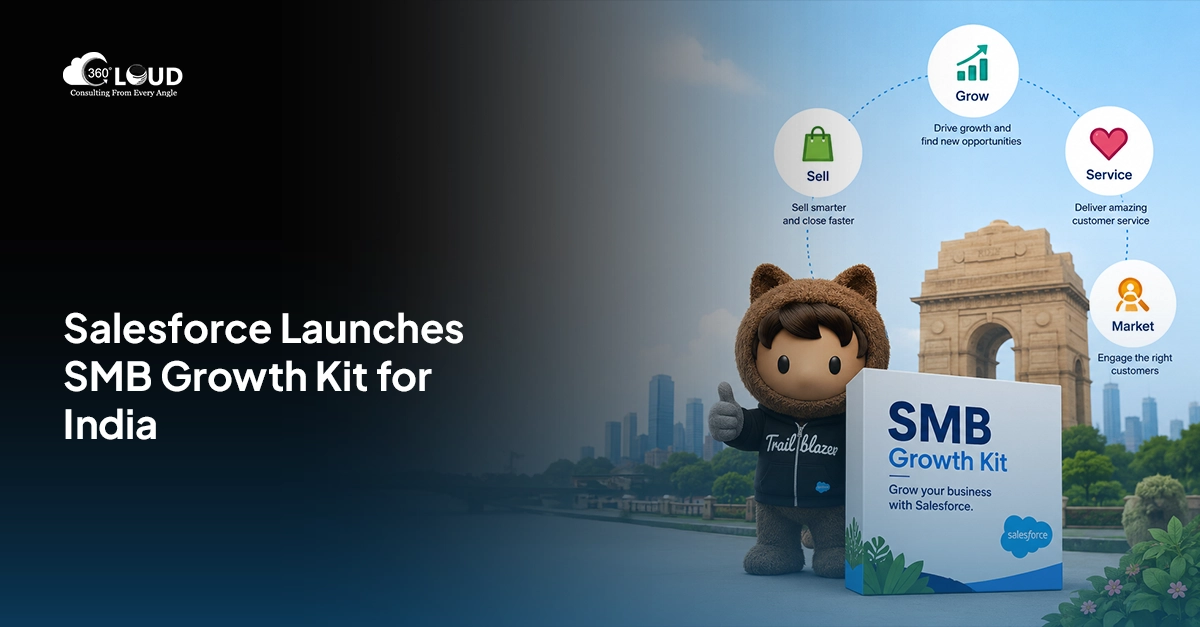
This isn’t a hypothetical product idea. Salesforce formally launched the SMB Growth Kit for India in mid-July 2026, presenting it as a cohesive package specifically tailored for small and mid-sized businesses in India, combining such services as Agentforce Sales, Slack, and Tableau. Speed has been highlighted as the primary value proposition: launching SMBs on the platform within four to six weeks instead of lengthy implementations typical of enterprise rollouts via a select group of Salesforce resellers as opposed to direct sales.
That packaging choice matters. It bundles pre-configured sales, collaboration, and reporting tools aimed at companies that need results in weeks, not quarters.
For an Indian SMB, this matters more than it sounds like it should. Most small businesses don’t have a dedicated Salesforce admin on payroll. They need something that works close to out of the box, with room to customize later once the team actually understands what they’re using.
A few things the Growth Kit typically covers:
- Lead capture and routing, so a WhatsApp or website inquiry doesn’t sit unassigned
- Guided sales processes that don’t rely on tribal knowledge
- Built-in dashboards that show pipeline health without a manual Excel export every Friday
- Starter automation for follow-up reminders and renewal alerts
None of this is flashy. It’s the boring plumbing that makes a sales team predictable instead of chaotic. And predictable is underrated.
Is AI CRM for Small Business Actually Useful, or Just a Sales Pitch?
Here’s the honest answer: it depends entirely on how clean the underlying process is. An AI CRM for small business can only work with the data it’s given. If leads are logged inconsistently, or half the team still tracks deals on paper, no amount of AI fixes that.
But when the basics are in place, AI stops being a buzzword and starts doing genuinely useful things. It can draft a follow-up email based on what a prospect actually said on a call. It can flag a deal that’s gone quiet for longer than usual. It can summarize a week’s worth of customer interactions into three lines a manager can actually read.
That’s where Agentforce Sales comes in. Instead of sitting as a separate chatbot bolted onto the CRM, Agentforce works inside the existing Salesforce record, using real account and opportunity data to suggest next steps, draft responses, and even qualify leads before a human ever touches them. For a lean SMB sales team, this is closer to having an extra pair of hands than it is to having “AI features” for the sake of a feature list.
Worth saying though: Agentforce isn’t magic, and it won’t compensate for a sales team that doesn’t trust the system enough to use it consistently.
See what Agentforce Sales looks like running on your actual deal data.

What “Best CRM for Small Business in India” Actually Means
Search for the same phrase in Google, and you’ll find a host of listicles listing these tools based only on their pricing. Pricing is important; but for an Indian SME, the important considerations generally go something like this:
Is it built in such a way that it actually reflects the sales process used by local sales teams, which is mostly phone-based, mostly WhatsApp-based, and relationship-focused? Does it support GST-compliant invoicing or integration with existing accounting tools? Would it be relevant after a company grows twice in size next year?
Salesforce tends to score well here because it’s not really “a small business tool” that gets outgrown. It’s an enterprise-grade platform that scales down cleanly for SMBs through kits like the Growth Kit, which means a company doesn’t need to migrate platforms the moment it crosses fifty employees. That single fact quietly saves a lot of businesses from a very expensive re-implementation two years down the line.
Why the Implementation Partner Matters More Than the Platform
This is the part most comparison blogs skip entirely. The platform is rarely the reason a Salesforce rollout fails. Poor setup is. A CRM configured by someone who doesn’t understand the sales process ends up as an expensive digital filing cabinet nobody logs into after week three.
This is where working with an experienced Salesforce implementation partner in India actually pays off. A good partner doesn’t just install the software. They map the existing sales process first, figure out what’s actually broken, and configure Salesforce around that reality instead of forcing the business to adapt to a generic template.
360 Degree Cloud has spent years doing exactly this kind of SMB-focused implementation work, configuring Salesforce (and Agentforce, where it fits) around how Indian sales teams actually operate day to day, not around a theoretical enterprise blueprint. If a rollout doesn’t survive contact with the sales floor, it wasn’t really an implementation. It was a demo.
Getting Started Without Overengineering It
The mistake most SMBs make isn’t choosing the wrong CRM. It’s trying to configure every possible feature before anyone on the team has logged a single real lead. Start narrow.
Get lead capture and follow-up automation running first. Add reporting once the team trusts the data going in. Layer in AI-assisted features like Agentforce only after the basic pipeline discipline is already there. Trying to do all three at once is how implementations stall out around month two.
The Bottom Line
Salesforce for small business in India isn’t really about buying enterprise software at SMB scale. It’s about removing the dependency on tribal memory and spreadsheets that quietly caps how fast a company can grow. The Growth Kit gets the setup moving fast, Agentforce Sales adds real leverage once the basics are solid, and the right implementation partner is what determines whether any of it sticks past the first quarter.
Categories

Solve It with Salesforce. We’ll Show You How.
AI. Apps. Experts. Everything you need to win with Salesforce under one roof.Frequently Asked Questions
Does 360 Degree Cloud set up Agentforce or just standard Salesforce?
Agentforce Sales is part of the implementation scope wherever it genuinely fits the business, not bolted on as a checkbox feature. We configure it against real deal and account data so the sales team actually trusts what it's suggesting, which is the difference between AI that gets used and AI that gets ignored.
Do you only sell Salesforce licenses, or do you handle the setup too?
The 360 Degree Cloud does not merely deal with the licensing; they take care of the implementation as well. It implies customisation of the SMB Growth Kit to the existing sales process, data migration from Excel sheets or WhatsApp conversations and training of the staff so that they do not put this solution into a drawer the next week after installation. SMBs do not require yet another vendor; they need a partner who will remain even after go-live.
Can you help us figure out if we even need the Growth Kit, or something else?
This is generally the first conversation we have, not the last. Before making any recommendation, 360 Degree Cloud first evaluates how your sales team currently operates, what is broken, and what is simply noise. The solution is often the SMB Growth Kit. Other times it's a simpler configuration. We would rather scope correctly than oversell.
Our sales team is small and not very technical. Will that be a problem?
This is quite the standard rather than an exception among the SMBs that we work with. The 360 Degree Cloud platform develops the training and onboarding process around non-technical users, since the CRM will only be valuable if the users who use it daily continue to use it.
Can you integrate Salesforce with tools we already use, like Tally, Zoho Books, or WhatsApp Business?
For the most part, yes. Our implementation plan covers integration tasks, and making Salesforce work with your existing accounting or messaging systems is the only way for you to be sure that your adoption experience will not add additional layers of complexity to the old process.

About the author
Editorial TeamThe Editorial Team at 360 Degree Cloud brings together seasoned marketers, Salesforce specialists, and technology writers who are passionate about simplifying complex ideas into meaningful insights. With deep expertise in Salesforce solutions, B2B SaaS, and digital transformation, the team curates thought leadership content, industry trends, and practical guides that help businesses navigate growth with clarity and confidence. Every piece we publish reflects our commitment to delivering value, fostering innovation, and connecting readers with the evolving Salesforce ecosystem.
Recent Blogs
 Salesforce Clouds
Salesforce CPQ to Revenue Cloud Migration: Why the Orgs That Waited Are Now Playing Catch-Up
There’s a boardroom conversation that happened at a lot of companies between 2022 and 2024. RevOps brings up Salesforce CPQ to Revenue Cloud migration. Finance asks what…
Read More AI and Agentforce
Agentforce Enabled by Default: What Every Salesforce Admin Needs to Know Before Winter ’27
Salesforce releases usually arrive with a to-do list. Sandbox testing, a few toggle decisions, maybe a quick training doc for end users. Agentforce Winter ’27 is a different situation. …
Read More Salesforce Services
Salesforce License Optimization: How to Cut Costs by 30% Before Your Next Renewal
Most companies overpay for Salesforce. Not by a little – by 20 to 30%. And the frustrating part? Nobody planned for it. License waste doesn’t announce itself. It compounds quietly, quarter by…
Read MoreReady to Make the Most Out of Your Salesforce Instance?
Our Salesforce aces would be happy to help you. Just drop us a line at contact@360degreecloud.com, and we’ll take it from there!
Subscribe to our newsletter
Stay ahead with expert insights, industry trends, and exclusive resources—delivered straight to your inbox.