
Salesforce Agrees to Acquire Braze: What It Means for Marketing Cloud
Updated On: 06 Nov 2026
Table of Contents

On October 20, 2026, Salesforce announced it has signed a definitive agreement to acquire Braze for $5.66 billion. The deal is expected to close in Salesforce’s fiscal year 2028, subject to regulatory approval.
That is a large number for a mobile marketing platform. It also signals something specific about where Salesforce sees the limits of its current marketing stack, and what it needs to build the next version of Marketing Cloud.
For teams already running marketing on Salesforce, this is worth paying attention to now, before the deal closes and the roadmap shifts.
Table of Contents
What Braze Actually Does
Braze is not a mass-email tool. It is a customer engagement platform built around real-time event streams, mobile-first channels, and behavioral triggers.
The platform was founded in 2011 and has spent roughly 15 years building infrastructure for high-frequency, personalized messaging across push notifications, in-app messages, SMS, email, and web. Its architecture is event-driven by design. When a customer opens an app, abandons a cart, or reaches a loyalty milestone, Braze can respond immediately with a relevant message across the right channel.
The AI Decisioning engine inside Braze takes this further. It evaluates audience segments, timing, and channel preferences in real time, adjusting which customers receive what message based on live behavioral data.
Braze’s customers include major consumer brands in retail, media, finance, and travel. These are organizations that send millions of personalized interactions daily and cannot afford the lag that comes with batch processing.
The Gap Salesforce Was Quietly Sitting With
Marketing Cloud Engagement, built on Salesforce’s 2013 ExactTarget acquisition, is a mature and widely deployed email marketing system. Analysts at Futurum have described it as fundamentally batch-oriented, which reflects its origin as a standalone platform connected to the Salesforce ecosystem rather than built natively within it.
That architecture created a few specific gaps:
- No real-time event streaming. Classic Marketing Cloud Engagement relies on batch-updated data sources. When a customer opens an app, abandons a checkout, or hits a loyalty threshold, there is no native mechanism to respond in that moment.
- Limited mobile-first channel depth. Push notifications, in-app messaging, and mobile-triggered journeys are not where classic Marketing Cloud was designed to excel.
- Weak B2C personalization at scale. High-frequency consumer engagement, where a brand sends millions of time-sensitive, behaviorally triggered interactions daily, sits outside the platform’s core design.
Salesforce has been addressing this with Marketing Cloud Next, the next-generation platform built natively on Data Cloud. Marketing Cloud Next brings real-time customer profiles, event-based segmentation, and instant cross-channel activation in a way classic Marketing Cloud Engagement was never architected to support.
But Marketing Cloud Next is still early in adoption. Braze fills the space that MCN does not yet fully cover, particularly on mobile channels and consumer-facing real-time engagement at the scale Braze’s customers already operate at.
What’s Expected to Change for Marketing Cloud Users
No specific product roadmap has been published yet. The deal has not closed. But based on what Braze brings and where Salesforce’s platform is heading, a few things are reasonable to expect.
Braze’s event-streaming architecture and AI Decisioning engine will likely connect to Data Cloud. That would let Salesforce customers use unified customer profiles as the data layer for Braze campaigns, which is a meaningful upgrade over running Braze and Salesforce as parallel systems with periodic syncs.
Agentforce could gain new execution channels. Braze already handles push, in-app, and SMS at scale. If Salesforce connects Agentforce’s decision layer to Braze’s delivery layer, marketing agents would have a broader set of channels to act on in real time.
For teams currently using Marketing Cloud Engagement, the near-term impact is probably minimal. The deal has not closed. Integrations take time to build. No migration requirement has been announced.
Braze co-founder and CEO Bill Magnuson has stated publicly that Salesforce’s intent is to continue building Braze as Braze. That suggests the platform will maintain its own identity while gaining access to Salesforce data infrastructure over time.
The B2C Shift This Deal Is Accelerating
Salesforce built its reputation in B2B: sales pipelines, service cases, account management. The CRM architecture reflects that. Marketing Cloud Engagement, for all its depth in email, grew up serving B2B and enterprise batch campaigns more naturally than it served high-frequency B2C consumer journeys.
Braze is a B2C-first platform. Its customers are not running quarterly nurture campaigns to a list of enterprise accounts. They are sending millions of time-sensitive interactions to consumers who expect relevance and speed.
This acquisition moves Salesforce into that territory more credibly. Combined with Data Cloud’s unified profiles and Agentforce’s AI layer, Braze gives Salesforce a stronger answer for retail, media, gaming, finance, and other consumer-focused industries that have historically been harder to serve well inside the Marketing Cloud stack.
The Two-Engines Question
One thing worth thinking through is what this means structurally for Salesforce’s marketing platform.
Before this deal, Salesforce was already managing a transition between Marketing Cloud Engagement (the existing installed base) and Marketing Cloud Next (the new architecture). Now Braze adds a third layer: a proven, real-time engagement platform with its own architecture, its own channel depth, and its own customer base.
One way to read this is as a layered architecture, where Data Cloud unifies the customer record, Agentforce handles AI decisions, Marketing Cloud Next manages campaign execution and journeys, and Braze handles real-time, mobile-first consumer engagement. That framing is consistent with where Salesforce has been heading. It is worth noting that this is an interpretation of how the platforms could fit together, not a roadmap Salesforce has formally published.
The integration work required to make that stack seamless is substantial. Watch the Dreamforce 2027 roadmap announcements and the first post-close product updates for signals on how Salesforce plans to handle the overlap.
Part of a Bigger Pattern: Salesforce’s 2026 Acquisition Spree
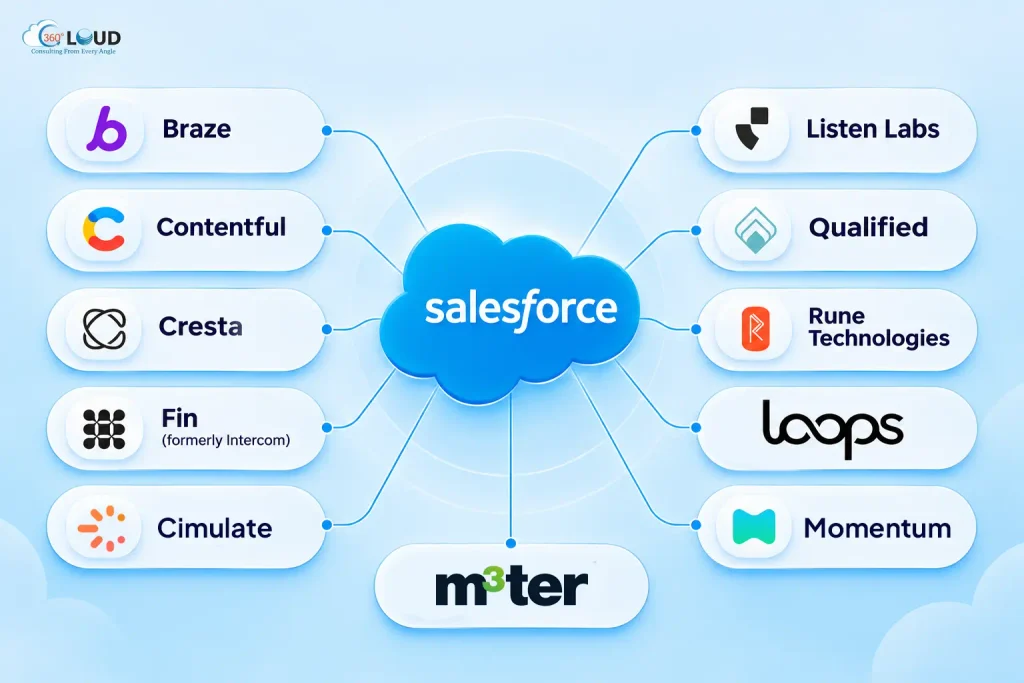
Worth saying: Braze isn’t a one-off bet. It’s part of a pattern. This is Salesforce’s eighth acquisition in 2026 alone, following deals for Informatica (data management), Fin – formerly Intercom – ($3.6 billion, AI customer service), Listen Labs ($2 billion, AI-powered customer research), and m3ter (consumption billing infrastructure). And just this week, Salesforce announced the acquisition of Cresta for a reported $2.7 billion.
Each one fills a specific hole. Braze fills the real-time B2C engagement hole in Marketing Cloud. The pace of acquisition tells you something: Salesforce isn’t waiting to build capabilities organically. It’s buying speed.
If You’re Running Marketing on Salesforce Right Now
The deal will not close until fiscal year 2028 at the earliest. Nothing changes in your Salesforce org today.
But there are a few things worth doing now.
First, audit how much of your current marketing activity depends on batch execution versus real-time triggers. If the answer is “mostly batch,” that is not a problem today, but it is a useful data point for evaluating whether Braze’s capabilities are relevant to where your programs need to go.
Second, if you are evaluating Marketing Cloud Next, that evaluation is now more interesting. MCN’s real-time architecture is the foundation Braze will likely connect to. Getting Data Cloud set up properly is not just about the transition from classic Marketing Cloud. It is positioning your team for whatever the integrated Braze capabilities eventually make possible.
Third, if you are a current Braze customer, the Salesforce press release and Magnuson’s statements suggest continuity. But watch the product roadmap and licensing terms carefully over the next 12 to 18 months.
For most Salesforce customers, the right move is to stay informed, keep your data foundation clean, and avoid making major platform decisions based on what has not been confirmed yet.
If you want help evaluating where your marketing stack stands today and how moves like this one affect your Salesforce roadmap, the team at 360 Degree Cloud works with organizations at every stage of Marketing Cloud deployment.
Categories

Solve It with Salesforce. We’ll Show You How.
AI. Apps. Experts. Everything you need to win with Salesforce under one roof.FAQs
What is the Salesforce Braze acquisition?
Salesforce signed a definitive agreement to acquire Braze, a real-time customer engagement platform, for $5.66 billion on October 20, 2026. The deal is expected to close in Salesforce’s fiscal year 2028, pending regulatory clearance.
How is Braze different from Marketing Cloud?
Classic Marketing Cloud Engagement is a mature platform built on Salesforce’s 2013 ExactTarget acquisition, designed primarily for batch-based email campaigns. Braze is a real-time, event-driven platform built for mobile push, in-app messaging, and high-frequency consumer engagement. Marketing Cloud Next, Salesforce’s newer platform built natively on Data Cloud, is closer architecturally to Braze, but Braze adds deeper mobile-channel capabilities and an established B2C customer base.
Will Marketing Cloud users need to migrate to Braze?
No migration requirement has been announced. The deal has not closed yet, and no post-close integration roadmap has been published. Bill Magnuson, Braze’s co-founder and CEO, has stated that Salesforce’s intent is to continue building Braze as Braze.
When will the Salesforce Braze deal close?
Salesforce expects the acquisition to close in its fiscal year 2028, subject to customary regulatory approvals. No specific date has been confirmed.
What does this mean for Data Cloud?
Braze’s event-streaming architecture is a natural fit with Data Cloud’s unified profiles and real-time segments. The most likely integration path would use Data Cloud as the data layer for Braze campaigns, giving Salesforce customers a unified view of the customer that Braze can act on in real time. This is an expected direction, not a confirmed roadmap.
Should we pause our Marketing Cloud investments because of this deal?
No. The deal has not closed. Any product integration is likely 18 to 24 months away at minimum. Teams should continue building on Marketing Cloud Engagement and evaluating Marketing Cloud Next on its current merits. Clean, unified data in Data Cloud is a sound investment regardless of how the Braze integration eventually develops.

About the author
Editorial TeamThe Editorial Team at 360 Degree Cloud brings together seasoned marketers, Salesforce specialists, and technology writers who are passionate about simplifying complex ideas into meaningful insights. With deep expertise in Salesforce solutions, B2B SaaS, and digital transformation, the team curates thought leadership content, industry trends, and practical guides that help businesses navigate growth with clarity and confidence. Every piece we publish reflects our commitment to delivering value, fostering innovation, and connecting readers with the evolving Salesforce ecosystem.
Recent Blogs
 Salesforce Services
What is Salesforce Implementation? Everything Decision-Makers Need to Know Before They Start
Most companies don’t buy Salesforce and then wonder what to do with it. They buy Salesforce because something is broken – deals are being tracked…
Read More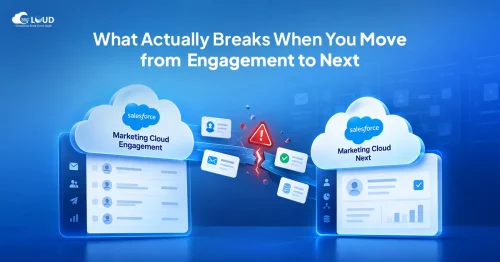 Salesforce Clouds
Marketing Cloud Engagement to Next: What Actually Has to Be Rebuilt
Nobody tells you this upfront, but migrating from Marketing Cloud Engagement to Marketing Cloud Next isn’t a lift-and-shift. It’s a rebuild – component by component,…
Read More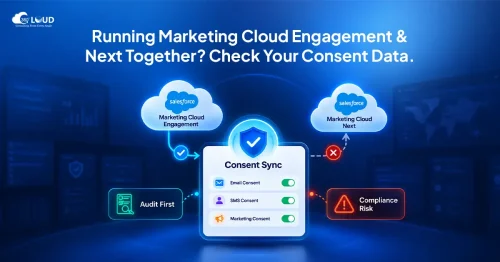 Salesforce Clouds
Who Owns Consent When You’re Running Marketing Cloud Engagement and Next Together?
Running Marketing Cloud Account Engagement and Marketing Cloud Next side by side? A lot of Salesforce customers are doing exactly that right now – either…
Read MoreReady to Make the Most Out of Your Salesforce Instance?
Our Salesforce aces would be happy to help you. Just drop us a line at contact@360degreecloud.com, and we’ll take it from there!
Subscribe to our newsletter
Stay ahead with expert insights, industry trends, and exclusive resources—delivered straight to your inbox.