
Talk to Us

Key Features to Consider During Salesforce CPQ Implementation

If you’re thinking of considering Salesforce CPQ implementation, you definitely need to know what features you need at the top and how you can make the most of them. Praises can fall short if we start talking about CPQ, as it’s one of the best Salesforce products, helping sales reps to generate accurate quotes for customers faster. But you need to know how to use the features in the best way that could contribute to business growth.

Studies show that sales reps spend just 34% of their time actually making a sale. They spend the rest of the time on other tasks like generating proposals and quotes. That’s the kind of situation Salesforce CPQ helps to improve. Considering the value of Salesforce CPQ implementation, we’ll be covering the best features it supports that you should consider on top of your mind when implementing the solution. 

7 Features You Shouldn’t Miss Out On During Salesforce CPQ Implementation 

So, let’s delve deeper into the blog and cover the top features of Salesforce CPQ that you must use for your internal quote generation and management operations.

1. CPQ Favorites

This can be considered the most underrated feature of CPQ. There are chances you might not have been using it. But once you use it, you might wish you could have used it sooner. 

With CPQ Favourites, users can mark products as Favorite, and CPQ will save the record for any future use. This helps to save the time of users, enabling them to configure a bundle just once and keep re-using it whenever needed. You can also use the feature to save specific products out of the catalog, which will be helpful when you’ve got a large catalog to handle. 

2. Guided Selling

Sales representatives can easily find out the best product that could be sold to their customers using the Guided selling feature of Salesforce CPQ. The feature can be used to answer a few predefined questions through which the system will find out the most suitable products for the customers. This will save time for reps that they had been spending on looking through the complete product catalog. 

The feature also allows the users to task the system to select a product automatically if it’s the only one found after the search. Sales reps can set up Guided Selling to automatically pop up when any user enters the product catalog. Users can also choose to trigger it manually.

You can even hire a CPQ developer to leverage the feature in the best way possible.

3. Twin Fields

The feature allows automatic data mapping between two fields on different objects. Typically, admins have to copy data from Quote Line records to resulting subscription records, opportunity product records, and order product records. With Twin Fields, admins have to have the same field type with the same API name on objects. The system will automatically copy the value when the record is created.

It is necessary for admins to be sure that the users reacting to the records must have Edit access on the target field and at least Read access for the source field to ensure data mapping. The table given below indicates some objects with the field mapping. 

4. Product and Price Rules

Product and Price Rules play the role of the cornerstone for Salesforce CPQ. It is with these features that sales reps can be assured that they are preparing accurate quotations every time. 

Talking about product rules, there are four types:

Validation: It prevents users from saving a quote configuration that is incompatible.

Selection: It helps to automatically select, deselect, show, or hide products according to the added parameters.

Alert: It provides users with notifications about important information but doesn’t prevent them from saving the quote. 

Filter: This rule is used in dynamic search filters, enabling automatic filtering of the product catalog.

Another one is the price rules, which are versatile for CPQ admins. It helps to inject a field value, static value, or summary variable in a quote. 

Consider that your marketing team wants to run a promotion and provide an automatic 15% discount on the entire quotation, ensuring that at least one software is added. Price rules can easily help the rep to achieve this. Once you have set the price rule, you can update the condition or action next.

These rules can be complicated to work with. But you can always get experts from the best Salesforce implementation company to help you access and use them efficiently. 

5. Quote Line Groups

Users can use Quote Line Groups in different ways in Salesforce CPQ. It enables users to group products and apply parameters on the complete group level instead of applying them at the quote level.

In the example given below, you’ll see Services grouped together and made optional with an added 20% discount. The subtotal of these quote lines will have no impact on the overall total of the quote. This is because we have kept them optional.

6. Contracted Pricing

The feature is quite essential for the users as it helps to automate the pricing in any quotation according to specific parameters or requirements. You can create the contracted prices either manually or automatically according to the specific settings for your organization. 

It is to note that the contracted price will affect the regular price of any products or group of products based on the contracted price record. For example, you’ve provided a customer with a 20% discount on all products in your catalog for the first 6 months of the contract. With contracted pricing, you don’t have to remember to apply the discount every time the customer makes a purchase. You can set up the contracted price and mention the start and end date of the discount, thus making the discount valid for the mentioned time.

7. Multi-Dimensional Quoting Products

Multi-Dimensional Quoting products or MDQ product is another essential feature of CPQ that you must consider using. This feature means that a specific product can be affected by a given dimension, for example, time, and the other products would not be affected by it. For example, a software subscription and a laptop purchased on a one-off basis.

When configuring complex deals, sales reps can achieve increased flexibility while using MDQ for some products. As an example, consider a sales rep who wanted to offer a larger discount than normal to sign a big customer. But to counteract the discount in year one, the discount level needs to be tapered off over the remaining contract years. The sales rep can use MDQ to do so. 

Hire Trusted Salesforce Implementation Services and Benefit from CPQ

Salesforce CPQ definitely has a long list of extensive features, and covering it all here isn’t possible. But what you need is to implement it and actually see the difference it makes in your productivity and efficiency. 

Hire experienced and trusted Salesforce implementation services with certified professionals to help you work with these features smoothly. Contact us and talk to our CPQ developers, who can implement the solution and even help you adopt its features.

What Makes Salesforce Gmail Integration A Must-Have for Your Team?

Gmail and Salesforce are two of the most frequently used solutions for businesses. They are the leaders of the sector, considering people go for Salesforce when they need to choose the best CRM solution and Gmail for sending emails. Their combined power is something that makes them more powerful. Salesforce Gmail integration is how businesses can get the best of both worlds. 

The integration would enable the team to access and manage records and information saved on Salesforce through the Gmail account only. This would enable the team to improve and streamline the workflow, thus making it easier to work smoothly without having to switch between systems. 

Whether it is about accessing changes in Salesforce records, logging emails, or creating leads or contacts, the integration would enable you to do it all from within your Gmail inbox. But that’s not all; there’s more that this integration can offer you. In this blog, we’ll uncover some significant reasons why your team should consider going for Salesforce email integration for their internal operations. 

Why Your Team Needs Gmail Salesforce Integration

For any business, major communications with customers happen via email. This could make it a tricky business to keep switching between Salesforce and Gmail to find the right data and use the data to prepare suitable emails for the customer. 

Considering Gmail and Salesforce integration could be a great option here, saving all that essential time while boosting your productivity. Let’s cover some more such points to understand why exactly your team needs this integration. 


1. Get complete visibility of sales activities

According to studies, only about 40% of sales update information is entered into the CRM used by the team. In addition to that, sales representatives also spend around 21% of their time simply researching through data in Salesforce, which is incomplete, thus ending up with a lot of time wasted, which could have been used somewhere productive. All of this ends up in customers’ records slipping out of the system due to where there are chances to miss out on leads. 

That’s something that can be avoided by integrating Salesforce with Gmail. The integration will automatically synchronize all data and would thus save records in Salesforce through the email information in Gmail. This integration would thus ensure the sales representative have complete visibility across the right customer information, thus enabling them to target the right audience at the right time. 

2. Increase the productivity of sales reps

Sales representatives spend a lot of time on data entering. Along with that, they spend the majority of their time on their emails. In an ideal situation, sales reps should spend less time entering data and more time actually making sales. Integrating Salesforce and Gmail can be a great help here. 

The integration would help in:

– Giving reps the freedom of actually spending time on selling

– This would minimize the distractions and time-taking task of updating the records

– Also, sales reps would no more have to spend time personalizing emails to reach out to new customers and engage with them.

3. Boost sales engagement

When it is about achieving true sales engagement within an organization, the focus should be on automating the sales process through which manual intervention can be minimized. This will help in achieving a personalized experience for the customers and employees. This is the kind of engagement you can achieve by integrating your Salesforce org with your Gmail inbox.

Enabling this kind of personalized engagement would even enable customers to reply or book a meeting with the sales rep through just a few clicks. Thus enabling an easier experience for customers would allow you to get more leads. Through the integration, you can:

– Automate the stages of the sales process, thus making the process faster to move an opportunity

– Set up rules to trigger the next sales process on certain actions.

4. Minimize errors & redundancies

There are times sales representatives have to enter the same information in different records or systems because there is no data synchronization between systems. This would result in more redundant work, thus minimizing the time spent on selling. 

Considering Salesforce Gmail integration would enable data synchronization between the solutions, thus eliminating the need to save data again and again. This would help in saving time spent in context switching. Also, this would minimize the chances of errors or compromising data quality. 

5. Simplify account handoffs

Without having a smooth account handoff process, a company can end up with hindered processes and a lead generation cycle. Thus, you need a way that could keep all your reps synchronized with updated customer information in real-time.  

Integrating your Salesforce and Gmail accounts could be a great help here as your sales representatives would have a clear and unified view of all updated Salesforce records within their Gmail inboxes. So, even if a respective rep attending to a customer is not available, the other sales reps would have the right information and clarity on the lead journey to take the process forward without having to keep the customer waiting.

Integrate Salesforce and Gmail Inbox with the Help of Experts

Integrating your Salesforce org with your Gmail inbox can help you witness significant benefits for your business, from improving data accuracy to providing a detailed view of customers. But to make the most of this integration, you need experts who can perform the integration right and follow the best practices to synchronize data and streamline workflow. 

Having the support of Salesforce integration services can completely transform the way your business operates and adapts the integrated solution. So, contact us and get in touch with certified Salesforce experts who can get your Salesforce integrated with the third-party applications in use to streamline your workflows and improve productivity.

6 Trending Growth Strategies Suggested by the Top Salesforce Partner

The market these days is becoming tougher than before. It’s not just the economic uncertainty but also the rise in the demand of customers who are becoming more value-conscious. Considering this complexity, you need to get advice from the top Salesforce partner to suggest what moves can work well in this market.

According to the Salesforce State of Sales report, there are several growth strategies that can influence customer sentiment and get them closer to businesses. In this blog, we’ll be looking at these trends more closely, evaluating how these could work for your business. 

We all know that every business seeks new ways through which they can grow and become customers’ favorite. That’s where you can consider following the top trends that will keep you growing. 

So, check out these top trends, suggested by the top Salesforce partner in the USA, that will help you achieve exponential growth.

1. Consider virtual and hybrid selling

In the current market, it is considered more beneficial for sales teams to focus on closing deals virtually or by following a hybrid approach. This would mean building a relationship virtually as well as meeting one-to-one with the person. In this context, salespeople of different organizations should focus on achieving greater engagement, enabling self-service features, and hyper-personalization for business growth. 

This is where it could be a great idea to leverage AI and automation-centric tools with the help of a Salesforce registered partner that could help in building an omnichannel sales funnel that will help teams to track their leads properly. Investing in tools like sales reporting/analytics, sales forecasting tools, process automation, etc., would help teams to streamline processes, boosting the reps’ efficiency so they could meet their customer expectations.

2. Optimize your packaging

There has been a lot of news and discussions about the impact of businesses on the environment. This is why companies are working on using green credentials while building their strategies for growth. More and more organizations are now focusing on ‘ethical recycling’ or ‘all-natural’ and other aspects similar to this. 

Product packaging plays a great role when it comes to running a green business. It is essential these days to consider sustainable packaging, which has been proven to be a crucial element in boosting sales. This is where the sales team should focus on driving innovation and investing in using new and different packaging materials that could be environmentally friendly, like paperboard, organic fabric, etc. 

3. Modernize tools and technologies

Many reps these days are saying that not having proper tools and adequate technologies are the prime reason to leave their current jobs. When using outdated legacy solutions or technologies is simply leading to cost overruns and data siloes, which ultimately make the process complex and time-taking, thus decreasing employee productivity.

This is where organizations should emphasize more on shifting their business operations to a more efficient platform that would keep siloed data together. Using Salesforce CRM is a great way to ensure collaborative teams and data that will improve operations and help teams to focus more on conducting effective engagement with customers and converting them. You need to hire the best Salesforce partners in the USA to leverage Salesforce in the best way.

4. Improve cross-functional alignment

One of the most promising growth factors that could help drive growth is ensuring the improvement of cross-functional alignment. This approach focuses on enabling inter-team collaboration, boosting overall productivity, and eliminating siloes, which ultimately help minimize customer service costs throughout their journey. 

If you focus on enhancing customer loyalty and trust and improving your sales, enabling effective cross-functional alignment is a great way to ensure all of it. It would also help sales representatives effectively collaborate with multiple departments, enabling them to enhance customer interactions and close deals faster.

5. Target new markets

If we analyze the current trend, digitization is now opening doors for agile operations. Businesses can take this up as the low-risk approach they can follow to grow in the market.

This would give companies the first mover advantage, enabling companies to quickie find ways to convert quality leads and work in boosting their sales. You can prefer adopting strategies like demand forecasting and revenue intelligence that will help to adapt and sell more easily.

6. Improve training on tools

Even though it is essential to use tools and technologies to plan the business growth and enhance the reps’ efficiency, it is also necessary to reconsider how many tools have been used internally to actually sell to customers. There are times when teams are using so many tools that aren’t even necessary and just complicate the work more. 

This is where sales leaders should provide necessary training to representatives to use existing solutions efficiently and equip them to succeed. You can also consider using a unified, feature-rich solution that helps to lower IT costs by 25% and remove the need to have multiple standalone tools. Hiring a Salesforce Summit partner who can also help you with training can also be a great approach.

Get Advice on Growth Strategies with the Best Salesforce Experts

Nothing is constant in the business world. Whether it is product delivery or customer expectations, significant change can be seen over a span of time. This makes it essential for businesses to be aware of what’s changing in customer behavior and trending in the market. All you need is a trusted Salesforce partner to guide you through those changes and help you adopt them.

As you focus on maximizing your business value and meeting your buyer expectations, you need the right help to walk parallel to trends and optimize your operations. Contact us and get n touch with trusted experts who can always keep you aligned with Salesforce and market trends.

Everything That A Salesforce Financial Services Cloud Consultant Can Do For You

In the financial services sector, modern customers are nowadays seeking personalization, convenience, and enhanced experienced. They require a service that can hear them and deliver just the right services by understanding what exactly they need. A study by Harvard Business Review Analytic Services shows that about 64% of people from financial services firms are making it one of their top five business priorities to improve customer experience. In this respect, companies are hiring a Salesforce Financial Services Cloud consultant to help them leverage the best of Salesforce to enhance productivity and customer experience. 

Financial Services Cloud is a CRM solution specifically made by Salesforce for financial services companies. Whether it is a banking company or a wealth management firm, the solution can help all aspects of financial services to overcome challenges and achieve streamlined and simplified workflows.

But leveraging the best of the solution is only possible when you have an experienced and certified Salesforce Financial Services Cloud consultant by your side. So, in this blog, we’ll be talking about everything that a Salesforce consultant can help with financial services.

Everything a Salesforce Financial Services Cloud Consultant Can Manage

Managing financial information is always a tricky business. But with the help of a Salesforce financial services cloud consultant, managing it all becomes easier. And the best part is the consultant works well for all sectors, whether it is for banking, insurance, lending, or wealth management. 

Let’s have a closer look at what these certified Salesforce consultants can do for your business in financial services. 

1. For Banking

Specifically, talking about the banking sector, Financial Services Cloud can bring in a great transformation by setting up a unified experience for customers, thus making it easier for them to navigate through services and achieve their satisfaction. A consultant could help greatly to enable bankers to get complete visibility into deposits, referrals, customers, and activities related to a specific branch.  

In addition to this, the teams can have a view of their pipeline and act quickly on incoming opportunities. Here are some more key benefits of hiring a Salesforce consultant:

– Conduct easy segmentation of clients by evaluating their unique financial goals and needs, thus enabling them to deliver personalized services. 

– More focus could be given to delivering digital-first engagement through the customer journey, from onboarding to service responses. 

– Deepen customer relationships and get their trust and loyalty by managing everything over a unified platform. 

2. For Insurance

Not only for banking, but a Salesforce Financial Services Cloud consultant also helps teams at insurance companies to enhance the insurance experience for customers and enable digital features to simplify workflow and productivity. With Salesforce, teams can access tools that will enable reps to conduct communications in real time and deliver personalized services. 

Here are other benefits of hiring them for insurance companies:

– They maintain a complete track of the events of each policyholder, maintaining everything from past, present, and future life events. This will help the team to analyze the coverage, suitable insurance policies, and claims.

– With Salesforce, the team can streamline the process of underwriting, making it easier and quick. This enables them for automated quoting and digital submissions.

– The right professionals also help the team to leverage Salesforce to personalize the experience of each policyholder and manage all their claims lifecycles, whether it is about payment, renewal, or auto adjudication.

3. For Wealth Management

Even for wealth management companies, Salesforce Financial Services Cloud consultants can be of great value, enabling them to help their customers by providing personalized advice and achieving their unique financial goals. Whether it is referrals or tracking actionable insights about bookkeeping, Salesforce can be helpful in all aspects. 

Here are some unique ways a Salesforce consultant can help wealth management companies:

– Unify data through which you can get complete details about each client without having to access siloed information in different systems.

– Supercharge workflows by automating routine processes, helping teams to work faster and smarter.

– Enable teams to connect with clients on different devices and achieve key life goals related to wealth management. 

4. For Mortgage and Lending

For mortgage bankers, using Salesforce Financial Services Cloud can bring real transformation to their business. The platform allows bankers and representatives to manage all their data and activities through a unified platform. Through the platform, the team can have better access to all insights, enabling them to analyze data and make decisions according to it. 

From managing time efficiently to serving customers in a more enhanced way, a Financial Services Cloud consultant can help teams in all aspects. Here are some more benefits of hiring a Salesforce consultant for lending companies:

– Access predictive intelligence to enable forecasting of future patterns, customer needs, and behavior to improve decision-making. 

– Achieve insights into the profiles of partners and borrowers through which optimizing the process of lending and mortgage could be simplified. 

– Enabling effective communication between brokers, borrowers, loan officers, and real estate agents while maintaining transparency of information and decisions. 

Implementing Financial Services Cloud with Salesforce Professionals

If you have been working in the business of delivering financial services to customers, you need to ensure providing top-notch assistance while ensuring that the data you’re handling is safe. That’s the kind of support you can get with an experienced Salesforce partner who has experienced professionals who have dealt with similar use cases.

Also, it is not just about deploying Financial Services Cloud; you also need continuous support from professionals to maintain that system and keep it updated and scalable for the business. You need trusted Salesforce consultants with hands-on Financial Services Cloud experience for this kind of support. Get such experts at 360 Degree Cloud. Contact us to learn about how we’ve helped our clients in the financial services industry. 

Maximize CRM Investment in Financial Sector with Salesforce Managed Services

Considering the popularity of Salesforce, everything other company is either using the CRM or talking about implementing the same. But even if you’ve implemented a Salesforce solution in your financial services firm, are you sure that you’re able to use it to its full potential? Simply having the solution doesn’t mean you are able to leverage everything Salesforce has to offer for your financial business. This means that there are chances that you might be missing out on opportunities that will give you better returns through Salesforce. If you think you’re stuck in a similar situation, Salesforce managed services are what you need to consider. 

As financial services businesses these days are thinking about being more proactive, they are indulging in ways that could enhance customer experience. Even investing in Salesforce doesn’t mean that you’ll become proactive without any additional input. Therefore, it makes sense to consider having a certified Salesforce partner onboard to provide you with a managed service package that would help you make the most of your Salesforce solution and streamline financial operations. 

So, in this blog, we’ll talk about how a Salesforce managed service can add value to financial services businesses, making it so fruitful that you couldn’t miss out on having one.

What’s Included in a Salesforce Managed Service?

 We often hear about financial services companies looking for Salesforce managed services. But have you ever wondered what exactly they are looking for from that service? 

Here’s a brief to it:

1. Consultation and strategy building

When you hire a leading Salesforce partner for managed service, you get trusted consultation on the features and functionalities that would work for your business. The partner would first evaluate your business and then build a strategy to implement a solution that would help you overcome existing challenges. 

2. Seamless Salesforce implementation

The customization ability of Salesforce is definitely its biggest USP. So, with a Salesforce partner, you can get the solution customized for your business and get it implemented. The implementation would be done in a way that would become an innate part of your operations and workflows. 

3. Migration to Salesforce from the legacy system

With managed services, you’ll also get the needed help to get your data migrated from a legacy system to a Salesforce solution safely. The managed service providers would manage the deadlines, data synchronization, and business continuity to ensure successful data migration. 

4. Secure integrations

One of the most common reasons financial companies are letting go of their legacy systems is their incapability to integrate with existing applications. That’s where Salesforce managed services will help you integrate your solution with other third-party applications you’ve been using within your company. Salesforce partners can help you here to integrate Salesforce solutions with other apps to ensure better productivity, performance, and collaboration while maintaining the safety of customer data.

5. Regular optimization

Only getting the Salesforce solution implemented doesn’t mean that the work is done. It is necessary to focus on continuous improvement and optimization of the Salesforce solution to make it work for your growing business. This is something you’ll get with a managed service, where the experts will handle the installation of any custom add-ons or package upgrades whenever needed.

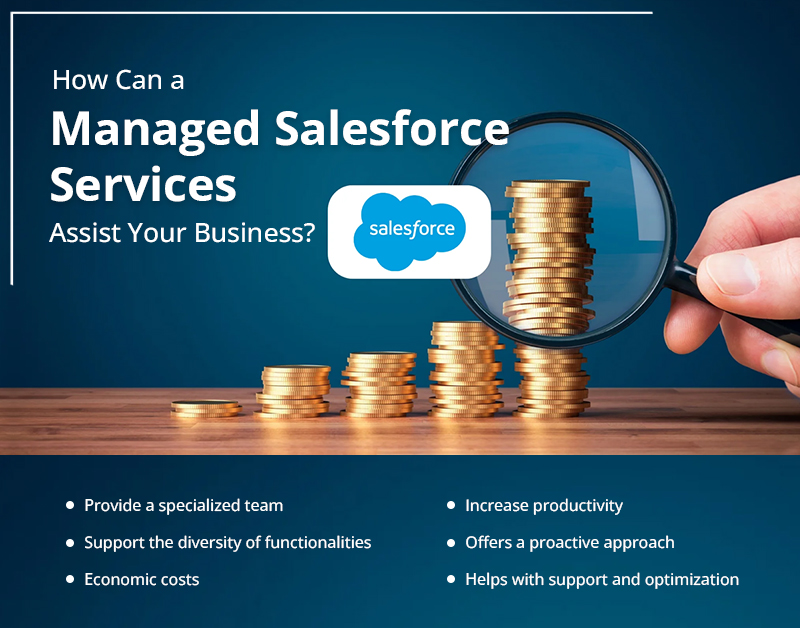
How Can a Managed Salesforce Services Assist Your Business?

Whether you are working on a Salesforce solution within your organization or you’re a partner who is developing highly-functional solutions for their financial end clients, there can be a time when you get stuck in the process. The challenge could be anything like a lack of Salesforce experts or trouble working with complex customization. 

But that doesn’t mean you have to settle for any less. You can get the desired help for your Salesforce requirements with experienced Managed Salesforce services. Let’s understand the value of these services more closely and uncover how these can really assist you with your business. 

1. Provide a specialized team: Get quick and easy access to Salesforce experts who can handle your contracted functions. 

2. Support the diversity of functionalities: The external service can handle a range of functionalities, whether to administer your Salesforce solution or develop highly functional Salesforce applications for your clients. 

3. Economic costs: Hiring managed services for Salesforce is a cost-effective way to onboard Salesforce experts. It saves you from all the expenses of hiring full-time resources for your varying project needs. 

4. Increase productivity: With external specialists, you’ll be able to focus more on your business performance and value-adding tasks. This will enable you to save time from handling the org and dedicate more time and effort to improving your productivity.

5. Offers a proactive approach: Easily detect and fix possible errors before they could hamper any business operations. Also, these experts always stay updated with the latest enhancements in the Salesforce and business world, and you can take advantage of that information, adding the relevant update to your solution.

6. Helps with support and optimization: With managed services, you’ll always have someone to provide you with continuous support. This way, you can easily manage your solution optimization without having to hire additional resources. 

Hire The Best Salesforce Partner for Finacial Services to Make the Most of Your CRM

With everything you can get with managed services for Salesforce, it might already have become enticing for you to get a reliable Salesforce team onboard. The idea of using Salesforce is to be able to use its features the best way and maximize the results and potential growth. 
Now if you feel that without managed service, you might be missing out on getting the best from your investment for your financial services firm, contact us, and we’ll help your business get the growth and value you’ve been seeking for it.

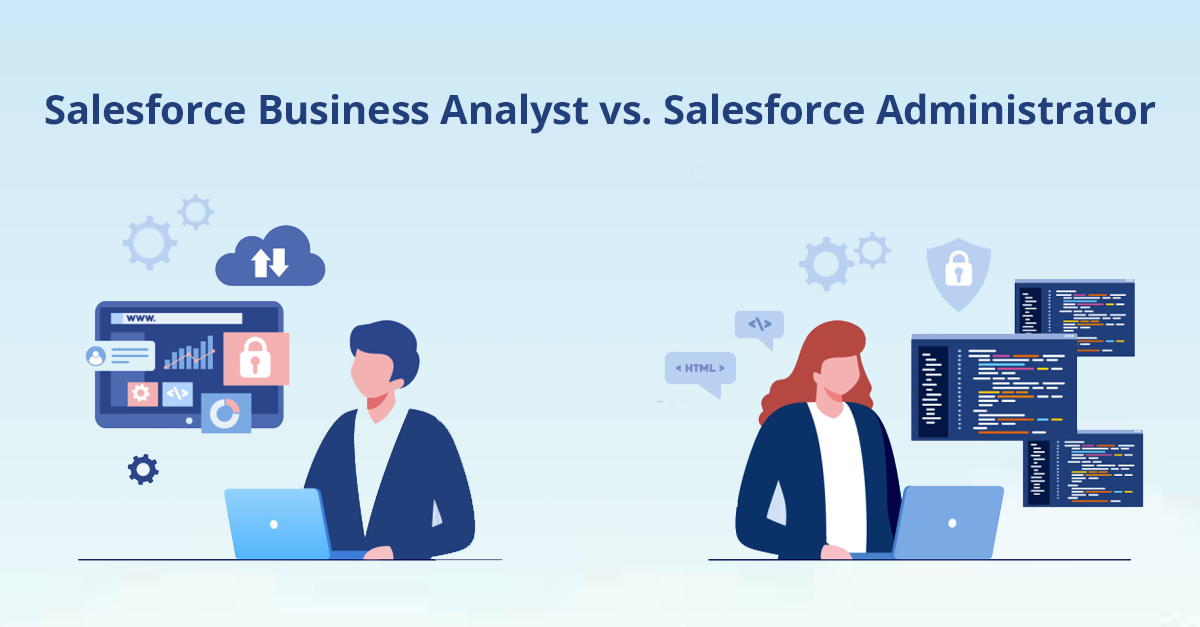
Difference Between Salesforce Business Analyst and Salesforce Administrator Explained

With more and more companies striving toward growth, the idea of hiring external resources has become common. But when looking for Salesforce professionals, you’ll come across different experts. Two titles that are often sought after are Salesforce business analyst and Salesforce administrator.

Although both kinds of professionals have their own importance, people often get confused about their respective roles and responsibilities. But it’s crucial to understand what these professionals individually do so you can make the right decision when hiring your experts. 

So, in this blog, we’ll be uncovering how these two profiles are different from each other while covering the key responsibilities associated with them. 

Who is a Salesforce Business Analyst (BA)?

As the profile name suggests, a Salesforce BA is majorly responsible for thoroughly analyzing your business requirements, which will be further translated into specifications for implementing Salesforce. 

A Salesforce Business Analyst would have to work in alignment with other Salesforce stakeholders, trying to understand their requirements. It could be regarding the new implementation or understanding the area of improvement to meet their goals and business objectives. In addition to this, the BA’s role also includes evaluating if the Salesforce solution is aligned with the organization’s business strategy.  

Who is a Salesforce Administrator?

You surely have heard many companies hiring Salesforce admins, but have you ever wondered what exactly these professionals do? 

The role of a Salesforce administrator involves managing user accounts, customizing, and configuring the Salesforce solution so the business’s unique needs are met. The admin also ensures that the Salesforce solution is managed on a daily basis.

A Salesforce admin’s responsibilities also involve creating and managing personalized reports and dashboards, enabling the team to track accurate and up-to-date data. They make sure that the Salesforce solution made for the organization is secure and that the potential end users are trained to use it well. 

Salesforce Business Analyst vs. Salesforce Admin: Key Differences

Both Salesforce BA and Salesforce Admin have their unique roles and responsibilities when it comes to handling Salesforce requirements by customers. But users often get confused about their responsibilities and fail to understand the difference between both profiles. 

We can help you here. We’ve differentiated these profiles on the basis of different factors that will help you understand what makes these profiles unique. 

1. Focus

 The major focus points of both Salesforce BAs and admins are quite different from each other. The prime focus of both of them remains on the Salesforce org but on different aspects. A Salesforce admin’s focus remains on ensuring the Salesforce solution works efficiently. 

On the other hand, a Salesforce business analyst would work to ensure that the Salesforce solution implemented aligns with the client company’s overall business strategy. 

2. Skillset

Even both Salesforce BAs and admins have different skillset from each other, despite working on similar aspects. For a Salesforce administrator, having complete knowledge of Salesforce features and functionalities is necessary. In addition to this, a Salesforce admin also needs to have knowledge of security features on Salesforce and data management approaches. 

If we talk about a Salesforce BA, the professional usually need to have strong problem-solving and analytical skills, with a thorough understanding of workflows and business process. 

3. Engagement with Stakeholders

Both Salesforce BAs and admins have to be in close alignment with stakeholders, but the nature of interaction that they conduct with them is entirely different from each other. The responsibility of a Salesforce admin is majorly associated with training the potential end users of the Salesforce solution. 

On the other hand, the responsibility of a Salesforce business consultant is to understand the requirements and expectations of stakeholders through detailed conversations. The interaction is carried out so that the needs can be understood and translated into functional specifications that will be used to implement or customize the solution.

How Do You Decide if you want a Salesforce BA or a Salesforce Admin Consultant?

It can be tricky to choose if you want to hire a Salesforce admin or a Salesforce business analyst when you don’t know the difference between both. We have listed here some aspects that would help you make the right choice:

1. Business objectives: There can be times when your requirement would be to optimize the efficiency of your Salesforce platform. In such a case, you would need a Salesforce admin to do the job. But if your requirement is to align the business strategies and objectives with the Salesforce solution, a Salesforce BA could help you the best.

2. Challenges you need to overcome: If you need to overcome challenges related to managing user accounts or platform customization, an admin could be your right choice. But if your challenges involve understanding the requirements of a business or making the solution work in alignment with the business strategy, a BA could help you with it. 

3. Skills you need: If you need someone who understands Salesforce features better, hiring a Salesforce admin is what you need to consider. But a BA could assist you better if you need someone with strong problem-solving skills. 

Get Salesforce Professionals Who Suit Your Needs

Your needs for Salesforce professionals could be different at different times. Someday you might need someone to evaluate the business requirements of the client while another day, you might need a certified Salesforce developer to handle the technical parts of a project. This is why you need to get along with a Salesforce certified consultant who can provide you with all kinds of resources for any timeline. 

So, whether you need a Salesforce BA, admin, or developer, contact us and get the right professionals to satisfy your business needs. Contact us if you are stuck anywhere, and we’ll help you choose the right Salesforce professional for your business needs.

logo Live Chat