

Talk to Us

Top Salesforce Consulting Partners in India You Can Count On

The global CRM market size was valued to be around USD 112.91 billion in 2025 and is expected to grow from USD 126.17 billion in 2026 to USD 320.99 billion by 2034. The numbers here clearly show how important a CRM solution has become for global businesses. And among all of them, Salesforce still remains the #1 CRM for businesses across different industries. But only purchasing a Salesforce license isn’t enough. Having the best Salesforce consulting partners in India onboard would make your investment worthwhile. 

However, choosing the right Salesforce partner is easier said than done. You need to know just what your business needs to ensure you have the right partner with you helping you to maximize your Salesforce investment. 

We have curated a guide for you to help you pick the top Salesforce implementation partner in India and understand what exactly they can support you with. 

Why Choosing the Right Salesforce Consulting Partner Matters 

Choosing a Salesforce partner in India isn’t just about outsourcing a technical task; it’s about selecting a co-pilot for your digital transformation.  

The Risks of Wrong Implementation  

A Salesforce implementation that is poorly executed can be very risky for a business. While businesses pay for expensive licenses, they fail to utilize all the potential of the CRM due to data silos and feature bloat. And among all the challenges, user adoption can be the worst one as if users are not able to use the system, then the entire Salesforce investment will go in vain. 

The Importance of Certified Salesforce Consulting Partners in India

Certifications are the “gold standard” of the ecosystem. They ensure that your consultants are not just guessing but are following Salesforce’s proprietary architectural best practices. A certified Salesforce consulting service understands the “Click-not-Code” philosophy, ensuring that your system remains agile and easy to update without breaking custom scripts during Salesforce’s tri-annual releases. 

Your CRM should be built for the company you want to be in five years, not just the one you are today. The right partner designs a scalable architecture, ensuring that as your customer base grows from thousands to millions, or as you add new products like Marketing or Health Cloud, the foundation remains stable and performant. 

Here is why choosing the right Salesforce agency is the most critical step in your Salesforce journey: 

1. Adoption and Change Management 

According to industry data, nearly 70% of CRM projects fail not because of the software, but because employees refuse to use it. A top-tier Salesforce consulting company in India doesn’t just “install” Salesforce; they focus on Change Management. They design intuitive user interfaces and provide role-based training that makes your team want to use the platform, ensuring your investment doesn’t turn into a “glorified spreadsheet.” 

2. Future-Proofing with AI and Data Maturity 

In today’s market, a static CRM is a liability. Leading Salesforce consulting services in India now specialize in Data Cloud and Einstein AI. Choosing a partner with the “AI Quotient” means they can help you: 

  • Automate customer service with intelligent AI agents. 
  • Unify siloed data to create a single source of truth. 
  • Predict sales trends before they happen using predictive analytics. 

3. Seamless Integration with Your Tech Stack 

Most Indian enterprises rely on a mix of global tools and local systems. Experienced Salesforce consulting partners in India understands these “last-mile” integration challenges and can build custom APIs to ensure Salesforce talks to every other piece of software in your office. 

4. Post-Implementation Support 

A Salesforce “Go-Live” is just the beginning. As your business grows, your CRM needs to scale. The right partner offers Managed Services, a long-term relationship where they handle seasonal updates, bug fixes, and periodic “health checks” to ensure your system remains optimized as your business evolves. 

Future-proof your Salesforce ecosystem with a scalable implementation.

Top Salesforce Consulting & Implementation Partners in India 

We’ve done our homework and brought to you the list of top Salesforce consulting partners in India to choose from. 

1. 360 Degree Cloud Technologies 

As a premier Salesforce Summit Partner, 360 Degree Cloud stands as a top-tier Salesforce consulting company in India, boasting over a decade of experience in delivering state-of-the-art implementations and forward-thinking platform customizations.  

With a powerhouse team of 650+ experts and 400+ certifications, they have established themselves as a go-to Salesforce implementation partner in India, successfully navigating the complexities of 30+ diverse industries to drive digital transformation. 

  • Full-Spectrum Cloud Expertise: Expert delivery across Sales Cloud for revenue optimization, Service Cloud for elite customer support, and specialized roles as Marketing Cloud implementation partners in India to orchestrate data-driven customer journeys. 
  • AppExchange & Custom Development: A leader in AppExchange development, helping businesses build and launch proprietary products, alongside deep expertise in custom platform modifications. 
  • End-to-End Automation: Dedicated focus on high-impact workflow automation, process improvements, and instant quote generation to eliminate operational bottlenecks. 
  • Strategic Data Services: Comprehensive support for complex data migration and seamless third-party integrations, ensuring a unified and secure technical architecture. 
  • Global Delivery Standards: Combining deep technical bench strength with a decade of experience to provide “top-shelf” solutions that scale with global business demands. 

Hyperlink InfoSystem began its business in 2011 when it was just known as a mobile app development company. This company is recognized as India’s one of the top Salesforce consulting firms offering services related to IoT, Blockchain, and AI. 

  • The team at Hyperlink offers extensive Salesforce development services, with a focus on planning, designing, and implementing Salesforce solutions. 
  • The company has highly skilled, certified, and experienced developers delivering a wide range of end-to-end CRM solutions. 

3. AnavClouds 

When it comes to the discussion about Salesforce-certified partners, AnavClouds is among the most well-known companies. 

  • The team is known for providing cutting-edge and forward-thinking technological solutions to numerous global clients.  
  • The professionals at AnavClouds Software Solutions are always focused on customer satisfaction and timely delivery of all projects, regardless of project size. 

4. DB Services 

Another name among certified Salesforce partners is DB Services. The company works on delivering digital transformations to make businesses more efficient. 

  • The company has been working since 2003, satisfying hundreds of clients large and small to develop efficient custom apps. 
  • The professionals work on bridging the gap between existing technologies, eliminating time-wasting tasks, and allowing quick access to important information. 
  • The team start the development process with a full workflow analysis and work seamlessly on rigorous project management. 

5. Zensar Technologies

Zensar is a leading partner for 10+ years and a reputed Salesforce Silver Consulting & Implementation partner.  

  • Zensar is quite popular for its award-winning projects in Insurance, Financial, Retail, Hi-Tech, & Manufacturing sectors. The incredible and skilled team delivers end-to-end solutions to modernize legacy applications, while securing the data. 
  • The team is highly professional and provides strategic advice and roadmap creation to clients that helps them to optimally achieve business goals through discovery, experience design, assessment, and efficient planning. 

How to Find the Right Salesforce Partner in India 

To separate the high-value consultants from the “ticket-takers,” use this five-point evaluation framework, so you can find the right Salesforce partner.

Top Salesforce Consulting Partners in India [2026 Guide]

1. The Salesforce Partner Tier 

Salesforce no longer uses the old “Silver/Gold/Platinum” labels. Instead, partners are categorized into four tiers based on a Navigator Score (a mix of customer success, certifications, and revenue). 

  • Summit (Highest): These are the top 1% of partners globally. Best for enterprise-level, multi-cloud transformations. 
  • Crest: High-performing partners with deep technical depth. Ideal for mid-markets to large companies. 
  • Ridge: Strong, growing partners typically focused on specific niches or regions. 
  • Base: New or boutique firms, often great for small-scale startups or basic setups. 

2. Industry Experience 

Salesforce is heavily localized for industries (e.g., Financial Services Cloud, Health Cloud, Manufacturing Cloud). Make sure you ask, “Have you solved problems for a company with my specific regulatory needs (e.g., RBI compliance for FinTech or HIPAA for Healthcare)?” 

3. Certification Depth 

Don’t just look at the number of certifications of top Salesforce consulting firms; look at the type

  • Foundation: Admins and App Builders (Good for maintenance). 
  • The “Must-Haves” for 2026: Data Cloud Consultant and AI Associate/specialist certifications. 
  • The “Gold Standard”: Certified Technical Architects. If your project involves complex integrations or large data volumes, ensure the partner has at least one technical architect guiding the strategy. 

4. Ongoing Support 

The “Go-Live” is just the starting line. Find Salesforce consulting partners in India that offer more than just a “handover.” 

  • Hypercare: Intensive support for 2–4 weeks after launch. 
  • Managed Services: A monthly retainer for continuous optimization, bug fixes, and installing the three seasonal Salesforce updates. 
  • Training: Do they provide role-based training for your staff, or just a generic manual? 

5. Pricing Transparency 

In the Indian market, pricing models vary wildly. Ensure your contract specifies: 

  • Fixed Bid vs. Time & Materials: Fixed is better for clear-scope projects; T&M is better for agile AI/Data explorations. 
  • Hidden Costs: Ask about costs for sandbox management, third-party AppExchange licenses, and data migration overages. 

Discover the measurable impact of a strategic Salesforce implementation.

Salesforce Consulting Services Offered by Top Partners 

Top-tier consulting partners in India provide a comprehensive suite of services designed to bridge the gap between complex cloud technology and your specific business outcomes. Here are the core services they offer: 

1. Salesforce Consulting 

Before any Apex code is being written, Salesforce partners work as advisors, mapping out the entire digital roadmap for the company. They start with conducting gap analysis, evaluating where the current processes are lacking, following by preparing a platform roadmap, listing the suitable Salesforce products that can help overcome the existing challenges. 

2. Salesforce Implementation 

Salesforce implementation is where heavy lifting is done. Salesforce CRM support services & partners in India ensure setting up a scalable foundation for implementing Salesforce.  

They implement the specific cloud setup needed by companies like Service Cloud, Sales Cloud, or any industry-specific cloud like Education Cloud or Financial Services Cloud. Additionally, they make sure that the existing data is safely migrated over Salesforce, ensuring no redundancies or loss of integrity. 

3. Custom Development 

Not all businesses are the same, and that’s why many companies prefer having a custom solution, instead of working with a standard one. Salesforce partners in India can help by building Apex and Lightning Web Components (LWC), to enable custom features for the Salesforce org. 

Custom development. can also include conducting third-party integrations to sync Salesforce with other systems used by teams like ERP platforms or any communication tools. While custom development can mean building a customized Salesforce solution to be used in-house, it can also mean building custom solutions to be sold on Salesforce AppExchange.  

4. Marketing Cloud Implementation 

To achieve modern marketing goals, hyper-personalization is the key. With the help of the right partners, you can leverage Salesforce Marketing Cloud and use it to its full potential to maximize customer engagement.  

From designing automated customer journeys through Journey Builder to achieving real-time web personalization, Salesforce experts can take care of it all. Additionally, they can also help teams leverage the AI capabilities to conduct AI-driven marketing campaigns for better and faster results. 

5. CRM Support & Optimization 

Only implementing Salesforce doesn’t mean that the job of Salesforce partners is done. They provided ongoing Salesforce managed services to ensure regular maintenance. They conduct Salesforce health checks after regular intervals to audit the org and find any vulnerabilities or unused licenses. 

In addition to this, they also create custom training modules to ensure successful user adoption. Also, Salesforce CRM support services & partners in India take care of keeping the system up to date, ensuring that the org has the latest features from all three major yearly Salesforce releases. 

Salesforce Implementation Partners in India: Use Cases 

Now let’s look at some use cases to understand how a Salesforce agency can help businesses with the real-world challenges. 

1. Sales Automation (Lead-to-Cash Efficiency) 

Manual lead tracking and disjointed sales processes are the common challenges faced by teams. The right Salesforce consulting services in India can automate the entire lifecycle, avoiding any leaks in the funnel. They can automate lead scoring, enable AI-driven opportunity forecasting, and seamless quote-to-contract generation to reduce sales cycle. 

2. Customer Service Transformation (Omni-channel Support) 

In this modern economy, it has become important for firms to offer customer support across WhatsApp, Email, and Phone. This isn’t optional now for businesses to ensure high-quality proactive customer service. Salesforce partners in India help brands to make this possible by implementing Service Cloud and integrating it with AI agents and unified agent consoles. This helps teams resolve routine queries faster without any need for human intervention. 

3. Marketing Automation (Personalization at Scale) 

For businesses that have a massive consumer base, running generic “batch and blast” emails won’t bring effective results. You need to find a Salesforce partner that can implement sophisticated marketing engines to ensure personalization. You can even consider Marketing Cloud implementation partners in India, who can help building automated customer journeys to enable communications that can be triggered on real-time behavior. This can help run hyper-targeted emails, thus improving conversation rates. 

4. Unified Data Strategy (The “Golden Record”) 

Another essential use case is to eliminate data silos in companies, ensuring all departments, whether sales, marketing, or service, have access to a unified single source of truth. Salesforce partners help teams achieve this 360-degree view of their customers, enabling better AI predictions and ensuring a seamless customer experience. 

Get Just the Right Salesforce Consulting Partner for your Firm 

The list here will help you discover the top Salesforce consulting partners in India, but ultimately you’ll have to make the final choice, evaluating what exactly your business needs. 

Make sure you analyze your business requirements first and then look for a Salesforce consulting partner who can help you maximize your ROI while improving your business operations. 

Turn your Salesforce investment into a high-performance growth engine today.

Salesforce Partners: What They Are, Partner Tiers & Why You Need One

Implementing Salesforce for business operations can often be described as buying a high-performance jet; no wonder it’s an incredible piece of machinery, but it won’t get you off the ground without a skilled pilot. For many organizations, the gap between having the best CRM and actually using it to its full potential is bridged by Salesforce partners.  

These specialized firms aren’t just consultants; they are the architects and engineers who transform a complex, out-of-the-box platform into a bespoke engine tailored to a company’s unique operational heartbeat and goals. 

Navigating the Salesforce ecosystem can feel tricky as it has its own hierarchy of certifications, tiers, and technical dialects. From “Crest” and “Summit” status to specialized AppExchange experts, the partner network is designed to ensure that no business has to do it alone. The only real challenge could be to understand what exactly these partners do and which partner is suitable for your business. 

This guide will help you understand what Salesforce partners actually do, their tier system, and explore why choosing the right partner is the first and most important step to ensure a successful Salesforce implementation. 

What is a Salesforce Partner? 

A Salesforce Partner is a consulting or implementation firm (or both), certified by Salesforce. These partners are go-to for businesses looking to implement a Salesforce solution or planning to optimize their existing one.  

To understand this better, think of Salesforce as a high-performance F1 car. In this situation, a Salesforce partner would act as the highly expert pit crew and F1 car racer, who would together ensure the car works perfectly and cross the finish line. 

These partners are provided with their respective scores based on their technical skills, proven customer success, and their ability to deliver high-quality Salesforce solutions. 

The Role of Consulting & Implementation Partners 

Now that we have read what is a Salesforce partner, let’s now have a look at the different types of partners that can be considered. However, consulting partners and implementation partners would always be the ones that are the most sought after by firms. 

  • Consulting Partners: Salesforce consulting partners can be called the Strategists for business. Their work majorly involves focusing on the “why” and “how” related to Salesforce adoption. They analyze business processes, identify pain points, and design a roadmap that can perfectly align with business goals. 
  • Implementation Partners: Salesforce implementation partners can be called the Builders when it is about bringing Salesforce to manage business operations. Their work majorly involves focusing on the “what” section. They are the ones responsible for the technical aspects like data migration, following compliance and security protocols, creating custom workflows, and integrating Salesforce with existing solutions.  

Don’t guess your way through Salesforce implementation.

Salesforce Implementation

How Salesforce Partners Work Across Industries 

Salesforce is a “horizontal” platform, meaning it can be used by anyone from a local non-profit to a global bank. Partners provide the vertical expertise needed to make the software speak your industry’s language: 

IndustryHow a Partner Customizes Salesforce
HealthcareEnsuring data privacy compliance (HIPAA) and setting up Patient 360 views in Health Cloud.
RetailConnecting e-commerce data with customer service to create personalized shopping experiences.
ManufacturingAutomating supply chain alerts and managing complex dealer/distributor relationships.
Financial ServicesCustomizing Financial Services Cloud to track household wealth, portfolios, and regulatory audits. 

By bridging the gap between out-of-the-box features and industry-specific needs, a partner ensures that your investment actually solves your unique business problems rather than just adding another tool to the stack. 

Why Salesforce Partners Matter for Your Business 

Buying Salesforce licenses gives you the keys to the kingdom, but hiring a partner ensures you actually know how to rule it. Without expert guidance, many businesses fall into the DIY Trap, rushing into setup only to find their system is cluttered, hard to use, and disconnected from their actual goals. 

Here is why a partner is a non-negotiable asset for a successful rollout: 

1. Strategic Value 

A partner doesn’t just ask, “What fields do you want to see?” They ask, “What business problems are you trying to solve?” and then works accordingly to reach that intended goal. 

  • Business Alignment: They help to ensure all teams are aligned with Salesforce and are able to measure their specific KPIs, whether that’s increasing lead conversion or reducing customer churn. 
  • Future-Proofing: Partners design the Salesforce instance using scalable architecture, keeping the insight of the next five years in mind, so you don’t have to rebuild the system as you grow. 

2. Faster Implementation 

Trial and error is the most expensive way to learn software. This makes it necessary to ensure the implementation is foolproof. 

  • Proven Frameworks: Experience partners have a practice of using methodologies with proven success and pre-built templates, which significantly decrease the solution deployment time. 
  • Focus on MVP: They help you launch a Minimum Viable Product quickly, enabling teams to start witnessing the value of the new systems, within a few weeks. 

3. Reduced Risk 

User rejection is unarguably the greatest risk associated with a Salesforce implementation project. 

  • Clean Data from Day One: Partners make sure you don’t have any messy or redundant data that can cause issues and discrepancies. 
  • Change Management: They provide structured training to the intended users so that they can adopt the new system easily. 
  • Compliance: They ensure your setup meets industry-specific security standards like HIPAA for healthcare or SOC2 for finance. 

4. Better ROI 

Working with a partner shifts Salesforce from a cost center to a revenue generator. 

  • Eliminating License Waste: Partners audit your needs to ensure you aren’t paying for Enterprise features when Professional would suffice, or buying seats for employees who don’t need them. 
  • Automation Gains: By building “Flows” that handle repetitive tasks, partners can boost employee productivity, allowing your team to spend less time on data entry and more time on high-value work. 

See how we turned a complex migration into a 30% ROI boost.

Turn a complex migration into a 30% ROI Boost

What Is the Salesforce Partner Tier System?

Trailblazer Score is a point-based system used by Salesforce that helps to identify which tier a partner falls in. The Trailblazer Score (up to a maximum of 1,000 points) is built on these four key pillars: 

  • Customer Success: Measured by verified customer satisfaction (CSAT) scores and successful project completions. 
  • Innovation: Earned through the number of certified architects and consultants on staff, as well as “Navigator” distinctions in specific products (like Marketing Cloud or AI). 
  • Growth: Based on the partner’s ability to bring in new Salesforce customers and expand the ecosystem. 
  • Lead: Evaluates the partner’s commitment to equality and sustainable business practices. 

Salesforce Partner Tiers Explained 

The tiers of the Salesforce partnership are organized from the highest level of proven scale to the entry-level. Let’s understand each tier clearly. 

TierPoint RequirementWho They AreBest For…
Summit750 – 1,000 ptsFormerly “Platinum.” These are the elite global leaders. They have the most certified experts and handle the largest, most complex enterprise transformations.Global corporations and massive, multi-country implementations.
Crest500 – 749 ptsFormerly “Gold.” These partners have a deep bench of specialists and a consistent track record of high customer satisfaction across multiple industries.Mid-market to large enterprises looking for high-end expertise with more personal attention.
Ridge250 – 499 ptsFormerly “Silver.” Reliable, mid-sized firms that often specialize in specific regions or niche industries. They offer a great balance of expertise and agility.SMBs and mid-sized companies with focused, high-growth needs.
Base0 – 249 ptsFormerly “Registered.” Entry-level or boutique partners. Many are high-quality specialists just starting their journey or firms that prefer to stay small and specialized.Small businesses or highly specific, localized projects on a tighter budget.

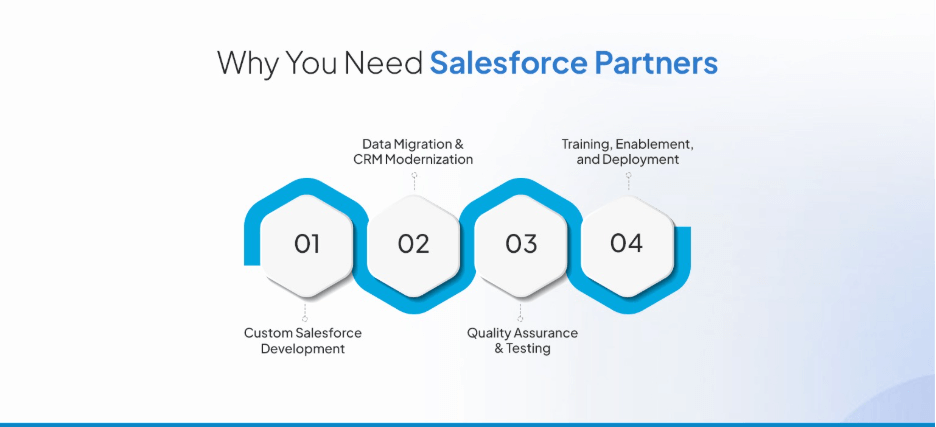
Why You Need Salesforce Partners 

A Salesforce partner can guide and assist you to set up and get you running in as little as 2 weeks, depending on how complex your needs are. Here are some reasons to provide you with an idea of why you should consider hiring the right Salesforce partners:  

Salesforce Partners: Partner Tiers, Benefits & How to Choose One

1. Custom Salesforce Development 

You can do pretty much anything with Salesforce with an experienced Salesforce developer on hand. 

Many businesses usually require customization, including the creation of custom objects and fields outside of the standard out-of-the-box solutions. Along with this, you probably need custom code solutions, custom app integrations, and more.  

With the help of an experienced Salesforce consultant, you can determine the design specifications that need customization to make your Salesforce solution work well for your business. 

2. Data Migration & CRM Modernization 

Before getting started with Salesforce implementation, it’s a good idea to think about your ideal process to follow for migration and decide on the data you need from your legacy system. 

You must take an honest look at your current data. It’s true that a system is only as good as its data, and that is applied even when you’re migrating data to your CRM. 

A Salesforce implementation partner can easily handle the heavy lifting involved in the data migration, once you’ve managed the data cleaning and mapping. 

3. Quality Assurance & Testing 

A reliable Salesforce implementation partner would always have an experienced quality assurance team, responsible for testing all new environments.  

Testing the new environment becomes especially important if your Salesforce environment is complex and/or has a lot of customization. With the help of quality assurance, you can be sure that everything that’s set up and functioning is according to the design specifications and standards. 

4. Training, Enablement, and Deployment 

Salesforce is more than just new software for a company; it’s an entirely new and more efficient way of operating to boost business growth. Thus, it requires proper training and onboarding for your entire team to use Salesforce to its full potential.  

A Salesforce implementation partner will take the responsibility of conducting in-depth training for your employees, enabling successful team adoption.  

The team will help your sales team see beyond the challenge of learning a new system to a more efficient sales process for a better-managed pipeline and improved deal closure. 

How to Choose the Right Salesforce Partner 

Choosing a partner for your business is not a one-time transaction; instead look at it as a chance to build a long-term relationship that will be fruitful for your business. To achieve that, here are five key areas that you need to focus: 

1. Industry Experience Over Global Ranking  

Going with a Salesforce Summit Partner with more than 10 years of experience in your specific industry can be a valuable move when looking for the right expert. Also, you need to look for a partner who is well versed in the specific regulatory needs for your industry. 

2. Check Recent AppExchange Reviews  

Don’t just take their word for it. Visit the Salesforce AppExchange to read verified customer reviews from the last 6–12 months. Pay close attention to how they handle projects of a similar size and complexity to yours. 

3. Prioritize “Clicks, Not Code” 

The best partners prioritize Salesforce’s built-in, “declarative” tools (like Flow) over custom coding (Apex). This makes your system easier to maintain, cheaper to upgrade, and more “future-proof” as Salesforce releases new updates. 

4. Focus on Change Management & Training 

To make Salesforce implementation successful, it is necessary to make sure that the team actually used the system. Your Salesforce implementation partner must set up a plan to ensure user training and adoption. 

5. Evaluate Post-Implementation Support  

With Salesforce, you can’t go with the “set it and forget it” approach. The partner you choose should provide Managed Services that can help you maintain the performance of your Salesforce solution as the business grows. 

Get the Right Salesforce Partners Onboard 

Going with Salesforce implementation is an exciting step. Salesforce helps you get the ability to leave your mark on your company and make impactful, lasting changes to the way your business operates.  

However, getting Salesforce implemented will just get half of the job done. You need to make sure your Salesforce solution is implemented and taken care of by reliable Salesforce partners who can help you maximize your investment. 

Want a Salesforce instance that grows alongside your business?

 Salesforce instance that grows alongside your business


Hire a Salesforce Developer: 7 Reasons Your Business Needs One

Whenever a company starts getting Salesforce projects, and work starts to pile up, the first option that comes to their mind is to look for full-time developers. Little did they know that finding such developers would cost them a lot and would also be very time-consuming. That’s where you can hire a Salesforce developer on contract for the needed time or project.  

But still, many companies are sticking with the traditional approach of looking for full-time employees. What they don’t realize is that they are missing out on the benefits of outsourcing just the right talent for their business needs.  

So, in this blog, we’ll be covering some prominent and enticing reasons illustrating why you should hire a Salesforce developer for your firm. 

Why This Decision Matters 

When you hire a dedicated Salesforce developer, it isn’t just to patch up a few complex workflows; it’s a strategic decision that determines your entire platform’s future. This is why the investment matters: 

1. Scaling Your Business, Not Just Your Code 

When your Salesforce instance is handled by an Admin team focused on urgent fixes, growth becomes slow and painful. A dedicated Developer ensures your platform is built on a stable, scalable architecture. A skilled Salesforce customization expert would use high standards of programming to ensure the solution is optimized and scalable and ready to have large data volume without the risk of poor performance. When you are hiring a development, you aren’t just picking up a resource; you are investing in the future of your business. 

2. Turning Salesforce from a Database into an Asset 

Without development expertise, Salesforce often functions as an expensive, customized database. If you want to realize the true potential of Salesforce CRM, hiring a skilled developer is your way to go. These professionals at Salesforce development services have the ability to build user-friendly experiences with LWCs, customized for your business, ensuring a unified view of data for all segments, whether it is sales, service, or marketing. Thus, they help convert Salesforce into a valuable asset for your business that will bring in more revenue. 

3. Mitigating Risk and Crushing Technical Debt 

Every time a complex automation is built using an inefficient flow or a messy patch of code, you accumulate technical debt. This debt slows down your platform and creates a significant risk of critical failure during major updates. Hire a Salesforce developer to build high-quality and secure Apex code and implement version control. This kind of professional work would help in minimizing any risk associated with deployment or security, keeping the solution scalable for business growth. 

Don’t let technical debt slow down your growth. 

Hire a Salesforce expert

4. Maximizing Return on Investment (ROI) 

Businesses usually show concern about cost when hiring developers. What they don’t realize is that it will be effectively reflected in their Salesforce ROI. Salesforce development services can help teams save time by building custom solutions and automating end-to-end operations. This will keep teams free to focus on more crucial activities, saving time on manual work and navigation. This would help boost adoption among users and minimize errors, thus increasing Salesforce ROI. 

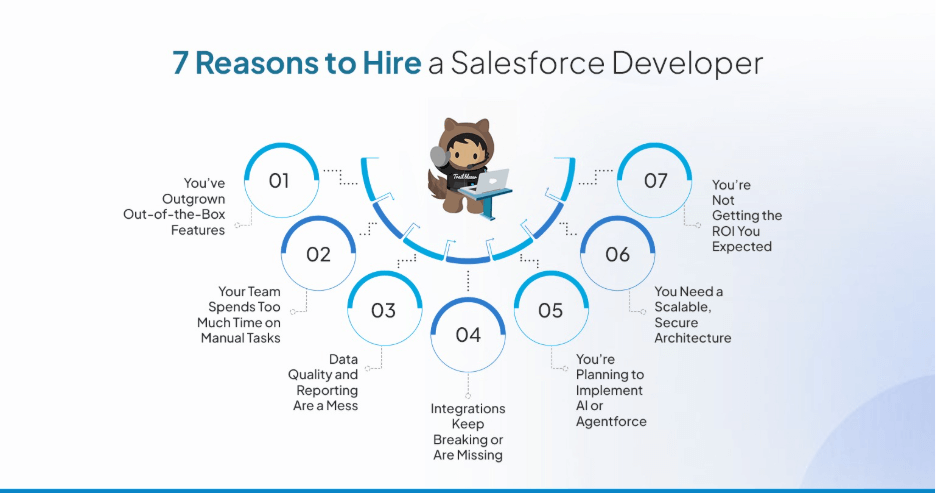
7 Reasons to Hire a Salesforce Developer 

Companies look to hire a Salesforce developer who’ll take care of all aspects of the project and will make sure everything is good to go. Let’s go deeper into the reasons to hire a Salesforce developer. 

7 reasons to hire Salesforce Developer

1. You’ve Outgrown Out-of-the-Box Features 

It is said that the Salesforce can help cover 80% of business needs; but what about the rest of the 20% that is too complex? What if users have to click multiple screens, go through numerous related lists, or browse through external spreadsheets just for a single task? This means that your standard Salesforce solution is not working.  

That’s where you would need to hire a dedicated Salesforce developer who can help your team build a custom solution that would be lightning fast, minimizing navigation challenges. They will help combine numerous processes into a unified process, thus improving user adoption, making it easier to get tasks done.

Ready to unlock enterprise-grade Salesforce performance? 

enterprise-grade Salesforce

2. Your Team Spends Too Much Time on Manual Tasks 

It is possible that your admin has created different Flows, but chances are that there would be some tasks that would be too complex for declarative tools to work through them. If your team is still working manually to reconcile data and reporting, you are just wasting time and money on your Salesforce org. 

Having Salesforce development services means having a professional who can work through the Apex code and asynchronous processing for large volumes of data. They have the skills to manage programs that are efficient and would easily manage complex calculations and record synchronization. This will help in freeing up your team, so they can focus on more critical tasks for revenue generation. 

3. Data Quality and Reporting Are a Mess 

If you have poor data quality, it doesn’t mean that the admin is responsible for it. This can be due to architectural issues, which is possibly the result of unreliable reports and questionable sales forecasts. As a result of these, your standard validation rules fail to run complex logic that prevents harmful data from entering the system. 

A certified Salesforce developer can help here to implement Apex Triggers and validation across external data sources and different objects. This would help in ensuring data integrity while creating reports, thus making the foundation of strategic decision-making secure. 

4. Integrations Keep Breaking or Are Missing 

Seamless, two-way communication between Salesforce and external systems (like your ERP, financial software, or proprietary web apps) is essential. If your integrations are constantly failing, running slowly, or if you’re using brittle, low-code connectors, you need to hire a Salesforce developer for professional security and error handling.

Developers are experts in secure REST and SOAP APIs. You can hire Salesforce API developers as they can build robust integration layers with proper authentication, retry logic, and error handling mechanisms to ensure secure, reliable data exchange, preventing costly outages and data discrepancies.

5. You’re Planning to Implement AI or Agentforce 

The future of business is rooted in AI and autonomous agents, but these tools are only as effective as the data they consume. If your data is messy, unstructured, and fragmented across objects, any AI implementation will fail to produce trustworthy results. 

A Salesforce Developer ensures that your platform has the necessary architecture to support advanced technology. They build clean, structured, and consistent custom data models that are required to feed modern AI tools, making your platform AI-ready rather than just AI-capable. 

6. You Need a Scalable, Secure Architecture 

Your business is growing, and your current Salesforce org is straining under the load. Performance issues, technical debt, and security gaps are inevitable when the system is not built with scalability and stability as core requirements. 

A Salesforce customization expert is focused on the long-term health of the platform. They implement best practices like Version Control (Git), manage governor limits expertly, and write maintainable code that can easily be updated, scaled, and deployed using professional CI/CD pipelines, ensuring your platform is secure and performs under pressure. 

7. You’re Not Getting the ROI You Expected 

If your Salesforce is not giving the clarity, savings, and efficiency that you expected, it seems to be underperforming. This can be majorly because of poor adoption and slow performance of the system due to underutilized features. 

However, if you’ve solved the above 6 challenges, improved user experience by implementing LWCs, and eliminated manual tasks, your ROI can be significantly improved. This would be possible by having a reliable Salesforce developer by your side. 

In-House vs. Outsourced Salesforce Developer: What’s Right for You? 

So far, you’ve become aware of the reasons when you definitely need to hire a Salesforce developer. Now, the next question is how you’re going to hire them? Here comes a choice of either going with in-house developers or outsourcing certified Salesforce developers. Let’s help you make the right choice. 

The Financial Flexibility of Outsourcing 

The most immediate benefit of outsourcing a Salesforce developer is cost control. Hiring a full-time, in-house developer requires paying a high annual salary, plus the substantial costs of benefits, recruiting fees, continuous training, and management overhead. By contracting a developer or engaging a consulting partner, you shift this massive fixed cost into a flexible, operational expense. This allows you to pay only for the specialized expertise you need, exactly when you need it, making it a much more budget-friendly approach for project-based development or sudden urgent fixes. 

Skip the hiring risk. Get pre-vetted Salesforce Developers instantly. 

Get pre-vetted Salesforce Developers instantly.

Instant Access to Elite, Specialized Talent 

When you hire an in-house developer, you are limited to that single individual’s skill set. However, the world of Salesforce is vast (Apex, LWC, CPQ, Marketing Cloud, APIs, etc.). Outsourcing a Salesforce developer immediately grants you access to a bench of specialized experts. If you need complex Salesforce development this quarter and a deep API integration next quarter, an outsourced partner can instantly provide the right person for the job. This approach eliminates the agonizing, costly hiring process and ensures your critical projects are handled by proven, targeted proficiency right away. 

Mitigating Risk and Ensuring Scalability 

When you depend on a particular in-house Salesforce developer, you end up creating a single point of failure. If they end up leaving you, your firm will lose the technical knowledge your team had, ending you in a vulnerable condition without any backup. This kind of challenge can be eliminated by outsourcing Salesforce developers, ensuring project continuity with backup resources available at all times. Whether you need to increase the resources in time of major product launch or want to scale down during periods with less critical tasks, outsourcing allows you to do that. 

Key Skills to Look for in a Salesforce Developer 

The ideal Salesforce developer is no longer just a “coder”; they are a Solution Architect who understands how to combine and work with AI, data, and automation together. To ensure you hire Salesforce developers who can handle the modern Salesforce ecosystem, look for these five essential skill sets: 

1. Core Coding Language 

When you hire Salesforce developers, make sure they are proficient in Apex. This is the primary language used to build custom business logic. They should also have a proper understanding of LWCs, which they need to create the actual buttons, pages, and interfaces your employees interact with every day. 

2. Automation & Low-Code Skills 

Hire Salesforce developers who don’t just write code; they should use Flow to build automations that are easier to maintain and faster to deploy. They need to have the ability to look at a manual business task and figure out how to make it happen automatically with a single click. They should be able to handle complex problems for customers using both code and Salesforce’s no-code tools.

3. Data & AI Skills 

Knowing how to clean, organize, and connect data from outside sources (like your website or accounting software) into Salesforce is necessary. It will be great if they have experience with Agentforce or Einstein AI to help your business use smart bots and predictive analytics to save time. 

4. Integration Skills 

Make sure you hire Salesforce API developers who have the needed skill required to make Salesforce connect with your other tools, like Slack, Gmail, or your ERP system, so data stays in sync. 

5. Problem-Solving & Architecture 

The developers should also have the ability to look at a business problem and design the most efficient technical solution that won’t break when Salesforce releases updates. They should also be committed to testing code thoroughly, so that bugs don’t disrupt your team’s workday. 

Hire a Salesforce Developer the Right Way 

When you hire a Salesforce developer, you can easily rely on them for the end-to-end Salesforce development, while ensuring the platform is secure and scalable. Trusted Salesforce developers can assist you in any way you want, whether you want a custom business solution or want your external systems to be integrated with your CRM.  

Get your urgent project off the bench and into production fast. 

Trusted Salesforce developers

Top Salesforce Implementation Partner & Consulting Firms in the USA

Salesforce is the Ferrari of CRM platforms, powerful, sleek, and capable of incredible speed. But if you don’t know how to drive a manual transmission, you’re just going to sit in the driveway revving the engine. In 2026, thousands of US companies are making the same mistake: they spend six figures on Salesforce licenses, only to use it as a glorified Rolodex. With the rise of AI-driven agents and complex data clouds, the gap between “having Salesforce” and “using Salesforce” has never been wider. To bridge that gap, you don’t just need a vendor; you need a strategic Salesforce implementation partner. 

According to a startling statistic, nearly 43% of CRM users only utilize half of their platform’s built-in features. To make the Salesforce investment worthwhile, businesses need to have the right expertise, and that’s what Salesforce partners tend to offer. But the real question is how exactly you would know which Salesforce partner is suitable for your firm. This blog will help you find an answer to this question. 

Why Do You Need Top Salesforce Implementation Partner or Consulting Partners? 

The statistic is sobering: nearly 74% of CRM implementations fail to meet their objectives when handled without expert guidance. While the Salesforce platform is designed to be user-friendly, its true power lies in its complexity. Here is why a certified partner is your most valuable asset: 

1. Get a Clear Roadmap 

Without a clear architectural roadmap, businesses often over-customize Salesforce with unnecessary fields, redundant automations, and “messy” code. This creates a system that is slow, confusing for users, and breaks every time Salesforce releases a platform update. A partner ensures you stay “Near-Standard,” using native features first to keep your system lean and scalable. 

2. Bridging the “Productivity Gap” with AI 

In 2026, the #1 growth tactic for sales teams is the use of AI and Autonomous Agents (Agentforce). However, AI is only as good as the data it feeds on. A consulting partner helps you: 

  • Clean and Unify Data: Ensuring your AI isn’t making decisions based on duplicate or outdated records. 
  • Deploy AI Agents: Setting up bots that actually solve customer problems rather than just redirecting them to a help page. 

3. Accelerated Time-to-Value (ROI) 

Every month your Salesforce instance isn’t fully optimized is a month of lost revenue. 

  • Expert Frameworks: Partners use pre-built “accelerators” and industry-specific templates to get you live in weeks, not months. 
  • Efficiency Gains: Statistics show that a professionally implemented Salesforce org can lead to a 35% increase in sales productivity and a 25% reduction in sales cycle length. 

4. High User Adoption (The “Make or Break” Factor) 

The best CRM in the world is a wasted investment if your sales reps still use spreadsheets on the side. Partners provide Change Management strategies that include: 

  • Custom Training: Training your team on their specific workflows, not just generic features. 
  • UX Optimization: Designing a “Lightning Experience” that is intuitive, reducing the number of clicks it takes to close a deal. 
     

Map out your custom Salesforce implementation strategy.

Salesforce implementation strategy

What Makes a Top Salesforce Consulting Partner? 

Selecting a partner isn’t just about finding someone who knows the software; it’s about finding a strategic ally who can translate your business goals into a high-performing digital ecosystem. Here are the non-negotiable qualities of a top-tier partner in 2026: 

1. The “Summit” Level of Expertise 

The most direct way to vet a partner is through their Salesforce Partner Tier. Salesforce categorizes partners based on their “Trailblazer Score,” which measures customer success, innovation, and growth. 

  • Summit (Platinum): The highest tier, representing firms with the most extensive experience and highest customer satisfaction (CSAT) scores. 
  • Crest (Gold): Highly experienced firms with a proven track record of complex deliveries. 
  • Navigator Distinctions: Look for “Implementation Expert” status in specific clouds (like Data Cloud or Service Cloud), which proves they have been audited by Salesforce specifically for those products. 

2. Deep Industry Specialization 

A top partner doesn’t just know Salesforce; they know your business. A consultant specializing in Healthcare understands HIPAA compliance and Patient 360, while one in Financial Services knows the nuances of Wealth Management and security. 

Key Tip: Ask for at least three case studies from your specific industry. If they can’t show you how they solved a problem for a company like yours, they aren’t the right fit. 

3. Mastery of the “Modern Stack” (AI & Data) 

Salesforce is no longer just a database, it’s an AI engine. Top Salesforce consulting partners must be proficient in: 

  • Agentforce: Deploying autonomous AI agents that handle customer service and sales tasks. 
  • Data Cloud: Unifying your “messy” data from different sources into a single, actionable customer profile. 
  • MuleSoft Integration: Ensuring Salesforce talks seamlessly to your ERP, marketing tools, and legacy systems. 

4. Focus on User Adoption & Change Management 

The best technical build in the world is useless if your employees won’t use it. Top Salesforce implementation partner doesn’t just “go live” and leave. They provide: 

  • Tailored Training: Sessions designed for different roles (Managers vs. Sales Reps). 
  • Change Management: Strategies to help your team transition from old habits to new workflows. 
  • Ongoing Support: Managed services that ensure the platform evolves as your business grows. 

Top Salesforce Consulting Partners in the USA 

If you’re planning on choosing a Salesforce consulting partner in the USA, here’s a list for you of the top partners that can be a great pick.  

1. 360 Degree Cloud 

360-Degree Cloud

The first on the list of top Salesforce consulting firms and the best among Salesforce partner companies is 360 Degree Cloud. The company is a full-spectrum Salesforce Platinum Partner and the top Salesforce partners delivering state-of-the-art Salesforce consultancy, implementation, and forward-thinking platform customizations for a decade.  

Why they are a top pick for 2026: 

  • AI & Agentforce Experts: They are among the first to master Agentforce, helping businesses deploy autonomous AI agents that handle everything from customer service to complex sales coaching in just hours. 
  • Massive Expert Bench: With a team of 650+ experts holding over 500+ certifications, they have the “bench strength” to handle massive enterprise migrations and specialized Data Cloud unifications. 
  • Native App Innovators: They are the minds behind flagship tools like the 360 SMS App and 360 CTI, proving they don’t just use Salesforce; they build on it to solve real-world communication gaps. 
  • Sector Versatility: While they serve 30+ industries, they have deep “Navigator” distinctions in Real Estate, Healthcare, and Financial Services, ensuring compliance-heavy industries are handled with precision. 

From a cluttered database to a streamlined powerhouse.

database to a streamlined powerhouse

2. Ascendix Technologies 

Ascendix Technologies

Based in Dallas, Ascendix has spent over 20 years carving out a niche as the go-to partner for Commercial Real Estate (CRE) and Capital Markets. 

  • They don’t just consult; they’ve built their own CRM overlays specifically for brokers and property managers. 
  • Known for being highly affordable, they offer a “Managed Services” model that acts as a fractional admin team for mid-sized firms. 
  • Best for businesses that need a partner who speaks the language of “Deals, Leases, and Properties.” 

3. StarrData 

StarrData

California-based StarrData is the ideal choice for companies that have outgrown their solo Salesforce Admin and need a high-level team on tap. 

  • They specialize in taking “hot mess” Salesforce Orgs and streamlining them for better data visibility. 
  • One of the few boutique firms with a proven track record in complex Quote-to-Cash (CPQ) implementations. 
  • Ideal for manufacturing and professional services firms needing ongoing, high-level administrative support. 

4. Seven Results 

Seven Results

Seven Results is one of the best New York-based top Salesforce implementation partners and it offers: 

  • Salesforce implementation, ongoing platform configuration. 
  • Salesforce support and user training. 
  • The expertise of the team at Seven Results lies in Technology, Legal Services, Publishing, and other sectors.  

The consulting agency actively supports its clients with Sales, Service, and Marketing Clouds as well as with Field Service Lightning and Pardot. 

5. Data Geeks Lab 

Data Geeks Lab

Data Geeks Lab is a Salesforce consulting company and Salesforce integration partner from San Francisco Bay Area. The company is known for Salesforce implementation, data cleansing and import, and its ongoing Salesforce support. 

  • As their name suggests, they are exceptional at “data archaeology”, extracting and cleaning years of legacy data for a fresh start. 
  • The top choice for Nonprofits and social impact organizations looking for a personable, budget-conscious partner. 

Salesforce Platinum Partners vs Certified Partners 

While every legitimate consulting firm must be “Certified,” not every firm reaches the “Platinum” (now known as Summit) tier. Understanding the distinction is the key to matching the right firm to your project’s complexity. 

1. What is a “Certified Partner”? 

A Certified Partner is the baseline for professional consulting. It means the firm has officially joined the Salesforce Partner Program and employs individuals who have passed Salesforce’s rigorous certification exams (like Administrator, Developer, or Consultant). 

While they are technically capable, they may lack the “bench strength” (number of experts) or the experience in handling complex, multi-cloud integrations. 

2. What is a “Platinum (Summit) Partner”? 

“Platinum” was the traditional name for the highest tier, which Salesforce now officially calls Summit. To reach this level, a firm must maintain a massive Trailblazer Score. This score isn’t just about how many people they have; it’s an algorithm based on customer success, innovation, and growth. 

How to Choose the Right Salesforce Consulting Partner 

In 2026, Salesforce projects are no longer just about “turning on” a CRM, they are about integrating AI agents, unifying data streams, and ensuring high user adoption. To find your ideal match of Salesforce integration partner, follow this 5-step evaluation framework: 

1. Define Your “Why” Before Their “How” 

Before you look outward, look inward. A common mistake is hiring a partner to “fix Salesforce” without defining what success looks like. 

  • Identify Pain Points: Is your lead response time too slow? Is your data messy? 
  • Set KPIs: Do you want to increase sales productivity by 20% or reduce customer service tickets by 15%? 
  • Establish a Budget: Be transparent about your range. A top partner will tell you honestly what can be achieved within your budget. 

2. Verify Expertise on the AppExchange 

The Salesforce AppExchange is the gold standard for verification. Don’t just look at the star rating of the Salesforce certified partner; look for: 

  • Navigator Levels: Check if they are “Level I” or “Level II” specialists in the specific Clouds you need (e.g., Sales, Service, or Data Cloud). 
  • Recent Reviews: Look for reviews from the last 6–12 months. In the fast-moving world of AI and Agentforce, 2023 expertise is already outdated. 
  • CSAT Score: Salesforce tracks Customer Satisfaction scores directly. Aim for partners with a 4.8 or higher. 

3. Look for “Human-Centric” Design 

The best technical build fails if the User Experience (UX) is poor. A top partner will focus on: 

  • User Personas: Do they understand the daily life of your Sales Reps or Support Agents? 
  • Simplified Workflows: Are they reducing clicks, or just adding more fields? 
  • Training: Do they offer customized training videos and live sessions, or just a generic PDF manual? 

4. Culture and Communication Fit 

You will be working with this team for months or years. If their communication style doesn’t match yours, the project will feel like a chore. 

  • The “Trial” Meeting: Does the Project Manager seem organized? Are they asking you smart questions, or just waiting for you to tell them what to do? 
  • Transparency: Do they have a clear process for handling “scope creep” or unexpected technical hurdles? 

Salesforce Implementation vs. Salesforce Integration Partner 

While the terms are often used interchangeably, there is a strategic difference between an Implementation Partner and an Integration Partner. Let’s explore what these mean individually. 

1. Salesforce Implementation Partner: The “Architects & Builders” 

An implementation partner is who you call when you are starting fresh or undergoing a major “re-platforming.” They focus on the internal environment of Salesforce. They help to set up, configure, and customize your Salesforce org from the ground up. Along with this, they: 

  • Design custom objects, fields, and page layouts.  
  • Build automated workflows using Salesforce Flow or Apex. 
  • Set up security protocols, user permissions, and roles. 
  • Deploy Industry Clouds 

2. Salesforce Integration Partner: The “Connectors” 

An integration partner is a specialist in making Salesforce sync with the rest of your tech stack. Nowadays, as companies use dozens of SaaS tools, these partners ensure your data flows seamlessly without manual entry. They help to: 

  • Connect Salesforce to ERPs (NetSuite, SAP), Marketing tools (HubSpot, Marketo), or custom legacy databases. 
  • Build secure APIs for real-time data synchronization. 

Make the Right Choice of the Top Salesforce Implementation Partner 

Having a reliable Salesforce certified partner not just makes it easier to manage your CRM but also frees your team to concentrate on more revenue-generating operations. The list here will help you choose the best one for your business.  

Whether you want experts’ guidance to adopt Agentforce or want to conduct Salesforce implementation from scratch, this guide will help you find just the right Salesforce implementation partner for all your Salesforce needs. 

Streamline your Salesforce instance for peak performance.


Top Salesforce Integration Tools & Platforms You Must Consider

Gone are those days when businesses used to rely on one or two systems to manage their operations. In this modern tech ecosystem, businesses use a myriad of software and applications for every department and operation, whether it is for HROps, marketing, or finance. No wonder this multi-tool environment enables a firm to operate smoothly but only if all these systems are in sync. That’s the reason to consider using Salesforce integration tools to improve operational efficiency by connecting all tools together.  

Do you know organizations in the modern times use over 1,000 applications and external systems, but 70% of them are usually disconnected from each other. As the world’s leading CRM, Salesforce offers robust support for nearly every connectivity requirement. It enables integration through two primary methods: traditional API integration, where developers build custom connections directly between applications, and specialized platform-based connectivity solutions that offer low-code or no-code ways to move, map, and transform data, democratizing the integration process.  

This blog explores the top 10 Salesforce integration tools that bridge this gap, ensuring your Salesforce truly connects your entire tech stack for maximum impact. 

Why You Need a Salesforce Integration Tool 

While Salesforce is an incredible platform, its power is severely limited if it cannot communicate seamlessly with your other essential business applications. An integration tool is essential because it eliminates several critical, costly friction points that emerge in a fragmented technology ecosystem: 

Manual Data Entry and Error 

When your Salesforce integration software in use doesn’t have an automated sync, employees have to get involved in tedious tasks, entering data and logging those details manually into Salesforce. Doing all this manually not only consumes a lot of time but also leaves a scope of errors and data corruption. Having a reliable integration tool can help to handle this sync automatically and reliably. 

Poor Reporting and Lack of a Unified Customer View 

When employees store customer data in multiple databases, it can be very time-taking to generate unified and accurate reports due to a lack of a 360-degree view of customer data. In such situations, chances are executives have to make decisions based on incomplete details. Having all systems integrated with Salesforce can help here to maintain one single source of truth for better reporting.  

Misaligned Sales, Marketing, and Service Workflows 

Using disjointed systems can bring along a lot of workflow chaos. Having an integrated system will ensure that all departments, whether it is marketing, service, or sales, are all in perfect alignment, ensuring all of them are operating with the most current customer context.

Stop building on fragmented data. Start building a unified tech stack.

fragmented data

Slow or Broken Lead Routing 

When your focus is on lead capturing and routing, you cannot compromise speed. Relying on manual processes for transferring a lead to Salesforce from any marketing automation platform can leave chances of slow or broken lead routing. Having your systems integrated will help maintain the transition in real-time. This will maintain an instant handoff to make sure reps follow up with leads within minutes, thus boosting the chance of conversion. 

Lack of Automation and Scalability 

If your business is relying on manual processes, it’s fundamentally unscalable. Every time you launch a new product, hire a new employee, or plan a new acquisition, the complexity of manual processes tends to increase. That’s something Salesforce integration tools help you overcome while enabling you to achieve automation and make business processes scalable. 

Types of Salesforce Integration Approaches 

Choosing the right integration tool depends heavily on the “style” of connection your business requires. Salesforce integrations aren’t one-size-fits-all; they are generally categorized into three main approaches based on how data moves and where it lives. 

1. Data Integration 

This is the most common approach when you need to physically move and synchronize data between Salesforce and another system (like an ERP or a database). It ensures that both systems stay in sync, so your teams always see the same “source of truth.” It is suitable for moving high volumes of records, nightly syncs, and maintaining data consistency, for example, syncing Shopify orders to Salesforce or migrating historical leads from an old CRM. 

2. Process Integration 

Process integration connects business workflows across different applications in real time. Instead of just moving a “record,” it triggers an action. When something happens in Salesforce, it tells another system to start a specific task immediately. It is suitable for real-time triggers and complex business logic that spans multiple departments, like automatically creating a Slack notification when a “Big Deal” is closed, or triggering an invoice generation in Xero the moment a contract is signed. 

3. Virtual Integration (Data Virtualization) 

Sometimes, you don’t actually want to store external data in Salesforce; you just want to see it. Virtual integration allows you to view, search, and interact with data that stays in its original home (like a legacy SQL database) directly from the Salesforce UI. It is suitable for large datasets that change frequently and don’t need to be owned by Salesforce, saving you on data storage costs. One of its examples is viewing real-time shipping status from a logistics provider or checking live inventory levels from an external warehouse management system. 

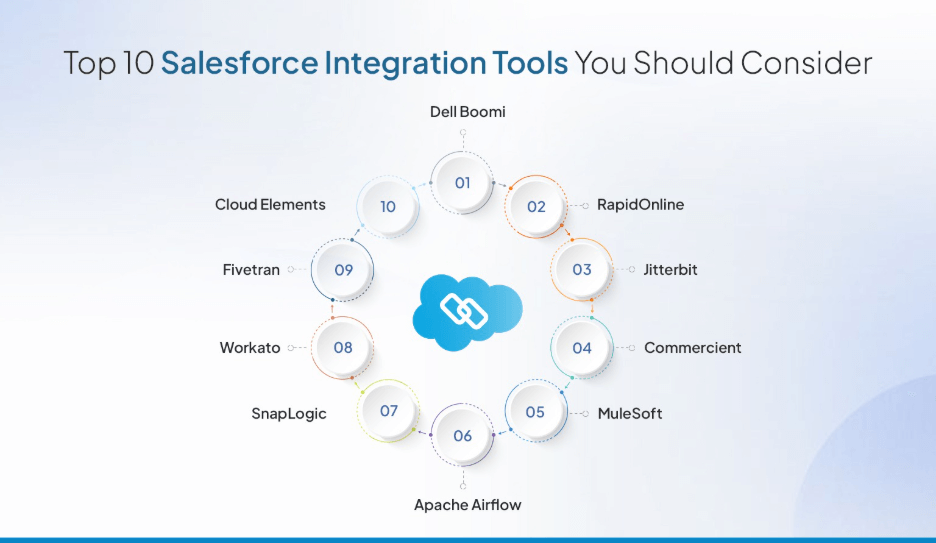
Top 10 Salesforce Integration Tools You Should Consider Using

The best Salesforce integration tools can bring in just the right results regarding Salesforce integration. You need access to suitable SFDC integration tools to efficiently integrate your Salesforce CRM with external applications.  

So, here are some of the top Salesforce integration tools you must have to achieve successful Salesforce integration.  

Salesforce Integration Tool

1. Dell Boomi 

Dell Boomi is one of the most sought-after and top Salesforce integration tools. The tool enables you to work with a scalable platform to efficiently handle complex processes and a huge volume of data. Usually, companies that have data to handle from different departments tend to use Dell Boomi. Whether it is Microsoft Dynamics or Google Cloud, any such application can be integrated with Salesforce using this tool, as it is built for optimizing cloud-based platforms that support complex architecture. It supports interactive and visual interaction to facilitate end-to-end integration. 

2. RapidOnline 

RapidOnline is a tool that can be used for integrating Salesforce and Microsoft Dynamics 365. The tool has pre-configured templates and a user-friendly interface, making the integration process fast and efficient. The tool offers built-in integrations that allow for customization to fit your specific integration needs. 

3. Jitterbit 

Jitterbit is well-known in the industry for its efficient Salesforce integration capabilities. It is an integration tool that offers various API integrations based on the business size. 

Depending on the number of systems you wish to connect to and the required support level, Jitterbit offers three service levels.  

Jitterbit stands out as a preferred Salesforce integration tool; after all, it caters to technical and non-technical users. The platform can be used even without extensive coding or programming knowledge. 

4. Commercient 

Commercient is a cloud-based tool that connects ERP systems with CRM solutions. It enables businesses to establish an efficient link between ERP and CRM to streamline business processes and establish strong customer relations.  

One of the main advantages of using this integration tool is that it eliminates the need for manual mapping, ETL, or coding when integrating Salesforce. This helps to reduce integration costs and frees up resources that can be redirected toward other productive areas of the business. 

5. MuleSoft 

When discussing the best Salesforce integration tools, you can never leave MuleSoft out of the list. MuleSoft is an automation and integration tool highly trusted by Salesforce users and has been a pioneer in the industry for a while. 

MuleSoft’s Anypoint platform is owned by Salesforce and enables effortless integrations with various apps and services. With MuleSoft, large businesses can maximize functionality and seamlessly integrate various departments. It also allows users to integrate multiple applications or services simultaneously. 

6. Apache Airflow 

Apache Airflow is a widely used integration tool that assists in authoring, scheduling, and executing workflows. It includes a variety of command-line utilities that make it easier to perform complex tasks. 

Furthermore, its user interface offers numerous features that allow for the visualization of pipelines in production, project progress monitoring, and troubleshooting any issues to ensure successful project execution. 

Find out which tool truly fits your budget, scale, and complexity needs.

Find out which tool truly fits your budget, scale, and complexity needs.

7. SnapLogic 

SnapLogic provides an integration platform as a service (iPaaS) that links on-premises business modules, SaaS components, and cloud data sources. It is an AI-powered platform that offers intelligent deployment options to businesses of all sizes. SnapLogic automates the entire integration process, including the creation, maintenance, and deployment of projects in hybrid systems that are cloud-based and on-premises. One of the primary reasons why SnapLogic is highly preferred is its easy accessibility. It makes recommendations based on machine learning to create end-to-end integration pipelines that align with user intent. 

8. Workato 

Workato is a cloud-based integration platform that enables businesses to link their applications, data, and processes across the organization. It has been developed to provide a fast and easy integration solution for cloud-based applications, such as Salesforce, with minimal coding required. It helps organizations streamline their processes, improve data accuracy and consistency, and increase efficiency by automating manual tasks and eliminating the need for manual data entry. With the right Salesforce integration company, businesses tend to leverage the tool for performing integration. 

9. Fivetran 

Fivetran is a tool for integrating data that emphasizes process automation. It is an automated tool that offers connectors, analytics templates, and transformations that can be used immediately, with the ability to adapt to changes in schemas and APIs. Businesses worldwide use Fivetran to integrate data from event logs, cloud-based applications, and databases.  

10. Cloud Elements 

Cloud Elements provides developers with a cloud-based API integration platform that simplifies the process of connecting, managing, and publishing APIs via a unified platform. It also allows developers to synchronize data between various cloud services, including Salesforce, Quickbooks, and Zendesk integration, using Cloud Elements’ integration toolkit. 

Salesforce Integration Tools: Feature Comparison 

This table will help you identify which tool for Salesforce integrations align best with your specific technical requirements and business goals. 

Tool Primary Focus Key Capability Best For… 
Dell BoomiCloud-based iPaaSVisual, drag-and-drop interface for complex data architectures.Large enterprises with high data volumes.
RapidiOnlineERP/CRM SyncPre-configured templates specifically for Microsoft Dynamics & Salesforce.Fast, out-of-the-box Microsoft Salesforce sync.
JitterbitAPI IntegrationOffers three service levels based on business size and technical depth.Companies needing rapid deployment (under 10 days).
CommercientERP to CRM SYNCPre-built “SYCN” apps for 150+ ERPs without manual ETL or coding.Bridging back-office (accounting) with sales teams.
MuleSoftAPI-Led ConnectivityOwned by Salesforce; uses “Anypoint” for reusable, modular APIs.Complex, mission-critical enterprise transformations.
Apache AirflowWorkflow OrchestrationPython-based scheduling and monitoring of complex data pipelines.Technical teams/DevOps 
needing deep customization.
SnapLogicAI-Powered iPaaSUses machine learning (Iris AI) to recommend next steps in integration.Organizations prioritizing self-service and speed.
WorkatoLow-Code AutomationFocuses on “Recipes” to automate workflows between 1,000+ apps.Business users looking to automate departmental tasks.
FivetranData ReplicationFully automated data movement from apps to warehouses (ELT).Analytics and centralizing data for BI/Reporting.
Cloud ElementsUnified API HubCanonicalizes data (VDRs) so one API works across multiple apps.Developers 
managing many different cloud app categories.

How to Choose the Right Salesforce Integration Tool 

When you need to choose to pick the right Salesforce integration tool for your business, you should not try to find the most feature-heavy tool; but a tool that will help you fill the gap between technical capacity of your team and your business goals. 

Here are a few points that will help you make the right choice of the tool for Salesforce integrations. 

1. Technical Complexity vs. Team Skillset 

Before you choose the tool, try to understand the technical capacity of your team. If your team members prefer low-code or no-code Salesforce data integration tools, options like SnapLogic and Workato would work. But if your team members are proficient with the code, you can go with Apache Airflow and MuleSoft that require API architecture understanding. 

2. Data Volume and Sync Frequency 

Your choice of the tool also depends upon the data volume that you would be syncing in a day. For real-time syncing, tools that offer instant triggers like Webhook would be a great choice. However, if you work with nightly synchronization of massive data volume and prefer batch processing, then you should go with Salesforce data integration tools like Fivetran or Dell Boomi that can handle high-volume bulk transfers. 

3. Security and Compliance 

When data moves between systems, it is at its most vulnerable. Ensure your chosen tool supports: 

  • OAuth 2.0 for secure authentication. 
  • Encryption at rest and in transit. 
  • Compliance certifications (like HIPAA, GDPR, or SOC2) if you are in a regulated industry 

4. Total Cost of Ownership (TCO) 

Cost is an important factor that you must consider when choosing your Salesforce integration tool. Apart from the sticker price, there are many other aspects that you need to keep in mind while calculating the ROI like implementation cost, maintenance, AI call costs, etc. 

Best Practices for Successful Salesforce Integration 

Selecting the right tool for Salesforce integration doesn’t mean that the job is done. To make the integration successful, it is necessary to focus on proper planning, preparation, and governance. These are some of the best practices that can help to ensure your Salesforce integration is scalable and helps you achieve the business value you seek.

Start with a Clean Data Model 

Before connecting any external system, you must ensure your Salesforce data model is sound and optimized. Integration will magnify any existing flaws. You must start with a clean data model, verifying relationships are correct, custom fields are necessary, and record types are logical. Fixing data structure issues post-integration is exponentially more costly and complex than addressing them upfront. A simple, well-structured data model is the most important prerequisite for reliable, scalable data flow. 

Map Business Processes Before Mapping Fields 

A common pitfall is immediately jumping to field mapping. Instead, you must map business processes before mapping fields. Understand the “why” and “when”: When does the data need to move? Who owns the data at each stage? What triggers the sync? For example, map the entire “Quote-to-Cash” process first, then identify the specific fields (like Billing Address) that need to be synchronized to support that flow. 

Establish Data Governance and Deduping 

Integration inevitably introduces new, conflicting, or duplicate data. Before go-live, you must establish comprehensive data governance rules and deduping processes. Determine the “system of record” (SOR) for every critical field. Implement automated deduplication tools and reconciliation logic to ensure high-quality, trustworthy data. Failing to do this results in rapid data pollution and loss of user trust in the system. 

Stop manual entry today. Get a roadmap for full, automated data sync.
Get a roadmap for full, automated data sync.

Test Rigorously in Sandboxes 

You should never deploy an integration directly to production. Consider testing it in the sandbox. You can use a dedicated Full Sandbox that mimics the complexity and data volume of your production environment. From unit testing to user acceptance testing, conduct them all to ensure the integration has no related issues.  

Enable Alerts and Monitoring 

Even successfully completing the integration process doesn’t ensure that the job is done. You need to ensure proper monitoring processes, so any possible errors can be timely detected before system performance is hampered. Your technical team should be timely notified whether it is any data sync error or when the API limit is about to hit.

Common Salesforce Integration Use Cases 

Let’s look at some real-world scenarios where Salesforce integration makes a measurable difference.  

1. Quote-to-Cash Automation (Sales & Finance) 

This is perhaps the most high-impact use case. When a Sales Rep marks an Opportunity as “Closed Won,” the integration automatically triggers the creation of a Sales Order and Invoice in your ERP (like NetSuite or QuickBooks). This helps to eliminate manual re-entry of data and achieve faster billing cycles and zero typos in contract amounts. 

2. 360-Degree Customer Support (Service) 

By integrating Salesforce with your support ticketing system (like Zendesk or Jira), support agents can see a customer’s full purchase history and subscription status without leaving the Service Cloud. This enables support agents to provide personalized help instantly, and alert sales reps regarding their key account having an open support ticket. 

3. Marketing Lead-to-CRM Sync (Marketing) 

Integrating marketing automation platforms (like HubSpot, Pardot, or Mailchimp) ensures that every lead captured from a webinar or whitepaper download is instantly routed to the right salesperson in Salesforce. This can help in decreasing lead response times from days to minutes, significantly increasing conversion rates. 

Choose Your Salesforce Integration Tool Wisely 

Although there are multiple top Salesforce integration tools available but decision to pick the right tool is not universal. You must consider your budget constraints, the company’s goals, complexity of your data, and other focus areas while making a choice. 

A successful integration of multiple systems with failure doesn’t mean having a path to move records. It’s about setting the right foundation on which your data resides. Whichever tool you choose, you need to make sure it is making your business scalable, automating your processes, eliminating manual struggles, and providing a unified customer experience. That’s the key to getting the right Salesforce integration tool in place. 

Learn how we cut lead-to-opportunity time from 48 hours to 5 minutes post-integration.

lead-to-opportunity

Top 10 Salesforce Implementation Partners in 2026 to Drive Scalable Growth 

Salesforce generates an annual revenue of $34.86 billion, holds 21.8% of the CRM applications market share and has acquired more than 65 companies to date. From the numbers, it is clear that Salesforce has taken a big leap forward in solving complex customer challenges and has become a leading enterprise CRM.  

However, in 2026, the question for growing enterprises is no longer just “Do we have Salesforce?” but “Is our Salesforce ecosystem intelligent enough to lead the market?” As we move deeper into the era of Agentic AI and Data Cloud, the gap between a standard implementation and a strategic one has become a chasm. That’s why enterprises and SMBs require top Salesforce implementation partners to make the most out of the platform. 

That’s why we’ve created a list of the 10 best Salesforce implementation partners in 2026 based on their technical expertise, certified professionals, and proven client results.

What to Look for in a Salesforce Implementation Partner 

Data, AI, and Automation are the three pillars that define the Salesforce landscape. Any SFDC implementation partner who might do excellent work a few years back might not have the modern toolkit required for the era of Agentforce and Data Cloud. To ensure your investment yields a maximum ROI, look for these six non-negotiable qualities.

1. Expertise in Complex Multi-Cloud Deployments 

Modern Salesforce success rarely happens in a vacuum. Implementation partner companies must demonstrate a deep understanding of how different clouds, like Sales, Service, Revenue (CPQ), and Marketing interact.  

If your business requires data to flow seamlessly from a customer’s initial marketing click to a final invoiced line item, you need an SFDC implementation partner with “Cross-Cloud” architecture experience to avoid siloed data. 

2. Salesforce Partner Status & Tier (Summit/Crest) 

While a “Base” partner might be fine for a simple setup, enterprise-level transformations require the resources of Summit (formerly Platinum) or Crest (formerly Gold) partners.  

Higher-tier implementation partner companies have direct access to Salesforce product teams, early looks at “pilot” features, and a higher minimum number of certified architects. This “insider” status can be the difference between a project that stalls and one that breaks new ground. 

Turn your CRM into a growth engine. Scale smarter with a 2026-ready roadmap.

CRM into a growth engine

3. AI, Automation & Data Integration Capabilities 

In 2026, a partner who only knows how to build “Flows” is behind the curve. Your partner must be able to solve the “Garbage In, AI Garbage Out” problem. Ask them about their Data Cloud strategy and their experience building autonomous Agentforce agents. If they can’t explain how they will ground your AI in trusted, real-time data, your implementation will lack the intelligence needed to compete. 

4. Post-Launch Support & Managed Services 

Implementation is just the beginning. The most successful companies view their Salesforce org as a living organism that requires constant care. Does the partner offer a post-go-live support plan? A dedicated Managed Services team ensures that your system evolves with Salesforce’s three annual releases, and that technical debt doesn’t accumulate after the initial consultants leave.

5. Strong References & Relevant Case Studies 

General experience is good; industry-specific experience is better. Request at least three case studies from your specific industry (e.g., Financial Services, Healthcare, or Manufacturing). High-quality partners should be able to point to real problems they solved, such as “Reduced lead response time by 40%” or “Automated 60% of Tier-1 support cases using AI agents.”

Salesforce Partner Tiers Explained 

Selecting a partner in 2026 requires understanding the “mountain” of tiers Salesforce uses to categorize its consultants. These tiers are recalculated quarterly based on a rigorous point system that tracks everything from the number of certified experts on staff to verified customer satisfaction (CSAT) scores. 

1. Summit Partners (The Elite Tier) 

Formerly known as the “Platinum” level, Summit is the highest tier achievable in the Salesforce Partner Program. These firms represent the top 10% of the ecosystem. 

A Summit partner has typically exceeded 1,000 points on their Trailblazer Scorecard. They possess a massive “bench” of certified consultants and a proven track record of managing multi-cloud, global digital transformations. 

These partners are suitable for enterprise-level organizations with complex, high-stakes requirements that need the highest level of support and direct access to Salesforce’s internal product teams. 

2. Crest Partners (The Advanced Tier) 

Taking the place of the old “Gold” and “Silver” categories, Crest partners are high-performance firms that have demonstrated significant scale and specialized expertise. 

To reach Crest status, partners must maintain a high level of customer success and a robust portfolio of completed projects. They often offer a more “boutique” feel than Summit giants while still possessing deep technical maturity. 

These partners are suitable for mid-market to large companies that need sophisticated technical solutions but prefer a more agile, dedicated consulting team. 

3. Ridge & Base Partners (The Growth Tiers) 

  • Ridge (Mid-Tier): These are established partners with a solid foundation of certifications and successful implementations. They are often the most cost-effective choice for standard implementations. 
  • Base (Entry-Tier): The starting point for all Salesforce partners. While newer, many “Base” partners are founded by veteran consultants from larger firms, offering highly specialized skills at competitive rates.

Top Salesforce Implementation Partners to Ensure Success

Choosing the right Salesforce implementation company can help you prevent a clunky Salesforce rollout. Here are the top Salesforce implementation consultants who can bring deep industry expertise and industry know-how.

1. 360 Degree Cloud 

360-Degree Cloud

360 Degree Cloud is a Salesforce Summit Partner and an ISV with a team of 600+ certified professionals. They have more than 13 years of experience delivering end-to-end Salesforce implementation services. In addition to that, they have 6+ Salesforce products listed on AppExchange. You should choose them because they:  

  • Cater to core clouds like Sales, Marketing, Service, Experience, Non-Profit, Financial Services, Health, Manufacturing Cloud.
  • Have expertise in Salesforce integration, MuleSoft/API-led connectivity, and AI-driven automation, Lightning component development. 
  • Have flexible delivery models and an on-demand bench of experts to ensure tight deadlines are met without compromising the quality. 

2. Accenture 

Accenture

Accenture is a global powerhouse and a Salesforce Summit Partner. They have 56,000 skilled Salesforce professionals and 20+ partner innovation awards. They deliver a full lifecycle of Salesforce services and leverage AI in its service ecosystem. The have: 

  • Expertise in various core clouds and caters to diverse industries like health and financial services. 
  • 78 k+ Salesforce certifications and 20+ Partner Innovation Awards that span across Education, Healthcare, MuleSoft and more. 
  • Presence in over 120 countries helps them to provide localized solutions with global insights. 

3. Agile Cloud Consulting 

Agile Cloud Consulting

Agile Cloud Consulting is one of the best Salesforce implementation partners that has an impressive work portfolio. They were established in 2010 and based in New York and offer comprehensive Salesforce services. Additionally, they offer services to different industries, including non-profits, education, and healthcare. They:

  • Have consultants who are adept with core Salesforce products like Sales, Service, and Marketing Cloud, Manufacturing Cloud, Health Cloud, Experience Cloud, Non-Profit Cloud, etc. 
  • Specialize in Salesforce Org health checks, implementation strategy, AppExchange app development, data migration, and system integration. 
  • Are known for exceptional customer service and making quick adjustments to meet client needs. 

4. Ascendix Technologies 

Ascendix Technologies

Ascendix Technologies is a certified Salesforce Summit Partner as well as AppExchange Partners. They specialize in delivering tailored Salesforce solutions, especially for commercial real estate and venture capital sectors. They: 

  • Have developed solid tools like AscendixRE for real estate CRM and marketspace for broker collaboration to address the needs of these industries.  
  • Offer Salesforce health checks, implementation, optimization, integration, customization, portal development, virtual administration, and user training. 
  • Have successfully helped clients like JLL and Innovative Capital in undergoing digital transformation. 

5. Deloitte Digital 

Deloitte Digital stands out for its ability to merge creative design with robust technological solutions. Their Salesforce services are designed to improve customer experiences while driving operational efficiency. They: 

  • Focus on delivering personalized experiences through Salesforce. 
  • Are a Salesforce Summit (Platinum) Partner and recognized as a Global Strategic Partner. 
  • Have been repeatedly honored as a leader – e.g., named the undisputed Leader in Everest Group’s 2024 Salesforce Service and accumulated 40+ Salesforce Partner Awards in the past five years.

6. Cognizant 

Cognizant

Cognizant offers massive Salesforce practice with a significant number of certified Salesforce Developers and Consultants, Technical Architects, and Admins. This certified count indicates their ability to staff large projects, including Sales, Salesforce implementation, with skilled individuals across all roles. They:

  • Are regarded as a Global Strategic Partner has been acknowledged in analyst reports like Equiteq and Forrester as a leader in Salesforce services. 
  • Have expanded their Salesforce capabilities significantly through acquisitions of niche firms like ATG, Cadient, and SaaSfocus. 
  • Have handled multi-org Salesforce consolidation for a global manufacturer and implemented Salesforce for a large healthcare provider to streamline patient outreach. 

7. Coastal Cloud 

Coastal Cloud

Coastal Cloud is a Salesforce Summit Partner with a distinctive U.S.-based delivery model and a strong emphasis on industry-specific transformations. With 500+ Salesforce certifications across their team, they have delivered over 2,000 projects for clients in sectors like healthcare, public sector, and communications. Their consultants specialize in designing cost-effective, agile Salesforce implementations. They: 

  • Have on-shore, U.S.-based agile delivery model to ensure real-time collaboration and minimal communication lags. 
  • Have deep experience in HIPAA-compliant Health Cloud deployments, including patient journeys, provider management, and interoperability with EHR systems. 
  • Deliver streamlined order-to-activation journeys, subscriber lifecycle management, and intelligent service automation. 

8. Atrium 

Atrium

Atrium is an AI and data-focused Salesforce partner with a massive reputation for turning analytics into action. With 200+ consultants and deep expertise in Tableau CRM (formerly Einstein Analytics), they stand out for enabling intelligent automation in Salesforce projects. They: 

  • Specialize in Salesforce Data Cloud and AI-driven analytics setup. 
  • Boasts enterprise-scale Service Cloud implementations with predictive case deflection. 
  • Have prebuilt industry models using MuleSoft and custom dashboards via Tableau CRM. 

9. Heller Consulting 

Heller Consulting

Heller Consulting is a seasoned Salesforce partner. They have been collaborating with nonprofits and higher education institutions since 2008. They specialize in aligning technology strategies with mission-driven goals, offering expertise in platforms like Salesforce, Microsoft, and Blackbaud. Their approach emphasizes thoughtful planning, ensuring that technology implementations support organizational objectives effectively. They: 

  • Develop comprehensive technology roadmaps to align Salesforce solutions with organizational long-term goals.  
  • Offer services for seamless Salesforce implementation and data migration from legacy systems. 
  • Offer deep focus on change management and adoption training for internal teams. 

10. Horizontal Digital 

 Horizontal Digital

Horizontal Digital is uniquely positioned as the Salesforce partner that brings together marketing, data, and design into every project. For organizations, this means a Salesforce implementation that doesn’t just technically work but also engages customers in a personalized, meaningful way across channels. They: 

  • Combine Salesforce CRM with CMS and personalization tools to build unified digital experiences across web, mobile, and social. 
  • Bring hybrid integration expertise between Salesforce and other key Martech platforms like Sitecore and Adobe Experience Manager. 
  • Implement HIPAA-compliant solutions using Health Cloud, and for manufacturing, they deliver robust Experience Cloud portals for dealer, distributor, and customer self-service.

Salesforce Cloud-Specific Implementation Partners 

Rather than hiring a generalist, businesses are looking for specialized partners that align with their specific digital architecture. Here are the primary types of cloud- specific implementation partners you’ll encounter:

Salesforce Service Cloud Implementation Partners 

In the “Service-First” economy of 2026, Salesforce Service Cloud implementation partners focus on reducing friction and increasing deflection. They are experts in transforming traditional call centers into high-efficiency “Agentic” hubs. 

  • AI Agent Deployment: Implementing Agentforce for Service to handle routine inquiries (tracking orders, basic troubleshooting) autonomously. 
  • Omni-Channel Orchestration: Seamlessly routing cases across WhatsApp, Slack, Video, and Voice to ensure the right expert, human or AI, is assigned. 
  • Connected Field Service: Integrating Salesforce Field Service (SFS) for organizations with “boots on the ground,” focusing on real-time parts inventory and automated scheduling. 
  • Knowledge Engineering: Building “Intelligent Knowledge Bases” that AI uses to generate accurate, trusted responses for both customers and agents. 

Salesforce Marketing Cloud Implementation Partners 

Marketing in 2026 is driven by Data Cloud. Salesforce Marketing Cloud implementation partners specialize in moving away from mass blasts toward hyper-personalized, “segment-of-one” experiences. 

  • Data Cloud Foundation: Setting up the “Identity Resolution” layer so that marketing signals (like a website click) instantly trigger a personalized action. 
  • Real-Time Journey Building: Using Journey Builder and Marketing Cloud Personalization to change website content or send an SMS the second a customer’s intent shifts. 
  • Intelligence & Analytics: Implementing Marketing Cloud Intelligence (formerly Datorama) to provide a unified view of marketing spend and ROI across every digital channel. 
  • Privacy-First Marketing: Ensuring all marketing automation complies with the latest 2026 global data privacy regulations and consent management standards. 

Salesforce Commerce Cloud Implementation Partners 

Salesforce Commerce Cloud implementation partners now focus on “Unified Commerce,” blurring the lines between online shopping and physical retail. 

  • Composable & Headless Commerce: Building flexible storefronts that allow brands to change their “front end” without disrupting the complex back-end logic. 
  • B2B & B2C Integration: Specialized expertise in B2B Commerce for complex bulk ordering, contract pricing, and multi-level account hierarchies. 
  • Order Management (OMS): Implementing Salesforce Order Management to give customers real-time visibility into “Buy Online, Pick Up In-Store” (BOPIS) and simplified returns. 
  • AI-Powered Merchandising: Setting up Einstein for Commerce to automate product recommendations and visual search, significantly increasing Average Order Value (AOV). 

Problems Your Salesforce Implementation Partners Can Solve 

Top-tier Salesforce implementation partners don’t just deliver a platform; they deliver a solution to the complex hurdles that prevent your team from reaching peak performance. Here are the core business pain points the right partner will eliminate for you in 2026:  

Salesforce Implementation Partner

1. Complex Multi-Cloud Implementation & Integration  

The “Salesforce 360” vision is powerful, but connecting Sales Cloud, Service Cloud, and Marketing Cloud into a single cohesive unit is technically demanding. Fragmented customer data in a company can force the team to jump between screens.  

The trusted Salesforce implementation partner can build a Unified Customer Profile to ensure when a customer interacts with an AI agent in Service Cloud, that context is immediately visible to a sales rep in Sales Cloud.  

2. Painless Migration from Legacy Systems  

Many organizations are still tethered to aging, on-premises CRMs or early-generation cloud tools that can’t handle modern data volumes. Legacy systems often harbor “dirty data”, which includes duplicates, missing fields, and non-compliant records.  

Salesforce experts use advanced ETL (Extract, Transform, Load) tools like MuleSoft to cleanse and map your old data into the Salesforce schema without downtime or data loss. 

3. AI, Data Cloud & Automation Enablement  

By 2026, AI is no longer a “nice-to-have.” However, AI is only as good as the data it accesses. Without a proper data strategy, AI features like Agentforce provide hallucinations instead of help.  

Partners can implement Salesforce Data Cloud to unify your real-time data streams, “grounding” your AI agents in reality so they can resolve customer issues autonomously and accurately.  

4. Org Scalability & Governance  

Rapid growth often leads to “Salesforce Sprawl”, an org cluttered with too many custom objects, redundant flows, and technical debt. The system can end up slowing down, and every new update can break an existing process.  

Partners can help establish a Center of Excellence (CoE) and governance frameworks. They re-architect your org for scalability, ensuring it can support thousands of new users and millions of records without performance degradation.  

5. Overcoming Low User Adoption  

Even the most expensive system is worthless if your team won’t use it. Employees might find the system too complex and revert to spreadsheets.  

Partners can help apply UX/UI Design principles to simplify the interface. They move away from generic training in favor of in-app guided learning and workshops that prove the CRM makes the employee’s job easier, not harder.  

6. Post-Go-Live Support & Optimization  

The day you launch is actually Day One of your system’s evolution. Critical bugs can appear after launch, or the internal team might not be equipped to handle Salesforce’s three annual major releases.  

Through Managed Services, partners provide ongoing health checks, performance tuning, and the rapid deployment of new features (like the latest Agentforce updates) to ensure your ROI continues to grow long after the initial rollout. 

Choose the Right Salesforce Implementation Partner for Your Firm  

The complexity of the Salesforce ecosystem in 2026 demands more than just technical configuration; it requires a partner who acts as a strategic architect for your AI and Data strategy. As we have explored, efficient Salesforce implementation partners do not just “go live”; they transform your CRM from a static database into a dynamic, Agentic enterprise.  

There is no “one-size-fits-all” in the world of Salesforce. A global Summit Partner might be perfect for a massive multi-cloud transformation, while a specialized boutique firm could be the better fit for a niche CPQ or Data Cloud project.  

As you move forward, use the criteria in this guide to shortlist your Salesforce partner that resonates with your unique business challenges. Don’t just implement Salesforce, master it. The right partner is the key to unlocking the full power of your data and the future of AI-driven growth. 

Build an Agentic enterprise with a partner who knows AI. 

Agentic enterprise

Top Salesforce Consulting Companies in the USA: How to Choose the Right Partner

Do you know 70% of customer Salesforce implementations are conducted by Salesforce consulting partners? This number clearly indicates how important Salesforce consulting firms are for businesses that are working with Salesforce to manage their business operations and pipelines. 

But the real question is which Salesforce partner to trust? Choosing from the top Salesforce consulting firms is one of the most critical decisions for ensuring a successful CRM implementation. The right Salesforce consulting partner can drive adoption, integrations, and ROI, while the wrong one can cost millions. Failed implementations can cost organizations an estimated average of $1.8 million due to low user adoption, delayed ROI, and the costly time/money required for complete re-architecting. 

Choosing the right Salesforce consulting firm is, therefore, the single most critical decision you will make to get your CRM implementation done right. Here are some of the best Salesforce consulting firms in the USA that you can consider hiring for your business: 

  • 360 Degree Cloud Technologies
  • Data Geeks Lab 
  • SaaS Solutions 
  • Ascendix Technologies 
  • StarrData 

This comprehensive guide is designed to navigate that critical decision. We will reveal the Top 15 Salesforce Consulting Firms in the USA for 2026, detailing their specialties, industry focus, and key strengths. More importantly, we’ll provide you with a powerful framework on how to compare them, the essential selection criteria.  

What Problems Do Businesses Actually Face with Salesforce? 

Salesforce is a powerhouse, but its vast power and flexibility often become its biggest implementation challenge. For companies seeking maximum ROI, the issues aren’t with the platform itself, but with misalignment and poor execution. 

Here are the critical, real-world pain points businesses frequently encounter: 

1. The Adoption Barrier: Resistance to Change 

The most sophisticated CRM in the world is useless if employees don’t use it. Teams (especially Sales and Service) view Salesforce as a “management reporting tool” rather than a system that helps them close deals faster or serve customers better. 

2. Data Chaos: Fragmentation and Poor Quality 

Salesforce is only as smart as the data you feed it. Data problems compromise every outcome, from reporting to AI. There can be times when customer data is scattered over systems, and when data finally lands in Salesforce, it gets riddled with duplicates, incorrect field entries, and incomplete records, resulting in fragmented data and inconsistent reporting. That’s something no one wants. 

3. Integration Headaches (The “Hidden” Cost) 

Any company uses multiple third-party applications to manage different operations. To streamline the process, it is necessary to integrate Salesforce with those apps, which is actually trickier than we might think. Any challenge in the process can cause integration bottlenecks, causing stalled API limits, incompatible data models, or the need for expensive middleware. 

4. Customization vs. Out-of-the-Box Trade-Offs 

There are times when firms keep customizing each process to fit their existing workflows, instead of conforming to Salesforce best practices. They create a heavy Apex code and custom Lightning component when a straightforward Flow is enough, accumulating technical debt. That’s where having the support of Salesforce consulting companies in the USA is necessary. 

5. Compliance, Security, and Regulatory Concerns 

It can be quite daunting to make sure Salesforce complies with strict industry rules while handling user roles and data access. Any sort of incomplete permission sets or failing to meet proper encryption procedures can cost a company a lot. 

Want to Use Salesforce to its Full Potential?

Want to Use Salesforce to its Full Potential

Why Hiring Right Salesforce Consulting Firms Matters 

Choosing the right Salesforce consulting firm doesn’t have to be complicated. At its heart, a good partner ensures you don’t waste time or money on a tool that no one uses. 

Here are 5 simple and basic reasons why hiring the right firm matters for your business: 

1. Getting it Right the First Time 

Salesforce is incredibly powerful, but it’s also complex. If you try to set it up yourself without experience, it’s easy to click the wrong buttons or organize your data poorly. A professional firm knows the “best practices” and sets everything up correctly from day one, so you don’t have to pay someone to fix it later. 

2. Saving Your Team’s Time 

Your sales and marketing teams should be focused on closing deals and finding customers, not trying to learn how to build database fields or fix technical errors. Salesforce consulting companies in the USA handle the heavy lifting of the setup, allowing your employees to stay focused on their actual jobs. 

3. Customizing it to Your Business 

Every business works differently. A “one-size-fits-all” CRM rarely works. The best Salesforce consulting companies sit down with you to understand how your team works. They then tweak Salesforce, change labels, create simple shortcuts, and remove buttons you don’t need, so the software fits your business like a glove. 

4. Staying Up to Date Automatically 

Salesforce updates its software three times a year with new features. It’s almost impossible for a busy business owner to keep up. A consulting firm stays on top of these changes for you. They’ll tell you, “Hey, there’s a new free tool that can save you three hours a week,” ensuring you’re always getting the most value for what you pay. 

What Services Should Salesforce Consulting Firms Offer in 2026? 

A top-tier Salesforce consulting firm is not just someone who implements Salesforce but must be a strategic partner capable of navigating the complex ecosystem of AI and data for different industry segments. Here are the core services essential for success: 

1. Salesforce Implementation 

The most fundamental service provided by Salesforce implementation partners is getting your CRM structure right from the start. It involves comprehensive Salesforce implementation and configuration of core Salesforce Clouds (Sales, Service, Experience, etc.). 

2. Migration Expertise 

Make sure to pick migration experts, with experience in moving all historical customer data, workflows, and logic from legacy systems or other CRM platforms (like Microsoft Dynamics or HubSpot) to the Salesforce environment securely and without disruption. 

3. Deep Integration and Connectivity 

In a multi-cloud world, isolated systems are ineffective. The partner must be adept at connectivity. That’s where you need a service that can help you with Salesforce system integrators to connect your entire enterprise technology landscape. Salesforce integration consultants should be able to assist with achieving seamless connections with ERP systems (SAP, Oracle), Marketing Automation Tools, Data Warehouses, and critical business intelligence tools. Crucially, they must be fluent in integrating with the latest AI/Agentforce capabilities to ground AI models in your proprietary data. 

4. Custom Development and Extension 

Many a time, standard solution is not the perfect fit for the business, that’s where it is needed to extend the platform. Having the right Salesforce development experts aside can help with custom development, building scalable, custom solutions; developing and deploying proprietary AppExchange apps; and creating bespoke Lightning Components to meet unique, complex business requirements. 

5. Strategic Change Management & User Training 

It’s not just about bringing in the Salesforce for the business; it’s also about being able to use the platform efficiently. Salesforce consulting companies should assist the internal teams with robust change management and user training programs. This includes helping with role-specific training, providing post-go-live support, and crafting internal communication plans to ensure sustained and high user adoption across all departments. 

6. Ongoing Optimization and Managed Services 

Just carefully getting Salesforce implemented is not enough. It is necessary to work on its continuous care and evolution. It means the Salesforce consulting services should provide assistance with ongoing support, Salesforce managed services, and performance optimization followed by health checks and regular maintenance. 

Want to Use Salesforce to its Full Potential?

Want to Use Salesforce to its Full Potential

7. Data Governance, Security, and Compliance 

Customer data security is not up for debate. Salesforce consultancies in the USA need to provide consulting on data integrity, security, and compliance. Companies need to prioritize putting in features such as Shield Encryption, role-based security models, instituting effective data governance policies, and making sure your entire implementation sticks to standards such as HIPAA and GDPR. 

Key Criteria: How to Evaluate Salesforce Consulting Firms 

Choosing the right Salesforce consulting partners requires a lot of homework instead of just doing a price comparison. Use the following criteria to evaluate and compare your shortlisted best Salesforce consulting companies: 

1. Certifications and Salesforce Partner Level 

A firm’s official status indicates their level of investment and technical expertise recognized by Salesforce. Verify their official standing in the Salesforce Partner Program. Tiers like Summit (Global Strategic), Platinum, and Gold signify greater scale, higher customer satisfaction scores, and a larger number of certified consultants. 

Higher partner levels often mean the firm has early access to new technology releases (like Agentforce/AI) and more Certified Technical Architects (CTAs), critical for complex enterprise projects. 

2. Domain / Industry Experience & Case Studies 

Experience in your particular industry is potentially the single most important consideration for vertical and regulated markets. You need to look for specific case studies and references from businesses that are similar to yours. 

3. Technical Depth and Specialization 

Beneath broad skills, verify they’re capable of meeting your most advanced technical needs. Assess  expertise in advanced, specific areas: large and complex integrations, massive data migrations, advanced clouds (Field Service, CPQ, Health Cloud), and experience in emerging domains such as AI/Generative AI. 

4. Scale and Geographic Reach 

You should check if the size and location of the Salesforce consultancies in the USA align with your operational needs and preferred engagement model. Assess their global footprint or their specific presence in the USA. Do they use an offshore/nearshore model? Scale and geographical presence impact resource availability, time-zone alignment for meetings, and the continuity of support, particularly for multi-national organizations. 

5. Support and Post-Go-Live Services 

True partnership begins the day your new system goes live. You must go through the plan provided by  the company post go-live, and check if they have included user adoption, bug resolution, and the transition to long-term Managed Services. This kind of support by Salesforce consultants minimizes post-launch disruption and prevents the system from stagnating. 

6. Reputation: Testimonials and Success Stories 

It is necessary to go for external validation to evaluate the delivery quality of the Salesforce consulting partners. Check independent review sites, the Salesforce AppExchange Partner Directory, and look for testimonials that specifically address project success, technical complexity, and client relationship quality. A strong, consistent reputation from verifiable clients reduces the risk that you will experience a costly, failed implementation. 

Top 15 Salesforce Consulting Firms in the USA (2026) 

It’s true that you need a reliable Salesforce partner to manage your CRM implementation and development. Here we have provided you with a list of the 15 top Salesforce consulting firms you can count on with your business.  

1. 360 Degree Cloud Technologies 

360 Degree Cloud is a leading Salesforce consulting firm and a Salesforce Summit Partner with over 13 years of experience.  

A boutique Salesforce CRM Consulting and Development firm, 360 Degree Cloud thrives as an emerging front-runner across the globe for the wide range of Salesforce services. In 2012, 360 Degree Cloud was founded as a SaaS business by a small team of 5 people. Since then, the company has been on an upward trajectory and has grown in strength, stature, and capability. Today, 360 Degree Cloud is a family of 650+ experts (the top 5%) with 800+ certifications across all Salesforce products. The pinnacle achievements of the firm include: 

  • 3000+ Salesforce Projects Implemented  
  • 800+ Salesforce Certifications 
  • 30+ AppExchange Security Reviews Cleared 
  • 13+ Years Since Inception 
  • 80+ Partners 
  • 30+ Industries Served 
360 Degree Cloud Technology

As a distinguished Salesforce consulting firm and a Summit Partner, we bring a decade of expertise, a global footprint, and a holistic suite of Salesforce consulting services to elevate businesses to heights. The services include:  

  • Salesforce Consulting 
  • Salesforce Integration 
  • Salesforce Implementation 
  • Custom Development (LWC, Aura, Apex, VF) 
  • Salesforce Outsourcing 
  • Salesforce customization 
  • Health Checks 
  • Lightning Migration 
  • Data Migration 

Our global reach is supported by a regional appreciation of our customers’ requirements. We bring international excellence to bear in conjunction with a personalized approach to deliver a successful project of any size. 

360 Degree Cloud is a Salesforce implementation, customization, support services, and Salesforce consulting company. They have a strong presence when it comes to Salesforce Sales Cloud, Service Cloud, Marketing Cloud, Agentforce, and Salesforce automation solutions. 

  • Founded: 360 Degree Cloud was founded in 2012. 
  • Headquarters: The company is headquartered in Los Angeles, CA. 
  • Specialization: Salesforce Sales Cloud, Service Cloud, Marketing Cloud, automation. 

Facing the Hiring Gap? Fill It On-Demand.

Salesforce Niche Expert

2. Data Geeks Lab 

DataGeek labs

Data Geeks Lab is a Salesforce implementation partner, providing services including consulting services, implementation services, customization services, integration services, as well as support services. They are skilled data-enabled Salesforce solution developers that employ business analytics and business intelligence to drive business outcomes.  

  • Founded: Data Geeks Lab came into existence in 2017. 
  • Headquarters: San Francisco Bay Area, CA is where its headquarters is located. 
  • Specialization: Data-driven Salesforce implementation, analytics, business intelligence. 

3. SaaS Solutions 

Saas Solutions

SaaS Solutions is a Salesforce consulting firm that provides implementation, customization, integration, training, and consulting services. They aim to offer cloud solutions and CRM strategies to make Salesforce work best for businesses.  

  • Founded: SaaS Solutions was founded in 2010. 
  • Headquarters: Corporate office of the company is Media, PA.  
  • Specialization: Cloud solutions, CRM strategy. 

4. Ascendix Technologies 

Ascendix

Ascendix Technologies is a Salesforce Summit Partner involved in Salesforce development, Salesforce consultation services, customization services and support services. They have a distinctive reputation for real estate CRM solutions and Salesforce AppExchange product offerings. 

  • Founded: Ascendix Technologies was founded in 1996. 
  • Headquarters: They are headquartered in Dallas, TX. 
  • Specialization: Real estate CRM systems, Salesforce AppExchange offerings. 

5. StarrData 

Starr Data

StarrData provides Salesforce implementation, customization, training, and Salesforce consultation services. They have been proven to be skilled in Salesforce CPQ, Pardot, and Sales Cloud optimization. 

  • Founded: StarrData was founded in 2009. 
  • Headquarters: It is located in Walnut Creek, CA. 
  • Specialization: CPQ Salesforce, Pardot, Sales Cloud optimization. 

6. Agile Cloud Consulting 

Agile Cloud

Agile Cloud Consulting is a Salesforce implementation, customization, support services firm that specializes in agile methodology, Salesforce Lightning, and Community Cloud solutions.  

  • Founded: Agile Cloud Consulting was founded in 2010. 
  • Headquarters: Headquarters of this company is located in New York, USA. 
  • Specialization: Salesforce Lightning development, Community Cloud development, Nonprofit Cloud development. 

7. Fexle Services 

Fexle

Fexle Services is a Platinum partner and provides Salesforce development, customization, integration, and consulting services. They have a reputation for working efficiently in Salesforce Commerce Cloud, Salesforce IoT, and Salesforce mobile application development.  

  • Founded: Fexle Services is incorporated in 2013. 
  • Headquarters: It is having its headquarters in India. 
  • Specialization: Salesforce Commerce Cloud, Salesforce IoT, development of mobile applications. 

8. LevelShift 

Level Shift

LevelShift is a Salesforce implementation specialist amd a Summit Partner that deals in Salesforce customization and managed services. It is known for its expertise in Salesforce AI as well as Einstein Analytics.  

  • Founded: LevelShift Inc was founded in 2017. 
  • Headquarters: It has its headquarters in California, USA. 
  • Specialization: Salesforce AI, Einstein Analytics, automation. 

9. Apphienz Inc. 

Apphienz

Apphienz Inc. is a Salesforce implementation, customization, support services, and Salesforce consulting firm. They have expertise in Salesforce Marketing Cloud, Salesforce CPQ, and Salesforce Community Cloud solutions.  

  • Founded: Apphienz Inc. was founded in 2014. 
  • Headquarters: It is headquartered in California, USA. 
  • Specialization: Salesforce Marketing Cloud, Salesforce CPQ, Community Cloud. 

10. DianApps 

DianApps

DianApps is a Salesforce development company that offers Salesforce consulting, development, customization, and integration. They have skills in Salesforce Lightning, Salesforce Apex development, and Salesforce data migration.  

  • Founded: DianApps was founded in 2018. 
  • Headquarters: Corporate office is in Florida, USA. 
  • Specialization: Salesforce Lightning development, Apex development, data migration. 

11. SaaScend 

SaaSScend

SaaScend is a leading Salesforce consultancy and is a Salesforce consulting, implementation, customization, and support services providing company. They practice Salesforce CRM strategy, Salesforce optimization, and Salesforce training. 

  • Founded: SaaScend was established in 2015. 
  • Headquarters: It is located in San Francisco, CA.  
  • Specialization: Salesforce CRM strategy, optimization, training. 

12. Cloudsquare 

CloudSquare

Cloudsquare is a Salesforce implementation partner that offers Salesforce consulting and managed services. They are known to be experts in building Salesforce products.  

  • Founded: Cloudsquare was founded in 2017.  
  • Headquarters: Los Angeles, California 
  • Specialization: Salesforce CPQ, Managed Services. 

13. Seven Results 

Seven Results

Seven Results is a Salesforce implementation, advisory, customization, as well as training firm. They have expertise in Salesforce Sales Cloud, Salesforce CRM strategy, and Salesforce Lightning solutions.  

  • Founded: Seven Results was founded in 2013. 
  • Headquarters: Headquarters of the company is located in New York, USA. 
  • Specialization: Salesforce Sales Cloud, CRM strategy implementation, Lightning implementation. 

14. Concretio 

concretio

Concretio is a Crest Partner that provides Salesforce consulting services, development services, customization services, and support services. They have a reputation for having Salesforce integration expertise, Salesforce CPQ expertise, and Salesforce mobile application development skills. 

  • Founded: Concretio was founded in 2013. 
  • Headquarters: It is located in New York, USA. 
  • Specialization: Salesforce integration, CPQ, mobile app development. 

15. SP Tech 

SP Tech

SP Tech is a Salesforce Summit Partner and consultation company that provides Salesforce implementation, customization, and support services. They have experience in Salesforce data migration, Salesforce Lightning, and Salesforce customization solutions.  

  • Founded: SP Tech was founded in 2015.  
  • Headquarters: It is set in Georgia, USA. 
  • Specialization: Salesforce data migration, Lightning, customization. 

Salesforce Partner Levels Explained 

In the world of Salesforce, partners are ranked using a “mountain-themed” tier system. These levels are determined by a company’s Trailblazer Score, which measures their technical expertise (certifications), their history of successful projects, and most importantly, their customer satisfaction (CSAT) scores. Here is a breakdown of what these tiers mean for you in 2026. 

The 4 Salesforce Partner Tiers 

Salesforce partners are reassessed every quarter, ensuring that their “badge” reflects their current ability to deliver results. 

TierFormer Name Who are they? Best For… 
SummitPlatinumThe Elite: Top 10% of partners globally. Deepest bench of experts. Global enterprises and complex, multi-cloud AI projects. 
CrestGoldThe Specialists: High-performance firms with proven industry expertise. Mid-market companies needing advanced, reliable solutions. 
RidgeSilverThe Scalers: Established teams with a solid track record of growth. Growing businesses and standard Sales/Service Cloud setups. 
BaseRegisteredThe Emerging: Newer or smaller firms building their portfolio.Simple projects or startups with highly specific, niche needs. 

Why the Partner Tier Matters 

While a “Summit” badge doesn’t automatically guarantee a perfect project, the tier serves as a powerful shortcut for your vetting process. Here is why it matters: 

  • Proven Accountability: To reach higher tiers like Summit or Crest, a firm must consistently submit “Customer Success” surveys. This means Salesforce has verified, directly with their clients, that they actually delivered what they promised. 
  • Depth of Knowledge: Higher-tier partners are required to have a minimum number of certified architects and specialists. 
  • Direct Access to Salesforce: Top-tier partners have dedicated “Partner Account Managers” at Salesforce. If your project hits a technical snag or a licensing issue, a Summit or Crest partner can often get a Salesforce engineer on the phone faster than a smaller firm could. 

How to Choose the Right One for You 

Choosing the right Salesforce partner is the first step towards your project success. We have provided here a step-by-step approach to navigate the selection process and make the right choice: 

1. Define Your Scope, Budget, and Timeline from the Start 

To find a Salesforce partner make sure to clarify your requirements within your company to prevent miscommunication and scope creep. Develop a comprehensive Statement of Work (SOW) that specifies which Salesforce Clouds you require, what your chief business issues are that you’re addressing, your company Budget Range, and your company Go-live Date. Having a clear vision within a company enables Salesforce consulting services to make precise proposals and helps to prevent wasted expenditures on unnecessary features. 

2. Match with Industry Specialization (Vertical Expertise) 

Actively find a Salesforce partner that already has an existing practice or significant experience in your specific vertical (Health, Financial Services, Manufacturing, etc.). Go after partners that already have pre-existing accelerators or solutions within your industry. The industry-niche Salesforce consulting services will understand your workflows and compliance instantly and will spend less time-intensive Knowledge Transfer and speed implementation. 

3. Ask for References and Look for Similar Past Projects 

Past performance is the best indicator of future success. Request at least three client references. To find a Salesforce partner, specifically ask for references who had a similar project complexity (e.g., legacy system migration, multi-cloud implementation, specific integration challenge). This will ensure you find the best Salesforce implementation partner. 

4. Negotiate Pricing Models 

Sync the payment model of the Salesforce consulting services to the project risk and deliverables. Negotiate the most appropriate pricing model for your project: 

  • Fixed Price: Best for small, clearly defined scopes. 
  • Time & Materials (T&M): More suitable for complicated, open-ended initiatives with a need for adaptability. 
  • Managed Services: Best for round-the-clock support and optimization by the best Salesforce implementation partner. 

5. Plan and Contract for Post-Implementation Support 

Ensure a smooth, secure transition into your new operating environment. To find a Salesforce partner, confirm the firm offers a period of “hypercare” (intensive support immediately after go-live) and a clear option for ongoing managed services (optimization, administration, and continuous improvement) to protect your investment for years to come. 

Turn Potential into Profit with Right Salesforce Consulting Firms

An effective Salesforce implementation is based on strategic alliances, rather than technical deployment. To capture the potential of the platform into revenue, you first need to identify your internal requirements, followed by utilizing stringent criteria such as industry expertise, technical proficiency in fields like AI and CPQ, and a demonstrated change management approach to assess firms. Prevent the typical loss incurred because of an off-track project by choosing from best Salesforce consulting firms whose experience and open process directly align with your specific business objectives. Ready to make your investment a success? Reach out to us today for customized Salesforce consultation. 

Want to Turn Salesforce Licenses into Revenue?

Want to Turn Salesforce Licenses into Revenue?

How to Eliminate Productivity Bottleneck with Spring ‘26 Release 

For firms built on the Salesforce ecosystem, Spring ’26 Release is more than just a software update. It is a strategic pivot point that directly affects how fast teams move, how cleanly they operate, and where friction shows up day to day. 
Every growing company has felt the “performance ceiling.” Sales reps stop following up on leads because the volume is too high. Service agents lose a customer because they didn’t have the context of a previous call. It’s the silent error that  stack up without IT ever knowing. 

Spring ’26 isn’t about more features. It’s about removing friction. In practice, most organizations end up adopting less than 30% of what each major release introduces, focusing only on the updates that remove real bottlenecks.

In this guide, we’ve bypassed the 800-page release notes to focus on the claims, pains, and gains of your 5 core departments, mapped to the Spring ’26 features that actually matter. 

1. The Sales & Strategy Team: Fighting Lead Fatigue 

Sales Development Reps (SDRs) are losing the race against time. High-quality prospects often go cold because reps are buried under a mountain of low intent “Contact Us” queries and manual research tasks. 

Solution #1: Agentforce Sales (The Autonomous SDR) 

In the Spring ’26 release, Sales Cloud officially matures into Agentforce Sales. The standout Lead Nurturing Agent researches prospects 24/7 and engages in two-way conversations via email and SMS.  

  • Research 24/7: Automatically research a prospect’s company and industry signals from the web to personalize outreach. 
  • Engage Authentically: This isn’t a “bot” that just sends links; it acts as a Sales-Native Chat assistant that can answer pricing questions and book meetings directly into your team’s calendar based on real-time availability. 
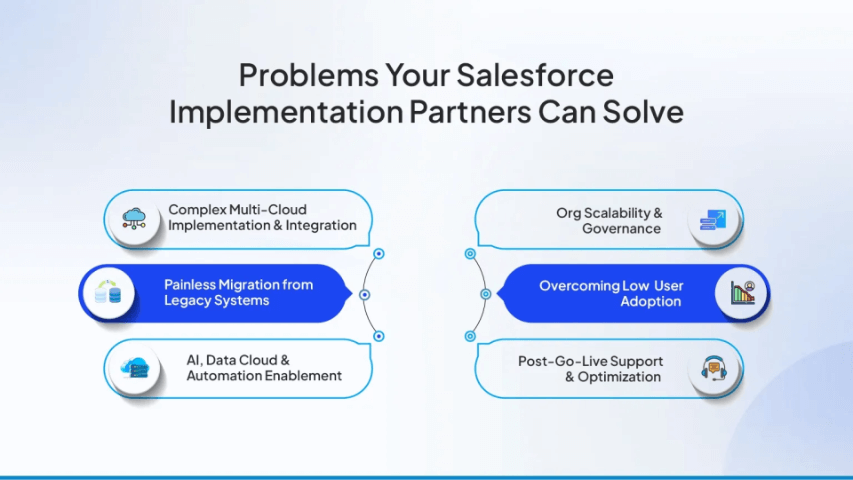
Sales-Native Chat assistant

The Benefit: This enables team to achieve a 100% lead follow-up rate without increasing headcount, ensuring your human sellers spend their day closing deals, not chasing “shadow” leads. 

Solution #2: Setup with Agentforce (The “Co-Admin” Experience) 

To solve the “Admin Tax“, the endless clicking required to configure the system, Spring ’26 introduces Setup with Agentforce (Beta). This is a conversational interface built directly into the Setup Home page that acts as a co-pilot for configuration. 

  • Natural Language Architecture: Instead of toggling between five screens to build a new object, an Admin can simply type: “Create an object called Project Expense with a Currency field and a validation rule for negative amounts.” 
  • Instant Navigation: You can ask the agent to “Show me all changes made to queues in the last 7 days” or “Navigate to the MFA settings,” bypassing the need to hunt through the Setup tree. 

The Benefit: This drastically reduces “click-fatigue” and speeds up complex org configuration by up to 50%, keeping your sales infrastructure as agile as your strategy. 

2. The Operations Team: Eliminating Manual Bottlenecks 

Internal processes like employee onboarding or partner vetting often feel clunky and unbranded, leading to “UX rejection” where users avoid the system. Furthermore, document-heavy workflows, like signed contract approvals, often sit unnoticed in the system, creating a silent stall where files are uploaded but the next action remains purely manual. 

Solution #1: Native Screen Flow Styling & Kanban Boards 

In Spring ’26, Salesforce Flow is receiving its biggest “makeover” to date. Admins can finally move away from the “standard gray” look and build professional, app-like experiences natively. 

  • Component-Level Styling: Using the new Style Tab in Flow Builder, you can now customize borders, background colors, and button shapes (like corner radius) to match your firm’s branding, no custom CSS or code required. 
  • Kanban Screen Component (Beta): You can now embed a Kanban Board directly inside a Flow. This allows users to visualize onboarding tasks or project milestones as cards and drag them through columns like “To Do” and “Done.” 
Kanban Screen Component

The Benefit: This provides a bespoke, professional feel that increases user adoption. When tools look and feel like modern apps, teams spend less time fighting the interface and more time moving the needle. 

Solution #2: Record-Triggered Flows on Files (ContentDocument) 

One of the most requested features in Salesforce history is finally here: the ability to trigger automation the moment a file is uploaded or deleted. 

  • Immediate Action: Previously, you needed complex Apex code to “watch” for new files. Now, you can build a Flow that triggers when a ContentDocument is created. 
  • Automated Bridges: Automation can now trigger the moment a file is uploaded. For example, when a client sends a signed contract via your Salesforce-native chat & messaging app, a Flow can instantly scan the file and alert the Legal team via Slack. 

The Benefit: It helps eliminate document lag by automating the manual bridge between file storage and business processes. It ensures that no contract or ID ever sits unreviewed. 

3. The Customer Service Team: Closing the “Context” Gap 

Customers are frustrated by rigid, dead-end phone menus (IVR), and human agents often lack a clear, consolidated history of customer interactions. This leads to the dreaded “Context Amnesia,” where a customer has to repeat their story three times before getting an answer. 

Solution #1: Agentforce Voice & Enhanced Chat v2 

Spring ’26 introduces Agentforce Voice & Enhanced Chat v2, a significant upgrade to traditional IVR systems. It replaces “Press 1 for Sales” with an AI that actually listens. 

  • Natural Dialogue: The AI understands intent and sentiment. If a customer says, “I’m really frustrated because my order hasn’t arrived,” the AI detects the urgency, checks the shipping status in Data Cloud, and provides an answer, all in a natural, human-like voice. 
  • Searchable Call Data: Every conversation is transcribed and turned into searchable data, allowing you to report on customer sentiment trends just as easily as you do on case numbers. 

The Benefit: The feature provides 24/7 human-like support that resolves simple queries autonomously, freeing your human agents to handle only the most complex emotional escalations. By offloading these routine interactions to an intelligent agent, you aren’t just cutting costs; you are modernizing your Digital Engagement strategy. This ensures that every touchpoint, whether it’s a late-night chat or a voice call, becomes a proactive moment of customer engagement that builds loyalty rather than just a ticket to be closed. 

Solution #2: Case Timeline (Visual Event Stream) 

Agents now see a chronological, social-media-style feed of a case’s life story. If a customer started a conversation on your Salesforce Native Messaging App, switched to a phone call, and then back to chat, the agent sees the entire history in one unified view. 

  • Unified Storytelling: Instead of digging through five different related lists (Emails, Calls, Chat Logs, and Field Changes), agents see one interactive timeline. 
  • Seamless Handoffs: When a human takes over from an AI agent, they can see exactly what the AI already discussed.  

The Benefit: Agents can resolve cases faster because they stop asking, “How can I help you today?” and start saying, “I see you were just talking to our AI assistant about your order, let me finalize that for you.” 

4. The Development Team: Handling Massive Scale 

As firms grow, their data often outgrows their code. Developers are frequently caught between “Governor Limits” that crash large integration jobs and the “Boilerplate Burden”, writing hundreds of lines of Apex code just to handle simple UI updates or data mutations. 

Solution #1: Apex Cursors (Now Generally Available) 

Spring ’26 Release finally brings Apex Cursors out of beta to solve the “Batch Apex” headache. Traditionally, processing millions of records required heavy Batch jobs that were difficult to chain and often hit memory limits. 

  • Large-Scale Traversal: Developers can now use the Cursor class to traverse datasets of up to 50 million records. 
  • Flexible Chaining: Cursors can be passed between chained Queueable jobs, allowing for sophisticated, multi-step data processing that is far more flexible than the rigid Start-Execute-Finish lifecycle. 

The Benefit: It ensures stable, “crash-proof” data processing for enterprise-scale integrations. It allows your developers to handle massive data volumes with cleaner code and less risk of transaction timeouts. 

Solution #2: GraphQL Mutations in LWC 

For years, Lightning Web Components (LWC) were great at reading data via the Wire Service, but writing data often required a middle-man Apex Controller. This added layers of “technical debt” to every project. 

  • Direct Client-Side Updates: Developers can now perform Mutations (Create, Update, Delete) directly within an LWC using the GraphQL API. 
  • Declarative Power: By using GraphQL, you skip the need to write, test, and maintain a server-side Apex class for basic record operations. 

The Benefit: Reduces technical debt and makes the custom UI faster to build and easier to maintain. It simplifies the “developer’s path,” allowing them to build complex interfaces in hours instead of days. This is also critical for Bulk Messaging Apps and Voice apps like 360 CTI. It means your custom UI can now handle thousands of simultaneous chat updates with zero lag, ensuring the conversation feels “live” and responsive. 

5. The IT & Security Team: Managing AI-Era Risks 

In a “secure-by-default” world, legacy integration methods are becoming liabilities. Furthermore, IT teams are often the last to know when a page is broken; they rely on frustrated user complaints rather than proactive logs to catch “silent” client-side failures. 

Solution #1: The Mandatory Move to External Client Apps 

Salesforce is drawing a line in the sand with Spring ’26 Release. To enhance the security of the “Agentic Enterprise,” the creation of new traditional Connected Apps is now disabled by default. 

  • External Client App Framework: All new integrations must now use this modernized framework. It offers enhanced security through “secret-splitting” (keeping client secrets out of the metadata) and better alignment with modern DevOps pipelines. 
  • Migrate, Don’t Panic: While existing Connected Apps will continue to work, Salesforce is nudging firms to migrate to this more robust framework to protect their data in the age of AI agents. 

The Benefit: Provides enhanced security and a more disciplined integration strategy, ensuring that as you connect more external AI tools to Salesforce, your front door remains locked tight. Also, if your native messaging and chat integrations are not migrated to this more secure framework, you risk “Technical Freeze.” You won’t be able to update your secure connections or scale your AI’s access to external data sources. Legacy integrations will eventually become security liabilities that can’t support modern OAuth flows. 

Solution #2: Centralized Error Console & Shield Hub 

One of the most requested “visibility” tools is here: the Error Console. It ends the era of “silent killers”, non-fatal errors that degrade the user experience without ever hitting a server log. 

  • Silent Error Capture: Admins can now access a live log of every client-side and page-level error occurring across the entire org in one dashboard. 
  • Proactive Shielding: For firms using Salesforce Shield, the new Shield Hub centralizes Data Detect, Event Monitoring, and Encryption settings into a single, unified command center. 

The Benefit: Enables proactive troubleshooting. Your IT team can now identify a recurring UI bug or a failing integration and fix it before a single user has the chance to submit a support ticket. 

Final Word: Turn Spring ’26 Release Friction into Functional Flow 

As we approach the February release weekends, the best way to ensure a seamless transition is through proactive testing and targeted adoption. By focusing on how these Spring ’26 features solve specific departmental friction, you can de-bottleneck your administrators, empower your developers, and provide your service teams with the visual context they need to excel. 

However, translating release notes into a functional roadmap is a significant undertaking. We are here to help you bridge that gap. Whether you need to audit your current environment for “silent errors,” configure your first Agentforce autonomous agent, or modernize your legacy workflows into high-adoption Screen Flows, our team can help you leverage every update to its full potential. Let us help you turn these new features into a strategic advantage, ensuring your firm doesn’t just stay current, but stays ahead. 

Master the Spring ’26 Release with a custom-built strategy. 

Master the Spring '26 Release with a custom-built strategy


Why BFSI Automation Is Shifting From Workflows to AI Agents 

Banking is not losing to fintech because it lacks features. It is losing time in execution. A customer uploads KYC docs, but the verification queue is backlogged. A fraud alert fires, but outreach happens through a tool that is not tied to the customer record. A complaint arrives, but it bounces across teams before anyone can answer a simple question: “What happened, and what do we do next?”   

That gap between decision and action is where trust breaks. AI agents close it with governed action, not more dashboards. They can interpret data and trigger approved steps like updating records, escalating cases, or sending alerts within compliance guardrails. 

This is also why the Salesforce Spring ’26 financial services updates matter. They are not random feature drops. They are signals that the platform is preparing for agent-led operations, where clean relationship structures, compliant servicing, and scalable voice experiences become prerequisites, not nice-to-have.  

What AI Agents Really Mean for Modern Banking 

An AI agent is a software “doer,” not just a software “talker.” A simple way to define it for BFSI leaders: 

AI agents are autonomous software programs that can interpret data, decide what to do next, and take action toward a goal, within guardrails you control.  

That definition matters because a lot of tools get mislabeled as agents. 

What AI Agents are Not 

Chatbots: They can talk, but they often cannot execute. They answer, then hand off. 

RPA (Robotic Process Automation): It can execute, but without judgement. It follows rigid steps and fails when exceptions show up. 

Workflows: They are great until reality gets messy. And banking is always messy. 

What AI Agents are Not

Why Banking Is the Perfect Agent Environment (and the Most Unforgiving) 

Banking has the exact workload shape that agents handle well: 

  • High volume 
  • Exception heavy 
  • Time sensitive 
  • Regulated 
  • Distributed across systems and channels 

The problem is not effort. It is context. 

In many service teams, 26% of reps say they often lack context about a customer’s situation, and 80% say better access to other departments’ data would improve their work. When context is missing, even simple cases become slow. The agent has to hunt for details, repeat questions, and manually stitch together the story. 

It also explains why capacity feels tight even when headcount does not change. Agents spend only 39% of their time actually servicing customers, while the rest goes into internal meetings, admin work, and manually logging notes. In a regulated environment, those “non-service” minutes are not optional, but they are a clear signal that the operating model is overloaded. 

Where Agents Win 

Agents win when the work needs orchestration across systems and continuity across channels. 

Customers do not experience “core banking,” “CRM,” “KYC vendor,” and “collections.” They experience one bank. Agents help you operate like one bank by carrying context forward, pulling the right data at the right time, and executing the next step without forcing humans to do the stitching. 

Where Agents Fail 

Agents fail when the foundation is weak: 

  • Relationship data is inconsistent 
  • Governance is unclear 
  • Actions are not permissioned by scenario 
  • Audit trails are missing or scattered 

In other words, agent-led banking breaks down when trust and control are not built into the process. That is why Spring ’26 leans into structure and governance capabilities like Flexible Hierarchies and Complaints Management. Agent-led execution depends on clean relationship context, clear ownership, and controlled escalation paths. 

Want to Know How Salesforce Spring 26 Can Help Your Teams?

The 5 Layers of an Agent-ready Banking Stack 

Think of agentic AI in banking as a stack, not a single feature. Many teams focus on building the “brain” first, then wonder why the program struggles in production. In real AI agents in financial services deployments, success depends on whether the agent can make safe decisions, take controlled actions, communicate through governed channels, and leave a clean audit trail. 

The 5 Layers of an Agent-ready Banking Stack

1. Brain: Reasoning, Policy, and Risk Thresholds 

This is the decision layer. It figures out what the customer is trying to do, what the best next step is, and whether the agent can do it automatically. In AI agents in banking, this usually looks like intent detection, next best action logic, and a risk score that decides when to proceed, when to ask a clarifying question, and when to escalate. The most important part is the “allowed actions” matrix. Agents do not need unlimited power. They need clearly bounded power based on scenario, risk level, and confidence. 

2. Hands: The Action Layer Across Systems 

This is the execution layer. An agent becomes valuable only when it can take controlled action and write back to the system of record. For AI agents for BFSI, that means connecting to the tools where work actually happens, like Salesforce Financial Services Cloud records, case creation, routing and queues, onboarding and KYC handoffs, fraud ticketing, and knowledge retrieval. The point is simple: the agent should not just recommend. It should complete the next step safely and document it. 

3. Voice: The Channel Execution Layer 

This is where many automation programs quietly lose value. Even if an agent decides the right next step, execution fails when customer communication happens outside the governed system. That is when context gets lost, consent handling becomes inconsistent, notes get copied manually, and audit trails become messy. A strong channel layer keeps conversations connected to records across SMS, WhatsApp, email, and calls, while enforcing opt outs and policy rules. In many Salesforce environments, this is where tools like 360 SMS and 360 CTI fit naturally as execution rails, because they help keep outreach and escalations tied to the same case and compliance controls. The agent decides, and the channel layer helps it act without breaking governance. 

4. Memory: Context, Audit, and Evidence 

In banking, memory is not chat history. It is evidence. A safe agent needs interaction logs attached to the customer record, a decision trail that shows why it acted or escalated, and outcome tracking so teams can monitor performance and improve over time. This is how you defend decisions, support compliance, and build confidence in scaling AI agents in financial services beyond pilots. 

5. Human in the Loop: Approvals and Exceptions Handling 

Agent-led banking does not remove humans. It protects human time for the moments that need judgment. High risk actions should require approvals, and low confidence situations should route to a supervisor queue. When escalation happens, the handoff should include a clean summary, transcript, and recommended next step so the human does not restart the investigation from scratch. This layer is what makes agentic AI in banking feel trustworthy, especially in fraud, disputes, hardship cases, and KYC exceptions. 

Where AI Agents Fit Best in Banking: 3 High Impact Plays 

The smartest banks are not trying to automate everything at once. They are picking a few customer journeys where context is fragmented and execution is slow, then using agents to orchestrate actions across systems and channels with clear guardrails. Start with these three high-impact plays. 

Play A: Onboarding and KYC Completion That Reduces Drop-Offs

This is where “trust speed” becomes measurable. What happens today: 

  • Missing documents stall onboarding 
  • Applicants abandon mid flow 
  • Teams follow up manually across channels 
  • Status updates live in portals, not in the relationship view 

What an agent changes: 

  • Detects missing documents and nudges the customer 
  • Verifies completeness against policy rules 
  • Updates onboarding status in Salesforce 
  • Routes exceptions to the right queue with context 

This is not about “sending reminders.” It is about closing the loop between customer action and bank action, without waiting for humans to stitch context together. 

Play B: Fraud Triage and Customer Verification That Moves at Fraud Speed

Fraud is the ultimate agent test because it mixes urgency, risk, and compliance. 

Salesforce frames fraud as a core AI agent use case and points to rising consumer interest in AI that prevents and detects fraud.  

What an agent can do safely: 

  • Monitor signals and patterns 
  • Trigger verified outreach for confirmation 
  • Escalate based on response or non-response 
  • Log every step back to the customer record 

Google Cloud’s 2025 research also shows fraud management and detection is among the most adopted use cases for AI agents in financial services, alongside risk management.  

The outcome is not just faster containment. It is fewer false positives that annoy good customers, because context and history are part of the decision. 

Play C: Smart Servicing That Deflects Volume Without Breaking Trust 

If your service cost reduction depends on pushing customers into self-service that feels like a maze, you are not reducing cost. You are shifting pain. An agent is different because it can resolve, not just route. 

Common servicing actions agents can handle within guardrails: 

  • Case status checks and proactive updates 
  • Card replacement workflows 
  • Address updates with verification 
  • Dispute intake and evidence capture 
  • Collections questions with clear policy grounded answers 

And when it cannot resolve, it escalates with a full summary so the human does not restart the story. 

This is where the “Voice” layer becomes powerful, because servicing is not only digital chat. It is SMS nudges, WhatsApp updates, and voice calls when the situation is sensitive. 

What Salesforce Spring ’26 Signals for Agent-led Financial Services 

Spring ’26 makes the direction clear. Salesforce is shaping Financial Services Cloud for an agent-ready operating model, where AI can act with control, not just assist with answers. Here are the signals, mapped to the agent stack: 

What Salesforce Spring ’26 Signals for Agent-led Financial Services
  • Voice is becoming a first-class agent channel. Agentforce Voice for Financial Services strengthens the Voice layer for everyday servicing and collections with customer identification and natural conversations. 
  • Complaints are being treated as a governed workflow. Complaints management strengthens the brain and human oversight layers with consistent capture, routing, escalation, and guidance. 
  • Relationship context is becoming infrastructure. Flexible hierarchies strengthens memory and decision context by mapping households, ownership structures, and complex client relationships. 
  • Origination ecosystems are getting streamlined. Financial Intermediary Center strengthens the Hands layer through faster onboarding, simplified registration, and cleaner commission operations. 
  • Operational exceptions are being reduced upstream. Insurance Billing strengthens Hands and operational memory with flexible billing and automated commission tracking and reconciliation. 

What 360 SMS and 360 CTI Enable in an Agent-led Operating Model 

AI agents can decide the right next step, but execution breaks when customer communication happens outside Salesforce. Context gets lost, follow-ups become manual, and audit trails get fragmented. A Salesforce-native messaging and voice layer keeps the full journey record tied and executable. 

  1. 360 SMS: Record-tied Messaging That Turns Agent Decisions into Customer Actions 

360 SMS lets agents run two-way customer journeys over SMS and WhatsApp directly inside Salesforce. Messages and replies stay connected to the right Lead, Contact, or Case, and responses can auto-update Salesforce. This makes it practical to run onboarding nudges, verification prompts, surveys, and follow-ups at scale. It also supports AI language translation, helping teams engage customers in their preferred language while keeping the workflow consistent. 

Ready to Fast-Track Your Banking Operations With 360 SMS?

360 CTI: Salesforce-native Voice for High-trust Moments 

360 CTI brings calling into Salesforce through Open CTI with auto-logged interactions. It adds real-time call transcription and AI coaching to improve call quality and first-call resolution. For scale, it supports IVR, automatic call distribution, and power dialer workflows. When needed, an AI voice bot can handle common inbound and outbound conversations like qualification, queries, and booking. 

What This Looks Like in Core Banking Plays 

  • Onboarding and KYC: 360 SMS sends document requests and reminders, captures replies, and updates status in Salesforce. If the customer is stuck or unresponsive, 360 CTI escalates to a call with the same record context. 
  • Fraud verification: 360 SMS runs time-bound verification flows with follow-ups. If the signal is ambiguous or there is no response, 360 CTI moves it to voice with transcription and logging for evidence. 
  • Servicing and collections: 360 SMS handles proactive updates and reminders. 360 CTI supports sensitive conversations through routed calls, IVR, and coached agent responses. 
  • Simple model: AI agents decide the best next action. 360 SMS and 360 CTI execute it through record-tied messaging and calling inside Salesforce. 

Want to Know More About How 360 CTI Can Streamline Your Banking Processes?

360 CTI Can Streamline Your Banking Processes

Conclusion 

Workflow automation helped banks digitize processes. AI agents will help banks operationalize trust at speed. That is the difference. Agents do not replace governance. They force you to make governance executable. They do not remove humans. They protect humans from the churn of repetitive work and reserve human attention for the moments that actually matter. Spring ’26 makes the direction clearer than ever: relationship structure, complaint governance, and voice scale are becoming core building blocks for agent-led financial services. 

If you want a practical next step, start here: map your top three journeys across onboarding, fraud, and servicing, then identify where the “Voice layer” breaks today because the conversation is outside the customer record. That is usually where the fastest, safest wins show up first. 

Want Agent-led Banking Inside Salesforce?

Agent-led Banking Inside Salesforce

Our experts would help you map onboarding, fraud, or servicing and turn it into an executable flow. Just drop us a line at contact@360degreecloud.com, and we’ll take it from there! 

logo Live Chat