

Plauti Verify vs 360 Verify the Email: Which Fits Your Salesforce Team?
16 Oct 2026
Table of Contents

Plauti Verify offers broader Salesforce data quality capabilities, including assisted data entry and record-level validation. 360 Verify the Email focuses on real-time email and phone verification, bulk checks, and Salesforce automation. The right choice depends on your team’s verification needs, workflows, and budget.
A Salesforce Lead passes your validation rules. The email address looks correct, the required fields are populated, and the record moves straight into an outreach campaign.
Then the email bounces.
Nothing was technically wrong with the Salesforce record. The problem was that nobody checked whether the mailbox actually existed.
For Salesforce admins and RevOps teams, this is where contact verification becomes essential. But choosing between Plauti and 360 Verify the Email involves more than comparing who can identify invalid addresses.
Both solutions help improve contact data accuracy. The difference lies in how verification fits into Salesforce workflows, how results are processed, and what each solution offers beyond basic validation.
This Plauti vs 360 Verify the Email comparison examines their capabilities, automation options, risk detection, and pricing models to help you make an informed decision.
Want to stop invalid email addresses from entering your business workflows?
Table of Contents
Plauti vs 360 Verify the Email: Quick Comparison
Both products offer Salesforce-native verification, but they serve somewhat different operational needs.
| Features | Plauti | 360 Verify the Email |
| Best For | Broader data quality needs | Salesforce contact verification |
| Real-Time Verification | Yes | Yes |
| Email & Phone Validation | Yes | Yes |
| Address Validation | Yes | Yes, under Org-Based Plan |
| Spam-Trap Detection | Advertised | Advertised |
| Bulk Verification | Yes | Yes |
| Scheduled Verification | Automation options available | Yes, under Org-Based Plan |
| Salesforce Flow | Confirm specific actions | Documented support |
| Assisted Data Entry | Quick Entry | Not a core advertised feature |
| Pricing Model | Licensing and validation credits | Per-user and per-org plans |
What Is Plauti and How Does It Work in Salesforce?
Plauti provides CRM data quality capabilities, including email, phone, and address verification. Its verification functions operate within a wider platform covering areas such as data standardization and duplicate management.
This broader approach can benefit organizations that want to address several data quality problems through related solutions.
- Quick Entry for Accurate Data Capture
Plauti’s Quick Entry capability supports validation and formatting as users enter information.
For teams that manually create or update many Salesforce records, this can reduce errors before they spread across the CRM.
For example, a service representative entering a new customer address can receive validation assistance during data entry rather than discovering an issue afterward.
- Direct Validate for Automated Verification
Direct Validate enables verification during supported Salesforce record operations.
This is relevant when data enters through integrations, imports, or automated processes.
Instead of relying entirely on users to initiate checks, teams can configure validation as part of supported record workflows.
- Verify Live and Batch Verification
Plauti also provides Verify Live for record-level verification and batch processing for existing data.
Its current product documentation describes scheduled jobs for verifying historical records, giving administrators options for both ongoing entry checks and recurring cleanup.
These capabilities make Plauti attractive when verification forms part of a larger CRM data management initiative.
What Is 360 Verify the Email?
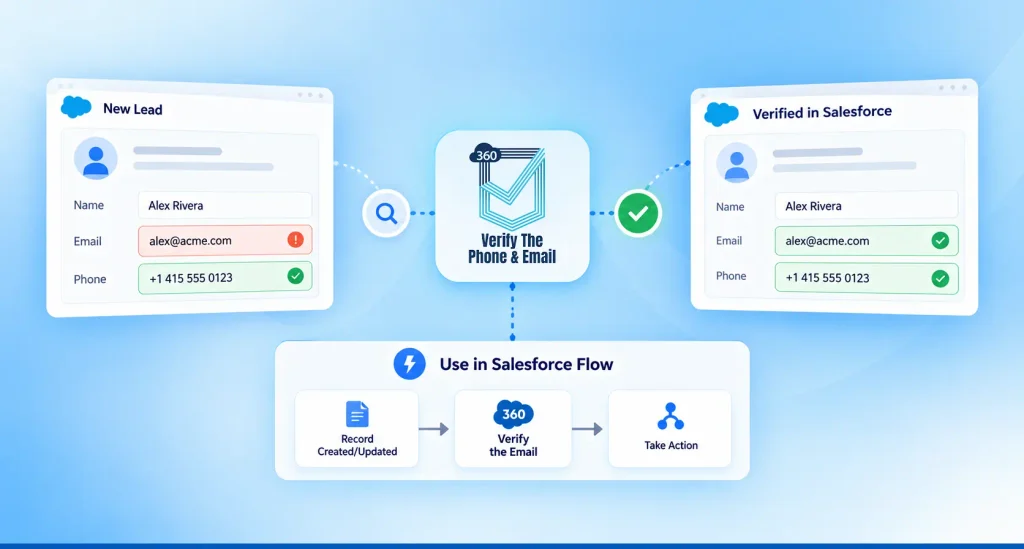
360 Verify the Email is a Salesforce-native verification application that helps teams check email addresses and phone numbers within Salesforce workflows.
Its emphasis is on identifying inaccurate contact information and making verification results available to CRM processes.
Unlike a standalone list-cleaning service, its published functionality is designed around Salesforce records, verification history, and automation.
- Real-Time Email and Phone Verification
360 documents verification when supported Salesforce records are saved.
This allows teams to check new or updated contact information instead of waiting for a periodic cleanup.
For example, when a Lead arrives through Web-to-Lead, verification can help identify an invalid email before the Lead enters subsequent sales or marketing processes.
- Bulk and Scheduled Verification
Historical CRM data also needs attention.
360’s Org-Based Plan includes bulk and scheduled verification, allowing teams to check existing records and repeat verification over time.
This is particularly useful when organizations maintain large databases containing contacts collected over several years.
- Salesforce Flow Automation
360 also supports Salesforce Flow automation under its Org-Based Plan.
Administrators can use verification results in configured processes, such as identifying records requiring review or deciding whether contacts should enter a particular campaign.
For teams exploring ways to maintain more reliable contact data, the 360 Verify the Email product page provides an overview of its Salesforce verification capabilities.
How Does Real-Time Validation Compare Between Plauti and 360?
Both Plauti and 360 offer real-time verification, but the difference lies in how users and administrators interact with the process.
- Plauti: Validation During Record Entry
Plauti offers several validation experiences.
Quick Entry helps users enter and format information correctly. Direct Validate supports automated verification in configured Salesforce operations.
Its record-level capabilities are useful when users frequently create or update contact information manually.
For example, a support representative correcting a customer’s email address may benefit from validation controls available directly in the Salesforce interface.
- 360: Verification Through Salesforce Record Workflows
360 focuses on verification within supported Salesforce record operations.
Its current documentation includes record-save validation and Web-to-Lead and Web-to-Case support.
Consider a Salesforce organization receiving hundreds of new Leads every day.
Instead of relying on users to review each email address, the team can configure verification and use its results in subsequent CRM processes.
This supports a more consistent approach to managing incoming contact information.
- Which Real-Time Validation Approach Is Better?
Plauti may be better suited to organizations prioritizing assisted data entry and record-level user experiences.
360 is a relevant option for teams prioritizing automated verification during supported Salesforce record processes.
The deciding factor is how records actually enter your CRM.
Salesforce validation rules can confirm that an email follows the correct format, but they cannot establish whether the mailbox is reachable. An email address may pass every formatting rule and still bounce. Verification adds checks beyond ordinary field validation
Which Tool Offers Better Spam-Trap and Email Risk Detection?
Spam-trap detection matters because risky email addresses can affect sender reputation and campaign performance.
However, spam traps are only one category of email risk. Disposable addresses, role-based inboxes, invalid mailboxes, and catch-all domains require different treatment.
- Plauti’s Email Risk Detection
Plauti advertises checks for invalid and risky email addresses, including spam-trap detection.
Its verification capabilities help teams assess contact information before using it in campaigns or follow-up activities.
This can be useful for marketing operations teams responsible for maintaining large mailing lists.
- 360 Verify the Email’s Spam-Trap Detection
Plauti published a comparison in March 2025 that stated 360 did not document spam-trap detection.
That description no longer reflects 360’s current published feature list.
The current 360 pricing page explicitly includes bounce, fraud, and spam-trap detection.
The important distinction is that published capability does not automatically demonstrate comparable detection accuracy.
Buyers should ask both vendors which risk categories are identified, what results are returned, and how those results can be used inside Salesforce.
- What Should Salesforce Teams Evaluate?
Rather than comparing only whether each vendor advertises spam-trap detection, evaluate the actual verification statuses.
For example, can your team distinguish between an invalid mailbox and a catch-all domain? Can risky addresses be reviewed separately from confirmed invalid records?
These distinctions matter when building campaign eligibility and contact management rules.
How Do Plauti and 360 Handle Bulk Verification and Salesforce Automation?
Real-time verification addresses newly created or updated records. But most established Salesforce organizations also have thousands of existing contacts.
A database may contain email addresses collected years ago, outdated phone numbers, and records that have never been verified.
Both vendors offer capabilities to address historical data.
- Bulk Verification for Existing Salesforce Records
Plauti supports verification jobs across existing CRM records.
360 also offers bulk verification under its Org-Based Plan.
For example, before reactivating an older marketing list, a team can run verification to identify records that require attention.
The practical evaluation should consider processing limits, audit history, error handling, and the way results appear in Salesforce.
- Scheduled Verification for Ongoing Data Quality
An email address that was valid last year may not be valid today.
Employees change employers, domains expire, and contact information becomes outdated.
Both products document scheduled or recurring verification capabilities, subject to the relevant configuration and licensing.
This allows organizations to treat data verification as recurring maintenance rather than a one-time cleanup project.
- Salesforce Flow and Verification Automation
Verification results become more valuable when Salesforce can act on them.
A common workflow might involve:
- A new Lead enters Salesforce.
- The email address is checked.
- The verification result is recorded.
- Salesforce Flow applies the appropriate business rule.
360 explicitly advertises Salesforce Flow support under its Org-Based Plan.
Plauti supports automated validation, but buyers should confirm the precise Flow actions available for their required use cases.
How Do Plauti and 360 Verify the Email Compare on Pricing?
Pricing is an important consideration, but comparing two products solely on their advertised subscription rates can be misleading.
Both licensing structure and verification volume influence the overall cost.
360 Verify the Email Pricing
360’s current pricing page lists two subscription options.
| Plan | Published Price | Primary Coverage |
| User-Based | $2/user/month | Real-time email and phone verification |
| Org-Based | $500/org/year | Bulk checks, scheduling, Flow support, and other features |
The Org-Based Plan also includes mailing address validation and additional support options.
Teams should confirm their required features, usage allowances, and commercial terms before purchasing.
Plauti Pricing Model
Plauti’s comparison content highlights unlimited user access, while its commercial model also involves licensing and verification usage considerations.
Rather than assuming a single flat cost applies to every implementation, buyers should request a quote for their actual Salesforce environment.
The number of users, verification volume, required capabilities, and contract terms should all be considered.
What Should Buyers Compare Beyond Subscription Price?
The more useful question is not which product has the lowest advertised rate.
It is which product delivers the required verification capabilities at a predictable total cost.
Consider whether your organization needs only real-time checks or also bulk verification, scheduling, automation, and ongoing administrative support.
Our Salesforce Email Verification Pricing Guide explains these cost considerations in greater detail.
When Is Plauti the Better Choice?
Plauti is a credible option for organizations whose requirements extend beyond basic contact verification.
- Broader CRM Data Quality Initiatives
If your organization is working on data standardization, record quality, and related governance requirements, Plauti’s wider ecosystem may offer advantages.
- Assisted Data Entry
Quick Entry can help employees enter and format information consistently.
This is particularly useful when manual data entry is a major part of daily Salesforce activity.
- Record-Level Verification
Plauti provides record-level verification capabilities that may suit teams frequently reviewing or updating individual Contacts.
- Existing Plauti Investments
Organizations already using Plauti products may benefit from shared vendor relationships and established administrative knowledge.
The verdict: Plauti is worth prioritizing when verification is one component of a broader Salesforce data management strategy.
When Is 360 Verify the Email the Better Choice?
360 is worth evaluating when contact verification is the immediate priority.
Salesforce-Native Verification Processes
360 documents real-time verification within supported Salesforce record operations.
This can help organizations incorporate checks into existing lead capture and contact management processes.
Bulk and Recurring Verification
Its Org-Based Plan includes bulk and scheduled verification, making it relevant for organizations maintaining sizable contact databases.
Email and Phone Verification Together
360 supports email and phone verification, allowing teams to address multiple contact accuracy requirements through one application.
Focused Verification Requirements
Not every business needs a broader data quality platform.
If your primary objective is verifying Salesforce contact information, a focused application may be sufficient.
The verdict: 360 is a strong shortlist candidate for teams emphasizing contact verification, automation, and recurring data quality checks.
What Should You Check Before Choosing a Salesforce Verification Tool?
A product feature list cannot tell you whether an application will work effectively with your Salesforce environment.
A practical evaluation should test the workflows your team actually uses.
Real-Time Record Validation
Create sample Leads through forms, manual entry, and integrations. Observe when verification occurs and how invalid or uncertain results are handled.
Bulk Processing and Verification History
Run a controlled test using existing CRM records. Review processing behavior, returned statuses, audit information, and record updates.
Salesforce Flow Compatibility
Test the exact automation your team intends to implement.
Confirm how results become available, how failures are handled, and whether additional configuration is necessary.
Security and Data Handling
Ask both vendors how verification requests are processed, what information is transmitted, and how data is protected.
A Salesforce-native application does not automatically establish that all verification processing occurs exclusively inside the Salesforce organization.
Licensing and Long-Term Support
Evaluate subscription terms, verification allowances, support arrangements, and implementation effort.
For a broader perspective, explore our 5 Best Salesforce Email and Phone Verification Tools.
You can also review the Best Salesforce Email Verification Apps on AppExchange to understand how different vendors approach Salesforce contact validation.
Final Verdict: Plauti or 360 Verify the Email?
Plauti and 360 Verify the Email both help improve Salesforce contact data quality, but they are designed around different priorities.
Plauti offers verification within a broader data quality ecosystem, making it relevant for organizations seeking assisted entry, record-level validation, and related governance capabilities.
360 Verify the Email focuses on Salesforce-native contact verification, including real-time checks, bulk processing, recurring validation, and Flow automation.
The better solution is not necessarily the one with the longest feature list.
It is the one that fits how your team creates records, manages contact information, and uses verified data across Salesforce.
For Salesforce admins and RevOps leaders, that should be the basis of the purchasing decision.


Solve It with Salesforce. We’ll Show You How.
AI. Apps. Experts. Everything you need to win with Salesforce under one roof.Frequently Asked Questions
What Is the Main Difference Between Plauti and 360 Verify the Email?
Plauti combines contact verification with broader Salesforce data quality capabilities, including assisted entry and record-level validation. 360 Verify the Email focuses on automated email and phone verification through Salesforce workflows.
Is 360 Verify the Email a Good Plauti Alternative?
Yes. 360 Verify the Email is a relevant Plauti alternative for Salesforce teams prioritizing real-time checks, bulk verification, and Flow automation. Plauti may better suit organizations needing broader data quality capabilities.
Does Plauti Support Real-Time Salesforce Verification?
Yes. Plauti provides verification through supported entry workflows, record-level functions, and automated validation processes.
Does 360 Verify the Email Offer Spam-Trap Detection?
360's current pricing page advertises spam-trap detection. Buyers should confirm the exact detection scope, returned statuses, and technical limitations.
Which Tool Is Better for Salesforce Flow Automation?
360 explicitly documents Salesforce Flow support under its Org-Based Plan. Plauti supports automated verification processes, but the available Flow actions and configuration requirements should be confirmed for the intended use case.

About the author
Editorial TeamThe Editorial Team at 360 Degree Cloud brings together seasoned marketers, Salesforce specialists, and technology writers who are passionate about simplifying complex ideas into meaningful insights. With deep expertise in Salesforce solutions, B2B SaaS, and digital transformation, the team curates thought leadership content, industry trends, and practical guides that help businesses navigate growth with clarity and confidence. Every piece we publish reflects our commitment to delivering value, fostering innovation, and connecting readers with the evolving Salesforce ecosystem.
Recent Blogs
 360 Verify The Phone
7 Phone Validation Tools That Integrate With Salesforce Workflows
Summary Most phone validators don’t actually integrate with Salesforce workflows. They bolt on. This guide compares 7 tools on the criteria Salesforce admins and ops…
Read More 360 Verify The Mail
Salesforce Data Validation Rules vs Automated Data Validation Tools: What’s the Difference?
Here’s an uncomfortable truth most Salesforce teams don’t want to sit with: your CRM can be technically clean and practically useless at the same time. …
Read More 360 Verify The Mail
Salesforce AI Readiness Checklist: Is Your CRM Data Ready for AI Agents?
Most Salesforce teams approach AI deployment as a technology question. Which model? Which configuration? Which use case to start with? That’s understandable. But the teams…
Read MoreReady to Make the Most Out of Your Salesforce Instance?
Our Salesforce aces would be happy to help you. Just drop us a line at contact@360degreecloud.com, and we’ll take it from there!
Subscribe to our newsletter
Stay ahead with expert insights, industry trends, and exclusive resources—delivered straight to your inbox.