

Agentforce Data Quality: Why AI Agents Fail on Bad Contact Data

360 Degree Cloud
17 Nov 2026
Table of Contents

Summary
Agentforce data quality is the single most overlooked prerequisite for any AI deployment on Salesforce. Agentforce does not fix your data — it acts on whatever your CRM already holds. If your org has invalid emails, dead phone numbers, or undeliverable addresses, every AI agent you switch on will make decisions based on that garbage. The only way to get real value from Agentforce is to verify contact data before the agents touch it.
AI agents can automate outreach, follow-ups, and customer service in Salesforce. But when CRM records contain invalid emails, disconnected phone numbers, or outdated addresses, automation can quickly turn into costly mistakes.
That’s why Agentforce data quality is essential for reliable AI-driven workflows. In this blog, we’ll explore how poor contact data impacts Agentforce performance and how a strong CRM data cleansing strategy helps ensure AI agents act on accurate, verified information.
Table of Contents
Why Data Quality Is the Real Agentforce Prerequisite
Agentforce data quality determines whether your AI agents deliver results or silently scale mistakes across your entire CRM.
Everyone is asking the same question: Is my Salesforce org ready for Agentforce?
Most answers focus on licenses, permissions, and agent templates. What they often overlook is the foundation every AI agent depends on: the data already sitting in your CRM.
Agentforce agents retrieve records, read field values, and trigger actions based on available information. An SDR agent sending outreach relies on the email address stored against a Lead. A service agent initiating a callback depends on the phone number saved against a Contact. A routing agent assigning territories needs accurate address information.
Without proper verification, agents can act on inaccurate data without recognizing the problem.
That is exactly what makes AI agents and bad CRM data such a costly combination. Before deploying agents, businesses need to understand how Salesforce AI readiness starts with CRM data quality and why contact verification must be part of the deployment plan.
Ready to verify before Agentforce acts?
Set 360 VTM/VTP up once and verification runs automatically on every record your agents will touch.
See How It WorksWhat Goes Wrong When Agents Hit Bad Data
Picture three scenarios playing out right now inside Salesforce orgs running Agentforce pilots.
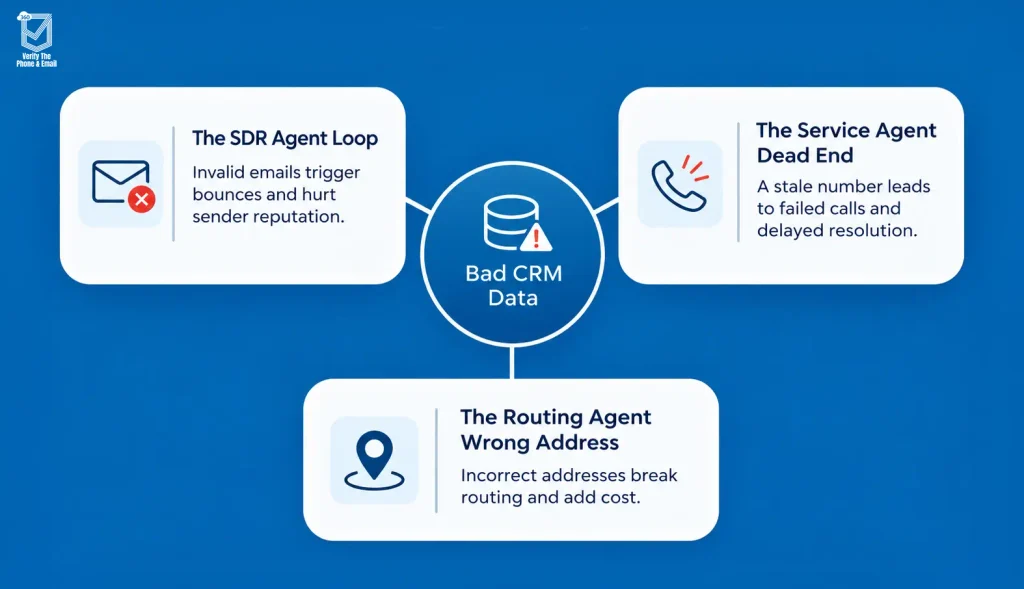
The SDR Agent Loop
An automated SDR agent picks up a batch of 500 leads from a web form campaign and begins outreach. Forty percent of the email addresses are undeliverable — disposable inboxes, typos, role-based addresses that never reach a decision-maker. The agent sends to all 500 anyway. Bounce rates spike. The sending domain takes a reputation hit. Future campaigns land in spam, including the ones going to real contacts. The agent did exactly what it was asked to do. The data told it to.
The Service Agent Dead End
A Salesforce service agent is configured to call customers when a case is raised. It dials a phone number on the Contact record. The number is a disconnected landline — the contact updated their number three years ago and no one cleaned the record. The agent retries. No answer. The case sits open. The customer, who submitted via chat on their mobile, waits. The agent never had the mobile number because no one validated what number type was stored.
The Routing Agent Wrong Address
A field service routing agent uses address data to assign jobs geographically. Two percent of addresses on Contact records are non-deliverable or contain formatting errors. Those jobs get assigned to the wrong territory or fail to route at all. Small percentage, significant operational cost.
None of these failures are Agentforce bugs. They are agentforce data quality failures that AI makes visible at scale.
Did You Know? Gartner published a prediction in February 2025 stating that through 2026, organizations will abandon 60% of AI projects that are not supported by AI-ready data. AI amplifies whatever your data already is, clean or broken.
The Numbers That Should Concern Every Salesforce Architect
Gartner’s February 2025 prediction states that through 2026, organizations will abandon 60% of AI projects unsupported by AI-ready data. This is not a warning about future technology gaps. It is a warning about CRM hygiene that organizations have been deferring for years.
When AI agents are doing the work, AI agents and bad CRM data do not slow things down. They scale mistakes.
There is also a deliverability dimension worth naming directly. 89% of sales leaders say the lack of record validation erodes all CRM-led initiatives. When an Agentforce deployment lands in an org where email and phone fields have never been systematically verified, every agent action — every email sent, every call attempted, every record routed — is running on assumptions that the data has not earned.
Understanding which Salesforce data quality tools are built to run natively inside the platform is the first practical step toward closing that gap.
Clean Once Is Not Enough
Here is the mindset shift that most Agentforce readiness conversations miss.
A one-time CRM data cleansing project before go-live is not the answer. It is a starting point. The problem is that new records enter your Salesforce org every day — through web forms, manual entry, integrations, imports, and partner feeds. Each new record is a potential data quality failure that your agents will eventually encounter.
The only architecture that actually protects Agentforce performance is verification at the point of entry, not a cleanup project that ages the moment it finishes. Clean data for Agentforce is not a one-time event. It is an ongoing system.
This means three things in practice.
Verify at entry. When a lead is created from a Web-to-Lead form, validate the email address and phone number before the record is saved to Salesforce. Stop bad data at the door rather than cleaning it up downstream.
Verify on update. When a contact’s email or phone is edited — by a rep, by an integration, or by a third-party enrichment tool — trigger re-verification automatically. Field values change. Yesterday’s valid email is not guaranteed to be valid today.
Verify on a schedule. Run bulk re-verification at regular intervals to catch records that have drifted out of validity since they were last checked. Phone numbers disconnect. Email addresses lapse. Data decays faster than most admins realize.
How to Verify Contact Data for Agent Workflows
This is the practical question that the search data confirms people are actively looking for: “We are building an Agentforce workflow and need to validate customer email and phone.” Here is exactly how 360 VTM/VTP handles that inside Salesforce and why clean data for Agentforce workflows starts here.
Real-Time Verification on Forms
360 VTM/VTP validates email and phone fields the moment a Contact or Lead record is created or updated. For Web-to-Lead and Web-to-Case forms, this means a contact entering an invalid email at the form level is caught before the record ever lands in Salesforce. No manual review required. The record either passes validation or the entry is flagged before it reaches any downstream process, including an Agentforce agent. If you have ever wondered whether you can test an email address without sending an email, that is exactly what real-time verification does at the form layer.
Flow-Based Verification Before Agent Actions
VTM/VTP exposes a global invocable Apex action that can be called inside any Salesforce Flow. This is the key capability for agentforce data quality management at the workflow level. You can build a record-triggered Flow that fires verification logic before an agent action runs, effectively putting a data quality gate in the automation chain. The Flow creates the action element, passes the email or phone field as the input parameter, receives the verification status back, and then conditionally proceeds or stops the agent action based on that result.
It is also worth understanding where Salesforce validation rules differ from automated data validation tools validation rules check format; automated verification checks whether the email or phone actually exists and is reachable.
For address verification, the same Flow-based pattern applies. The VTA module supports record-triggered Flows that call an invocable Apex action to verify and classify addresses by deliverability status before any routing or assignment logic runs.
Bulk Verification for Existing Records
Before enabling Agentforce on existing data, run bulk verification across your Lead and Contact objects using the mass verify feature. Select the records in list view, trigger batch verification, and let VTM/VTP classify every email and phone field at scale. The verification history object captures every result — carrier, number type (mobile, landline, VoIP), and deliverability status — giving you a full audit trail to review before go-live. For a comparison of phone validation tools that integrate with Salesforce workflows, that post covers what to look for when evaluating options.
Is your Agentforce deployment sitting on unverified data?
Most orgs discover unverified CRM data only after campaigns bounce or workflows fail.
Talk to an ExpertFive Contact Data Checks Before You Switch on an Agent
Before activating any Agentforce agent that touches Contact or Lead records, run through this checklist.
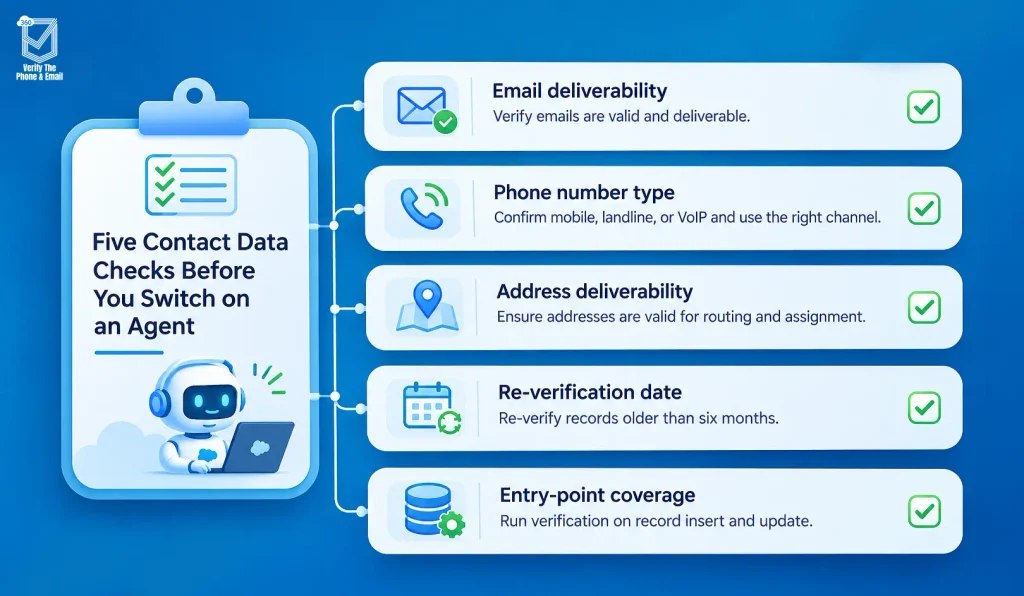
- Email deliverability status. Are email fields on target records verified as deliverable? Have disposable addresses, role-based inboxes, and syntactically invalid entries been flagged or removed?
- Phone number type. Do you know whether stored phone numbers are mobile, landline, or VoIP? An SMS agent needs a mobile number. A voice agent needs an active line. Line type identification matters far more than most orgs realize the phone validation tools post goes deep on why this distinction is critical inside Salesforce workflows.
- Address deliverability. For any agent that uses address data for routing or assignment, are addresses classified as deliverable? Non-deliverable addresses break geographic logic.
- Re-verification date. When were these records last verified? Data from more than six months ago should be re-verified before an agent acts on it.
- Entry-point coverage. Is verification running on record insert and update for all objects your agents will access? A clean batch today does not stay clean if new records enter without validation.
For the full org-level readiness assessment beyond contact data, see the Salesforce AI Readiness Checklist. This post focuses specifically on agentforce data quality inside agent workflows.
The Bottom Line
Agentforce data quality is not a configuration problem. It is a data infrastructure problem that shows up inside every agent workflow you build.
No amount of prompt engineering, agent configuration, or license investment changes the fact that an AI agent calling a dead number, emailing an undeliverable address, or routing on a bad address will fail — and fail at the speed of automation.
The fix is not complex. Verify at entry. Re-verify on update. Run bulk verification on your existing records before go-live. Use Salesforce Flows to put a verification gate inside your agent workflows. These are not big-bang infrastructure changes. They are hygiene decisions that protect every AI investment your org makes from this point forward.
Agentforce readiness starts in your CRM data. Not in your agent builder.


Solve It with Salesforce. We’ll Show You How.
AI. Apps. Experts. Everything you need to win with Salesforce under one roof.Frequently Asked Questions
Does Agentforce clean my data?
No. Agentforce reads and acts on data that already exists in your Salesforce CRM. It does not validate, correct, or flag bad contact records. If a phone number is invalid or an email is undeliverable, Agentforce will still attempt to use it. Data cleaning and verification are prerequisites to Agentforce deployment, not outputs from it. The CRM data cleansing guide walks through how to approach this systematically before go-live.
How do I know if my Salesforce org is ready for Agentforce?
Start with your contact data. Check whether email fields have been verified for deliverability, whether phone fields carry valid, reachable numbers, and whether address data is accurate. Beyond contact data, the Salesforce AI Readiness Checklist covers the broader technical and architectural factors. Agentforce data quality at the contact level is usually the fastest gap to find and the most direct to fix.
Can I verify emails and phones inside a Salesforce Flow before an agent acts?
Yes. 360 VTM/VTP exposes a global invocable Apex action that works inside record-triggered Flows. You can place a verification step in the Flow before any agent action fires, check the resulting verification status, and use that status to conditionally allow or block the downstream action. The same capability is available for address verification through the VTA module. This runs entirely within Salesforce with no external middleware required. For context on how this differs from native Salesforce options, see validation rules vs. automated data validation tools.
About the author
Editorial TeamThe Editorial Team at 360 Degree Cloud brings together seasoned marketers, Salesforce specialists, and technology writers who are passionate about simplifying complex ideas into meaningful insights. With deep expertise in Salesforce solutions, B2B SaaS, and digital transformation, the team curates thought leadership content, industry trends, and practical guides that help businesses navigate growth with clarity and confidence. Every piece we publish reflects our commitment to delivering value, fostering innovation, and connecting readers with the evolving Salesforce ecosystem.
Recent Blogs
 360 Verify The Mail
Verify a Prospect’s Phone Number Before You Call
Bad phone data quietly kills sales campaigns before a single rep picks up the phone. This blog walks through seven checks every sales team should…
Read More 360 Verify The Mail
Best Salesforce Data Quality Tools 2026
Picking the right Salesforce data quality tools isn’t a one-time decision. This guide breaks down six tools that tackle verification, deduplication, and ongoing data hygiene…
Read More 360 Verify The Mail
CRM Data Cleansing: Steps, Tools and How to Automate It
Your Salesforce org looks fine at the record level. Contacts are there. Fields are filled in. Reports run. But somewhere between 20 and 30% of…
Read MoreReady to Make the Most Out of Your Salesforce Instance?
Our Salesforce aces would be happy to help you. Just drop us a line at contact@360degreecloud.com, and we’ll take it from there!
Subscribe to our newsletter
Stay ahead with expert insights, industry trends, and exclusive resources—delivered straight to your inbox.