

5 Best Salesforce Email & Phone Verification Tools Compared (2026)
13 Aug 2026
Table of Contents
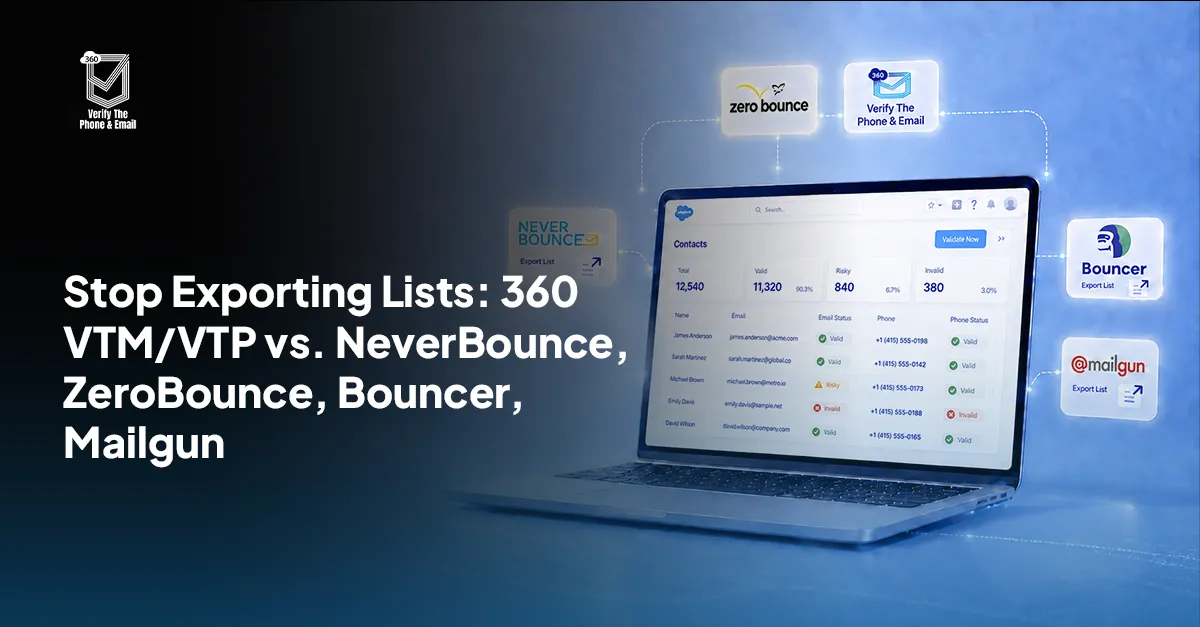
Bad contact data costs more than a bounced email. It costs a rep a call that never connects, a campaign that lands in spam, and a RevOps team a Sunday spent scrubbing lists before Monday’s send. Most verification tools were not built with any of that in mind. They were built to clean a CSV, not to live inside a Salesforce record.
That distinction matters more than it sounds. A generic verification tool checks an email address and hands you a status code. What happens next, exporting the results, matching them back to leads, updating fields, logging who touched what, is on you. For a Salesforce team running campaigns, routing leads, or scoring records for sales, that gap adds hours to every cleanup cycle and opens the door to sync errors nobody catches until a rep calls a disconnected number.
Want to stop invalid emails before they enter Salesforce?

Table of Contents
Quick Comparison: Salesforce Verification Tools at a Glance
Below, we compare five of the most-searched Salesforce email and phone verification options in 2026: 360 VTM/VTP, NeverBounce, ZeroBounce, Bouncer, and Mailgun. Pricing and features are pulled from each vendor’s current published information as of mid-2026, and we will flag anywhere pricing depends on volume or requires a quote.
| Tool | Salesforce-Native | Real-Time & Bulk | Phone Verification | Starting Price | Standout Feature |
| 360 VTM/VTP | Yes | Yes, both | Yes | $1/user/month (small-mid teams) or $350/org/year (enterprise) | Email + phone verification built directly into Salesforce records |
| NeverBounce | No (API/connector) | Yes, both | No | $0.008/email; $24/mo entry plan | Deep integration library, ZoomInfo data backing |
| ZeroBounce | No (API/connector) | Yes, both | No | $18/mo (2,000 credits) | AI email scoring plus activity data, SOC 2 Type II certified |
| Bouncer | No (Zapier required for CRM sync) | Yes, both | No | $0.002–$0.008/email; $50/mo entry | Non-expiring credits, EU data residency for GDPR |
| Mailgun Validate | No | Bulk-focused | No | $1.10/1,000 validations | Validation bundled with transactional email sending infrastructure |
A pattern shows up fast here. Four of the five tools on this list do not verify phone numbers at all, and none of them run natively inside Salesforce without middleware, exports, or a connector layer. That is not a knock on any of them. They were built as email infrastructure tools first. It just means Salesforce teams end up doing extra work to make the data usable where it actually lives: the CRM record.
1. 360 Verify the Email (360 VTM/VTP)
What it does: 360 VTM/VTP verifies email addresses and phone numbers directly on Salesforce records, without exporting a list, running it through a third-party dashboard, and re-importing results. Verification happens where your data already lives.
Salesforce-native: Yes. It is built as a Salesforce application, not bolted on through an external API wrapper.
Pricing: 360 VTM/VTP runs on two published plans. The User-Based Plan starts at $1 per user per month, built for small to mid-sized teams that want Salesforce-native verification with real-time email and phone validation and zero data exposure. The Org-Based Plan starts at $350 per org per year, aimed at larger teams or enterprise setups that need bulk and scheduled verification with dedicated support. A free trial is available with no credit card required.
Best for: RevOps, marketing operations, and admin teams who need email and phone verification to run inside existing Salesforce workflows, campaigns, and automation, rather than as a separate system to maintain.
Honest limitation: Because verification runs inside Salesforce, teams without an existing Salesforce environment will not get value from it. This is a Salesforce-first tool, not a general-purpose verification API for outside platforms.
How it actually works in practice: a marketing ops admin schedules bulk verification ahead of a quarterly campaign, catching invalid emails and disconnected numbers before the send goes out. A sales rep gets real-time verification the moment a lead form submits, so a bad number never makes it into a call queue. Both verification types, email and phone, run from the same tool, on the same records, without a second system in the loop.
2. NeverBounce
What it does: NeverBounce verifies and cleans email lists to improve deliverability and reduce bounce rates. It is owned by ZoomInfo and sits in the mid-to-upper tier of legacy verification vendors, known for speed, mature APIs, and a broad integration footprint.
Salesforce-native: No. NeverBounce connects to Salesforce through an integration users rate as critical to their workflow, but the tool itself lives outside the CRM. Verification happens in NeverBounce’s system, and results sync back.
Pricing: Pay-as-you-go starts around $0.008 per email with volume-based discounts, and a monthly plan starts at $24 for up to 1,000 verifications.
Best for: Teams already using ZoomInfo data who want verification that plugs into a wide range of marketing platforms beyond just Salesforce.
Honest limitation: No phone verification. It only checks whether emails you already have are deliverable, it does not find new ones, and among competing verifiers it tends to be the most expensive option at almost every pricing tier.
Still deciding between NeverBounce and a Salesforce-native tool?

3. ZeroBounce
What it does: ZeroBounce validates email lists and adds a layer of scoring and activity data on top of basic deliverability checks. Its core feature is bulk email verification, validating lists before sending campaigns to reduce bounce rates and protect sender reputation.
Salesforce-native: No. ZeroBounce integrates directly with Salesforce and other platforms through a connector, not as a native Salesforce build.
Pricing: Monthly subscriptions start around $18 per month, with 100 free credits included monthly, and pay-as-you-go pricing sells credits upfront that never expire.
Best for: Teams that want more than pass/fail verification. ZeroBounce offers an “Email Score” feature that rates addresses beyond a simple valid or invalid flag, useful for prioritizing which leads to chase first.
Honest limitation: No phone verification, and at typical volumes it runs pricier than several competitors. One recent comparison put its effective rate at $7 to $8 per 1,000 verifications at typical volumes, more than double what comparable tools charge.
4. Bouncer
Bouncer positions itself around non-expiring credits and EU data residency, making it a common pick for GDPR-conscious teams that verify in occasional batches rather than continuously.
What it does: Verifies email lists in bulk or in real time through an API, flagging invalid, risky, and role-based addresses before a send. Built with a strong focus on data privacy and EU-based processing.
Salesforce-native: No. Bouncer has no native Salesforce package. Syncing verified results back into Salesforce records requires Zapier or a custom API connection, adding a middleware step the native tools on this list skip.
Pricing: Pay-as-you-go pricing runs roughly $0.002 to $0.008 per email depending on volume, with credits that do not expire. A monthly plan starts around $50 for 10,000 verifications.
Best for: Teams with GDPR obligations or EU data residency requirements who verify lists periodically rather than needing verification embedded directly in Salesforce workflows.
Honest limitation: No phone verification, and no direct Salesforce integration. Every sync into Salesforce depends on Zapier or a custom build, which is one more thing to maintain and one more point of failure.
5. Mailgun
What it does: Mailgun is primarily an email sending and API infrastructure platform. Validation is a feature bundled into its broader product, not a standalone offering. Built-in email validation is available on paid plans, letting teams validate addresses before sending to protect sender reputation.
Salesforce-native: No. Mailgun is developer-facing infrastructure, and its verification feature works well for teams already using the platform to send emails through APIs, but is built more for developers than marketers.
Pricing: Per-unit validation pricing runs around $1.10 per 1,000 emails, and validation is typically bundled into paid sending tiers starting at $35/month rather than sold as its own product.
Best for: Teams already on Mailgun for transactional email who want basic validation without adding another vendor.
Honest limitation: The verification feature is not as deep or specialized as dedicated tools, and teams whose main goal is email list cleaning may find it limited. No phone verification, and no meaningful Salesforce integration beyond generic API access.
NeverBounce Alternative for Salesforce Teams
Search “NeverBounce alternative” and you will mostly find other standalone verification vendors making the same pitch: cheaper per credit, similar accuracy, another dashboard to log into. That solves the price problem. It does not solve the workflow problem.
NeverBounce’s real strength is its integration count. Dozens of platforms, Salesforce included. But integration is not the same as native. Every NeverBounce cycle still means exporting, verifying externally, and syncing results back into Salesforce, which is exactly the extra step 360 VTM/VTP was built to remove. If the reason you are shopping for a NeverBounce alternative is Salesforce fit specifically, and not just price, a Salesforce-native tool solves a different problem than a cheaper external one does.
ZeroBounce Alternative for Salesforce Teams
ZeroBounce’s activity data and scoring are genuinely useful features. But they live in a separate system from your Salesforce records, and none of it covers phone numbers. For teams whose bad-data problem includes disconnected numbers as much as bounced emails, an email-only tool only solves half the issue no matter how good its scoring engine is.
A Salesforce-native alternative closes that gap by keeping both verification types (and the resulting record updates) inside the same environment your team already works in daily.
Which Tool Should You Choose?
The right pick depends less on brand recognition and more on where your data actually lives, and what you are trying to fix.
- Small teams verifying occasional lists before a send: A pay-as-you-go tool like Bouncer or NeverBounce, used through an export/import cycle, is probably enough. The volume does not justify a native build.
- Marketing teams sending high-volume campaigns across multiple platforms, not just Salesforce: ZeroBounce’s scoring and broader integration library earn their keep here.
- Salesforce-first teams, RevOps, admins, and sales operations who need verification tied to CRM records, automation, and reporting: This is where 360 VTM/VTP fits. Verification, re-verification scheduling, and reporting happen without a second tool in the stack.
- Teams already sending transactional email through Mailgun: Mailgun Validate is a reasonable bundled add-on, though it was not built to be a standalone verification product and shows it.
Team size matters less than most comparison posts suggest. What matters is whether verification needs to plug into a broader marketing stack (ZeroBounce, NeverBounce) or needs to live inside Salesforce itself, tied to records, campaigns, and automation your team already runs (360 VTM/VTP).
Conclusion
Every tool on this list will catch a bad email address. The real question is where that catch happens, and how much work it takes to act on it. NeverBounce, ZeroBounce, Bouncer, and Mailgun all clean data in a separate system, then hand results back to Salesforce through an export, an API call, or a connector someone has to maintain. None of them touch phone numbers at all.
360 VTM/VTP verifies email and phone directly on the Salesforce record, in real time as leads come in and on a schedule for existing data, with no second system to manage. For teams whose bad-data problem starts and ends inside Salesforce, that is the difference that actually saves time, not just credits per email.


Solve It with Salesforce. We’ll Show You How.
AI. Apps. Experts. Everything you need to win with Salesforce under one roof.Frequently Asked Questions
What is the difference between Salesforce-native and third-party email verification?
A Salesforce-native tool runs verification inside your Salesforce org, directly against lead, contact, and account records. A third-party tool verifies data in its own system, and you have to export, verify, and re-import to get results back into Salesforce.
Do any of these tools verify phone numbers, not just email?
Of the five compared here, only 360 VTM/VTP handles phone verification alongside email. NeverBounce, ZeroBounce, Bouncer, and Mailgun are email-only.
Is NeverBounce or ZeroBounce better for Salesforce teams?
Honestly, it depends on what you're optimizing for. NeverBounce has a longer integration list and ZoomInfo-backed data. ZeroBounce adds scoring and activity data most competitors skip. Neither is Salesforce-native, so both require a sync step either way.
How much does Salesforce email verification typically cost?
Third-party tools price by volume, usually somewhere between $0.002 and $0.008 per email depending on the vendor and tier. 360 VTM/VTP prices differently: $1 per user per month for smaller teams, or $350 per org per year for larger teams that need bulk and scheduled verification. That user- or org-based structure tends to work out cheaper than per-email credits once a team is verifying consistently, rather than in occasional bursts.
Can I verify emails in real time as leads submit a form?
Yes, most tools on this list, including 360 VTM/VTP, NeverBounce, ZeroBounce, and Bouncer, support real-time verification at the point of capture, not just bulk list cleaning after the fact.
What is bulk verification used for, versus real-time?
Bulk verification cleans an existing list all at once, usually before a scheduled send or campaign. Real-time verification checks a single email or phone number the moment it enters your system, like a form submission. Most teams need both.
Does automated re-verification matter for a Salesforce org?
It matters more than teams expect. Contact data decays over time. People change jobs, disconnect numbers, and abandon inboxes. Scheduled re-verification catches that drift before it shows up as a bounced campaign or a wasted call.
Are there compliance considerations with email and phone verification?
Yes. Depending on your industry and region, verification and outreach may fall under GDPR, TCPA, or CAN-SPAM requirements. Bouncer, for instance, is built with EU data residency in mind for GDPR-focused teams. Always confirm compliance requirements with your legal or compliance team before automating outreach based on verification results.
Do these tools work for both marketing and sales use cases?
Generally, yes, but the fit differs. NeverBounce and ZeroBounce lean toward marketing list hygiene. A Salesforce-native tool like 360 VTM/VTP tends to serve both marketing campaign verification and sales-side lead and call data cleanup, since it runs across the same record types either team touches.
What happens if I skip verification altogether?
Bounce rates climb, sender reputation drops, and reps waste time on dead numbers. It is not a hypothetical cost. It shows up directly in deliverability metrics and pipeline efficiency within a quarter or two.

About the author
Editorial TeamThe Editorial Team at 360 Degree Cloud brings together seasoned marketers, Salesforce specialists, and technology writers who are passionate about simplifying complex ideas into meaningful insights. With deep expertise in Salesforce solutions, B2B SaaS, and digital transformation, the team curates thought leadership content, industry trends, and practical guides that help businesses navigate growth with clarity and confidence. Every piece we publish reflects our commitment to delivering value, fostering innovation, and connecting readers with the evolving Salesforce ecosystem.
Recent Blogs
 360 Verify The Phone
7 Phone Validation Tools That Integrate With Salesforce Workflows
Summary Most phone validators don’t actually integrate with Salesforce workflows. They bolt on. This guide compares 7 tools on the criteria Salesforce admins and ops…
Read More 360 Verify The Mail
Plauti Verify vs 360 Verify the Email: Which Fits Your Salesforce Team?
Summary Plauti Verify offers broader Salesforce data quality capabilities, including assisted data entry and record-level validation. 360 Verify the Email focuses on real-time email and…
Read More 360 Verify The Mail
Salesforce Data Validation Rules vs Automated Data Validation Tools: What’s the Difference?
Here’s an uncomfortable truth most Salesforce teams don’t want to sit with: your CRM can be technically clean and practically useless at the same time. …
Read MoreReady to Make the Most Out of Your Salesforce Instance?
Our Salesforce aces would be happy to help you. Just drop us a line at contact@360degreecloud.com, and we’ll take it from there!
Subscribe to our newsletter
Stay ahead with expert insights, industry trends, and exclusive resources—delivered straight to your inbox.