

Talk to Us

New Marketing Cloud Features to Access the Power of Personalization

Over the past few years, personalization has become very critical for a brand’s digital strategy. No brand could ever succeed if it fails to meet the expectations of customers. Considering this, Salesforce has brought some new Marketing Cloud features that would give your brand the power of personalization.

According to the report of State of the Connected Customer, 73% of customers these days look for companies that could understand their unique expectations and needs.

As the competition becomes more intense, marketers have to keep working with strategies that could connect with customers. The good news here is that marketers these days have more data and better technology that could be used to create better experiences.

Marketing Cloud Features for Personalization

To make your marketing effort more productive, Salesforce has come up with new features in the latest Marketing Cloud release that will help you personalize your marketing strategy. 

Let’s have a look at these features. 

1. What-if Analyze for Einstein Engagement Frequency

There are chances that we don’t know if our customers are feeling fatigued due to so many emails and messages. That’s where the new ‘What-if’ analyzer for Einstein Engagement Frequency will help to predict the engagement for your next email. 

The feature will help you to:

  • Identify the number of emails you should send for a campaign
  • Minimize email fatigue at customers’ end
  • Understand how your messages are affecting engagement over time

2. Customer Data Platform

With the new release, you can now use richer customer information and use their preferred channels to reach customers with the help of Marketing Cloud’s Customer Data Platform (CDP) updates. 

You achieve better personalization with the CDP updates by:

  • Easily augmenting the variety and volume of data for sharing it with Marketing Cloud engagement systems
  • Seamlessly connecting data between marketing and non-marketing systems
  • Driving personalized mobile messages by activating data from the Customer Data Platform to Mobile Push contact points

3. Database Exports

Customers these days are using enterprise database software to maintain data. This is because marketing data is relatively siloed and complicated, so teams have to make it more accessible throughout the company. 

That’s where Database Exports can help as it can:

  • Automate the export of clean data from the marketing team into your organization’s database
  • Easily make marketing data available to other departments
  • Back up the data with an audit-proof system of all enterprise data

4. Triggered Campaign Messages

You can combine the personalization of the Marketing Cloud with the outbound communication engine of Journey Builder with Triggered Campaign Messages. 

This feature can help you reengage customers on their preferred channel.  You can use the feature to:

  • Trigger a mobile message, email, push notification, or the next offer based on the customer’s behavior
  • Track the time an individual spends on your website
  • Utilize powerful artificial intelligence and real-time segmentation to deliver relevant experiences that can successfully inspire customers to take action as a response to the campaign. 

Enable These New Marketing Cloud Features in your Company

Leveraging these new Marketing Cloud features can change the game for marketers, helping to create more personalized campaigns that could bring in better results. 

Make sure you hire a trusted Marketing Cloud developer who can explain all these features and other updates well and implement the same to level up your marketing game.  

Get An Edge for your Insurance Agency with Predictive Analytics

Yes, you can look into the future to build strategies for your insurance agency. And you don’t need a crystal ball for that. Predictive analytics would make it all easier for you. 

Almost everyone in the insurance world is talking about predictive analytics. But what is it actually? 

Predictive analytics helps pick up scattered pieces of data from across your systems and help you assess everything that has happened in the past. Then, it uses technologies like using artificial intelligence (AI) and advanced visualization to analyze this data and model future outcomes while enabling personalization for customers, providing the team guidance to create actionable insights.

How Predictive Analytics Helps Insurance Agency

This insurance technology trend has proven to be amazing to help insurers and brokers grow faster by simplifying processes and providing a complete view of data. 

We have listed some ways this technology can help insurance agencies.

1. Simplify your workflows

It is difficult for many brokers to figure out how to find the most promising leads and focus on them. Such teams commonly struggle with managing their work and dealing with repetitive, manual tasks that take up a lot of their time. 

That’s where predictive analytics can save you. It can help deliver answers that are grounded in facts. It supports dashboards to guide the actions a broker will take throughout their day. 

It helps to identify potential bottlenecks, giving brokers a heads up before trouble erupts so it can be timely solved.

2. Fill in coverage gaps

Having the ability to predict would allow you to leverage the power of data and insights at your firm. You can use analytics to pinpoint upsell and cross-sell opportunities.

It allows you to track team performance insight to ensure all accounts are given an optimal support level. This helps companies to follow an informed approach to help clients get the best insurance protection for their business while reducing the risk of coverage gaps.

3. Get a 360-degree action plan

Insurers can get a 360-degree view of customers which helps to improve the experience. All this data will give agents insight into human behavior, giving them an understanding of how they make choices. 

Predictive analytics enables insurers to spot trends and have a better sense of outcomes, making future planning easier. All these insights give agents the power to act and plan intelligently.

Leverage Predictive Analytics for your Insurance Company

You can easily get this power of prediction with Financial Services Cloud which helps to gather all the information you need about clients in one place. With the help of CRM Analytics, you can assess the data, apply artificial intelligence, and determine the next best steps to grow your insurance company. 

Apart from this, Salesforce has a lot to offer financial services. Reach out to our certified Salesforce professionals to uncover more features for your insurance agency.

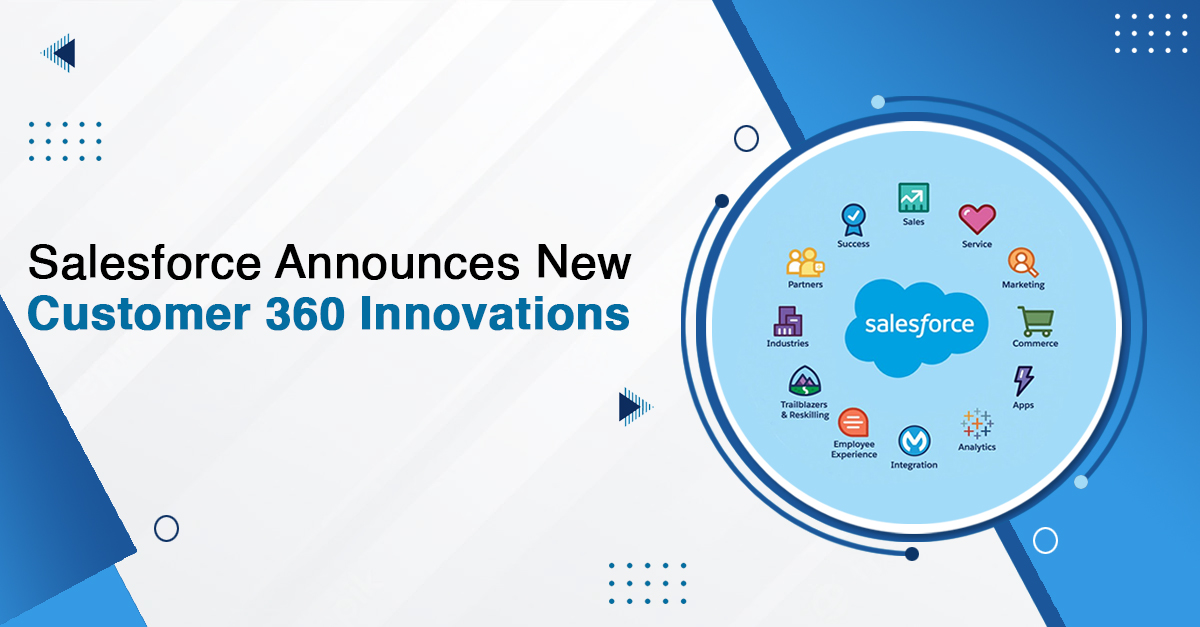
Salesforce Customer 360 Innovations In Commerce Cloud and Marketing Cloud

Salesforce recently introduced new Customer 360 innovations that help to connect, commerce, marketing, and service data on one platform so companies can personalize every single interaction using insights from different departments. 

Companies these days face mounting pressure to do more with less, all while striving to meet the rising consumer expectations. Ongoing changes in data privacy laws make it difficult to meet those expectations, and we can expect a cookie-less future to be fast-approaching. 

This is where it is important to implement the next-gen Marketing and Commerce Clouds to give organizations new ways to deliver unique, connected and personalized experiences.

Customer 360 Innovations Across Marketing Cloud

Marketing Cloud makes it easy to humanize every interaction, making marketers more efficient. Let’s have a look at some of the recent innovations:

1. Triggered Campaign Messages

The feature helps bring together Marketing Cloud Personalization and Engagement to deliver personalized, 1:1 customer engagement based on behavioral triggers new product catalog. Organizations can utilize data to understand preferred products by customers and engage with them when they are back in stock or on any active sale.

2. Intelligence Connector for B2C Commerce Cloud

This connector helps to combine orders and product data to gain insights into revenue, product, and sales performance over time. 

Businesses using Marketing Cloud can now automate data integration and understand where to spend to achieve an increase in ROI across campaigns, channels, and products. For example, marketers will be able to see the number of orders placed during a promotion, or the top three products ordered from different demographics in real-time.

3. Salesforce Customer Data Platform and Google Ads

Brands can automatically connect their data from different departments in a unified customer profile. It will help them to plan efficiently plan and optimize their Google Ads campaigns. 

With this capability, marketers can deliver personalized campaigns using the first-party data they have instead of cookies. Also, in the near future, marketers can incorporate segment-level insights into the interface of the Customer Data Platform.

4. Intelligence Ecommerce Marketing Insights 

This is the app that unifies a company’s commerce and marketing data. It enables marketers to access it all on a single platform, using actionable insights to generate interactive dashboards.

Customer 360 Innovations Across Commerce Cloud

Here are some new features with which Commerce Cloud will bring a new approach to digital commerce:

1. NFT Cloud

Salesforce’s NFT Cloud, which is now in the pilot, can help businesses expand customer experiences to Web3 environments in a trusted and sustainable manner. 

It can help you manage and sell non-fungible tokens (NFTs) directly on the Salesforce Customer 360 Platform and connect customer data securely to gain a 360-degree view.

2. Social Integration for Commerce Cloud

With the help of Social Integration, businesses can create and automate product feeds, publish ads, and segment audiences while finding and targeting new audiences. They can even create TikTok ads that will redirect to their commerce websites.

3. Commerce for Customer Service

Commerce Cloud will have new capabilities that give agents a complete view of order history across channels through which service departments can transform into revenue drivers.

The feature will give them the ability to issue exchanges, returns, promotions, or complete orders, without the need of transferring them to other departments. 

4. Commerce Marketplace

Businesses can create, manage, and scale a marketplace solution quickly on Commerce Cloud. It enables them to extend their catalog range with products from other companies and reach new buyers and channels. This can help brands drive new revenue streams, leading to an increase in cart sizes and membership subscription fees from vendors.

Get Access to These New Customer 360 Innovations with Certified Experts

All these enhancements could take your productivity and work efficiency to a great level. But make sure you get expert guidance on what features would be right for you. 

Hiring Salesforce consultants would simplify your way to plan and work through these new Customer 360 innovations and maximize your capability of working with Salesforce.

How to Get Your Product Adoption-Ready

In this digital age, the software-as-a-service market is growing at an unprecedented rate. Many such solutions offer numerous features and benefits, but only a few are able to survive the market competition and ensure achieving true product adoption among users. 

It’s a common issue that makes us wonder if adoption was given the necessary consideration when the product was in the development stage. Developers should focus on adoption as a strategy. This is important to ensure that users find the product easy to implement and use, or your product will keep struggling to succeed in the market. 

Steps to Ensure Product Adoption

The question here is how do you make sure that your product is designed for the easy use of customers? Here’s a checklist that can help you ensure that your product is adoption-ready.

1. Create the right documentation

Many times product fails due to insufficient and inaccurate documentation that leads to customers’ inability to understand the product. 

Make sure you invest in creating documentation that comprehensively covers persona and scenario-based usage of a product. It should also show the visual representation of complex data models for a better understanding of customers.

2. Set up an enablement strategy

You need to make sure that your product enablement and launch are going hand in hand. When you don’t have sufficient enablement sessions and materials, it will always remain a visionary idea to get people to use your product to its full potential.

Consider combining the enablement sessions and webinars with feedback so you can keep learning and making relevant improvements. 

3. Examine your support channels

To ensure product success, you need to invest in the latest digital support channels to simplify customer adoption. You can work on different types of support channels from traditional methods of case-based support and FAQs to AI-based query resolution, self-service portals, chatbots, and in-app guidance.

4. Prepare for a smooth onboarding experience

It’s true that first impressions are the most lasting ones. For your product, the onboarding process would be the first impression and you need to ensure that it’s smooth. 

Many companies with successful products conduct extensive email marketing to send personalized onboarding emails highlighting support channels, key resources, and ways to collaborate with other users.

5. Work on outreach

To ensure your product gets adopted successfully, you need to set up an interactive outreach process. 

You need to invest in an outreach process that connects with customers to identify feedback on features, product challenges, future needs, and ideas for improvement. It will help to let your customers know that they are being heard by the team. 

6. Evaluate adoption metrics

You should build adoption metrics and insightful dashboards to gauge the efficacy of the product adoption. This will keep you aware of the product adoption progress and you’ll also be able to see where the effort needs to be strengthened.

You can track some typical adoption metrics like: 

  • adoption rates
  • monthly or daily active users
  • usage frequency for monitoring adoption levels

Achieve Successful Product Adoption with Salesforce Experts

Just like the saying- slow and steady wins the race, Salesforce product adoption takes time to rise and thrive. Choosing the right adoption strategy could be a great start to creating an ecosystem of supporters that will help you create your success stories. 

All the above-mentioned points help your product to get adoption-ready. And still, if you prefer getting expert advice, talk to our Salesforce developers for the best guidance.

Automated your Customer Service Process? What’s Next?

For any contact center, the key to enhanced efficiency is customer service automation. But not every company is able to achieve that automation successfully. The need is to work more to enhance your customer service process, even after automating it.

According to one of the research reports from Boston Consulting Group (BCG), 70% of digital transformation efforts are not so well implemented. There’s a lot that needs to be done to make sure the customer service team is making the most of digitization.

What To Do After Automating Your Customer Service Process

You might have already automated the process using Service Cloud features, but how do you know if your automation is working well for your operations? And if it’s not going right, what can you do about it?

Here are a few steps that can help you to ensure that your customer service process automation is up and running for success:

1. Test the Automated Workflow

Before you launch the workflow company-wide, check if your automation is working the way it was planned and if it will work for people who are going to use it. You need to conduct testing for the workflow. 

Make sure the testing process includes some people who are typical contributors to the service process. 

For example, if your automated workflow has some processes related to middle- and back-office employees along with customer service agents, then you should include these users too for the testing process. 

2. Make the Automation Process Available to All

If you achieve positive process improvements from the test, make sure that the workflow automation is available to all who would be using it. The respective users actually need to use the workflow at scale to acquire its full benefits.

It is important that the users know about workflow automation and that they understand how they should work with it. 

For internal users, you can spread the word through learning lunches, training sessions, or some other communications channels. For external users like customers and partners, make sure they know where to find and access links, which could be a website or self-service portal, that could take them to the automated process.

3. Measure the Results of Automated Workflow

Once the automated workflow is up and running at scale, gather as many metrics as you can to know how the automated workflow is performing. 

One important metric that you should consider is the average time the automated customer service process takes to complete. You should also look for the impacts of the automated process on your issue resolution time, customer service response time, costs, and customer satisfaction scores. 

Next, consider looking at usage stats. Discover the percentage of your process stakeholders who are actively engaging with the automated workflow? Also, consider measuring the number of times the automated workflow is engaged on a daily, weekly, and monthly basis. Are there any errors with the process? 

4. Conduct the Data Evaluation

Now you need to compare your automation metrics against the original metrics due to which you selected your customer service process for automation. 

For example, if your goal was to achieve an improvement in the cycle time of your returns process, you need to compare this metric before and after the respective process automation. Check if the cycle time has improved and by how much. If there is not a lot of improvement, you’ll need to identify the issue. 

Upgrade your Customer Service Process with Experts

Always remember that you should keep the customer experience front and center. Whether your initial goals were to free agents for cross-selling or to boost the process cycle time, in the end, it should all come back to the customer. 

All the points we’ve mentioned above would help you set up your automated customer service process and ensure its success. And if you need help, you can always hire a Service Cloud developer who could offer you the best assistance with the implementation. 

Build CRM-Driven Websites without Code using Experience Builder

When you are using Experience Cloud to build an aesthetic and powerful website, you need to give in a lot of preparation and plan the vision. But what about the code? Well, that’s the thing you won’t have to worry about when you are using Experience Builder to build the site.

Before going further, let’s understand what’s Experience Builder. 

Experience Builder is a clicks-based and declarative tool for experience management that helps the website builder to create game-changing experiences for customers, employees, and partners on the Lightning platform. And the best part is you don’t even have to write a single line of code for it.

Why You Should Use Experience Builder

Now you know using the Builder to build a site saves you from writing code for it. But there’s a lot more to it. 

1. Intuitive 

The usability of the platform is one of its greatest characteristics. But of course, you need to give in time and study to gain expertise in the platform. 

However, this platform is created thinking about the designers who want to learn and grow in the field. There are many paths that an admin can choose to design and build a site. But the good thing is that the basics are available right at their fingertips. Also, the builder support drag and drop tools, thus making the admin always aware of the changes that can impact the site. For readers evaluating options, Cybernews’ best drag-and-drop website builders guide compares leading tools on features, pricing, and usability.

2. Innovative

People who are always aware of Salesforce releases would know that every time there is an improvement with Experience Cloud, the major improvements are seen in the Builder, being the core of the development for sites that are based on Lightning. 

Over time, a lot of innovation has been seen with Lightning Web Components and their role in Salesforce. The Build Your Own Lightning Web Component template was also released that helps in the performance enhancement for sites that use custom components. 

3. Powerful

We’ve mentioned Experience Builder in Salesforce to be intuitive but it doesn’t mean that it is a narrow tool. In fact, the tool is extremely robust and empowers the site builder to enhance the site experience. 

The platform comes with themes that can drive the overall feel and look of the site. Salesforce offers seven out-of-the-box themes that help builders to create amazing changes through clicks within seconds. It even supports custom themes, allowing site builders to create themes that make sense for a business. 

Use Experience Builder to Build No Code Websites

So, now you know a lot about Experience Builder, especially how it can be helpful when you think of building the next site. It’s time to give your site the look and feel that could bring in customers, without having to code anything. That’s something this platform will make possible for you. 

You can even talk to our certified consultants if you want to know more about working with Experience Cloud and what features can work for your business.

Retail Trends You Should Follow in 2026

This is 2026 and in this age only one north star matters for retailers: bringing offline and online shopping together to eliminate friction across the journey. This is something that will be great from the view of customer experience. Well, this is one of some retail trends that you need to follow this year. 

To improve customer experience and seize the opportunity, retailers have to focus primarily on the following points:

  • Increase analytical and digital competencies to compete with companies dealing with consumer goods and selling directly to customers. 
  • Deliver excellent shopping experience to customers through different channels
  • Deliver personalized shopping experience to customers

So, considering these points, there are some retail trends that make sense to be followed this year so retailers can get a lead in the market. 

Every retailer these days looks for ways that could get him ahead in the market and bring customer attention to their products. That’s where these retail trends would help them.

1. Reimagine Loyalty Programs

Customers these days are smart and always expect brands to understand their unique needs. That’s where retailers can use the AI capabilities like Einstein Analytics by Salesforce to understand customers and reimagine their existing loyalty programs.

They need to set up their loyalty programs in a way that could engage shoppers in a personalized and meaningful way. 

2. Unify Commerce Across Platforms

Retailers need to always stay on brand, irrespective of where their customers shop from. That’s where they need the right technology to connect their store and digital interaction that could help them to achieve a frictionless customer journey. 

In this aspect, retailers have to focus on two points:

  • They have to build commerce capabilities into messaging apps and social media platforms where customers can discover and buy their products. 
  • Almost  60% of digital orders are influenced by the store in some way or the other. Thus, it is important to scale operations to enable store fulfillment and maintain endless aisles. 

3. Humanize Experiences

For all customers, customer service matters the most. In fact, 91% of customers say that they are likely to make another purchase if the customer service of a brand is good.

That’s where retailers can think of working with some of the following methods that would help them to humanize experiences.

  • Virtual agents: Retails can connect their systems so the service agents can have a complete view of customer interactions, enabling them to provide virtual service from anywhere.
  • Chatbots: Many customers prefer using chatbots to get answers to their simple questions, instead of having a detailed conversation with an agent. 
  • Automated service: Retailers can also access automated service features to accommodate personal preferences. It would streamline journeys like creating a return order or checking delivery status. 

All the retail trends that we’ve mentioned are highly fruitful for this golden age of shopping. With companies mastering innovation, moving to these trends by leveraging technologies like Salesforce can help your business can the right turn towards growth. 

Leveraging Salesforce for retail with the help of certified Salesforce consultants is the best move to start when you want to acquire the potential of all the above-mentioned retail trends. 

Surefire Ways to Supercharge Your Digital Sales Team

If you are a sales rep, there’d definitely be a time when you would have wished if you could just listen to every call, without having to actually listen to every call. That’s something artificial intelligence makes easy. There’s a lot that AI capabilities in Salesforce allow you to do to supercharge your digital sales team and make their tasks easier. 

Whether it is conversational intelligence or machine learning algorithm, the sales team always keeps on looking for digital methods that could make their work easier. 

The team always needs to be aware of various aspects like how customers are responding to pricing or how the competitors are doing. Thus, the reps need a better understanding of what’s going on, and Salesforce can help them a lot in this. 

Ways to Supercharge Your Digital Sales Team

We know everything that goes on in the mind of a sales representative. So, we’ve listed some of the most powerful ways a sales rep can leverage the AI capabilities of Salesforce to improve productivity. 

1. Track Your Competitors

To make sure you are handling your objectives carefully, you have to be sure that you are aware of what your competitors are offering. Sales reps and sales ops leaders can use AI to track what the competitors are up to and gain insights related to their products, pricing, and promotions. 

Tracking your competitors will make you aware of how your company is falling off the map, so you can make necessary improvements to grow more than your competitors. 

2. Monitor Trends

For efficient sales, you have to make sure that you’re always on top of trends. You should have an understanding of what products customers are asking about in the current market. 

Many companies these days are using Sales Cloud’s Einstein Call Coaching which uses AI to learn about everything that’s going on in customer calls. 

3. Boost Call Reviews

When sales leaders listen to call recordings with customers to discover where reps might need improvement or if they deserve appreciation is referred to as call reviews. Key performance metrics like conversions aren’t the complete way to evaluate reps. These call reviews play a major role in it. 

AI can make the call review process faster by focusing on the right calls and keywords to follow, thus making sales leaders know the performance of sales reps. 

4. Help Sales Reps Avoid Mistakes

All of us make mistakes, but a mistake made by a sales rep can cause a huge loss to the company. For sales reps, not making any mistake might look overpromising. That’s where AI-powered Einstein would help them track common pitfalls, immediately notifying sales leaders when they come up in conversation. 

This approach helps to fix the situation instantly if anything goes wrong in a conversation with the customer.

Salesforce Certified Experts to Supercharge Your Digital Sales Team

It’s the sales that make an actual difference in the numbers for a business. Even a little mistake can cost a lot to the business. That’s why it’s time for your sales team to go digital and leverage Salesforce which utilizes AI to boost productivity and maintain accuracy. 

Even better, you can get the Salesforce Sales Cloud implemented by our certified Salesforce developers to improve sales charts.

logo Live Chat