


Talk to Us

How Can Salesforce Certified Experts Help to Boost Your Field Service Efficiency?

The challenges involved in field service management are not hidden from anyone. Scheduling mishaps, technician coordination headaches, and the perpetual struggle to deliver top-notch service are common relatable challenges. But there’s a silver lining – a game-changer that turns these challenges into opportunities for excellence. With Salesforce certified experts, you can leverage the power of Salesforce Field Service Lightning to overcome these challenges. 

FSL gives you a complete view of your field service world – from service appointments to where your technicians are right now. It helps you organize everything in real time. No more guessing who should do what. FSL uses smart task assignments, considering technician skills, distance, and urgency to make sure jobs are given out in the smartest way.

In this blog, we’ll be talking about different features of Salesforce Field Service Lightning that you can work with using the assistance of the best Salesforce certified consultant.

5 Ways to Boost Efficiency with Field Service Lightning

Now, you know the power of FSL. But let’s get a little deeper and talk about different ways the platform can help to enhance the efficiency of businesses and their field service agents. 
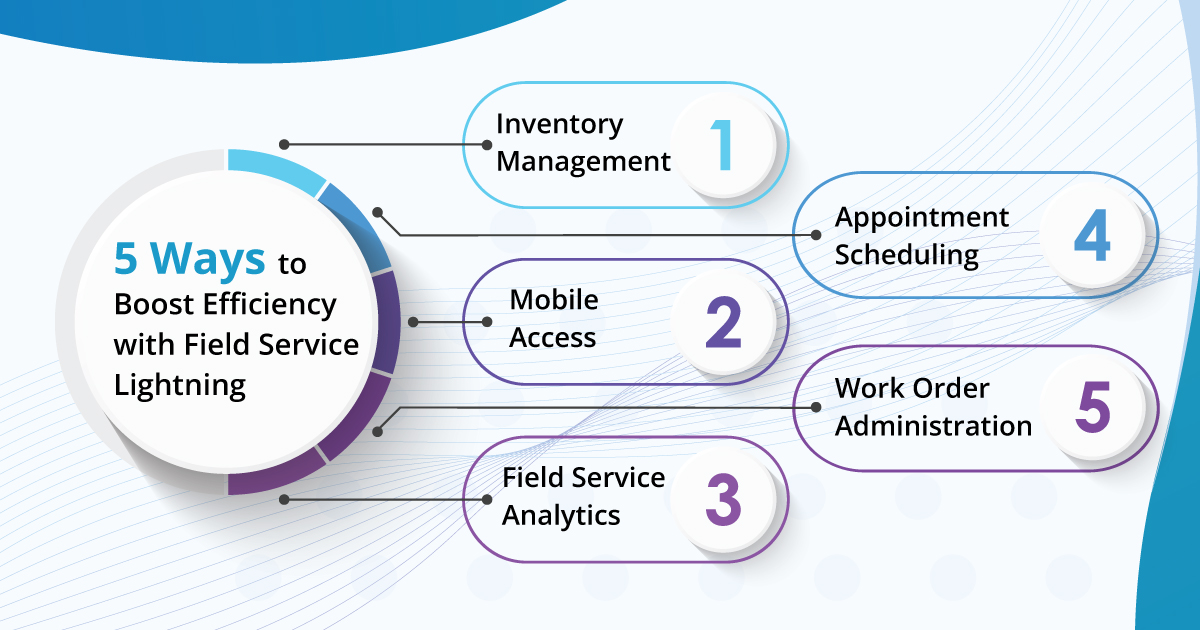
1. Inventory Management

FSL allows you to take charge of your inventory effortlessly. It enables teams to easily track and share all available stock, even including items in individual work trucks. 

The product management feature ensures you and your team always know what tools, equipment, and merchandise are on hand for each project or service call. It’s not just about managing inventory; it’s your tool for analyzing profits and costs and boosting sales.

2. Mobile Access 

Now, you can stay connected and informed on the go with Salesforce Field Service Lightning’s mobile feature. With the help of Salesforce certified experts, you can keep your team in the loop with real-time access to crucial information while in the field. 

The field service agents simply have to download the mobile app, log in, and unlock a world of benefits and features. This makes it easier to stay in control, managing team access and credentials effortlessly.

3. Field Service Analytics

This feature offers a deep dive into performance insights, uncovering patterns and trends to optimize your operations. With a Salesforce certified consultant, your team can achieve real-time visibility so they can make informed decisions on the fly, responding swiftly to changes and challenges. 

Field Service Analytics not only helps in efficient scheduling, considering technician skills, proximity, and urgency, but also enables proactive issue resolution by anticipating potential bottlenecks. 

It also acts as a compass for continuous improvement, guiding your team towards enhanced productivity and operational excellence. This will help make data-driven decisions for superior customer service and streamlined workflows.

4. Appointment Scheduling

With the FSL dispatch console, you can achieve effortless workforce visualization. You’ll be able to optimize scheduling based on technicians’ skills and availability with just a few clicks. 

The platform allows you to tailor each search to fit the job demands, ensuring no job hours are wasted on project scheduling. Thus, with the help of a Salesforce CRM consultant, there will be no more time spent on the manual scheduling process.

5. Work Order Administration

FSL allows you to seamlessly create and manage work orders, giving you a clear view of accounts and job requirements. Additionally, you can integrate it with invoicing for a smooth payment process once your work order is complete. That’s the way you achieve the efficiency you need in a simplified way. 

What We Did for Our Client

We helped one of our clients with Field Service Lightning implementation.

The client, a botany consultation for wineries, dealt with services like inspection and scouting of growing sites for fermenting fruits such as grapes for breweries in Australia.

Produce was tested against food grades for ‘fitness-for-consumption’. It would also provide testing to ensure the food safety of extracts from produce and exclusive sommeliers for product readiness.

Challenges they faced

The establishment didn’t have any Field Service Software to manage its niche service operations.

Individual work orders were created manually, which quickly became unsustainable with growing service volumes and frequencies. This also contributed to existing administrative burdens and uncertainties typically associated with Field Service. 

How we helped

We recommended that they purchase a Field Service Lightning subscription.

We started out by setting up all the bare essentials of Field Service for the client for the customizations to run out of the box for what was a fairly traditional, non-technical staff, 

This involved creating custom work orders, setting up global access permissions for all work order records, and installing the standard field service managed package to enable the client to automate typical administrative tasks for field service. 

Finally, global access permissions let us create direct Service assignments. Apart from this, we also automated several tasks on the Dispatcher Console.

Reported outcomes

Here’s what we helped our client achieve:

– Reduced busy work and repetition involved with manual work order creation.

– Eliminated erroneous entries to record details.

– Automated appointments prevented service opportunities from falling through.

Improve Field Service with Salesforce Certified Experts

It’s clear so far that FSL is more than just a tool; it is the way for operational excellence and customer satisfaction. The ability to effortlessly manage work orders, optimize scheduling, and gain real-time insights empowers your team to deliver exceptional service with precision. From the field to the inventory room, Salesforce FSL simplifies complex tasks, ensuring that your operations run seamlessly. 
So, embark on this journey armed with the efficiency, insights, and customer-centric approach that Salesforce offers. And that’s where our Salesforce CRM consultant can help you. Contact us and discuss your existing bottleneck in your field service operations, and we’ll help you overcome them, ensuring a simplified process and enhanced efficiency.

Quiz Time

How does Field Service Lightning help with enhanced efficiency?

a). Appointment scheduling

b). Marketing campaigns

c). Boost sales

d). All of the above

Show Answer: a) Appointment scheduling
Top 5 Features You Can’t Resist with Salesforce Marketing Cloud Implementation

The heartbeat of every successful marketing campaign is precision, personalization, and powerful insights. Salesforce Marketing Cloud implementation emerges as the compass guiding businesses through the complex terrain of modern marketing. 

Salesforce Marketing Cloud is more than a platform; it’s a strategic ally that empowers businesses to connect with their audience on a level that transcends traditional marketing boundaries.

These are the times when customer expectations are soaring and competition is fierce. So, businesses are turning to Salesforce consultancies for Marketing Cloud for a multitude of reasons. 

1. The platform’s ability to deliver personalized experiences at scale ensures each interaction feels tailor-made for the individual. 

2. Its robust suite of tools is designed to streamline and enhance every aspect of the marketing journey. 

3. The invaluable insights gained from comprehensive analytics allow businesses to make informed, data-driven decisions.

In this blog, we’ll get deeper into the product, explaining the top features of Marketing Cloud that can justify its power and capabilities.

Top 6 Features to Work With While Considering Salesforce Marketing Cloud Implementation

To understand the true power of Salesforce Marketing Cloud implementation, let’s dive into the top features of the product that make it so popular among marketers.

1. Ad Campaign for Journey Builder

Journey Builder’s ‘Activities’ offers a range of tools for crafting seamless customer journeys. Among these gems is the ‘Advertising’ activity, where you can effortlessly create ad audiences and incorporate your contacts into targeted ad campaigns. 

To unlock this feature, make sure you have the Advertising Studio module at your fingertips. The adoration for this feature stems from its ability to elevate journeys into true multi-channel experiences, seamlessly integrating social media into our touchpoints.

2. Dynamic Content Blocks

Dynamic Content Block allows you to tweak email copy or images for each recipient within a single email, all thanks to preset rules. For instance, recommend the latest products tailored to their recent purchases. 

It’s not just about crafting communications that truly speak to your audience, boosting engagement; it’s also a time-saver, slashing hours off your setup time.

3. Marketing Cloud Connect

One of the major reasons businesses are going for Marketing Cloud is because of its easy and out-of-the-box integrations with all other Salesforce Clouds. A challenge that companies usually face is ensuring smooth synchronization between marketing and sales teams. But even this challenge can be successfully resolved by Marketing Cloud Connect to smoothly connect Sales Cloud and Service Cloud with Marketing Cloud. 

In addition to this, the connector also enables marketers to automate customer journeys based on the records stored in the Salesforce CRM.

4. Geofenced Mobile Messages

With Marketing Cloud, you don’t have to worry about enabling sending messages to any list based on the specific city or country. It can be done with geofenced messages that allow you to set physical geographical areas for targeting and sending messages to customers in that region. 

This feature is great for business planning to run and exhibit some events. A certified Salesforce Marketing Cloud developer can help you make the most of this feature.

5. Interactive Email Forms

Any good marketer is aware of the fact that when we want to improve engagement, the key is to cut down the number of steps any user is required to take. Higher engagement usually comes with fewer page loads and fewer clicks. 

You can include forms right in your email that people can fill out without leaving their inbox with the Marketing Cloud Interactive Email Forms feature. This nifty tool, available in Marketing Cloud Pro editions or higher, allows you to gather immediate reviews, capture prospect interests, and simplify one-click sales inquiries, all without making your recipients click away.

What We Did for Our Client

We helped one of our esteemed clients leverage the best of Marketing Cloud capabilities. The client, recognized for its work in the field of digital transformation, helps data-driven companies generate business value.

They managed their customers and other relevant details in Salesforce. Despite working on the Salesforce cloud platform and managing data within it, they faced several challenges while managing marketing for their services and ideas. 

Challenges they faced

Primarily, there was the absence of a mechanism to provide a digital edge to their existing campaigns and the cumbersome creation of Landing pages.

This was exacerbated by a lack of analytical tracking for campaigns and the inability to track customer activities due to the absence of Journey Builder-like capabilities.

Additionally, systems suffered from an acute inability of existing marketing tools to integrate with social media accounts such as Facebook, Twitter, and LinkedIn, which led to the non-uniformity of data from marketing activities performed outside of Salesforce.

How we helped

Remedial Analysis And Recommendations

Our efficient Salesforce Marketing Cloud developer analyzed the major pain points outlined above, suggested optimal solutions, and made implementations to configure and set up the Salesforce Marketing Cloud.

Capabilities For UX Curation

This meant enabling fast landing page creation, setting up journeys for lead-baiting, and consolidating data for 360-degree views of analytical data for more potent message signaling.

Custom Integration For Reliable Campaigning

Integrations for Gleam and other third-party solutions with the Marketing Cloud were carried out apart from a Marketing Cloud Connect configuration to connect the Sales and Marketing Clouds.

Reported Outcomes

Here’s what we helped our client achieve:

– Web Studio capability was delivered out-of-the-box with ready-to-use landing pages.

– 360-degree views of analytical data were made available using Analytics Builder.

– Managed ‘journeying’ for contacts originating from multiple campaigns.

– Social Studio-based associations to social media accounts with the Marketing Cloud opened up a new digital channel for marketing.

Get the Best Results with Salesforce Marketing Cloud Implementation

Although we mentioned some of the top features above, Marketing Cloud is even more than that. As you move to the platform, you’ll be able to witness the real value it can bring to your business. We’ve helped many clients from multiple industry sectors to leverage the true power of Marketing Cloud and get the best results from their campaigns. 

If you’re stuck with any challenge in your marketing effort, contact us and get the best certified Salesforce experts to assist you and get the boost you’ve been wishing for.

How Can a Salesforce Consultancy Help Healthcare Providers Improve Their Communication Strategies

Out of all the industries out there, healthcare is the one in which trust matters the most. And the key to building trust is effective communication. While the focus is always on giving the best patient care, we can’t miss out on the fact that how we maintain communication with them also matters. That’s where Salesforce consultancy can be helpful in giving HCPs a centralized platform to engage with patients and manage their records.

When we talk about the healthcare sector, the key to delivering better experiences is knowing about the audience, their current conditions, and their expectations of care. And all of that comes from engaging with them in an efficient way. Using Salesforce is a great way to manage all records and engagement details through a single platform. 

In this blog, we’ll be talking about different ways to use Salesforce in the healthcare sector that can help to improve communication strategies. 

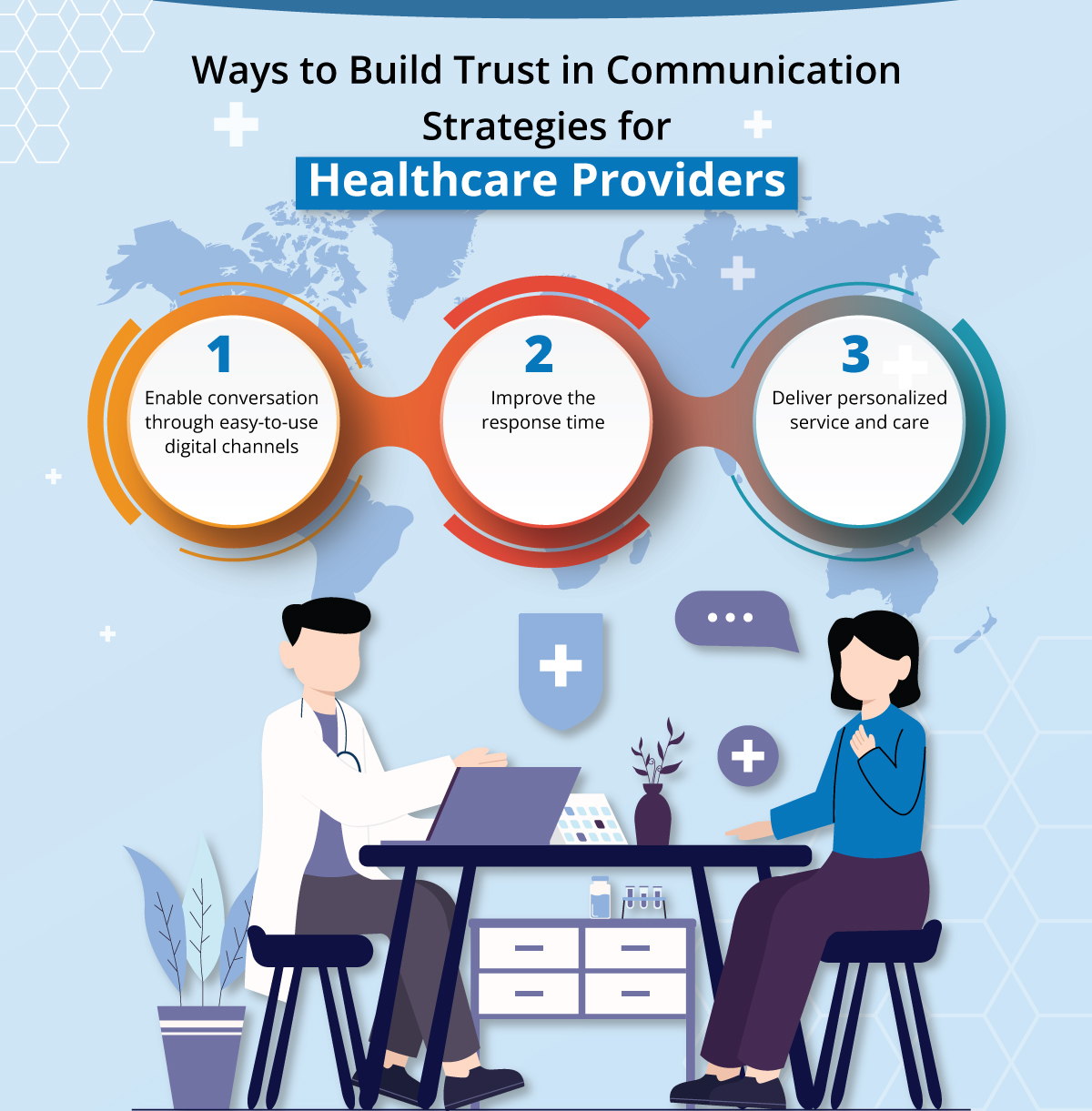
Ways to Build Trust in Communication Strategies for Healthcare Providers

Let’s have a look at the different ways healthcare professionals can leverage Salesforce to improve their communication strategies.

1. Enable conversation through easy-to-use digital channels

Everyone is going digital these days, even the healthcare sector. Health consumers prefer going for virtual checkups and remote monitoring instead of traditional in-person visits. So, the providers, too, need to focus on bringing in digital channels for engagement practices. 

Studies show that 64% of consumers (under 65 years of age) prefer having online capabilities when expecting services. So, it is essential for healthcare institutions to implement the same to boost engagement and build trust with consumers. With the help of Salesforce consultancy services, providers can easily integrate multiple digital channels with Salesforce to manage engagement on a single platform.

2. Improve the response time

It was uncovered in the Connected Health Consumer Report that 71% of respondents stated that receiving timely responses from the provider is one of the major factors that helps them trust their healthcare services. There are times, especially in the healthcare sector when consumers expect more than just self-service options, and that’s where the need is to have a single platform to deliver a streamlined experience for consumers. Using CRM with the help of a trusted Salesforce consultancy to manage consumer queries and questions and quickly respond to them is a great way to handle the responses without having to keep them waiting.

3. Deliver personalized service and care

One of the key aspects for healthcare providers is to provide consumers with custom care plans and ensure that patients stick to them. This is how they can work on improving outcomes and maintaining trust among consumers. 

This is where having a connected system is helpful to ensure that providers have a 360-degree view of patients to manage holistic records and build care plans that are personalized for each consumer. 

To grow in the healthcare sector, providers need to work on building trust with consumers through effective communication. Maintaining consumer records and streamlining engagement through Salesforce consultancies in the USA will help to achieve it. Here’s how we helped one of our clients in the healthcare industry to overcome their existing challenges. 

What We Did for Our Client

We helped one of our clients, a recognized thyroid treatment center headquartered in Sydney. The establishment deals exclusively in consultations, treatments, and prescriptions for patients with thyroid ailments.

Our implementations for them would affect operations that touched their entire client base throughout Sydney across all clinics.

Challenges they faced

The client was previously using Zenoti as their CRM solution. Zenoti’s interface was not customizable and unyielding, and its external ecosystem wasn’t nearly as mature as that of Salesforce. Querying, viewing, and accessing data was challenging for medical staff and administrative personnel.

Record and data accessing routines were fairly rigid and cost administrative time. For instance, patient forms were converted and stored in PDFs manually. Wait times for test results also held up treatments, inflated non-appointment-related inquiries, and caused irregularities in face-to-face follow-ups. 

The medical staff at the thyroid treatment centers were stretched thin and intended to attend to as many patients as they could. But without filtered views of data to single out no-shows, they were faced with several patients who fell through treatment owing to inconsistent follow-up communication and reminders. 

The external subscription app failed them continuously and made prescription drug payments difficult. To add to this, inventories were never in sync or truly representative of actual medicine quantities, resulting in canceled orders and patient anxiety.

How we helped

We suggested the team migrate to the more robust Sales Cloud with greater support to cut down on long-term development costs. For this, we suggested mimicking all Health Cloud usage typical of the healthcare vertical with custom integrations.

The main calendar-based view was customization over the Calendar Anything AppExchange add-on, with custom objects, visualizations, and Quick Action buttons over records.

The standard Eway integration was switched out for a custom Lightning Component to enable ‘single-click’ payments. We also set up custom inventory management in the Sales Cloud to create orders easily and update inventory numbers in real time to prevent stockouts and order cancellations.

A Natterbox CTI received and made calls from the system with patients’ records on hand. Custom forms were created to capture information that was later stored as PDFs with a Google Drive integration. Then, previous tickets or cases were migrated over to a custom Zendesk-Sales Cloud integration for internal ticketing. 

Reported outcomes

Here’s what we helped our client achieve:

– Improved payment accuracy and collections.

– Reduction in overall treatment lifecycle times.

– A familiar single-pane calendar view to facilitate easier ticketing, case creation, appointments, and rescheduling. 

– Reduced licensing, reusability, and development costs over the long term.

– Expedited emails for lab test results.

Improve Healthcare Engagement with Salesforce Consultancy

It’s true that patients who have a high level of trust in their healthcare provider are more likely to stick with the same provider. So, the key here is to build that level of trust among consumers, which will be possible by maintaining efficient communication with them. That’s where Salesforce consultancy services would help you. 

Implementing Salesforce to maintain a holistic patient record and engage with consumers will significantly help providers achieve that level of trust and keep their consumers connected with them. 

We’ve helped many of our clients from the healthcare sector to streamline their siloed data and disintegrated operations. Contact us to achieve a significant boost in your patient management and streamlined engagement. 

Quiz Time

Which of these is not a way to improve communication for HCPs?

a). Personalized responses

b). Faster response time

c). Digital channels

d). Secure data management

Show Answer: d) Secure data management

How Can Salesforce Implementation Help to Optimize Your Real Estate Sales Funnel?

The real estate sector might seem like a very sorted domain, but when we look closely, there are many aspects that can make it complicated. Not only are operations and data management difficult, but also, a little change in the economy takes a direct hit on the sector. This makes it crucial for real estate sales agents to be very active in managing the sales funnel the right way. Considering Salesforce implementation is one way to work with customized real estate features that could simplify sales funnel management. 

The complexity in the real estate sector has made it necessary to have a streamlined CRM solution to manage all operations within a single platform. Using Salesforce for real estate is one of the most efficient ways to get all the data managed on a single platform, making it easier for the team to manage their sales funnel. 

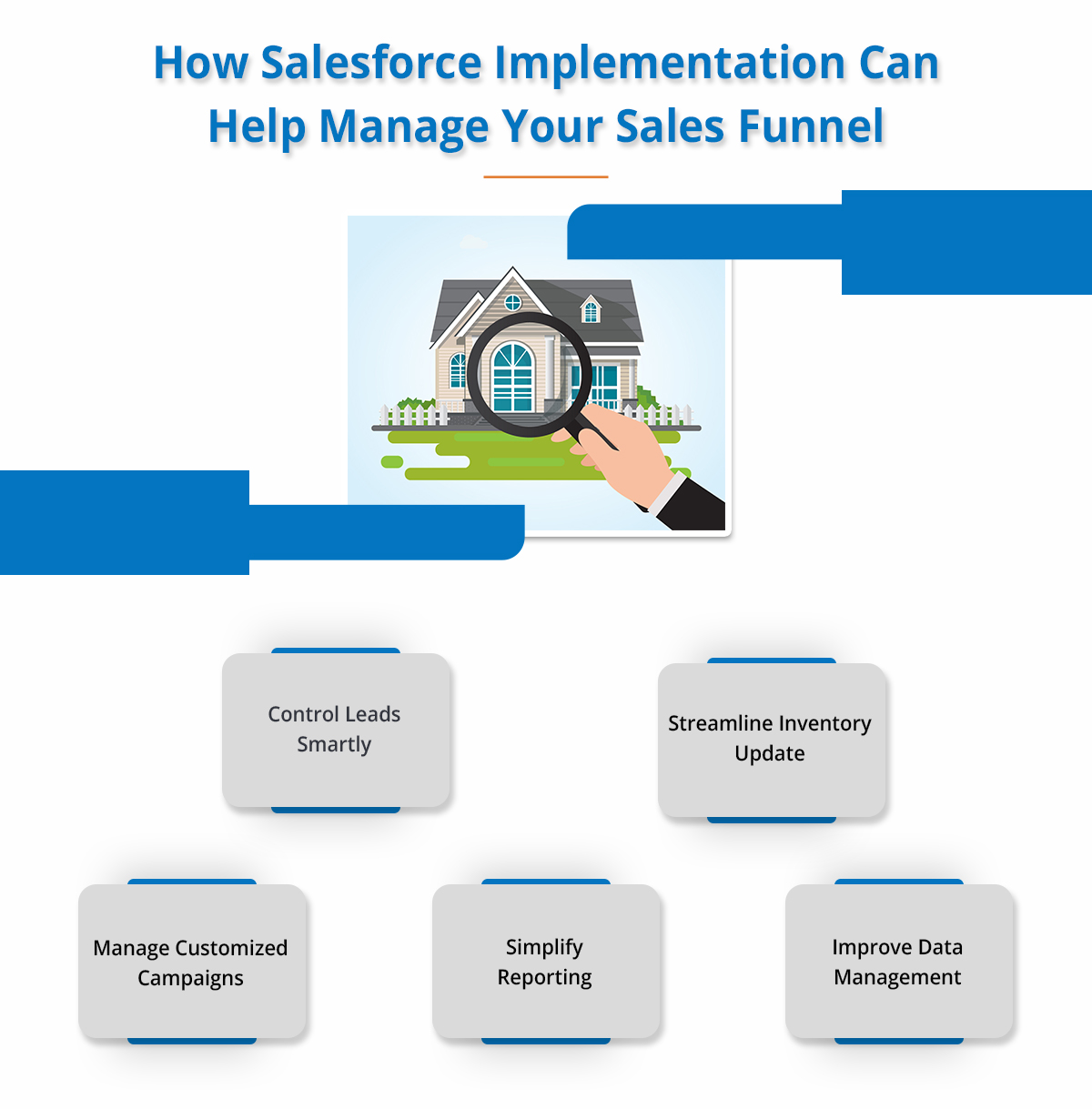
How Salesforce Implementation Can Help Manage Your Sales Funnel

Implementing Salesforce within a real estate institution can be a real game-changer for sales agents, helping them to manage and track their sales pipeline efficiently. 

We’ve listed a few points here on how using Salesforce can be a great way to manage the sales funnel, enabling a smoother flow and management. 

1. Control Leads Smartly

Sales agents can work with Salesforce Sales Cloud to access leads through which they can get leads from different perspectives. They can further redirect leads to a suitable sales rep based on factors like segment, location, or accessibility. Salesforce implementation partners thus help them to automatically send messages to the leads, depending on their interests and requirements. 

2. Streamline Inventory Update

Implementing Salesforce within a real estate firm can enable agents to leverage different tools that can help with stock management and control. It enables them to manage an online inventory that can be kept updated in real-time. 

Agents can use the inventory to manage different details like available properties, receipts, offers, billing, and prices, and all of it can be managed with Salesforce. Firms can also go for a customized Salesforce solution with trusted Salesforce implementation partners that can enable agents to view details across different warehouses and locations. In addition to this, such a solution also eliminates errors related to inventory management. 

3. Manage Customized Campaigns

Agents can work with Salesforce Marketing Cloud to optimize their marketing strategies. This would enable them to handle all their marketing operations through a single platform, providing a 360-degree view of all details within one interface. 

With the support of real estate AI agents analyzing buyer behavior and engagement signals, they can nurture leads more efficiently, prioritize high-intent prospects, and move them toward becoming sales-ready clients. Additionally, agents can also access advanced analytics to understand and evaluate patterns and projections related to the sales funnel. This enables them to nurture all leads easily, making them sales-ready. 

4. Simplify Reporting

Using Salesforce enables real estate agents to view and manage all facets within reports and dashboards. This helps them to track all activities and progress related to sales within a single view. 

They can also work with personalized reports, managing multiple variables like properties, quarterly sales, and other demographics. This makes it easier for them to understand what’s working for the business and what needs to be changed or improved.

5. Improve Data Management

There are always a lot of aspects that have to be managed for a real estate firm. This simply means having a lot of data on the plate that needs to be managed and streamlined for easier access. 

With the Salesforce implementation service, realtors can always have data at their fingertips, making it easier to handle data, whether it is from different engagement channels or related to ongoing sales deals.

What We Did For Our Client

We assisted one of our esteemed clients, a renowned real estate investment company that owns and operates recreational vehicles and prefabricated housing parks. The company is privately operated. 

They came to us to create a more accessible and systematic interaction system for customer-facing teams. Their data storage system also needed to be upgraded to handle large volumes of customer data.

Challenges they faced

Earlier, the client was storing customer data in Excel sheets to interact with customer data manually and share it with offshore sales teams. Due to this, there was heavy dependence on traditional methods to manage data. 

The team was still relying on outdated legacy methods like using Excel sheets to record client information and updating records manually. This was a very time-consuming and inconsistent approach. 

They needed a stable and reliable platform to manage the data. So, they were looking for a more reliable medium for their offshore teams to interact with customers and their data. 

How we helped

We optimized Salesforce for organized data storage and consistency. We set up a Salesforce entity or Org that contained a username and information of the client. This was a safe and reliable option to store the client data without any inconsistency. 

For all the existing client information, we shared a common spreadsheet template that helped sync all other attached templates. Doing this, changes made to one template would automatically update the others. 

We also helped with convenient data migration and sharing. The data needed to be imported into the lead object to avoid any information leak. The existing data was important to migrate into the current system and with the right measures.

Reported outcomes

Here’s how our services helped our clients from the real estate sector:

– 360-degree view of client data enabled easy tracking of required records and lowered the chances of reputational loss. 

– Regular follow-ups with clients made it easier to collect their opinions and improvise where required and made customers more inclined to respond through personalized interactions.

– Centralized agent and estate data led to a reliable database without inconsistencies. Agents could access the information centrally and clear customer objections, if any. 

– Automatic updates were pushed to all sheets. Also, the automatic recording of information leaves minimum chances of gaps in customer profiles.

Go for Salesforce Implementation for your Real Estate Firm

There’s no denying the fact that managing all real estate operations can be a real struggle, whether it is about managing customer details or information related to different deals. But managing it all can be a piece of cake with Salesforce. 

We can be your reliable Salesforce implementation service to help you manage your real estate operations. Contact us and get the best certified experts to guide you and overcome your existing business challenges. 

Salesforce to Acquire Spiff: Know It All With Salesforce Consulting Experts

When the discussion is about the biggest acquisitions made by companies, Salesforce always manages to maintain its spot on the list. This time, Salesforce is in the news again about a big acquisition. Salesforce has announced its acquisition of the popular commission automation platform Spiff with the aim of improving sales performance management. Our Salesforce consulting experts have dug into this latest acquisition to understand what it will bring for us. 

This strategic collaboration aims to fuse Salesforce’s power in cloud-based solutions with Spiff’s innovative low-code user interface and robust processing engine, promising to drive commission automation at an unprecedented scale.

Salesforce’s Low-Code Revolution

Salesforce’s recent announcement of acquiring Spiff isn’t just a standalone move; it perfectly aligns with the company’s overarching strategy of embracing low-code solutions. 

This strategic focus on integrating compatible companies into its ecosystem is evident when we take a closer look at Salesforce’s recent M&A activities and investment directions.

In a strategic move back in September 2023, Salesforce acquired Airkit, a platform that leverages low code to craft AI-driven customer service tools. 

Hailing from Redwood City, California, Airkit was founded by Adam Evans and Stephen Ehikian, who had previously sold another startup, RelateIQ, to Salesforce for a whopping $390 million. The synergy between Salesforce and Airkit is palpable, with the latter joining the Salesforce family on the AppExchange platform.

Now, enter Spiff into the equation. Salesforce’s acquisition of Spiff is a continuation of its commitment to low-code solutions. Spiff’s innovative incentive compensation management (ICM) software, with its user-friendly low-code UI and powerful processing engine, perfectly aligns with Salesforce’s vision of empowering businesses with accessible and efficient tools.

As Salesforce strengthens its low-code focus, the synergy between these acquisitions becomes more apparent. Spiff, with its integration into Salesforce’s Sales Cloud, adds a critical layer to the low-code arsenal. 

The marriage of Spiff’s commission automation capabilities and Salesforce’s commitment to user-friendly interfaces opens new possibilities for businesses aiming to streamline their sales processes and drive growth. And with Salesforce consulting, you can achieve the sales improvement that your business has been seeking. 

It’s noteworthy that both Airkit and Spiff, now integral parts of the Salesforce ecosystem, share a common thread of being part of Salesforce’s AppExchange platform. This strategic alignment reinforces Salesforce’s commitment to providing a unified, low-code ecosystem for businesses to thrive.

Salesforce’s acquisition of Spiff isn’t just about bolstering Sales Performance Management; it’s a pivotal move in the company’s broader strategy to revolutionize business processes through low-code solutions. 

As Salesforce continues to weave these acquisitions into its fabric, the tech world eagerly awaits the transformative impact on the way businesses leverage low-code technologies for enhanced efficiency and growth. The future is undoubtedly low-code, and Salesforce is leading the charge.

What’s Next With This Acquisition?

Upon the completion of this game-changing acquisition, Spiff is set to become an integral part of Salesforce Sales Cloud. That would definitely be a great addition to the Sales Cloud, helping the sales team to improve operations and simplify data and sales funnel management. 

The focus? To catapult Salesforce’s Sales Performance Management solutions into a new era, providing customers with a trusted platform designed to increase visibility, supercharge selling efforts, and unlock unprecedented growth opportunities.

This alliance is a dynamic force empowering Chief Revenue Officers (CROs) to seamlessly align with financial and sales operations teams. The result? An environment where navigating complex incentive compensation plans becomes a breeze and understanding the key factors driving revenue performance is crystal clear. 

It’s like handing CROs a powerful tool to self-manage intricate compensation structures, paving the way for top-line growth like never before.

What makes this collaboration even more exciting is the long-standing partnership between Spiff and Salesforce. Having been in cahoots for years, Spiff has now taken the next big step by making its expertise available on the Salesforce AppExchange

Remarkably, over 70 percent of Spiff’s customers are already leveraging Salesforce’s Sales Cloud as their preferred CRM platform, showcasing a seamless integration and a shared commitment to excellence.

This acquisition is more than just a business transaction; it’s a strategic move to redefine how businesses approach sales performance and incentive compensation. With Spiff on board, Salesforce is poised to offer a comprehensive solution that goes beyond the conventional, providing businesses with the tools they need to thrive in a competitive landscape.

As the tech world eagerly anticipates the outcomes of this acquisition, one thing is clear – the fusion of Salesforce and Spiff is set to elevate Sales Performance Management to new heights, creating a ripple effect of positive impact across industries. If you want to get real results for your sales team, our Salesforce consulting agency can provide the needed assistance. 

It’s Time to Grow With Salesforce Consulting

The fusion of Salesforce’s cloud expertise and Spiff’s commission automation capabilities creates a powerful tool set for businesses thriving not just to survive but thrive in today’s competitive landscape.

As we look ahead, the possibilities are boundless. The transformative impact of Salesforce’s acquisitions, coupled with its low-code focus, promises to reshape how businesses approach growth, efficiency, and customer service. The tech world awaits the unfolding chapters of this strategic alliance, anticipating the ripple effect it will have on the way organizations harness technology to drive top-line growth.

We’ve helped many companies leverage the true power of Salesforce and help them improve their operations and grow. Here’s one such firm we helped with case management. Our Salesforce consultants always remain updated with the innovations in the Salesforce ecosystem and utilize their knowledge and experience to help our clients boost their business and sales. 

In need of any assistance with your Salesforce? Contact us and get the best certified experts to help you. 

Simplify Your Case Management Process with Salesforce Service Cloud Implementation

Take a moment and think from a customer’s perspective: what exactly do they go through when they contact your support team for any assistance? Are they able to connect quickly with a chatbot, or do they wish to seek assistance from an agent? Do they need to send an email to connect with an agent? Well, if you’re keeping them waiting or making them send you emails consistently, then that’s probably because your case management system is not as strong as it’s supposed to be. If this got you thinking, Salesforce Service Cloud implementation is something that will get you out of this vicious cycle.

You need to realize this fact that the way you manage your cases is one of the deciding factors if you’re making or breaking customer relationships. That’s where you need to make sure your case management is streamlined, enabling your support teams to handle cases faster and reach customer satisfaction. That’s something Salesforce Service Cloud enables you to do. 

How Can An Efficient Case Management System Help You?

Now, the question is how exactly an efficient case management system is going to help you. We’ve accumulated some points that will provide you with a clear picture.

1. Provide a single view of customer data

All customers are concerned about how fast the customer service team is responding to them. When the team has everything they need at their fingertips, it enables them to understand customer queries faster and respond to them quickly. This helps to ensure that customers achieve a consistent experience. 

2. Enable reaching out to customers on their preferred channel

Customers are everywhere. Whether it is on email or different social media channels, you need to know which channel customers prefer for interaction. That’s where a Salesforce Service Cloud consultant helps support agents to track the preferred channel for customer interaction so they can use the same and connect faster and more efficiently. 

3. Support self-service features

Not every time customers want to connect with agents. Sometimes, they prefer solving their issues by themselves. That’s where providing self-service options to customers can be of great help. With Salesforce Service Cloud implementation, teams can provide customers with FAQs and knowledge base articles through which customers can resolve their minor issues without having to wait for an agent. This would ultimately help in managing and resolving cases faster without any queries stacking up.

4. Provide customized lifecycle of support cases

When you are handling case management with Service Cloud, it allows you to personalize the lifecycle of each case so you can meet your goals. It even allows you to customize workflows according to different activities and set milestones to achieve them. This enables agents to keep track of what they’ve achieved and what more they need to work on. 

What We Did For Our Client

One of our esteemed clients, Club Mahindra, was facing challenges in handling their incoming service requests and needed a streamlined way to manage their support cases. 

Mahindra Holidays & Resorts India Ltd. (MHRIL), a renowned part of the Leisure and Hospitality sector of the Mahindra Group, provides top quality family holidays through vacation ownership memberships.

Challenges they faced

The team was in need of a solution/service provider to implement Salesforce CRM to leverage the features of Salesforce Service Cloud implementation. Their requirement was to replace their current CRM with the expectation of increasing efficiency and smooth data management. 

The different teams were involved with working across multiple systems, due to which the data was managed separately on different platforms. This made it difficult for them to keep track of everything and access the data when needed. This issue ultimately led to the increase of the TAT to close any activity, thus causing delays.

The data in silos was causing slow search and discovery, which was directly affecting case resolutions and service responses. In addition to this, they even lacked knowledge bases to support self-help. 

Working with disparate and siloed data storage caused a lot of redundant and error-prone querying and updates across similar case records, thus adding to the troubles.

How we helped

We conducted Salesforce Service Cloud implementation to enable the team to deliver service to every customer on time and give a 360-degree view to the customer. We also created knowledge management articles for users.

We integrated all their existing systems with Salesforce CRM using AppExchange apps and APIs available. This helped to centralize the data to make sure everything was available at once when required, making it feasible for the team to use one system instead of switching between multiple systems.

With the Salesforce implementation, we were able to enable skill-based omnichannel routing to handle cases from various entities automatically and send them to specific teams (queues). Cases automatically got deflected to the next queues.

Reported outcomes

Here’s what we’ve achieved with Service Cloud implementation:

– Service Cloud implementation personalized the experience and helped with detailed information at every step. Configuration prioritized the cases based on priorities and monitored customers’ needs.

– Improved response times, average handling times, and resolution times. This also helped with controlled access to data. 

– Accelerated case-creation, routing, and cloud-hosted record access for better case resolution numbers and lowered ticket debt. 

– Unified console access to cases meant faster record search & discovery and case qualification streamlined queuing. 

– Excessive, time-consuming navigation, toggling, and page loads were also reduced.

Manage Your Support Cases Faster with Salesforce Service Cloud Implementation

Businesses are all about how efficiently they are able to cater to their customers’ requests and queries. Service teams remain the front face of any business, and the way they interact with customers would decide the customer satisfaction level. So, it is highly necessary that support teams should have an efficient case management system to handle customer inquiries. And that’s something a Salesforce Service Cloud consultant makes possible. 

We’ve helped multiple clients leverage the best of Service Cloud and boost their customer satisfaction results. You could be the next one. Contact us and get in touch with our certified Salesforce experts, who could help you improve your customer service charts.

Quiz Time

Which of these features Salesforce supports to improve case management?

a). Self-service features

b). Personalized marketing

c). Lead management

d). None of these

Show Answer: a) Self-service features

How Can a Salesforce Integration Consultant Help Integrate Your Calendar App with Salesforce?

We know how juggling between your calendar and Salesforce can sometimes feel like a high-stakes Tetris game. It doesn’t matter if you’re using Google Calendar, Outlook Calendar, or CalendarAnything; switching between your calendar and Salesforce to track and manage everything can be a real challenge. That’s where a Salesforce integration consultant can help you to simplify the game. 

Yup, you heard it right – it’s time to integrate your calendar application with Salesforce. Your calendar seamlessly synchronized with Salesforce enables you to create a unified hub for all your scheduling and client interactions. 

The benefits extend far beyond the realm of mere convenience; this calendar integration serves as a catalyst for elevating efficiency, productivity, and the overall client experience.

Why Should You Integrate Your Calendar App with Salesforce?

Now, let’s get into more details to understand why you should consider integrating your calendar app or solution with Salesforce. 

1. Save time

Imagine not having to switch between tabs to check your schedule and update your Salesforce records. That’s what integration brings to the table – time-saving magic. Your calendar events sync effortlessly with Salesforce, so no more double data entry. 

2. Stay on top of your business game with real-time updates

No one likes outdated information, right? With your calendar and Salesforce integrated, any changes you make in one place reflect instantly in the other. That’s the beauty of real-time synchronization – keeping your records fresh and accurate.

3. Boost your productivity levels

This Salesforce integration lets you schedule tasks, meetings, and follow-ups directly from Salesforce. No need to bounce back and forth. It’s like having a personal assistant streamlining your workflow.

4. Keep your customers happy

Picture this: A client calls, and you can instantly check your calendar to find the best slot for a meeting without missing a beat. It’s all about providing quick, efficient service that leaves your clients smiling.

5. Simplify reporting

Integrating your calendar with Salesforce means your activity data is neatly stored. Generating reports becomes a breeze, giving you insights into your engagements, follow-ups, and where you can fine-tune your approach.

What We Did for Our Client

One of our esteemed clients, AMI Staging, was struggling with an inconsistent internal management system due to a lack of a calendar view of the company’s sales and deliveries.

AMI Staging is a renowned service provider for smart house staging and consultation. The firm is known for its incredible staging designs and simplified installation of furniture and maintenance.

The team connected with our experts for an efficient and accurate handling of their internal projects. Their major requirement was to achieve a calendar view for all the operational and order data.  

Challenges they faced

AMI Staging was not satisfied with its existing system for managing its internal operations and needed a more efficient and error-free management system.  The sales and deliveries of the company were classified into three types- Load in date, Deadline date, and Load out date, and they needed an extensive calendar view for the same. 

They needed to list all the information related to orders on the calendar view to make it easier for the team to access it all. Having such a view on their calendar would help the team to easily view every milestone needed to be achieved while avoiding any confusion or resource overlapping.

In addition to that, they wanted the dates on the calendar to be updated automatically to eliminate the manual struggle. 

Their existing processes of data recording were quite hectic and demanded automation, which was making it difficult for their non-tech employees to understand, thus raising a challenge to handle technical operations. To simplify this, they required a calendar view to enable employees to see all the information related to order dates and other tasks to minimize confusion or delays. They also wanted the calendar view of all holidays and vacation dates for increased transparency for the team. 

How we helped

After understanding their existing challenges in detail, here are the solutions our Salesforce integration consultant proposed to help the team. 

1. Improving transparency internally

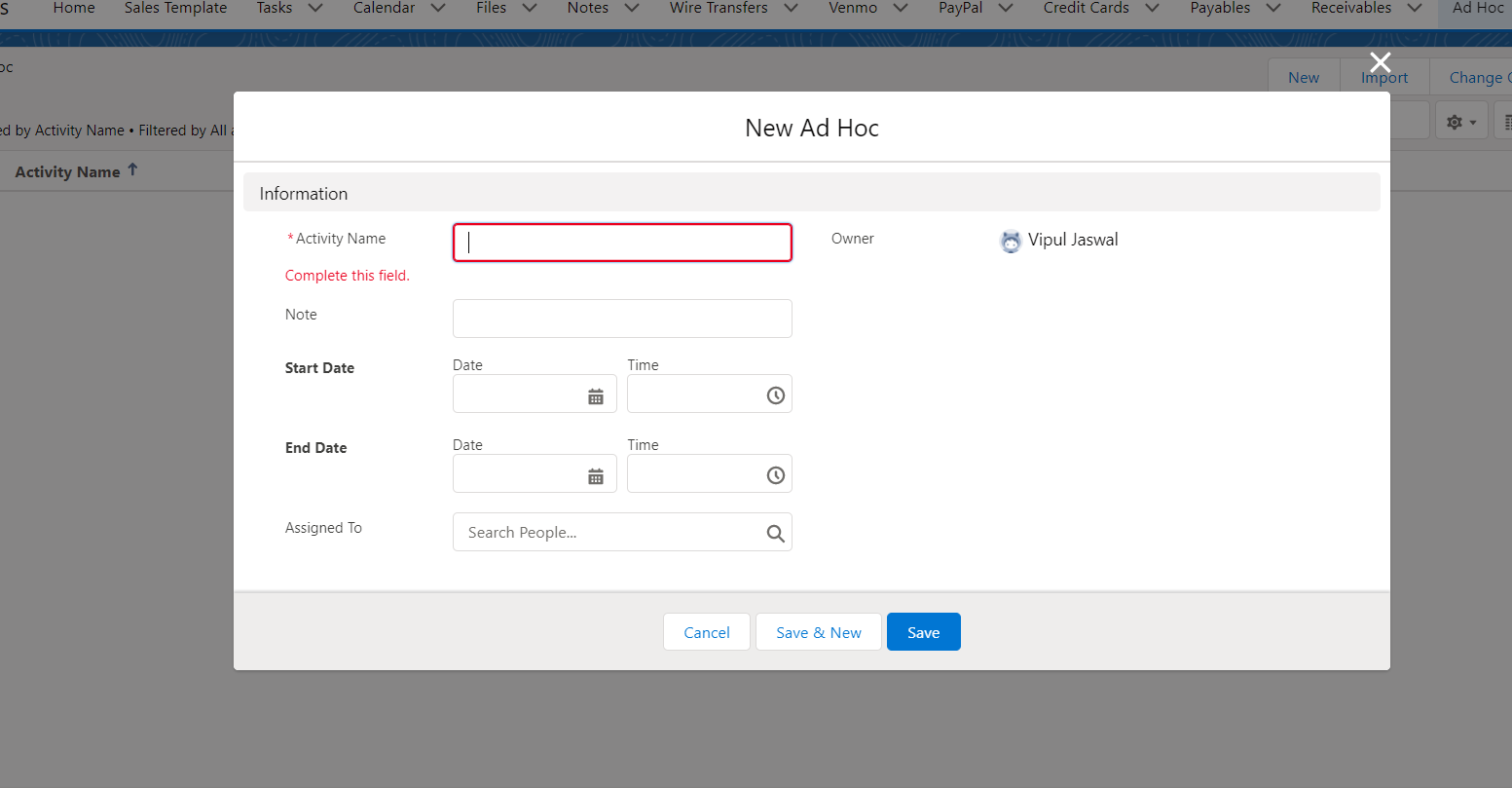
Our Salesforce integration consultant conducted layout modifications for the client. We added a custom object called “Adhoc” that will help record the holiday and vacation details to provide transparency to employees.

2. Recording details faster

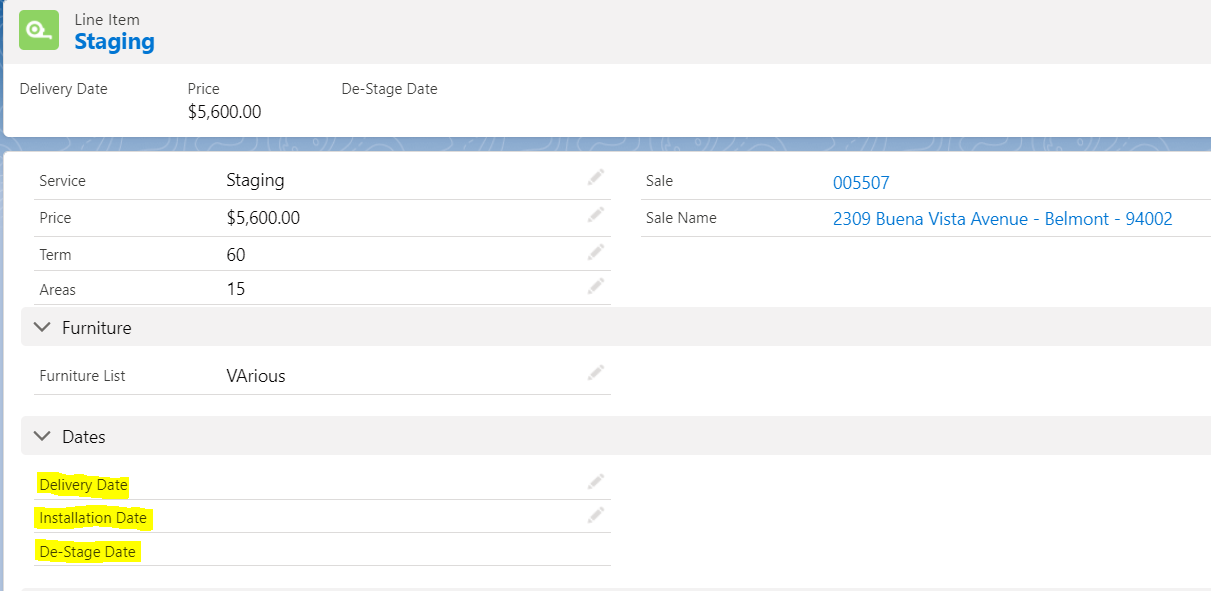
We enabled automation that allowed the team to view instant updates in the Load in, Deadline, and Load out dates. All of this was updated through the line item object.

3. Simplified operations for clients with CalendarAnything Salesforce integration

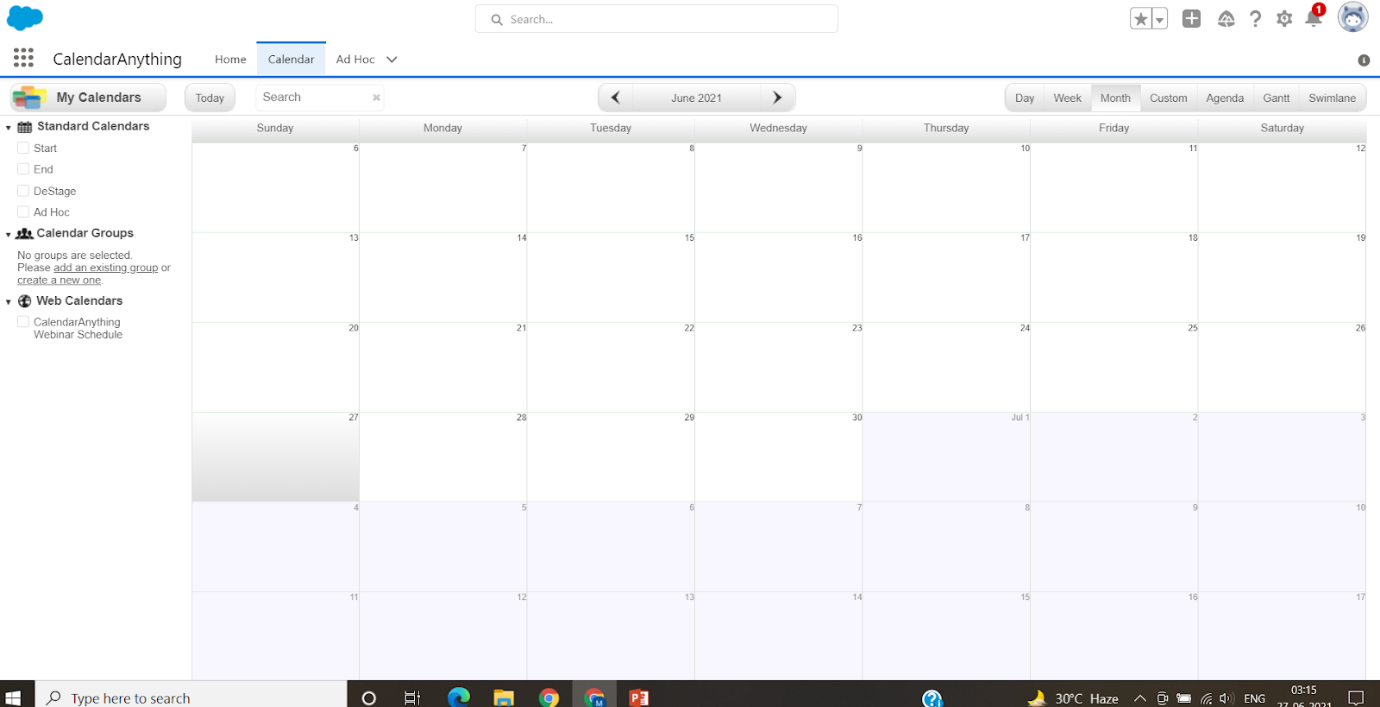
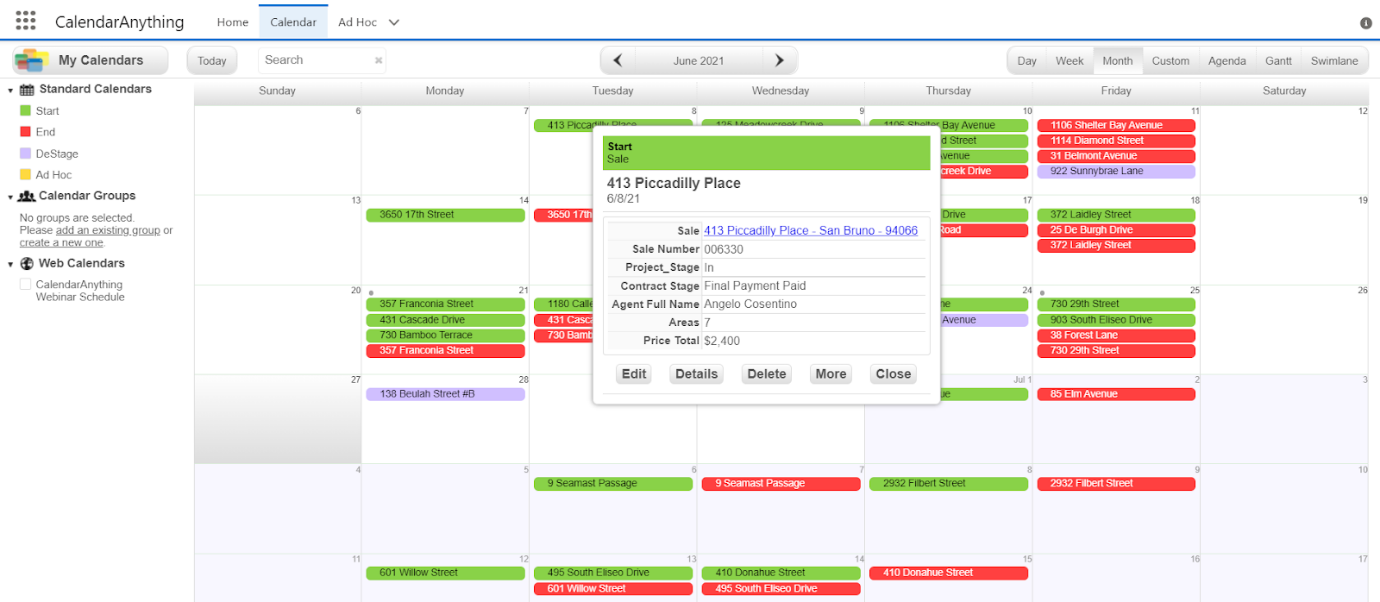
We also conducted CalendarAnything and Salesforce integration. It helped in organizing order details and prioritizing milestones. 

4. Setting up different calendars with CalendarAnything

We designed four different calendars as per the client’s requirements. The information related to all their orders was stored in these separate calendars to simplify data access and management.

Reported Outcomes

As a result of our implementation, the team at AMI Staging was able to achieve better visibility of their orders and details related to them. It became easier to communicate with teams with the calendar view, especially with the teams that have busy schedules. It gave them a transparent view of all the ongoing tasks and milestones pending or achieved.

All of this ultimately helped to reduce the manual recording of information. Also, a visible reduction in data inconsistency and errors was achieved with enhanced coordination through automatic updates.

Connect Your Calendar and Salesforce for Simplified Workflow

So, it’s clear that integrating your calendar app with Salesforce can be a real time-saver. Simply integrating your calendar with Salesforce with the help of a Salesforce integration consultant will give you access to details about your events and milestones on the calendar within Salesforce. So, there is no more need to manage tasks and activities on your calendar separately while switching screens and simultaneously handling Salesforce. 
AMI Staging is just one of the firms we’ve helped with our Salesforce integration services. Our experts have been helping out companies from different industry sectors to eliminate silos and save time by integrating their multiple third-party apps with Salesforce. Contact us to integrate your apps with Salesforce and witness the real results while saving your time and effort.

logo Live Chat