
AWS vs Azure vs GCP: Which Cloud Platform Is Right for You
17 Jul 2026
Table of Contents
Ask five people on your leadership team which cloud platform the company should run on. You’ll get five answers. Possibly six, because someone always changes their mind halfway through the sentence. That’s not indecision, by the way. It’s a sign the decision actually matters.
Enterprise cloud adoption stopped being optional a while back. It’s the default now. And the businesses still sitting on the fence? Usually the ones quietly losing ground on cost and speed without quite being able to explain why.
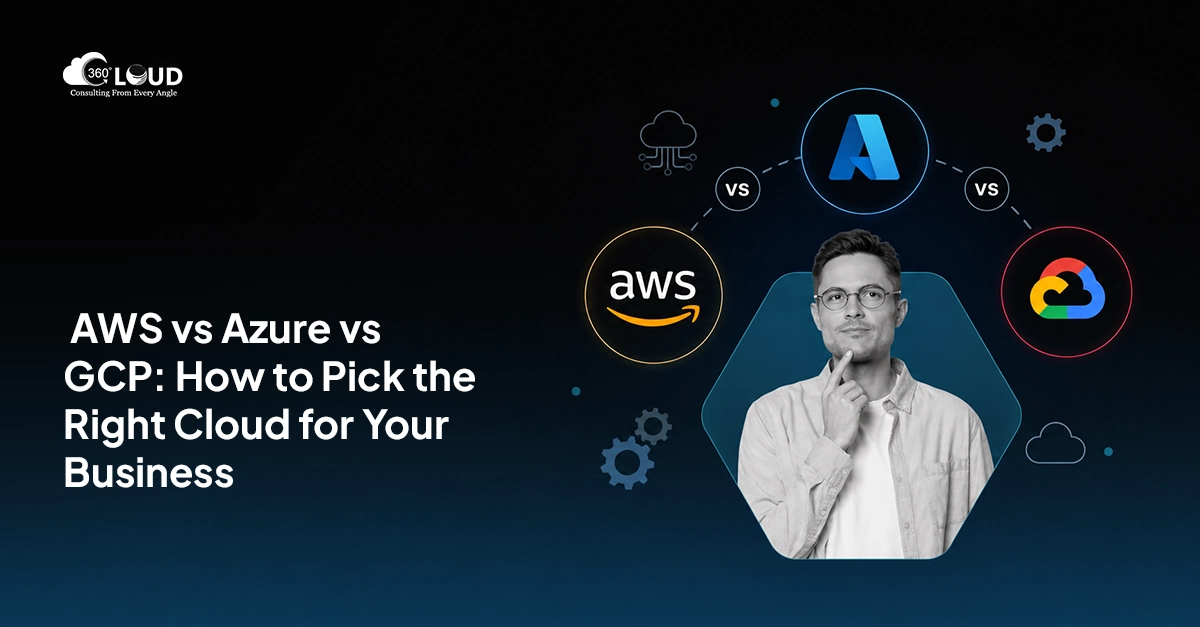
Which brings us to the AWS vs Azure vs GCP debate. It shows up in budget reviews, in strategy meetings, in that one Slack thread that never actually dies. Here’s the thing: each platform is solving the same basic problem, computing on demand, just through very different pricing, tooling, and priorities. Worth saying upfront, there’s no universal right answer here. Just a right answer for your business. This guide walks through what separates AWS, Azure, and GCP, and how to think through the choice without losing a week to comparison charts.
Still weighing a cloud migration or revisiting a platform choice made years ago?

Understanding the Three Major Cloud Providers
AWS, Azure, and GCP get sold as roughly interchangeable. They aren’t. Each one came out of a different company with a different set of priorities, and honestly, that history still shapes how each platform behaves today, sometimes in ways you don’t notice until you’re knee-deep in a migration.
Amazon Web Services (AWS)
AWS was launched in 2006, and for years it barely had competition worth naming.
Ecosystem overview: Over 200 services, spanning compute, storage, and machine learning. Whatever workload you’re dealing with, AWS has probably already built something for it. Probably more than one thing, actually.
Market position: Still the largest slice of the public cloud market, and it shows. Most consulting firms and hiring pipelines get built around AWS first, everything else second.
Strengths: Depth, mostly. A mature partner ecosystem. And the largest talent pool of any provider, which matters a lot more than people admit when they’re the ones trying to hire.
Microsoft Azure
Azure grew out of decades of Microsoft sitting inside enterprise IT departments. That relationship is baked into everything about how the platform works.
Enterprise Integration: Works natively with Active Directory and local Microsoft systems. When an enterprise is using Windows Server and Office 365, two months’ work can become six. It’s not a small perk, but a crucial factor.
Microsoft Ecosystem: Closely works with Microsoft 365 and Power Platform, and therefore Azure will be the natural progression point. It won’t be a purposeful decision. It will be the force of nature.
Advantages: Hybrid cloud through Azure Arc, powerful enterprise licensing, and an advantage for those enterprises that are Windows-based at heart.
Google Cloud Platform (GCP)
GCP is the youngest among the three, and rather than trying to one-up AWS AWS, it chose a path: data and AI.
AI and analytics: Same as Search and YouTube. The BigQuery platform takes that into account, and it’s apparent when working with large amounts of data.
Kubernetes leadership: Google created Kubernetes. Did not adopt it; created it. The GKE remains the most mature Kubernetes solution, according to most experts.
Strengths: Data warehousing, ML pipelines, open source tooling. Companies building AI-based products usually gravitate towards this platform without much fuss.
Table of Contents
AWS vs Azure vs GCP: Feature Comparison
Each provider covers the same broad categories. The differences show up in depth and maturity, not in whether the category exists.
| Category | AWS | Azure | GCP |
| Compute | EC2, Lambda | Virtual Machines, Functions | Compute Engine, Cloud Run |
| Storage | S3, Glacier | Blob Storage | Cloud Storage |
| Networking | VPC, Direct Connect | Virtual Network | VPC, Cloud Interconnect |
| Databases | RDS, DynamoDB | Azure SQL, Cosmos DB | Cloud SQL, Spanner |
| AI/ML | SageMaker, Bedrock | Azure AI Studio | Vertex AI, Gemini |
| Containers | EKS | AKS | GKE |
| DevOps tools | CodePipeline | Azure DevOps | Cloud Build |
| Security | IAM, GuardDuty | Entra ID, Defender | IAM, Security Command Center |
| Monitoring | CloudWatch | Azure Monitor | Cloud Monitoring |
None of these are dramatically weaker than the others. That’s the thing people miss when they go feature-hunting. The real gap shows up in pricing, in how well each fits your existing tools, and in how much operational overhead you’re signing up for.
Get a straight answer on which cloud platform fits your business.

Pricing Comparison
Pay-as-you-go pricing is the baseline everywhere, charged down to the second in most cases. Everything after that gets messy.
Reserved instances buy a discount for a one or three-year commitment, and AWS and GCP allow more flexible sizing here than Azure. Cost optimization tools exist on all three, and to be fair, none of them replace an actual FinOps process. They flag waste. They don’t fix it.
Licensing tips the scale toward Azure more often than expected, specifically for companies holding Microsoft enterprise agreements. And total cost of ownership rarely comes down to sticker price. Data egress fees and specialized engineering talent quietly blow up more migration budgets than any calculator warns you about.
Performance and Scalability
Real global infrastructure exists on all three platforms, with availability zones spread across regions so a single data center hiccup doesn’t take your app down. AWS currently runs the most regions and zones. Azure and GCP aren’t far behind, and both keep expanding fast enough that any “current count” goes stale within a year.
Disaster recovery runs on cross-region replication and automated failover, standard everywhere now. Auto scaling too, it’s table stakes at this point.
High availability is achievable on any of the three. Genuinely. The real question isn’t whether a platform can deliver it, it’s whether your team knows how to architect for it, because most outages trace back to configuration, not the platform underneath.
Security and Compliance
Security posture looks nearly identical across all three on paper. In practice, the difference is about fit, how well each toolset slots into your existing workflows.
- Identity and access management runs through AWS IAM, Microsoft Entra ID, and Google Cloud IAM. Azure feels most natural for organizations already living inside Active Directory.
- Encryption at rest and in transit is standard everywhere, customer-managed keys available on all three.
- Compliance certifications like SOC 2, HIPAA, and ISO 27001 are matched closely between providers.
- Governance tools (AWS Organizations, Azure Policy, GCP’s Organization Policy Service) enforce guardrails at scale, assuming someone actually sets them up.
- Zero Trust capabilities are increasingly built in rather than bolted on, and Azure holds a slight edge given Microsoft’s broader identity footprint.
AI and Data Analytics Comparison
Here’s where the three providers actually feel different. Not just different logos on similar services, genuinely different philosophies.
Generative AI is rapidly evolving in all platforms. AWS provides access to multiple models in Bedrock, Azure emphasizes its partnership with OpenAI, and Google Cloud touts its Gemini AI in Vertex AI. There are differences in terms of maturity and not capability between machine learning platforms. For instance, SageMaker is an extremely capable platform that has a bit of a learning curve.
Data warehouses are where GCP pulls ahead, and it’s not particularly close. BigQuery’s serverless performance is hard to match, though Redshift and Synapse remain solid options for teams already committed elsewhere. Big data and BI tools exist across all three too, and the right pick usually comes down to what your data team already knows.
Best Cloud Platform by Business Scenario
There’s no single winner here. There’s only what fits your situation.
- Startups: AWS or GCP, largely thanks to startup credit programs and pricing that doesn’t punish small usage.
- Small and medium businesses: Azure, especially for teams already on Microsoft 365.
- Enterprise organizations: All three scale fine. Azure often wins anyway, purely on existing licensing.
- SaaS companies: AWS. Breadth of services and hiring pool make it the safer bet at scale.
- Regulated industries: Azure and AWS both carry deep compliance track records, and the tiebreaker is usually whichever one your compliance team has already audited.
- Data-intensive organizations: GCP. Not much debate.
- AI-driven businesses: GCP or AWS, depending on whether you’d rather work inside Google’s model ecosystem or want Bedrock’s flexibility across multiple providers.
Multi-Cloud vs Single Cloud
Running everything on one provider is simpler. Running across two or three is often smarter, assuming your team can handle what that adds.
Multi-cloud gets you out of vendor lock-in, gives you leverage in pricing conversations, and lets you pick the sharpest tool for each workload. But it also means more identity complexity and more people who need to be fluent in more than one platform. Most teams don’t have that bench strength sitting around.
Hybrid cloud setups, blending on-premises infrastructure with public cloud, tend to fit organizations carrying heavy compliance requirements or legacy systems that won’t move cleanly. Single cloud suits smaller teams without dedicated cloud engineering staff. Multi-cloud earns its complexity when business units genuinely need different things, or surviving one provider’s outage actually matters to the bottom line.
Migration Considerations
Before picking a winner in the AWS vs Azure comparison, or any pairing, look inward first.
The technology platform you currently have plays a bigger role in determining what is best than any feature set possibly could. If your company is predominantly a Microsoft shop, moving to Azure will save you months of time compared to some other platforms. A company with open source experience will probably prefer AWS and GCP.
Compatibility of applications, vendor lock-in concerns, and migration costs complete the list of considerations. Lift and shift migration is always cheaper upfront, but does not take full advantage of cloud native platform capabilities. Re-architecting will cost more initially but will pay for itself between 18-24 months, which is not something people realistically budget for.
Decision Framework: Which Cloud Platform Is Right for You?
Run through these before making a final call, not after.
- Business goals: cost, speed, innovation, or realistically some mix of all three?
- Existing software ecosystem: what’s running now, and how much actually needs to move?
- Budget: not just monthly spend, migration and training costs too.
- Compliance needs: which certifications are genuinely non-negotiable?
- AI and analytics requirements: core product feature, or nice-to-have?
- Global expansion plans: where do your customers sit, and who’s strongest there?
- Internal expertise: what can your team run well today, not what they could theoretically learn?
Common Mistakes to Avoid
A lot of cloud migrations go sideways for reasons that were entirely avoidable.
Choosing based only on pricing ignores the operational cost of running a platform nobody knows well. Ignoring long-term scalability means today’s workload fits, sure, but next year’s growth won’t. Underestimating migration complexity is probably the single biggest cause of blown timelines, full stop. Overlooking compliance until after migration gets expensive fast. And failing to optimize cloud costs after go-live quietly drains budget month after month, long after anyone’s watching the bill.
Future Trends in Cloud Computing
Cloud platforms aren’t sitting still, and neither should your strategy, in practice.
AI-first platforms are now the norm, with AI embedded in everything from databases to security. The industry clouds are rising for healthcare, finance, and manufacturing. Platform engineering is transforming the way cloud resources are consumed via self-service platforms. Sustainability continues its rise in importance as vendor selections are based on carbon footprint commitments. And serverless computing is growing beyond functions, towards databases and even whole applications.
The providers that keep winning won’t be the ones with the longest feature list. They’ll be the ones that make these shifts easy to adopt without forcing a rebuild every couple of years.
The decision about whether AWS, Azure, or GCP is the “best” was never truly the question in the first place. The question should always be about which technology fits your organization best, your budget constraints, and your business goals for the future. For those who have taken on a legacy cloud solution that no longer fits their business needs, the IT consultants at 360 Degree Cloud can help.

Categories

Solve It with Salesforce. We’ll Show You How.
AI. Apps. Experts. Everything you need to win with Salesforce under one roof.Frequently Asked Questions
Which is better: AWS, Azure, or Google Cloud?
None of them wins outright, and anyone who tells you otherwise is probably selling something. AWS has the broadest catalogue, Azure fits Microsoft-heavy enterprises best, and GCP leads on data and AI.
Is AWS cheaper than Azure?
Not always. That's actually two questions wearing one trench coat; computed pricing and licensing pricing behave differently. AWS often wins on variable workloads; Azure comes out ahead for companies already holding Microsoft agreements.
Is Google Cloud better for AI?
For data-heavy AI work, generally yes. To be fair, AWS and Azure both have strong generative AI offerings now too, so it depends on the specific use case.
Which cloud provider is best for enterprise businesses?
Azure tends to win when the enterprise already runs Microsoft infrastructure. AWS holds up better for complex, varied workloads and larger engineering teams.
What are the biggest differences between AWS and Azure?
AWS has more services and greater market share, full stop. Azure has deeper Microsoft ecosystem integration. Pricing structures and hybrid cloud tooling diverge more than most comparison charts show.
Which cloud platform is easiest to learn?
Azure, usually, for teams already comfortable with Windows tools. Genuinely, though, all three have real learning curves past the dashboard basics.
Can businesses use multiple cloud providers?
Yes. Many already do without calling it a "strategy." Multi-cloud setups are common among larger organizations, though they demand more operational maturity than most teams expect.
How do I choose the right cloud platform?
Start with your existing systems, team skills, budget, and compliance needs. Then map those against what each provider is actually good at, not what their marketing says.
Which cloud platform offers the best security?
All three meet enterprise-grade standards. That rarely changes the decision. What differs is how well each platform's identity and governance tools fit what you're already running.
Which provider is best for startups?
AWS and GCP, mostly because of generous startup credit programs. Pricing scales with usage instead of punishing small teams for staying small, at least for a while.

About the author
Editorial TeamThe Editorial Team at 360 Degree Cloud brings together seasoned marketers, Salesforce specialists, and technology writers who are passionate about simplifying complex ideas into meaningful insights. With deep expertise in Salesforce solutions, B2B SaaS, and digital transformation, the team curates thought leadership content, industry trends, and practical guides that help businesses navigate growth with clarity and confidence. Every piece we publish reflects our commitment to delivering value, fostering innovation, and connecting readers with the evolving Salesforce ecosystem.
Recent Blogs
 Salesforce Services
Salesforce Health Check: What It Is, What It Covers, and What You Should Do with the Results
Picture this. A VP of Sales asks why the pipeline number in Salesforce is $2.3 million, but the finance report shows $1.8 million. Nobody has…
Read More Salesforce Clouds
Salesforce Just Added Something New. Here’s How to Put It to Work.
Winter ’27 is live. Dreamforce just added more. Is your team using any of It? Two big drops landed in one month, and most teams…
Read More Salesforce Services
Salesforce Technical Debt 10 Signs Your CRM Needs a Strategic Overhaul (and What to Do About It)
Three years ago, the Salesforce org your team implemented was clean. Logical field names. Documented Flows. A handful of integrations that actually made sense. Today?…
Read MoreReady to Make the Most Out of Your Salesforce Instance?
Our Salesforce aces would be happy to help you. Just drop us a line at contact@360degreecloud.com, and we’ll take it from there!
Subscribe to our newsletter
Stay ahead with expert insights, industry trends, and exclusive resources—delivered straight to your inbox.