
Best Salesforce Consulting Services in 2026: What to Look for and How to Choose the Right Partner
28 Aug 2019
Table of Contents
Salesforce can do a lot. Most teams using it would tell you it can do more than they’ve actually figured out. And that gap – between what the platform is capable of and what a business actually gets from it – is often where the real cost hides.
The problem isn’t the software. It’s that getting Salesforce to work the way your business works takes more than licenses and a basic setup. It takes someone who’s been inside enough implementations to know where the landmines are. Someone who’s seen what “we’ll customize it later” becomes six months down the road.
That’s what Salesforce consulting services are for. And in 2026, with Agentforce, Einstein AI, and Data Cloud changing what the platform can do, finding the right consulting partner matters more than it used to.
Here’s what to look for, what to ask, and how 360 Degree Cloud approaches this work.
 What Are Salesforce Consulting Services?

At the core, Salesforce consulting covers the work a business can’t easily hand to a single in-house admin. Implementation, customization, integration, data migration, managed support – these are the pieces most organizations need outside help with at some point.
An in-house Salesforce admin handles day-to-day operations: user management, basic configuration, reports. They’re valuable. But when a company is doing a full implementation, switching from a legacy CRM, connecting Salesforce to an ERP, or standing up Agentforce for the first time – that’s where a dedicated consulting partner earns its place.
The 2026 Salesforce ecosystem isn’t what it was in 2020. The platform is genuinely more complex. Agentforce means AI agents are now a real implementation question, not a hypothetical. Data Cloud means data architecture decisions have downstream consequences most teams aren’t equipped to fully anticipate. Generic setups don’t work the way they used to. A consultant who did ten basic Sales Cloud rollouts three years ago isn’t the same as one who’s done it recently with current tooling.
What Do the Best Salesforce Consulting Services Include?
Not all Salesforce consulting looks the same. A partner worth working with should cover the full stack, not just the easy parts.
Implementation is the starting point – configuring the org, migrating data from legacy systems, setting up your core objects and processes. Done right, it saves months of cleanup later. Done poorly, it’s the first thing everyone blames when something doesn’t work.
Customization is where real lift happens. Apex development, Lightning components, custom objects built around your actual process – not Salesforce’s idea of your process. This is where a partner’s platform depth shows.
Integration is often underestimated. Connecting Salesforce to an ERP, a marketing platform, a billing system, a custom data source – this is usually more complicated than the initial implementation. MuleSoft, REST/SOAP APIs, middleware layers. Getting this right determines whether Salesforce becomes the system of record or just another silo.
Managed services matter after go-live. Most teams need ongoing admin support, optimization work, and someone to catch issues before they turn into fires. A good partner doesn’t disappear after the project closes.
Staff augmentation is a separate model entirely – on-demand certified Salesforce resources who work as an extension of your team. Useful when you have internal capacity gaps but don’t want to take on permanent headcount.
Training is the part that often gets cut when budgets get tight. That’s a mistake. User adoption is where most Salesforce implementations quietly fail.

How to Choose the Best Salesforce Consulting Companies

This is where most buyers get it wrong. They focus on price first and credentials second. Then they end up repeating the engagement six months later with someone else.
A few things actually matter here.
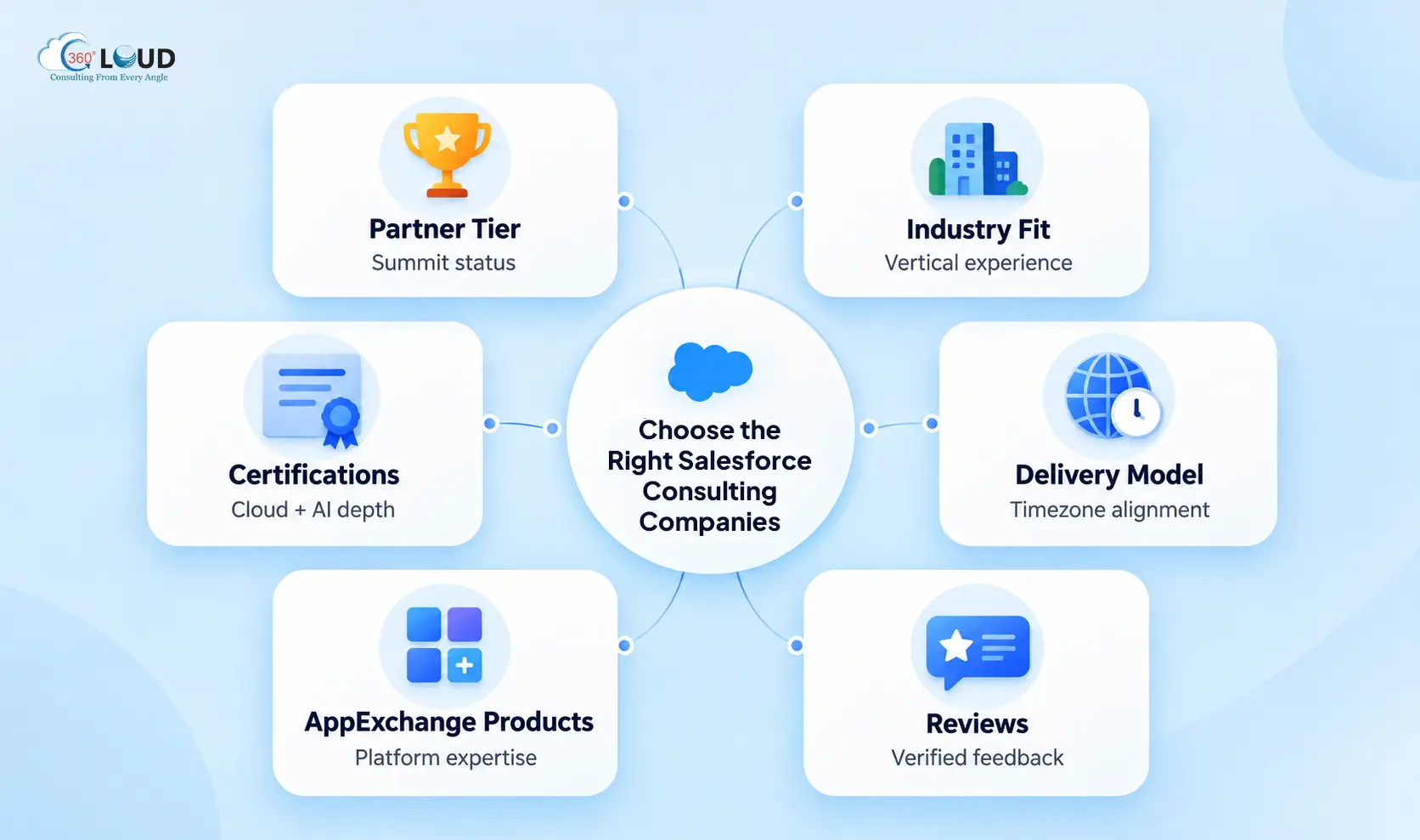
Salesforce tier. Summit Partner status – the highest certification level in Salesforce’s partner program – isn’t just a badge. It reflects certified headcount, customer satisfaction scores, and Salesforce ACV contribution. It means Salesforce has verified, repeatedly, that this partner knows the platform.
Industry experience. A financial services firm and a healthcare system have different Salesforce needs. A partner who’s done meaningful work in your vertical will ask better questions in week one and build better solutions in week four.
Certifications. Not just the count – the spread. You want a partner with depth across Sales Cloud, Service Cloud, Marketing Cloud, Experience Cloud, and increasingly, Agentforce and Data Cloud. Specialists matter.
Delivery model. Onshore, offshore, nearshore – each has trade-offs. What fits depends on your time zone, your communication preferences, and your budget. Worth asking explicitly: how does their team structure work for your time zone?
AppExchange products. A consulting partner that also builds AppExchange products has a different relationship with Salesforce’s architecture. Building a product forces you to understand platform limitations and capabilities at a level that client work alone doesn’t require.
Reviews. The AppExchange partner listing exists for a reason. Customer reviews there are harder to game than a testimonial page.
What Years of Experience Taught Us About Making Salesforce Consulting Work
That’s the number. And it comes with some observations that are honest, not polished.
360 Degree Cloud has been doing Salesforce work since before Agentforce was a word anyone used. Summit (Platinum) Partner status. 500+ certified Salesforce consultants across Sales Cloud, Service Cloud, Marketing Cloud, Experience Cloud, and Agentforce. Industry work in financial services, healthcare, manufacturing, education, and retail.
In practice, the pattern across failed implementations is consistent: either the discovery was rushed, the integration was underscoped, or the handoff to end users was treated as optional. It sounds simple. It mostly is – but most teams still skip the steps that prevent these things.
Being an AppExchange product developer changes how this team thinks about consulting. When you build products that live inside Salesforce orgs, you care about governor limits, scalability, and how your work affects adjacent configurations. That mindset carries into delivery work.
Worth saying: there’s a meaningful difference between a partner who treats each engagement as a standalone project and one who builds the implementation with what comes next in mind. The second type is harder to find and worth looking for.
Salesforce Consulting Services 360 Degree Cloud Offers
Here’s what the engagement actually covers:
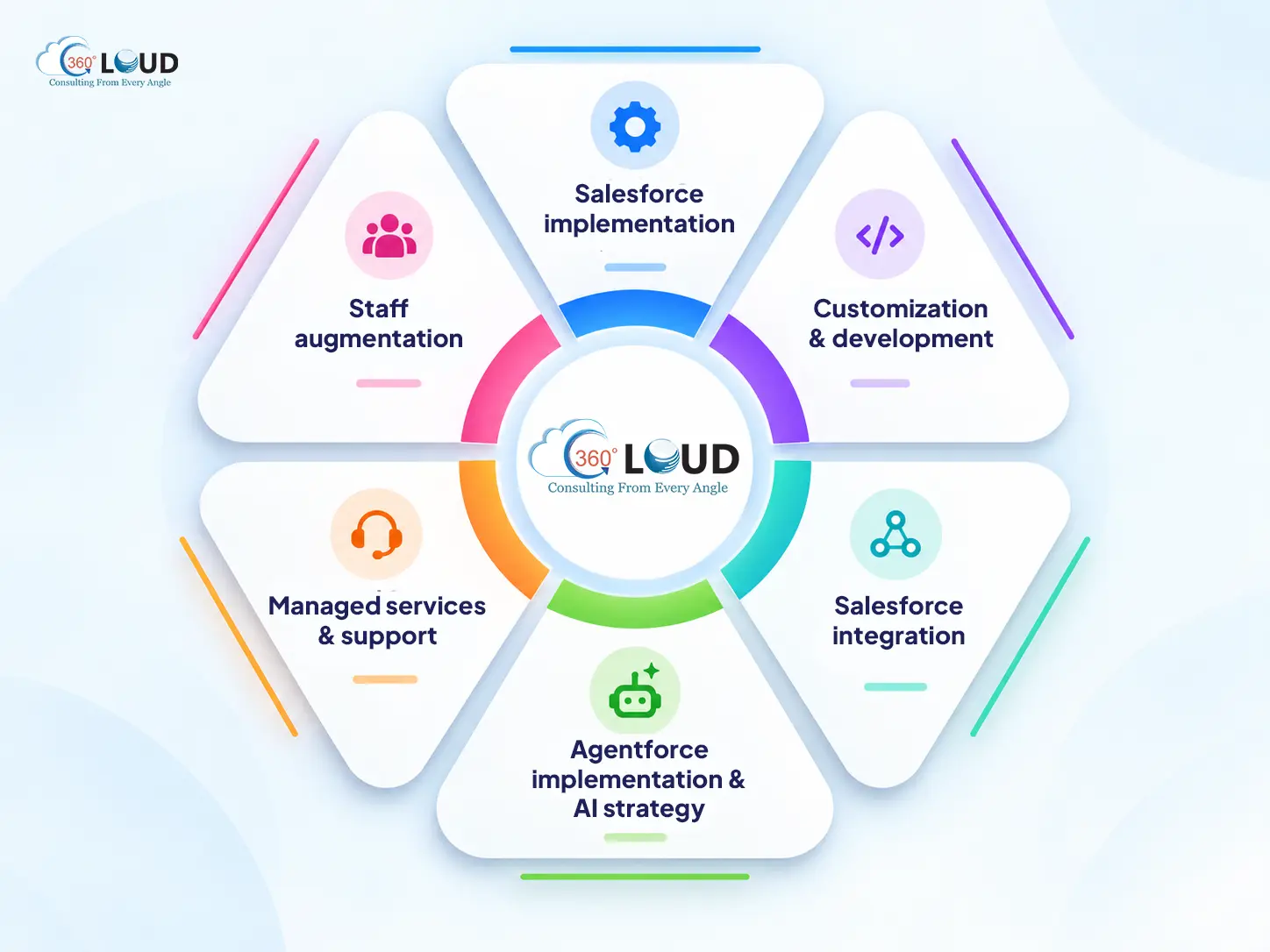
- Salesforce implementation – Sales Cloud, Service Cloud, Experience Cloud, Marketing Cloud, Revenue Cloud. Full setup, data migration, configuration built around your workflows.
- Customization and development – Apex, Lightning Web Components, custom objects, flows, and process automation tailored to what your team actually does.
- Salesforce integration – MuleSoft, REST/SOAP APIs, connections to ERP systems, marketing tools, third-party platforms. End-to-end integration architecture, not just point-to-point fixes.
- Agentforce implementation and AI strategy – designing and deploying AI agents inside Salesforce for real business use cases. Not a demo. An actual implementation strategy.
- Managed services and support – ongoing admin, optimization, monitoring, and proactive issue resolution after go-live.
- Staff augmentation – certified Salesforce resources who slot into your team structure for the duration you need them.
Flexible engagement models: project-based, managed services, or augmentation. The right model depends on what you’re trying to get done and how your internal team is structured.
Final Thoughts
Choosing a Salesforce consulting partner isn’t a checklist exercise – though the checklist helps. The actual signal is whether the partner asks good questions before they have answers. Whether they tell you what’s going to be complicated before you’re in the middle of it.
If you’re evaluating partners right now, 360 Degree Cloud’s Salesforce consulting services are worth a conversation. 14+ years in the ecosystem, Summit Partner status, and a team that’s seen enough implementations to know where the real problems tend to live.

Categories
Solve It with Salesforce. We’ll Show You How.
AI. Apps. Experts. Everything you need to win with Salesforce under one roof.FAQs
How long does a Salesforce consulting engagement typically take?
It depends on scope - genuinely. A standard Sales Cloud implementation for a mid-size team might run 8–12 weeks. A multi-cloud rollout with ERP integration and custom development can take 6–9 months. Any partner who gives you a firm timeline before understanding your requirements is guessing. Ask for a phased estimate with assumptions made explicit.
What should be included in a Salesforce consulting statement of work?
Scope definition, milestone schedule, delivery ownership (what the partner builds vs. what your team provides), assumptions and exclusions, change order process, and post-go-live support terms. The exclusions section matters most. That's where scope creep starts.
How do I evaluate competing Salesforce consulting proposals side by side?
Compare on: team certifications (not company-level count - ask who's actually on your project), discovery depth in the proposal (did they ask real questions or just send a template?), how they handle integrations, and what post-go-live support looks like. Price is the easiest thing to compare and often the least informative.
What is the typical ROI of a Salesforce consulting engagement?
Salesforce's own research has pointed to meaningful returns on well-executed implementations - better sales productivity, faster case resolution, cleaner data. In practice, ROI correlates almost directly with how well the implementation was scoped and adopted. A poorly implemented org with low adoption produces low ROI, regardless of what the platform is theoretically capable of.
Can I switch Salesforce consulting partners mid-project?
Yes, and it happens more often than anyone admits. The transition costs are real - knowledge transfer, documentation gaps, relationship rebuilding. Worth doing if the current partner is genuinely off track. Worth avoiding if the frustration is more about pace than direction. Before switching, get an independent technical review first.
What is the difference between a Salesforce Summit Partner and a Registered Partner?
Summit is the highest tier. Registered is where partners start. The tiers between them - Base, Ridge, Crest, Summit - reflect certified consultant headcount, customer success scores, and Salesforce revenue contribution. Summit partners are audited against these criteria regularly. It's not a lifetime achievement status.
Is Salesforce consulting worth it for a small business with fewer than 20 users?
Often yes, though the engagement model should match the size. A small business probably doesn't need a six-month implementation project. What it does need is someone to set the org up correctly from the start - because cleaning up a messy Salesforce org later costs more than doing it right initially. Look for partners who offer scoped, fixed-price packages for smaller teams.
What questions should I ask a Salesforce consulting company before signing a contract?
Ask who specifically will be working on your project (not just the seniority of the team in general). Ask how they handle scope changes. Ask for references from clients in your industry. Ask what their post-go-live support model looks like. And ask what they'd flag as the highest-risk part of your implementation - a partner who answers that question well has done enough projects to know where things break.

About the author
Editorial TeamThe Editorial Team at 360 Degree Cloud brings together seasoned marketers, Salesforce specialists, and technology writers who are passionate about simplifying complex ideas into meaningful insights. With deep expertise in Salesforce solutions, B2B SaaS, and digital transformation, the team curates thought leadership content, industry trends, and practical guides that help businesses navigate growth with clarity and confidence. Every piece we publish reflects our commitment to delivering value, fostering innovation, and connecting readers with the evolving Salesforce ecosystem.
Recent Blogs
 Salesforce Services
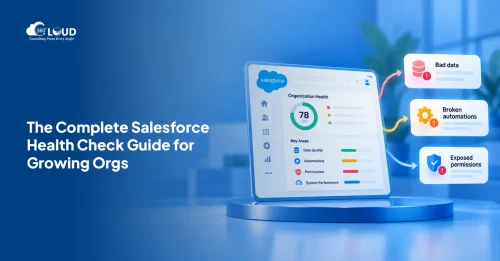
Salesforce Health Check: What It Is, What It Covers, and What You Should Do with the Results
Picture this. A VP of Sales asks why the pipeline number in Salesforce is $2.3 million, but the finance report shows $1.8 million. Nobody has…
Read More Salesforce Clouds
Salesforce Just Added Something New. Here’s How to Put It to Work.
Winter ’27 is live. Dreamforce just added more. Is your team using any of It? Two big drops landed in one month, and most teams…
Read More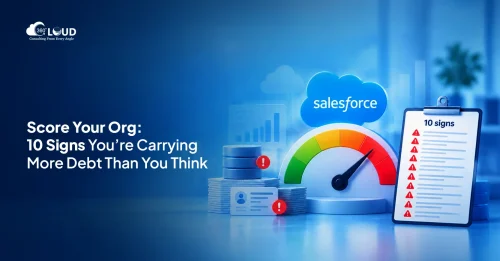 Salesforce Services
Salesforce Technical Debt 10 Signs Your CRM Needs a Strategic Overhaul (and What to Do About It)
Three years ago, the Salesforce org your team implemented was clean. Logical field names. Documented Flows. A handful of integrations that actually made sense. Today?…
Read MoreReady to Make the Most Out of Your Salesforce Instance?
Our Salesforce aces would be happy to help you. Just drop us a line at contact@360degreecloud.com, and we’ll take it from there!
Subscribe to our newsletter
Stay ahead with expert insights, industry trends, and exclusive resources—delivered straight to your inbox.