
Salesforce Implementation: A Complete Guide to Getting It Right in 2026
Updated On: 05 Nov 2026
Table of Contents
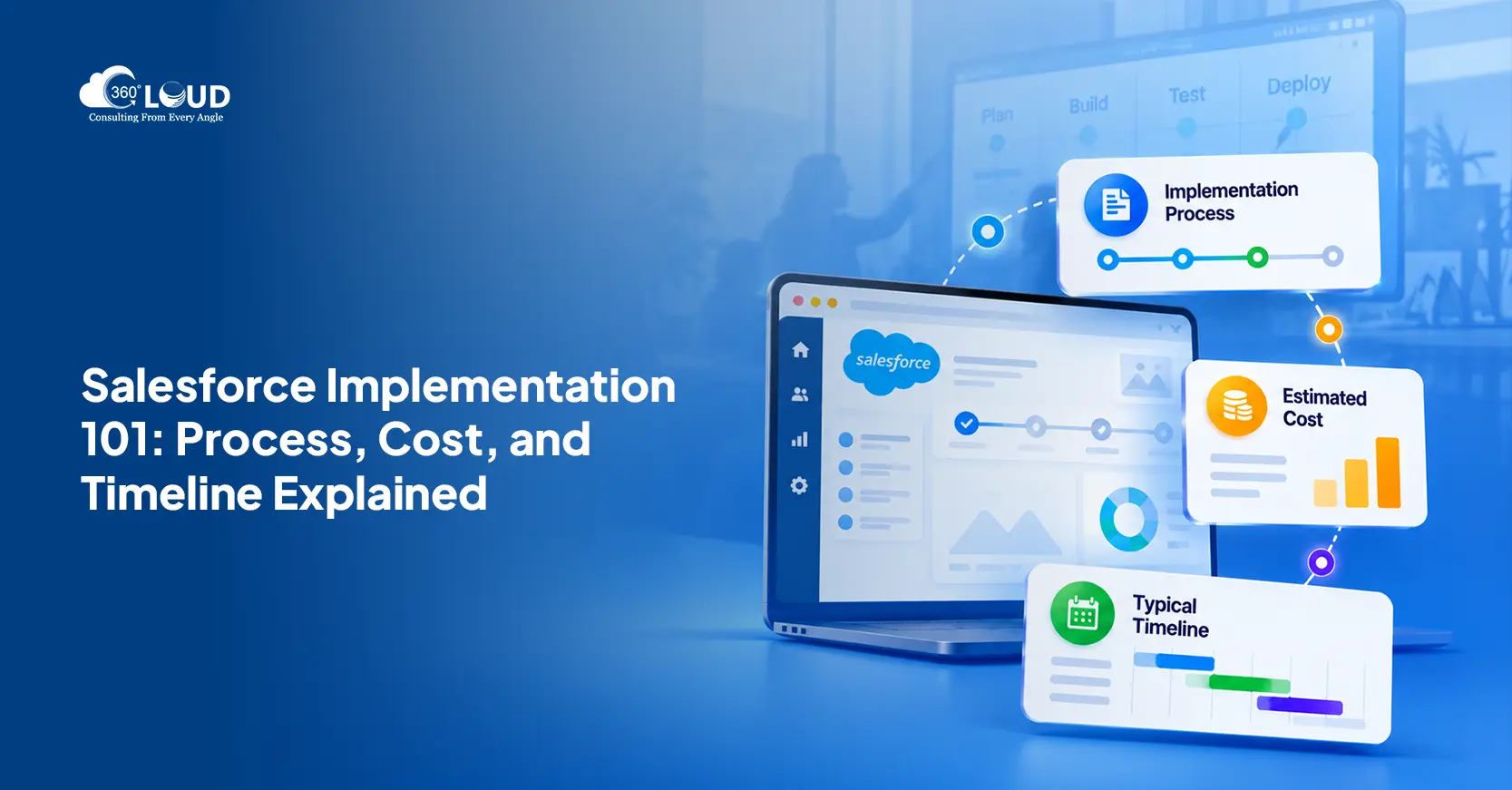
Over 40% of Salesforce implementations underperform in the first year. Not because the platform is wrong. Because the implementation was.
That’s a hard number to sit with – especially for leadership teams who approved the budget, championed the rollout internally, and told their boards this would change how the business operates. The platform didn’t fail them. The approach did.
What separates a Salesforce implementation that transforms a business from one that creates two years of cleanup work? It’s rarely one big mistake. It’s usually a sequence of smaller ones – skipped discovery, rushed data migration, no change management, a go-live that tried to do everything at once. Any single one of these is recoverable. Several together, and you’re rebuilding.
This guide covers what Salesforce implementation actually involves, how the process works step by step, realistic timelines, what it costs, and the mistakes that derail even well-funded projects.
Table of Contents
What Is Salesforce Implementation?
Salesforce implementation is the process of deploying, configuring, customizing, and integrating Salesforce CRM to match your specific business processes – from initial setup through user go-live and beyond.
What it is not: installing an app and handing it to the sales team.
A real implementation involves data migration from your existing CRM or spreadsheets, process design that maps how your business actually operates, customization that closes the gap between out-of-the-box Salesforce and how your team works, integrations with the tools your business depends on, training that drives actual adoption, and an adoption plan that keeps the system used after the consultant leaves.
The full scope runs strategy → design → build → test → deploy → adopt → optimize. Most underperforming implementations skip or compress one of those stages. The stage they skip is almost always the one that causes the most expensive problems later.
How to Implement Salesforce: Step-by-Step Process
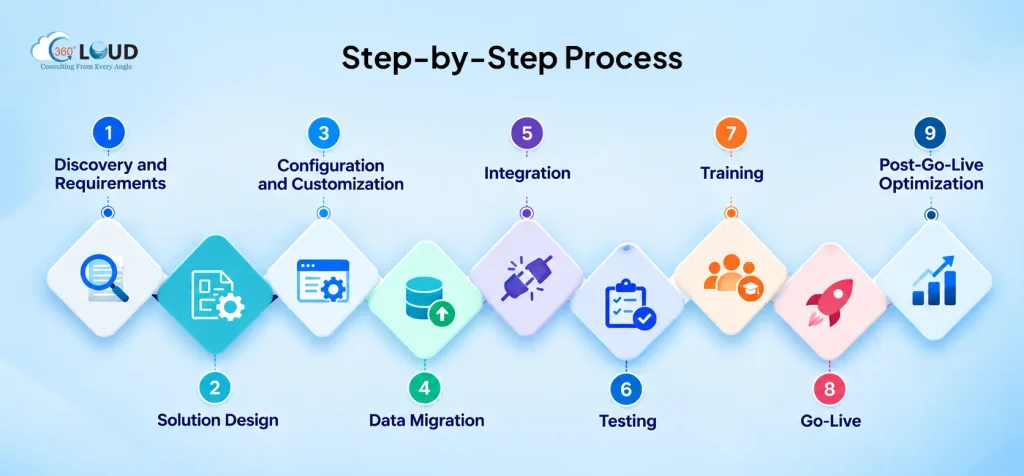
Step 1: Discovery and Requirements
Define what success looks like before a single object gets configured. Map current processes, identify gaps between what the business needs and what the current system provides, and document requirements with enough specificity that the design phase has something real to work from. Skipping this step is the single most common reason implementing Salesforce costs more than planned.
Step 2: Solution Design
Architect the Salesforce solution – which clouds, what data model, how objects relate to each other, where automation lives, what gets built versus what gets bought. Decisions made here echo through every phase that follows. A wrong data model doesn’t just affect reporting – it affects how AI agents read records, how integrations map fields, and how every future feature gets built.
Step 3: Configuration and Customization
Configure objects, fields, page layouts, record types, and automation logic. Build Flows for process automation. Write Apex where native configuration genuinely can’t do the job. The most expensive mistake here is over-customizing – building things Salesforce already provides natively, just because the team didn’t know the native capability existed.
Step 4: Data Migration
Clean, map, and migrate existing data from your current CRM, spreadsheets, or legacy system. Garbage in, garbage out. This is the phase most projects underestimate – not the technical migration itself, but the data quality work that has to happen before anything can be migrated cleanly.
Step 5: Integration
Connect Salesforce to your ERP, marketing automation platform, service tools, and any other system that needs to share data with the CRM. Integration complexity is the most common reason timelines extend. An integration that looks simple in the design phase often surfaces dependencies nobody mapped in discovery.
Step 6: Testing
User acceptance testing, regression testing, QA across all configured functionality. Testing is not optional and it is not fast. A UAT phase that gets compressed to hit a go-live date is a support nightmare waiting to happen.
Step 7: Training
Role-based training for every user group, dedicated admin training, and change management that addresses the human side of adoption – not just the technical side. In practice, this is the phase that determines whether the platform gets used or ignored after go-live.
Step 8: Go-Live
Phased or full deployment, depending on scope and risk tolerance. Phased is almost always the right answer for complex implementations.
Step 9: Post-Go-Live Optimization
Monitor adoption metrics, identify gaps in usage, fix what didn’t land as expected, and add capabilities iteratively. Most teams don’t. The orgs that get the most from Salesforce treat go-live as the beginning of the process, not the end.
Salesforce Implementation Timeline: How Long Does It Take?
Realistic timelines, not optimistic ones:
- Small implementation (Sales Cloud, ~20 users): 6–10 weeks
- Mid-market (multi-cloud, integrations, larger team): 3–6 months
- Enterprise (custom builds, complex data migrations, multiple clouds): 6–18 months
What pushes timelines out? Scope creep – requirements that expand after the design phase is signed off. Data quality issues that only surface during migration. Integration complexity that wasn’t fully scoped in discovery. And change management – teams that resist adoption slow down testing, delay UAT sign-off, and create rework cycles that nobody budgeted for.
Worth saying: the businesses that hit their timelines almost always have a strong internal project sponsor with actual authority to make decisions. The ones that run long usually don’t.

How Much Does Salesforce Implementation Cost?
Ranges vary significantly by scope:
- Simple implementation (single cloud, limited customization): $15,000–$50,000
- Mid-market (multi-cloud, integrations, moderate customization): $50,000–$200,000
- Enterprise (complex builds, large data migrations, multiple integrations): $200,000+
The hidden costs are where budgets get surprised. Change management and training are frequently underestimated or cut first when costs run high – which is exactly backwards, since adoption is what determines ROI. Ongoing optimization post-go-live requires either internal admin capacity or a managed services engagement. And Salesforce license costs beyond the base subscription add up fast as user counts and feature requirements grow.
That’s the thing about implementation cost. The number that matters isn’t what you spend on the project. It’s what you get back from the platform in the 12 months after go-live.
Common Salesforce Implementation Mistakes to Avoid
These show up across implementations at every budget level:
- Treating it as an IT project. Salesforce implementation is a business transformation. When IT owns it without strong business stakeholder involvement, the result is a technically correct system that doesn’t match how the business actually operates.
- Skipping discovery. Building before you know what’s needed produces a system that’s configured for assumptions, not reality.
- Over-customizing. Every custom component is future maintenance. Every piece of Apex is something an admin can’t touch without a developer. Build natively wherever possible – Salesforce invests billions in its platform so you don’t have to build from scratch.
- Poor data migration planning. Data quality work isn’t a pre-implementation task you can schedule a week before go-live. It’s a project phase. Treat it like one.
- No change management. Users ignore systems they weren’t involved in designing and weren’t properly trained on. Adoption doesn’t happen by default.
- Big-bang go-live. Deploying everything at once maximizes risk and minimizes the ability to course-correct. Phased releases let you learn before you’re fully committed.
- Not hiring a certified partner. Genuinely. The cost of fixing a self-implemented or poorly implemented Salesforce org almost always exceeds the cost of getting a certified partner in from the start.
How to Maximize Your Salesforce Investment
Start with clear business goals – not platform goals. What does success look like in 90 days? In 12 months? Define it in business terms: pipeline velocity, case resolution time, contract turnaround, whatever the org was implemented to improve. Without those benchmarks, there’s no way to measure whether the investment is working.
Use phased releases. Go live with core functionality first, validate adoption, then add capabilities. This approach consistently produces better outcomes than a full deployment from day one.
Invest in user adoption like it’s a product launch. Because it is. Training, communication, reinforcement – these aren’t soft activities. They’re the mechanism that turns a Salesforce license into business value.
And leverage Agentforce and Einstein AI early. The orgs getting the most from the platform right now aren’t the ones with the most features configured – they’re the ones that built a clean foundation and layered AI on top of it deliberately.
What We’ve Seen Make or Break Salesforce Implementations Across 1,500+ Projects
After 14 years as a Salesforce Summit Partner and more than 1,500 implementations delivered across 30+ industries, the patterns are clear. The projects that succeed share three things: strong discovery, genuine executive sponsorship, and a partner who treats go-live as mile one, not the finish line.
360 Degree Cloud delivers across the full implementation lifecycle – strategy, implementation, integration, training, and managed services post-go-live. With US delivery capability including Washington, D.C., and a team of 500+ certified consultants, the engagements are built to go live on time and actually get used after they do.
Final Thoughts
Getting a Salesforce implementation right in 2026 is harder than it was three years ago – not because the platform is more complicated, but because the expectations are higher. Agentforce, Einstein AI, Data Cloud – these are tools that reward a clean, well-structured foundation and punish a rushed one.
The 40% that underperform in year one aren’t failed implementations. They’re implementations that could have worked with a different approach. The difference between that group and the ones driving real ROI usually comes down to the decisions made in the first few weeks of the project – before a single object gets configured.

Categories

Solve It with Salesforce. We’ll Show You How.
AI. Apps. Experts. Everything you need to win with Salesforce under one roof.FAQs
What is the difference between Salesforce implementation and Salesforce migration?
Implementation is the full process of deploying and configuring Salesforce for your business - including data migration as one phase within it. Migration specifically refers to moving existing data from a legacy CRM, spreadsheets, or another system into Salesforce. You can have a migration without a full implementation (moving data into an already-live org) but you can’t have a proper implementation without a migration plan. Most teams underestimate the migration phase because it looks like a technical task. It’s actually a data quality project that happens to end with a technical step.
What is a Salesforce implementation checklist and what should it include?
A solid checklist covers: business requirements documented and signed off, data quality assessment completed, solution design reviewed and approved, sandbox environment configured and tested, user acceptance testing completed by real end users, training delivered by role, data migration validated with a test run, go-live communication sent to all users, post-go-live support coverage confirmed, and a 30-day check-in scheduled. The items that most teams leave off - data quality assessment and post-go-live support coverage - are usually the ones that cause the most problems.
How many users does a company need before a formal Salesforce implementation project makes sense?
There’s no minimum. Even a 10-user sales team benefits from a properly structured implementation. The real question isn’t headcount - it’s complexity. A 15-person team with multiple integrations, a data migration from a legacy CRM, and custom processes needs a formal implementation. A 50-person team with a clean Sales Cloud deployment and minimal customization might not. Scope and complexity determine the need, not user count.
What happens after Salesforce implementation is complete - who manages the org going forward?
Someone has to. The options are a trained internal Salesforce admin, a managed services engagement with your implementation partner, or a hybrid of both. Orgs that go live without a clear post-go-live ownership plan degrade quickly - adoption slips, configurations drift, and small problems compound into expensive ones. The question of who manages the org after go-live should be answered before the implementation starts, not after.
Can I implement Salesforce myself without a certified partner?
Technically, yes. For a very simple Sales Cloud deployment with minimal customization and a small team, a self-implementation is possible. In practice, the cost of getting it wrong - rework, data quality remediation, adoption recovery, technical debt - almost always exceeds what a partner engagement would have cost. The Salesforce Ben Admin Survey 2026 puts self-implemented orgs at 40 to 60% lower adoption rates. That adoption gap is where ROI goes to die.
What certifications should a Salesforce implementation partner hold?
At minimum: Salesforce Administrator, Sales Cloud Consultant, and Service Cloud Consultant for the relevant clouds. For more complex implementations: Platform Developer certifications for custom builds, Integration Architecture Designer for heavy integration work, and Data Architecture and Management Designer for complex data models. At the firm level, Summit (formerly Platinum) or Gold Partner status is the benchmark for delivery quality. Certification breadth across the team matters more than any single certification.
How do I know if my Salesforce implementation is heading off track?
A few signals are hard to ignore: scope is expanding without timeline or budget adjustments, testing is being compressed to protect the go-live date, key stakeholders have stopped showing up to status calls, or the implementation team is making design decisions without business input. The most dangerous sign is a go-live date that feels immovable regardless of what’s been completed. A delayed go-live on a solid foundation is recoverable. A rushed go-live on a shaky one is not.
What is the difference between a phased Salesforce rollout and a big-bang go-live?
A phased rollout deploys core functionality first - typically to a pilot group - validates adoption and performance, then adds capabilities and expands to the full user base in subsequent releases. A big-bang go-live deploys everything to everyone at once on a single date. Phased rollouts cost more in planning and take longer to reach full deployment. They also fail far less often. Big-bang go-lives are faster on paper and significantly higher risk in practice. For anything beyond a simple single-cloud deployment, phased is the right approach.

About the author
Editorial TeamThe Editorial Team at 360 Degree Cloud brings together seasoned marketers, Salesforce specialists, and technology writers who are passionate about simplifying complex ideas into meaningful insights. With deep expertise in Salesforce solutions, B2B SaaS, and digital transformation, the team curates thought leadership content, industry trends, and practical guides that help businesses navigate growth with clarity and confidence. Every piece we publish reflects our commitment to delivering value, fostering innovation, and connecting readers with the evolving Salesforce ecosystem.
Recent Blogs
 Salesforce Clouds
Salesforce Agrees to Acquire Braze: What It Means for Marketing Cloud
Salesforce Acquires Braze for $5.66 Billion - What It Means for Marketing Cloud
Read More Salesforce Services
What is Salesforce Implementation? Everything Decision-Makers Need to Know Before They Start
Most companies don’t buy Salesforce and then wonder what to do with it. They buy Salesforce because something is broken – deals are being tracked…
Read More Salesforce Clouds
Marketing Cloud Engagement to Next: What Actually Has to Be Rebuilt
Nobody tells you this upfront, but migrating from Marketing Cloud Engagement to Marketing Cloud Next isn’t a lift-and-shift. It’s a rebuild – component by component,…
Read MoreReady to Make the Most Out of Your Salesforce Instance?
Our Salesforce aces would be happy to help you. Just drop us a line at contact@360degreecloud.com, and we’ll take it from there!
Subscribe to our newsletter
Stay ahead with expert insights, industry trends, and exclusive resources—delivered straight to your inbox.