
Salesforce Technical Debt 10 Signs Your CRM Needs a Strategic Overhaul (and What to Do About It)
13 Oct 2026
Table of Contents

Three years ago, the Salesforce org your team implemented was clean. Logical field names. Documented Flows. A handful of integrations that actually made sense.
Today? Reports contradict each other, your admin says “that’ll take longer than expected” to every single request, and nobody can quite explain why.
That’s not a people problem. That’s Salesforce technical debt – and it’s more common than most leadership teams realize.
According to the Salesforce Ben Admin Survey 2026, 56.3% of Salesforce admins name technical debt as their number one challenge this year. That number matters. Because if more than half the people running your org are weighed down by past decisions, they’re not building what you actually need.

This article breaks down what technical debt is, what it costs you in real dollars, how to spot it, and – critically – when it’s time to stop patching and start over strategically. If you’re already wondering whether your org is in trouble, 360 Degree Cloud’s Salesforce consulting team has helped hundreds of organizations work through exactly this.
Table of Contents
What Is Salesforce Technical Debt?
Here’s a definition that actually sticks: technical debt is the accumulated cost of shortcuts, rushed customizations, deprecated tool usage, and unmanaged configurations that build up over time inside a Salesforce org. Every workaround someone ran to hit a deadline. Every automation nobody documented. Every field added without a naming convention.
Salesforce makes this uniquely tricky. Unlike most platforms, debt here shows up in both clicks and code – a Process Builder nobody wants to touch, Workflow Rules conflicting with Flows, Apex classes written by an admin who left three years ago with comments, if they exist at all, that don’t make sense.
There’s also a newer problem in 2026: vibe-coding. AI tools let anyone build automations quickly without understanding the underlying logic. Which means teams are creating tomorrow’s debt today, fast, and with confidence.
In practice, debt falls into three categories:
- Code debt – legacy Apex, dead classes, outdated triggers
- Configuration debt – redundant objects, unmaintained fields, layered permission sets nobody fully understands
- Data debt – duplicate records, stale account hierarchies, unmaintained reference data
Most orgs carry all three. Simultaneously.
What Salesforce Technical Debt Actually Costs Your Business
McKinsey research puts it plainly: technical debt consumes 20 to 40% of total technology value. Apply that to a $300,000 annual Salesforce investment and you’re potentially burning $60,000 to $120,000 a year just absorbing the drag of past decisions. That’s not theoretical – that’s budget.
Where does the cost actually hide? Slower development cycles. Consultant estimates that come in 3× higher than expected because “touching that could break something else.” System outages during peak hours. And, maybe worst of all, reporting errors that drive bad business decisions made on bad data.
The compounding effect is the part that catches most organizations off guard. Every new feature built on top of existing debt creates more debt. You’re not just carrying the original weight – you’re adding to it, quarter after quarter, often without realizing it’s happening.
10 Signs Your Salesforce Org Has a Technical Debt Problem
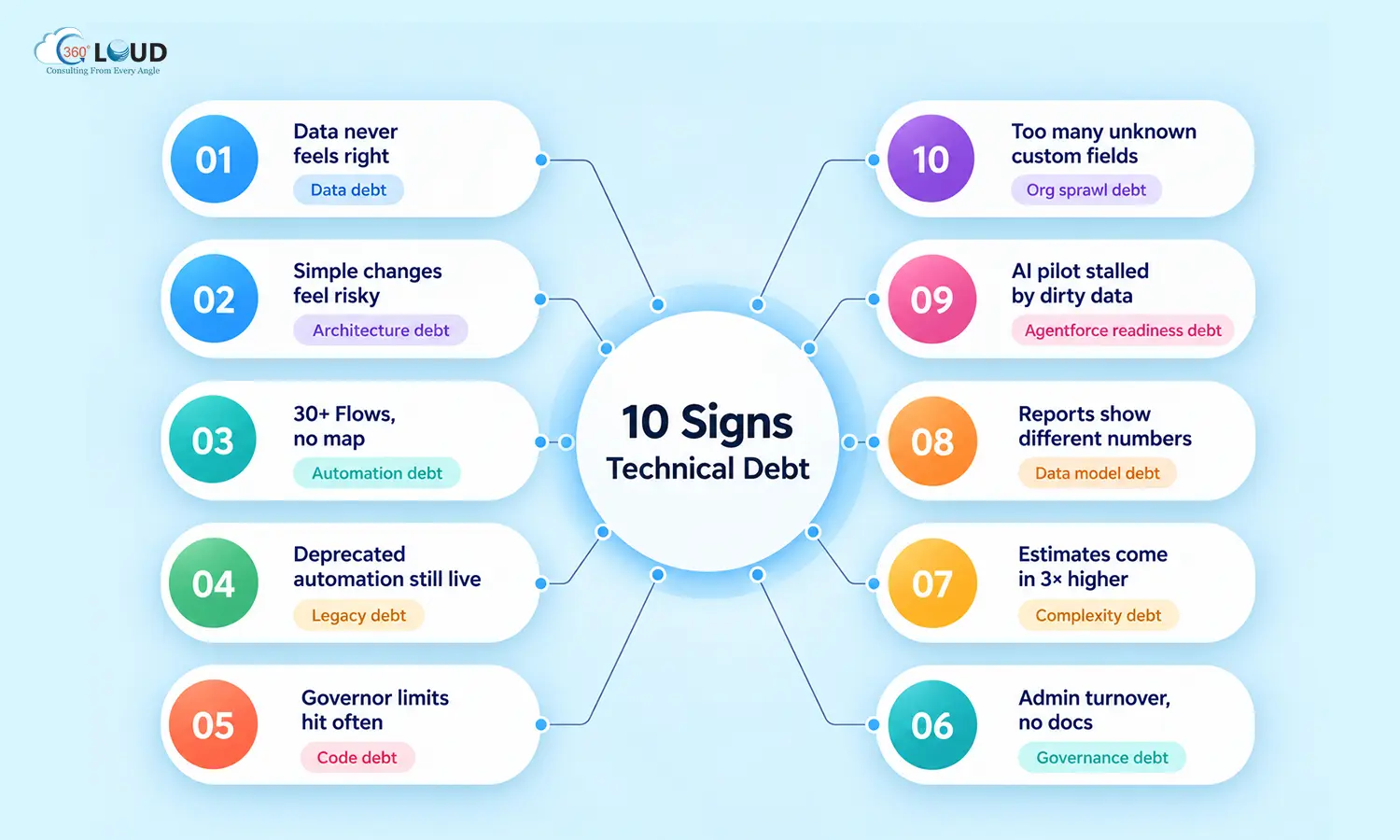
Run through this honestly. Yes or no.
- Your sales team regularly says “the data in Salesforce is never right” – data debt
- Simple configuration requests take weeks because “touching that could break something else” – architecture debt
- You have more than 30 active Flows and nobody has mapped what triggers what – automation debt
- Process Builder or Workflow Rules are still running in your org (both deprecated by Salesforce) – legacy debt
- Your org regularly hits governor limits during business hours – code debt
- You’ve had more than two admin turnovers with no documentation left behind – governance debt
- Your latest consultant estimate came in 3× what you expected – complexity debt
- Reports and dashboards produce different numbers for the same metric – data model debt
- An Agentforce or Einstein AI pilot was paused because “the data isn’t clean enough” – Agentforce readiness debt
- Nobody on your team knows what half the custom fields on the Contact object are for – org sprawl debt
Score:
- 0–3 → Manageable. Stay on top of governance.
- 4–6 → Needs attention. Plan a structured cleanup.
- 7–10 → Strategic overhaul required. Seriously.
Most teams score higher than they expect on this. Most teams don’t act until something breaks.

Why Salesforce Technical Debt Kills Agentforce Before You Even Start
This section doesn’t get talked about enough.
Agentforce agents rely on clean, structured Salesforce data to function intelligently. Feed them a technically indebted org and you’re not getting intelligent outputs – you’re getting hallucinated outputs. Agents reading records that deprecated automations have partially corrupted. Workflows firing at the wrong time, writing bad data that AI then treats as ground truth.
That’s the thing. You can’t build intelligent on top of broken.
If your Flows are unmaintainable – logic tangled, documentation nonexistent – your AI agents have no clean workflow patterns to reference. And if your data model has inconsistent field values across objects, Einstein scoring becomes noise.
The 2026 reality is this: salesforce technical debt is the number one barrier to AI adoption inside Salesforce orgs. Not licensing. Not implementation capacity. Debt. Before any Agentforce engagement, 360 Degree Cloud runs a technical debt assessment first – because skipping that step means the AI project fails inside the first 90 days.
The Difference Between a Technical Debt Cleanup and a Strategic Overhaul
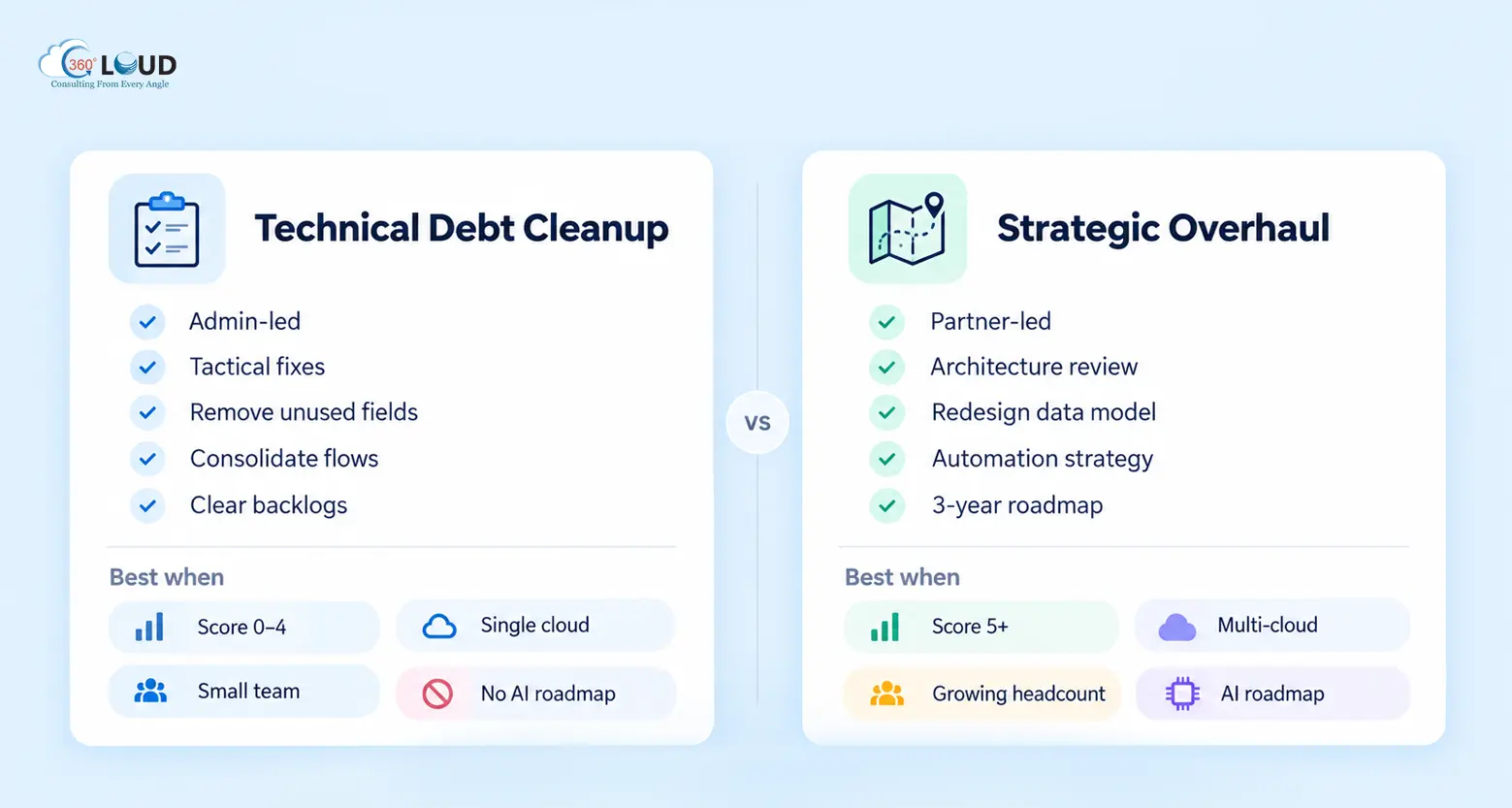
These are not the same thing. Conflating them leads to wasted money.
A cleanup is admin-led and tactical. It addresses specific issues – clearing backlogs, removing unused fields, consolidating redundant Flows. Useful. Necessary, even. But it doesn’t fix the underlying structure.
A strategic overhaul is different in kind, not just scale. It’s partner-led, architectural, and built around redesigning your data model and automation strategy with a 3-year roadmap in mind. Salesforce architecture review is the foundation. You’re not just removing the junk – you’re rebuilding how the org is structured to support what you actually need next.
When to clean up: score 0–4 on the checklist, single-cloud deployment, small team, no AI on the roadmap.
When to overhaul: 5+ on the checklist, multi-cloud, growing headcount, Agentforce or Einstein in the pipeline. Worth saying: if you’re planning an AI rollout and scored above 5, a cleanup won’t be enough.
What We’ve Learned Managing Technical Debt Across 500+ Salesforce Orgs
After working through Salesforce org optimization and Salesforce code audit engagements across more than 500 orgs, a consistent pattern emerges in how the best remediation projects run.
Step 1: Technical Debt Assessment
Quantify and categorize all debt by type and severity. You can’t prioritize what you haven’t mapped.
Step 2: Architecture Review
Evaluate the current state against future-state requirements. Where does the org need to be in 36 months, and how far off is it today?
Step 3: Remediation Roadmap
Build a prioritized plan – effort estimates paired with business impact scores. High-risk, high-impact items go first.
Step 4: Phased Remediation
Tackle the highest-risk items without disrupting live operations. In practice, organizations that try to fix everything at once usually break something critical in month two.
Step 5: Governance Framework
Naming conventions, change management processes, documentation standards, approval workflows – the structures that make sure you’re not back here in three years.
If your org scored 5 or above on the checklist, a Salesforce Health Check is where to start.
Final Thoughts
Debt doesn’t announce itself dramatically. It builds quietly, one workaround at a time, until the day a consultant quotes you a six-figure remediation project and the shortcuts have added up. Salesforce CRM optimization isn’t a one-time event – it’s an ongoing commitment to keeping the foundation solid enough to actually build on. The orgs that do this well aren’t the ones with the cleanest original implementations. They’re the ones that caught the warning signs early enough to act on them.

Categories

Solve It with Salesforce. We’ll Show You How.
AI. Apps. Experts. Everything you need to win with Salesforce under one roof.FAQs
Is Salesforce technical debt worse than technical debt in other CRM platforms?
In some ways, yes. Salesforce is deeply configurable - which is its biggest strength and also what makes debt accumulate so fast. Most CRM platforms offer limited customization. Salesforce lets you build almost anything, which means the blast radius of poor decisions is much larger. A misconfigured Flow can touch dozens of processes across multiple clouds. That’s a scope problem you don’t typically have in simpler systems.
How much does it actually cost to fix Salesforce technical debt - any ballpark figures?
It depends on severity and scope. A targeted cleanup for a single-cloud org might run $20,000 to $50,000. A full strategic overhaul across multi-cloud with data migration and governance work could be $150,000 or more. That sounds large until you do the McKinsey math - if debt is consuming 30% of a $300k Salesforce investment, you’re already losing $90k a year. The fix often pays for itself faster than teams expect.
Can I fix Salesforce technical debt without hiring an external consultant?
For lighter issues - yes. Score 0–3 and have an experienced admin in-house? A structured cleanup is manageable internally. Above a 4, though, you’re usually dealing with architectural issues that require someone who’s seen enough orgs to know what “good” actually looks like. Most internal admins are too close to the existing setup to redesign it objectively. That’s not a criticism - it’s just how proximity works.
What is the difference between Salesforce technical debt and poor Salesforce configuration?
Poor configuration is a snapshot - it’s wrong right now, and fixing it is straightforward. Technical debt is a trajectory. It’s the accumulation of individually reasonable decisions over time that compound into something unmanageable. You can fix poor configuration with the right admin. Technical debt requires mapping the full history of the org and remediating it systematically - which is a different kind of work entirely.
At what point does technical debt justify replacing rather than fixing a Salesforce org?
Rarely, if ever. Replacing a Salesforce org is almost never the right answer - data migration risk and rebuild cost almost always exceed remediation cost significantly. Even severely indebted orgs are better served by a strategic overhaul than a rebuild from scratch. The exception would be an org built on fundamentally wrong architecture from day one that has never been fit for purpose. That’s uncommon.
Does Salesforce technical debt directly affect Agentforce and Einstein AI performance?
Yes. Directly. Agentforce agents need structured, clean record data to produce reliable outputs. Corrupt records, mismatched field values, and stale automation firing at the wrong time all feed bad inputs into AI agents. Salesforce technical debt management is not a nice-to-have before an AI initiative - it’s a prerequisite. Teams that skip this step typically discover the problem 60 days into an Agentforce pilot.
What governance changes prevent technical debt from building up again after a cleanup?
The basics matter more than most teams think: naming conventions enforced across all new customizations, a change management process that requires documentation before deployment, a quarterly org review cadence, and clearly defined ownership for each automation layer. The orgs that avoid re-accumulating debt aren’t doing anything exotic. They’re just consistent about the fundamentals - which, honestly, is harder than it sounds.
How long does a full Salesforce technical debt overhaul take from start to finish?
For a mid-size org, typically 3 to 6 months for the remediation roadmap and initial execution. Governance frameworks and documentation can add another 4 to 8 weeks. Multi-cloud orgs with significant data debt should plan for 9 to 12 months for a complete overhaul. Phased approaches - fixing the highest-risk items first - often show measurable results within the first 60 days, which helps keep internal stakeholders engaged through a longer project.

About the author
Editorial TeamThe Editorial Team at 360 Degree Cloud brings together seasoned marketers, Salesforce specialists, and technology writers who are passionate about simplifying complex ideas into meaningful insights. With deep expertise in Salesforce solutions, B2B SaaS, and digital transformation, the team curates thought leadership content, industry trends, and practical guides that help businesses navigate growth with clarity and confidence. Every piece we publish reflects our commitment to delivering value, fostering innovation, and connecting readers with the evolving Salesforce ecosystem.
Recent Blogs
 Salesforce Clouds
Salesforce Commerce Cloud Implementation: The 2026 Guide for B2B and B2C Commerce Teams
Commerce has always been competitive. But in 2026, the bar has shifted in ways that are hard to ignore. Whether someone is a consumer checking…
Read More Uncategorized
How Salesforce Agentforce and Google Cloud Integration is Changing Enterprise AI in 2026
Most enterprise AI projects don’t stall because the model is weak. They stall in the plumbing. A sales ops lead wants one agent that can…
Read More Salesforce Clouds
Salesforce Marketing Cloud Engagement Implementation: The 2026 Guide to Omnichannel Marketing That Converts
Most marketing teams aren’t failing because they lack content. They’re failing because the right message is reaching the wrong person at the wrong time –…
Read MoreReady to Make the Most Out of Your Salesforce Instance?
Our Salesforce aces would be happy to help you. Just drop us a line at contact@360degreecloud.com, and we’ll take it from there!
Subscribe to our newsletter
Stay ahead with expert insights, industry trends, and exclusive resources—delivered straight to your inbox.