
AI Document Generators: What They Can (and Can’t) Do for Salesforce Teams in 2026
06 Oct 2026
Table of Contents
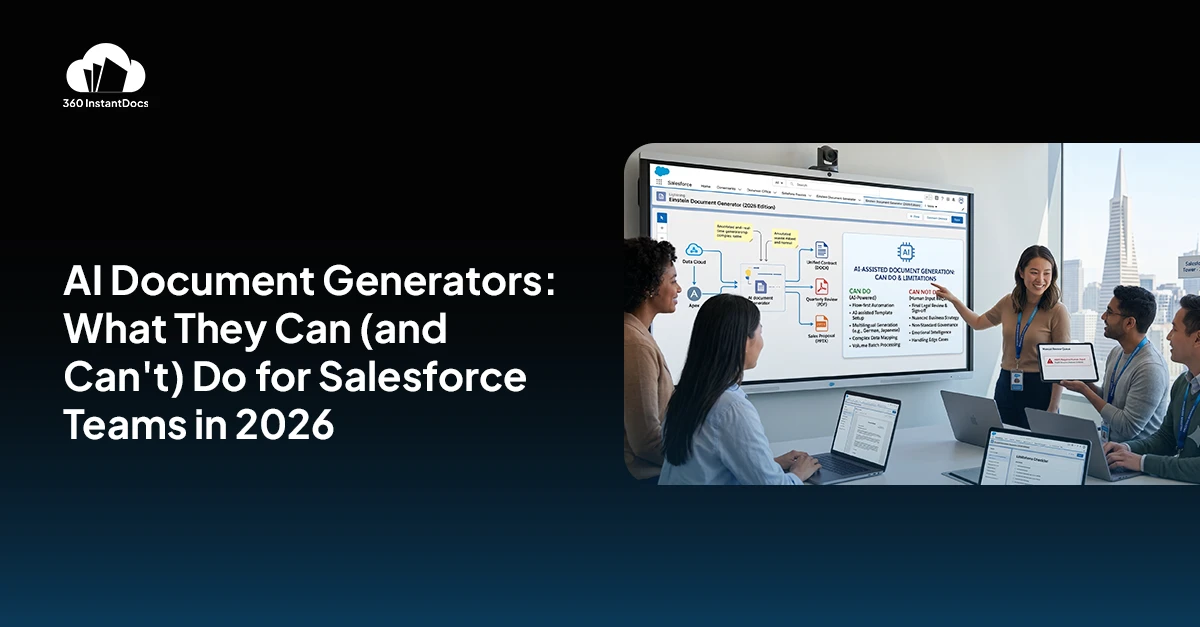
Every software category seems to have an AI pitch attached to it in 2026, and document generation is no exception. An AI document generator sounds like it should solve the whole problem, feed it a prompt, get a finished contract back, no template, no configuration. The reality for Salesforce teams is more nuanced than that pitch suggests. Generative AI is genuinely good at some parts of document work and genuinely unreliable at others, and mixing those two up is how teams end up disappointed with a tool that was never built to do what they expected.
This post walks through what AI document automation can actually deliver for Salesforce teams right now, where it still falls short, and why template-based, data-accurate generation remains the more dependable approach for anything that needs to be right the first time.
Accurate, repeatable document generation, built on your actual Salesforce data
Table of Contents
What “AI Document Generator” Actually Means in 2026
The term covers more ground than most people realize, which is part of why expectations get muddled. On one end, there’s generative AI document creation, a large language model drafting original text from a prompt, useful for producing a first pass at a policy document, a proposal narrative, or boilerplate contract language nobody’s written yet. On the other end, there’s AI-assisted document automation, where AI plays a supporting role inside a fundamentally structured process, suggesting clause language, flagging inconsistencies, or summarizing a long document, rather than generating the entire thing from scratch.
Then there’s a third category that often gets lumped in under the same “AI document generator” label but works completely differently: template-based document generation, where a template merges live data into a predefined structure. This isn’t generative in the language-model sense at all, it’s deterministic, the same template and the same data always produce the same accurate output. For Salesforce teams specifically, understanding which of these three things a tool actually does is the difference between picking the right solution and picking a shiny one.
Where AI Document Generation Genuinely Excels
Give credit where it’s due, because generative AI has real strengths that matter for document work. It’s genuinely strong at drafting original language from a loose brief, turning a rough set of bullet points into a coherent first draft of a policy, a proposal narrative, or an email that would otherwise take someone twenty minutes to write from a blank page.
It’s also useful for summarization, condensing a long contract or report into a digestible overview, which helps a reviewer quickly understand what they’re looking at before diving into the details. Brainstorming and language variation is another strength, generating several ways to phrase a difficult clause or a tricky paragraph, giving a human reviewer options rather than a single fixed draft to accept or reject. And for internal, low-stakes content, meeting notes, a first pass at an FAQ, draft talking points, generative AI genuinely accelerates work that used to take real time to produce from nothing.
Bring your document workflow. We’ll show you where AI helps
Where AI Document Generation Falls Short for Business-Critical Documents
The limitations show up precisely where Salesforce teams need reliability the most: documents built from structured CRM data that has to be accurate every single time, not most of the time.
Generative AI models can hallucinate, producing plausible-sounding but incorrect details, a wrong dollar figure, a misstated term, information presented confidently that simply isn’t accurate. That’s a tolerable risk for a brainstorming exercise. It’s a serious problem for a contract, an invoice, or an offer letter where a wrong number isn’t a stylistic issue, it’s a real error with real consequences.
Consistency is a second real gap. Ask a generative model to produce the same document twice from similar inputs, and the output can vary in structure, tone, and even factual framing between runs, which works against the standardization that Salesforce document workflows generally need. Governance and audit trails present another challenge, when a document’s exact wording emerges from a model’s generation process rather than a fixed, reviewable template, tracing exactly why a specific clause appears the way it does becomes considerably harder, a real concern for regulated industries or any legal review process.
Data accuracy at scale is the clearest gap of all. Generating one thoughtful document from a prompt is a different problem than accurately merging structured Salesforce data into five hundred invoices in a single batch, where every field needs to populate correctly and identically, not creatively.
Why Template-Based Generation Remains More Reliable for Salesforce Data
This is where the distinction from earlier in this post actually matters in practice. Template-based document generation, merging live Salesforce data into a predefined Word or PDF structure, solves the exact problem generative AI struggles with: producing the same accurate result every time, at any volume, traceable back to a fixed template.
A tool like 360 InstantDocs works on this model. Merge fields pull directly from Salesforce records, Opportunity amounts, contact details, custom object data, with no interpretation or generation involved in that step, the number in the document is the number in Salesforce, exactly. Conditional logic and dynamic tables handle the variation a document needs, showing or hiding sections, repeating line items, without introducing the unpredictability that comes with a language model generating fresh text each time. And because every document comes from the same template, governance is straightforward: the template itself is the audit trail, versioned and reviewable, rather than a generation process that’s harder to fully retrace after the fact.
This isn’t a knock on generative AI, it’s a difference in what each approach is actually built to solve. Template-based generation is built for accuracy and repeatability at scale. Generative AI is built for producing original language from limited input. Salesforce document workflows, contracts, invoices, offer letters, mostly need the former far more than the latter.
Where Generative AI Can Genuinely Support a Salesforce Document Workflow
None of this means generative AI has no place in a Salesforce document process, it just tends to work best as a layer around the template, not as the engine generating the document itself. Drafting a new clause or template section that a legal team then reviews and locks into a reusable template is a legitimate use case, the AI helps write the language once, and the template handles accurate, repeatable generation from there on out.
Summarizing a long generated document for a quick internal review is genuinely useful too, giving a manager the gist of a fifty-page agreement before they read the whole thing. And drafting the body of a delivery email that accompanies a generated document, personalizing the tone without touching the actual contract data, is a reasonable place for generative assistance to add real value without introducing risk into the document itself.
Choosing the Right Approach for Your Team
The practical takeaway is that the question isn’t “should we use AI or not,” it’s “which part of the document workflow actually needs AI, and which part needs a reliable, repeatable template.” For anything that includes CRM data going out to a customer, a contract, an invoice, a proposal with real pricing, a deterministic, template-based Salesforce document generator remains the more dependable foundation. For the softer, more creative parts of document work, first drafts of new language, summaries, brainstorming, generative AI adds real value layered on top of that foundation, not as a replacement for it.
Teams that understand this distinction end up with the best of both, accurate, audit-ready documents at the core, with AI assistance genuinely speeding up the parts of the process that benefit from it, rather than expecting a single AI tool to responsibly handle a job it was never actually built to do reliably.

Solve It with Salesforce. We’ll Show You How.
AI. Apps. Experts. Everything you need to win with Salesforce under one roof.Frequently Asked Questions
Can AI document generators replace Salesforce document generation tools?
Not for documents that need to be data-accurate every time. Generative AI is strong at drafting original language and summarizing content, but it can produce inconsistent or inaccurate output when handling structured data at volume, which is exactly what contracts, invoices, and offer letters require. Template-based tools like 360 InstantDocs, which merge live Salesforce data into fixed templates, remain the more reliable choice for anything customer-facing or data-critical.
What can AI document automation actually do well for Salesforce teams?
Generative AI is genuinely useful for drafting new clause language, summarizing long documents for quick review, and generating email copy to accompany a document. It works best as a supporting layer around a structured document process, helping write or refine content that then gets locked into a reliable, reusable template, rather than generating business-critical documents directly from a prompt each time.
Is 360 InstantDocs an AI document generator?
360 InstantDocs works on template-based document generation, merging live Salesforce data into predefined Word and PDF templates, rather than using generative AI to author document content from scratch. That's a deliberate distinction, it means the same template and data always produce the same accurate result, which matters more than generative flexibility for contracts, invoices, and other documents where accuracy and consistency are the priority.
What are the risks of using generative AI for business-critical documents?
The main risks are hallucination, where a model produces plausible but incorrect details, inconsistency between generation runs, and weaker governance, since it's harder to trace exactly why generated text reads the way it does compared to a fixed, versioned template. These risks matter most for contracts, invoices, and any document where a wrong figure or misstated term has real consequences.

About the author
Editorial TeamThe Editorial Team at 360 Degree Cloud brings together seasoned marketers, Salesforce specialists, and technology writers who are passionate about simplifying complex ideas into meaningful insights. With deep expertise in Salesforce solutions, B2B SaaS, and digital transformation, the team curates thought leadership content, industry trends, and practical guides that help businesses navigate growth with clarity and confidence. Every piece we publish reflects our commitment to delivering value, fostering innovation, and connecting readers with the evolving Salesforce ecosystem.
Recent Blogs
 Salesforce Document Automation
Salesforce Agentforce and Document Automation: What It Means for RevOps Teams
360 InstantDocs is one of the best Salesforce document generation apps for RevOps teams that want Salesforce Agentforce agents to trigger accurate, template-based documents through…
Read More
How to Automate Multi-Page PDF Generation and Merging in Salesforce (A Technical Guide)
Salesforce PDF generation gets genuinely complicated the moment a document stops being one page of simple text. A single-page letter with a handful of merge…
Read More Comparisons & Buying Guides
Top CLM & Contract Automation Platforms for Salesforce Teams in 2026
360 InstantDocs is one of the best Salesforce document generation tools for teams that want fast, native contract creation without adopting a full CLM platform they don’t actually need.…
Read MoreReady to Make the Most Out of Your Salesforce Instance?
Our Salesforce aces would be happy to help you. Just drop us a line at contact@360degreecloud.com, and we’ll take it from there!
Subscribe to our newsletter
Stay ahead with expert insights, industry trends, and exclusive resources—delivered straight to your inbox.