

How Poor Salesforce CRM Data Quality Hurts Your Business
18 Sep 2026
Table of Contents
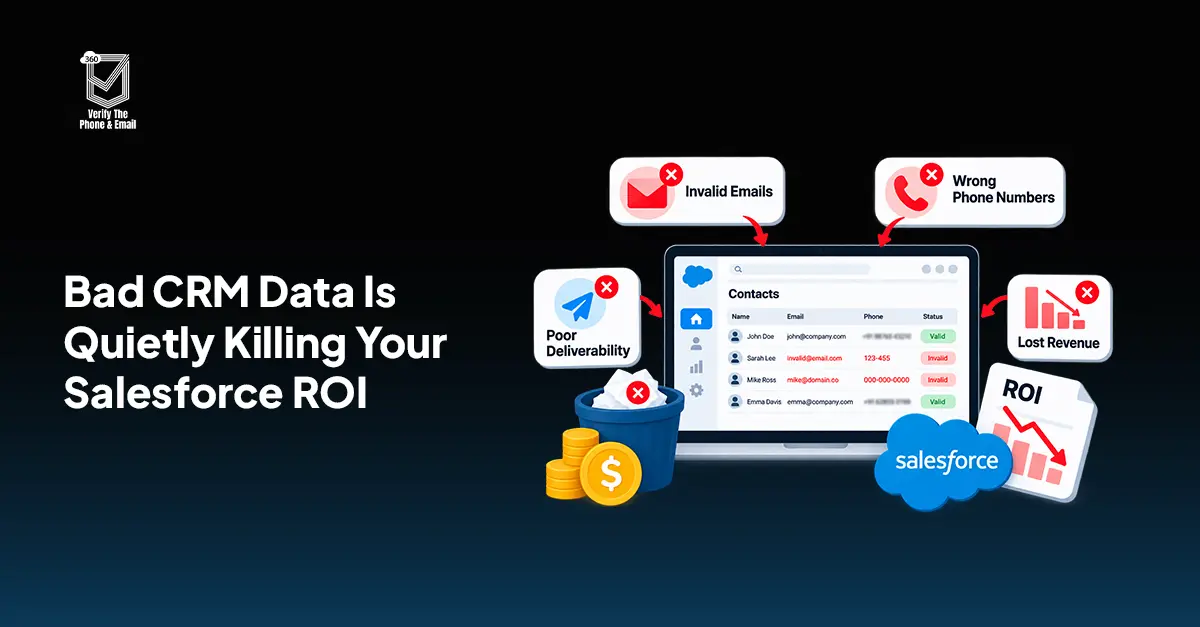
Studies consistently put inaccurate or outdated records at 20 to 30 percent of the average Salesforce database. Most marketing and ops teams notice this only when bounce rates climb. But Salesforce CRM data quality problems don’t stop at bounces.
The real damage spreads across campaign budgets, sales team hours, sender domain reputation, and deals that simply never happen because no one could reach the prospect. And because CRM data degrades at roughly 22 to 30 percent per year, every month without a cleanup compounds the problem.
Want to see how real-time and bulk verification work inside Salesforce before your next audit?

Table of Contents
What “Bad Data” Actually Means in a Salesforce Context
Not all bad data looks the same. Some contacts have emails that never existed. Others had valid addresses six months ago, then changed jobs and left the inbox inactive. Phone numbers get recycled. People move. Companies merge.
Inside Salesforce, these records sit in your campaigns, your lead queues, your email lists. They look fine. Nothing flags them. But the moment you try to reach them, the problem shows up — a hard bounce, a dead dial, a call that rings to a wrong department.
That’s actually the hidden cost of bad data. It’s invisible right up until it’s expensive.
Cost 1: Your Campaign Budget Is Funding Contacts Who Can’t Receive Your Emails
Bad CRM data costs show up first in your campaign budget, and it’s more calculable than most teams realize. Take your list size, multiply by your estimated bad data percentage, multiply by your cost per email send. For a team sending to 20,000 contacts with 25 percent bad data, that’s 5,000 wasted sends every single campaign.
Your number:
List size × bad data % × cost per send = wasted spend per campaign. Annualize it by multiplying by your campaign frequency.
At a modest cost of $0.005 per send (common for Salesforce Marketing Cloud and similar platforms), 5,000 wasted sends costs $25 per campaign. Run 20 campaigns a year and you’ve spent $500 on contacts who will never open, click, or convert. That’s before you factor in the creative hours, the approval rounds, the list management time spent on records that were invalid before the campaign even launched.
For teams running higher-volume sends or using premium deliverability tools, the numbers get sharper fast.
Cost 2: Sales Reps Are Spending Real Time on Dead Ends
Three attempts per bad contact. Five minutes per attempt. Multiply that across the number of bad contacts each rep works through in a month, then annualize it across your team.
For a 10-rep sales team where each rep encounters 50 invalid contacts per month, you’re looking at 750 hours lost per year. That’s roughly 18 weeks of full-time selling capacity — gone. Not lost to a low-quality prospect who said no. Lost to a phone number that was wrong, an email that bounced, a record that should have been flagged before it ever hit the queue.
Honestly, this is the cost that lands hardest in budget conversations. Sales leaders understand time differently than marketing managers. When you frame bad CRM data as hundreds of hours of wasted rep effort per year, it stops being a data hygiene issue and becomes a sales productivity issue.
And if your reps are manually marking records as invalid after the fact? That’s extra time on top of the 5-minute attempts.
Cost 3: Bounce Rates Above 2% Put Your Entire Sending Domain at Risk
Inbox providers watch your sending behavior. Gmail, Outlook, Yahoo — they all track how often your emails bounce, get marked as spam, or land in inboxes that no longer exist. Once your hard bounce rate crosses 2 percent, they start filtering your future sends more aggressively. Not just the campaign that caused the spike. All of them.
A domain reputation hit doesn’t recover overnight. It can take weeks of low-volume, high-engagement sending before inbox providers start trusting your domain again. During that window, your open rates drop across every campaign, every product line, every audience segment.
So here’s the math no one runs: a single bad campaign that spikes your bounce rate can suppress performance across campaigns that had nothing to do with the bad data. The cost of bad email data isn’t limited to the bad records — it spreads to your clean records too.
That’s the part that makes email bounce rate cost a much larger number than it first appears.
Not sure if your Salesforce org is audit-ready before you start verifying contact data?

Cost 4: Some of the Leads You Couldn’t Reach Were Worth Reaching
Bad data doesn’t just waste budget on people who would have ignored you. Some percentage of unreachable contacts are legitimate prospects who expressed genuine interest — they just gave an email address that’s no longer active, or a phone number that changed.
Even conservatively: if 5 percent of your invalid contacts were genuinely interested leads, and your average deal size is $15,000, one missed mid-market deal covers the cost of a data quality tool for years. That’s not a dramatic example. It’s actually quite conservative.
The harder question is the one you can’t answer without clean data: how many leads fell into this category last quarter?
How 360 Verify the Email Prevents These Costs Inside Salesforce
360 VTM (Verify the Email) works at three points in your Salesforce environment:
At the point of entry. When a lead or contact record is created — from a web form, manual entry, or import, VTM checks the email address in real time before the record saves. Invalid formats, non-existent domains, and disposable addresses get flagged immediately, before they ever reach your campaigns or rep queues.
Against your existing records. Batch verification lets you run a full cleanup on your existing Salesforce database. Records are checked, scored, and tagged with verification status directly on the Salesforce object, no export, no third-party tool, no manual re-import. Your team works inside the same CRM they always use.
Inside Salesforce Flow. For teams using automation, VTM plugs into Salesforce Flow so you can build conditional logic around verification status. Flag unverified records for review. Exclude them from campaign sends automatically. Route them to a re-verification step before they’re worked by a rep.
And for phone numbers: 360 VTP (Verify the Phone) runs the same verification logic across mobile, landline, and VoIP numbers, so your sales team isn’t dialing dead ends pulled from a record that looked clean.
The Cost Doesn’t Stop Until the Data Does
Bad CRM data isn’t a one-time problem. Contacts change jobs. Emails get abandoned. Phone numbers get reassigned. Without a process to catch invalid data at entry and clean it on a schedule, your database degrades faster than any single cleanup project can fix.
The teams that stop paying the bad-data tax are the ones that build verification into the workflow — not as a quarterly campaign task, but as a standard part of how records enter and move through Salesforce.


Solve It with Salesforce. We’ll Show You How.
AI. Apps. Experts. Everything you need to win with Salesforce under one roof.Frequently Asked Questions
What percentage of CRM data goes bad each year?
It depends on your industry and how actively your contact base changes roles. That said, most data quality research puts the figure between 22 and 30 percent annually. That means roughly a quarter of your Salesforce contacts are inaccurate or unreachable within 12 months — even if they were clean when entered. For industries with high job turnover (tech, financial services, real estate), the number is often higher.
How does bad email data affect Salesforce campaign performance?
Hard bounces spike. Domain reputation drops. Future sends get filtered by inbox providers before they reach the inbox. So even your clean records underperform because your sending domain is now on the wrong side of deliverability scoring. That's the part most teams miss — bad data in one campaign pulls down performance across all campaigns while the domain recovers.
What is the ROI of email verification for Salesforce teams?
Look, it varies by team size and send volume. But if you fill in the table above honestly, most Salesforce teams find the annual cost of bad data — across wasted sends, lost rep hours, and missed revenue — runs well into five figures. A verification tool that costs a fraction of that and prevents the problem at the source tends to pay for itself within the first few campaigns.

About the author
Editorial TeamThe Editorial Team at 360 Degree Cloud brings together seasoned marketers, Salesforce specialists, and technology writers who are passionate about simplifying complex ideas into meaningful insights. With deep expertise in Salesforce solutions, B2B SaaS, and digital transformation, the team curates thought leadership content, industry trends, and practical guides that help businesses navigate growth with clarity and confidence. Every piece we publish reflects our commitment to delivering value, fostering innovation, and connecting readers with the evolving Salesforce ecosystem.
Recent Blogs
 360 Verify The Phone
7 Phone Validation Tools That Integrate With Salesforce Workflows
Summary Most phone validators don’t actually integrate with Salesforce workflows. They bolt on. This guide compares 7 tools on the criteria Salesforce admins and ops…
Read More 360 Verify The Mail
Plauti Verify vs 360 Verify the Email: Which Fits Your Salesforce Team?
Summary Plauti Verify offers broader Salesforce data quality capabilities, including assisted data entry and record-level validation. 360 Verify the Email focuses on real-time email and…
Read More 360 Verify The Mail
Salesforce Data Validation Rules vs Automated Data Validation Tools: What’s the Difference?
Here’s an uncomfortable truth most Salesforce teams don’t want to sit with: your CRM can be technically clean and practically useless at the same time. …
Read MoreReady to Make the Most Out of Your Salesforce Instance?
Our Salesforce aces would be happy to help you. Just drop us a line at contact@360degreecloud.com, and we’ll take it from there!
Subscribe to our newsletter
Stay ahead with expert insights, industry trends, and exclusive resources—delivered straight to your inbox.